Why Your AC and Heater Might Both Run on the Same Day During Lancaster's October Shift


The High Desert's Daily Weather Whiplash
Before the first freeze hits, there is one thing every homeowner in the Antelope Valley needs to check. You might be wondering why your AC and heater might both run on the same day during Lancaster's October shift, especially when you wake up shivering but find yourself sweating by mid-afternoon. In our years of serving the Antelope Valley, our team at Affordable Air and Heating has seen firsthand how this extreme daily weather whiplash leaves many residents frustrated, constantly adjusting the thermostat and worrying about overworking their equipment. If you are struggling to keep your home comfortable without straining your HVAC system, our team is ready to help with comprehensive heating services.
Living in the Lancaster high desert means dealing with a unique topography. Because the surrounding mountains block coastal marine layers, our skies remain exceptionally clear. While this provides beautiful sunny days, it also means there is no cloud cover to trap heat at night. As soon as the sun goes down, the temperature plummets rapidly. You wake up to freezing conditions that demand a robust heating response. Yet, just a few hours later, that same unobstructed sun beats down on your roof, driving indoor temperatures up and forcing your cooling system to kick on.
This rapid shift creates a daily battle inside your home. You want to stay warm during your morning routine, but you also do not want to come home from work to a stifling hot living room. Finding the right balance requires strategic thermostat management. If you simply leave your system to figure it out on its own without the proper settings, you risk running both functions in a constant, overlapping loop. Navigating this transition smoothly means understanding exactly how your home retains temperatures and how your equipment responds to those sudden demands.
Understanding the 40-Degree Daily Temperature Swing
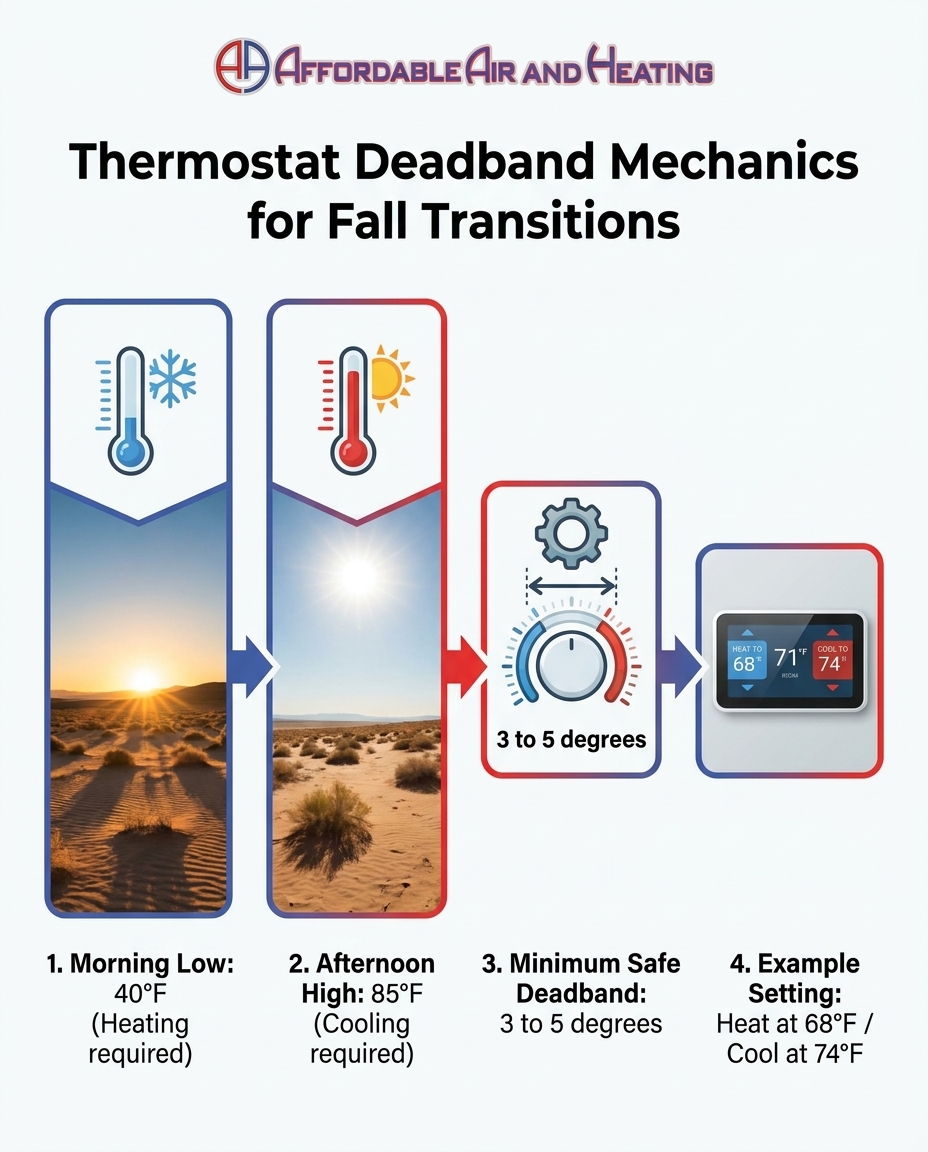
The typical October weather pattern in our region is anything but moderate. National Weather Service climate data frequently highlights the extreme diurnal temperature variations in the Antelope Valley during the fall. It is completely normal to see early morning lows hovering in the low 40s or even upper 30s, followed closely by 85-degree afternoons. That 40-degree swing within a single 12-hour window places unique demands on residential properties that homes in milder coastal climates simply never experience.
Your home's construction plays a major role in how you feel these shifts. Residential insulation, thick stucco exteriors, and tile roofs are designed to slow down the transfer of heat. During the night, your house loses thermal energy and the structure itself gets cold. When the sun comes up, your home holds onto that overnight cold. This thermal lag means that even if the outside temperature has reached 70 degrees by 10:00 AM, the inside of your house might still feel like a refrigerator. You end up needing the furnace to run well into the late morning just to maintain a baseline level of comfort.
However, the situation flips rapidly after lunch. As the afternoon progresses, intense solar heat gain through west-facing windows and direct sunlight on your roof begins to bake the house. The insulation that was holding the cold earlier is now trapping the afternoon heat inside. Indoor temperatures can spike quickly, forcing your cooling equipment to engage. This drastic environmental shift from extreme heat loss to extreme heat gain is exactly what forces mechanical home systems to work overtime, setting the stage for potential operational conflicts if your thermostat is not properly configured.
What Happens When Your System Switches Modes Too Quickly?
When your thermostat bounces between heating and cooling without a proper buffer, it leads to a destructive cycle known as short-cycling. Short-cycling occurs when an air conditioning system or furnace turns on and off rapidly before completing a full temperature cycle. During the October transition, this often happens because the system gets confused by the rapidly changing indoor temperatures, trying to heat the house one moment and cool it the next. This constant starting and stopping prevents the equipment from reaching its peak operating efficiency.
The mechanical strain caused by rapid mode switching is severe. Your compressor, which pressurizes the refrigerant to cool your home, requires a tremendous amount of electrical and mechanical energy to start up. If the system switches from heating to cooling too fast, the refrigerant pressures do not have adequate time to equalize. Forcing a compressor to start against unequalized pressure is like trying to pedal a bicycle in the highest gear from a dead stop. Over time, this extreme stress can cause the compressor to overheat, trip circuit breakers, or fail entirely.
Beyond the physical damage, overlapping heating and cooling demands lead to massive energy waste. Starting a heavy mechanical motor consumes significantly more electricity than keeping it running. If your system is short-cycling multiple times an hour, you will see a sharp spike in your utility bills. Older systems are particularly vulnerable to breaking down under this seasonal stress, as their aging components simply cannot handle the aggressive back-and-forth demands of high desert temperature swings.
The Hidden Costs of Mechanical Overlap
The damage from rapid mode switching extends beyond just the compressor. When heating and cooling overlap, several other critical components suffer:
• Increased wear on blower motors: The blower motor has to run constantly to push air through the ductwork for both heating and cooling cycles, leading to overheated bearings and premature burnout.
• Higher risk of part failure: Stressing the heat exchanger and contactors right before the heavy winter season drastically increases the likelihood of a total breakdown when you need the heat the most.
• Decreased indoor comfort: System confusion means your home never reaches a stable humidity or temperature level, leaving rooms feeling drafty, clammy, or unevenly conditioned.
The Secret to Safe Auto-Mode: Setting Your Thermostat Deadband
The most effective way to manage extreme daily temperature swings without damaging your equipment is by properly configuring your thermostat's deadband. The deadband is the designated temperature range where neither the heating nor the cooling system is activated. It acts as a neutral zone, giving your equipment a necessary resting period and preventing the furnace and air conditioner from fighting each other for control of your home's climate.
In the Lancaster high desert, a narrow deadband is a recipe for disaster. If you set your thermostat to heat at 70 degrees and cool at 71 degrees, a single passing cloud or a sudden burst of afternoon sun can trigger a system switch. To protect your equipment, a minimum deadband of 3 to 5 degrees is absolutely critical during the fall transition. This wider buffer ensures that minor, temporary temperature fluctuations do not force your system to short-cycle.
Here is how you can establish a safe auto-mode configuration for your home:
1. Access your thermostat settings: Navigate to the main menu on your digital or smart thermostat and look for the system mode options. Select "Auto" or "Auto Changeover."
2. Set your heating setpoint: Choose a comfortable baseline for the cold mornings. A common and efficient heating setpoint is 68°F.
3. Establish the cooling setpoint: Add at least 4 to 6 degrees to your heating setpoint to create the deadband. If your heat is at 68°F, set your cooling to 74°F or 75°F.
4. Verify the deadband lock: Many modern thermostats have a built-in safety feature that prevents you from setting the heat and cool points too close together. If your thermostat forces a 3-degree gap, do not try to override it.
If you are unsure whether your current device supports adjustable deadband settings, or if it seems to be ignoring the parameters you input, troubleshooting your thermostat is the best next step to regain control of your home's climate.
Should You Manually Switch Between Heat and Cool?
While configuring an auto-mode deadband is highly effective, some homeowners still prefer the traditional method of manually switching their system from heat to cool. This approach involves actively turning off the furnace mid-morning as the house warms up, leaving the system off for several hours, and then manually turning on the air conditioning when the 85-degree afternoons make the indoor air uncomfortable. Both manual and automatic methods have distinct benefits and drawbacks depending on your daily routine.
If you choose to operate your system manually, implementing a mandatory time buffer is non-negotiable. A pattern we see often on our Lancaster service calls is well-intentioned homeowners manually flipping the switch from heat to cool immediately as the house gets too warm. You must wait at least 5 to 10 minutes after turning off the heat before you switch on the cooling cycle. This critical resting period allows the high-pressure refrigerant in the compressor lines to equalize and lets the blower motor come to a complete stop. Failing to wait forces the system to start under immense mechanical stress, which can lead to blown fuses or permanent compressor damage.
• Convenience — Manual Switching: Requires constant monitoring and physical adjustments throughout the day. — Auto-Mode (with Deadband): Set it once; the smart thermostat handles the transitions automatically.
• Mechanical Safety — Manual Switching: Safe, provided you strictly observe the 5-to-10 minute resting buffer. — Auto-Mode (with Deadband): Very safe, as modern thermostats enforce built-in time delays automatically.
• Energy Control — Manual Switching: Total control over exactly when energy is consumed. — Auto-Mode (with Deadband): Highly efficient as long as the deadband is wide enough (3-5 degrees).
• Best For... — Manual Switching: Homes with someone always present to monitor indoor temperatures. — Auto-Mode (with Deadband): Homes that experience rapid afternoon solar heating while occupants are away.
For most modern households, a smart thermostat running in auto-mode offers the best balance of convenience and protection. It eliminates the risk of human error, ensuring that the system always observes the necessary time delays and deadband rules, keeping your home comfortable without the constant manual interventions.
How Modern Heat Pumps Handle Extreme Daily Shifts
If you are tired of managing a separate furnace and air conditioner during the October transition, upgrading your equipment might be the most effective long-term strategy. Heat pumps have become an incredibly popular and efficient solution for climates that require both heating and cooling in the exact same day. Unlike traditional setups that rely on two entirely different pieces of machinery, a heat pump provides both warm and cool air from a single, streamlined unit.
The secret to a heat pump's versatility is a component called the reversing valve. During the hot afternoon, the system operates exactly like a standard air conditioner, absorbing heat from inside your home and pumping it outside. When the temperature drops the next morning, the reversing valve shifts. The system now absorbs ambient heat from the outdoor air—even when it feels cold outside—and pumps that warmth directly into your living space. Because heat pumps move heat rather than burning fossil fuels to create it, they operate with remarkable efficiency during moderate fall temperatures.
Modern heat pump units are specifically engineered to handle frequent mode switching far more gracefully than older, mismatched gas furnaces and AC units. They feature variable-speed compressors that ramp up and down smoothly, drastically reducing the mechanical stress associated with short-cycling. If you are considering a heat pump installation, keep in mind that general energy rebates or federal tax credits may apply to qualifying high-efficiency models. We always advise homeowners to verify current incentive programs with their local utility provider or a tax professional to maximize their savings.
Preparing Your Equipment for Antelope Valley's Winter
While managing your daily thermostat settings is critical for getting through the fall, it is equally important to prepare your equipment for the sustained cold that is just around the corner. The constant mechanical stress of the fall transition takes a toll on moving parts. In our decades of conducting pre-winter inspections across the high desert, our team at Affordable Air and Heating has found that pushing an unmaintained system through weeks of daily mode-switching makes a fall tune-up absolutely crucial before the true freezing temperatures settle into Lancaster.
Affordable Air and Heating provides honest, reliable diagnostics and tune-ups to ensure systems can safely handle the extreme daily temperature swings without unnecessary wear and tear. A comprehensive fall inspection goes far beyond just swapping out an air filter. It involves a deep dive into the components that carry the heaviest workload.
During a professional fall tune-up, a qualified technician will evaluate several critical areas:
• Flame sensors and ignitors: Dust from summer AC use often settles on heating components. Technicians clean the flame sensor to ensure the furnace fires up safely and stays lit during cold mornings.
• Burner assemblies: Technicians inspect the burners for proper fuel combustion, ensuring there are no blockages that could cause delayed ignition or dangerous gas buildup.
• Blower motor performance: After running all summer to push cold air, the blower motor is tested for amperage draw and bearing wear to ensure it has the strength to push heavier, heated air all winter.
• Safety controls and limits: All internal safety switches are tested to guarantee the system will shut down automatically if it detects overheating or restricted airflow.
Having these components professionally evaluated provides the peace of mind that comes from knowing your heating system will not fail during the first bitter freeze of the year. Honest diagnostics catch minor friction points before they escalate into total system failures.
Protect Your Comfort Through the October Transition
Managing your indoor climate during the October transition does not have to be a frustrating daily chore. By setting a proper thermostat deadband of at least 3 to 5 degrees, you give your equipment the necessary buffer to operate efficiently. Managing these settings correctly prevents the unnecessary wear and tear that leads to short-cycling, blown fuses, and premature compressor failure.
The extreme daily temperature swings of the high desert do not have to ruin your home comfort or cause your energy bills to spike. Taking a proactive approach now ensures your equipment transitions smoothly from cooling to heating. Do not wait for a breakdown on a freezing morning—schedule your seasonal inspection today to ensure your system is fully prepared before the harsh winter weather arrives.
Frequently Asked Questions
Is it safe to run the heater in the morning and AC in the afternoon?
Yes, it is perfectly safe as long as the system is given enough time to transition between modes. The key is ensuring that the heating and cooling cycles do not overlap or switch rapidly back and forth. Using a smart thermostat with an appropriate deadband setting will automatically manage this transition safely.
What is thermostat deadband?
Thermostat deadband is the temperature range between your heating setpoint and your cooling setpoint where neither system runs. For example, if your heat is set to 68°F and your AC is set to 74°F, the 6-degree gap in the middle is the deadband. This neutral zone prevents your HVAC system from constantly turning on and off in response to minor temperature changes.
How do I stop my AC and heater from running at the same time?
To prevent both systems from fighting each other, you must widen the temperature gap on your thermostat settings. Ensure there is at least a 3 to 5-degree difference between the heating and cooling targets when using auto-mode. If your system continues to run simultaneously, you likely have a wiring issue or a malfunctioning thermostat that requires professional diagnostics.
How long should you wait between turning off AC and turning on heat?
If you are manually switching your thermostat from cooling to heating, you should wait a minimum of 5 to 10 minutes. This mandatory resting period allows the high-pressure refrigerant in the compressor to equalize and lets the blower motor spin down completely. Waiting prevents severe mechanical stress and protects your system from electrical overloads.
What should I set my thermostat to during Lancaster's fall transition?
A highly efficient and safe setting for the fall transition is to program your heating to activate at 68°F for the cold mornings and your cooling to activate at 74°F or 75°F for the hot afternoons. This creates a wide enough deadband to keep you comfortable without forcing the system to short-cycle as the outdoor temperature shifts drastically throughout the day.