Programmable vs. Manual Thermostats: Which Survives the High Desert Fall Better?


Are Your Thermostat Settings Ready for Unpredictable High Desert Temperature Drops?
Are you tired of constantly walking over to the wall to adjust the dial as hot afternoons rapidly turn into freezing nights? When it comes to the debate of Programmable vs. Manual Thermostats: Which Survives the High Desert Fall Better?, the answer ultimately comes down to how your equipment handles sudden, drastic shifts in temperature. October fall weather swings bring some of the most demanding environmental changes of the entire year to this region. Manual overcompensation stresses your home's climate control infrastructure, forcing your unit to work much harder than necessary just to keep you comfortable.
As the long, hot summer finally breaks, the arrival of fall creates a highly volatile environment for your indoor climate. You might find yourself running the air conditioner at 3:00 PM, only to need the furnace kicking on by 9:00 PM. This rapid transition is incredibly tough on older, manual controls. This guide will help you weigh your options objectively, so you can decide if upgrading your current setup is the right move for your home's specific layout and your daily routine.
If you are concerned about how your HVAC systems are handling the seasonal shift, professional guidance can ensure your equipment is operating efficiently before the true winter cold sets in.
The Hidden Cost of Constant Adjustments
Every time you manually push a thermostat lever up or down by several degrees at once, you send a sudden, demanding signal to your heating and cooling equipment. These abrupt commands force the system to run at maximum capacity to close the temperature gap as quickly as possible. Over time, this reactive approach accelerates wear and tear on blower motors, compressors, and heat exchangers. Understanding how these sudden demands affect your system is the first step in protecting your investment.
How Extreme Day-to-Night Swings Impact Lancaster Homes
Unlike milder coastal California climates where seasonal temperatures shift gradually and predictably, the Lancaster High Desert experiences drastic diurnal temperature variations. Diurnal variation refers to the difference between a day's highest and lowest temperatures. In this region, it is entirely common to experience 40-degree temperature swings within a single 24-hour period during the fall. This extreme environment demands highly responsive, efficient climate control.
To understand why this matters for your thermostat, it helps to look at the thermal dynamics of a typical house throughout an October day:
1. Afternoon Heat Absorption: During the peak heat of the day, your roof, walls, and attic absorb solar radiation. Even if the outside air begins to cool by late afternoon, the structural materials of your house continue to radiate trapped heat indoors.
2. Rapid Evening Heat Loss: Once the sun sets in the high desert, the ambient outdoor temperature plummets rapidly. The heat previously trapped in your home is quickly drawn outward through windows, doors, and poorly insulated walls.
3. The Rebound Effect: Because the temperature drops so quickly, the indoor climate shifts from uncomfortably warm to uncomfortably chilly in a matter of hours, requiring a swift mechanical response to maintain a stable environment.
These rapid shifts demand constant adjustments if a system is not automated. According to the U.S. Department of Energy, homeowners can save up to 10% annually on their utility bills simply by adjusting temperatures 7 to 10 degrees for 8 hours a day. However, achieving these energy savings manually requires perfect timing and constant vigilance—something few homeowners have the time to manage. If your system is struggling to keep up with these swings, exploring professional heating services can help identify underlying efficiency issues.
Why Manual Thermostats Struggle with Rapid Evening Cooling
The Core Problem: Manual thermostats rely entirely on human intervention. Most homeowners do not adjust the dial until they already feel uncomfortably cold. By the time you notice the chill of those October fall weather swings creeping into your living room, the indoor temperature has already dropped significantly below your preferred comfort level.
The Cause: When you finally walk over to the manual thermostat and bump the heat up by five or six degrees, the system receives a massive demand all at once. This leads to a phenomenon known as "short cycling" or prolonged heavy-load running. Instead of gently maintaining a steady temperature, the equipment is forced to blast heated air at full capacity to recover the lost ground. This reactive heating approach places immense mechanical strain on the system's internal components.
The Solution: Moving away from reactive adjustments prevents the system from overworking. When equipment is allowed to operate in steady, optimized cycles rather than frantic bursts, it consumes less energy and experiences less physical wear.
The Specific Impact on Heat Pumps
This reactive approach particularly affects the efficiency of heat pump systems. Heat pumps are brilliantly efficient devices designed to maintain steady temperatures through gradual, ongoing operation. They extract ambient heat from the outside air and move it indoors. However, if a manual thermostat is suddenly cranked up by several degrees to combat a freezing high desert night, the heat pump may sense that it cannot close the temperature gap fast enough.
When this happens, the system often triggers its auxiliary or emergency heat strips. These electric resistance heaters consume significantly more electricity than the heat pump's standard operation. Relying on a manual thermostat often forces a heat pump out of its most efficient operating mode, negating the very energy savings the system was designed to provide.
Can Programmable Thermostats Prevent System Overwork?
Programmable thermostats operate on a simple but highly effective "set-it-and-forget-it" principle. By allowing you to establish a daily schedule that aligns with your routine, these devices automatically handle the transitions between hot afternoons and freezing nights in the Lancaster High Desert. You no longer have to wait until you feel cold to trigger the heating cycle.
Proactive vs. Reactive Heating
The greatest advantage of a programmable unit is its ability to anticipate the temperature drop. By pre-scheduling temperature changes, the thermostat allows the HVAC system to gradually adjust the indoor climate before the extreme evening drop occurs. For example, if you know the temperature plummets at 6:00 PM, the programmable thermostat can gently engage the heating cycle at 5:30 PM. This proactive approach reduces mechanical strain because the system operates in steady, optimized cycles rather than reactive, full-capacity bursts.
Adaptive Recovery Technology
Many modern programmable and smart thermostats feature a function called adaptive recovery. Over time, the thermostat learns exactly how long your specific HVAC system takes to heat or cool your home. If you program the house to be 70 degrees by the time you wake up at 6:00 AM, the thermostat calculates precisely when to turn the system on—perhaps 5:15 AM—so the house reaches the target temperature right on time. This eliminates the harsh, sudden demands placed on the equipment by manual adjustments.
Of course, technology only works if the hardware is functioning correctly. If you notice ghost readings, delayed clicks when the system engages, or a screen that fades in and out, your current unit might be failing to read the room accurately. Addressing these symptoms early by troubleshooting your thermostat is essential before the harshest winter weather arrives.
Comparing Thermostat Performance During Extreme Weather Shifts
To truly understand which option survives the October fall weather swings better, it helps to look at a direct, objective comparison of how manual and programmable units handle the daily demands of a high desert climate.
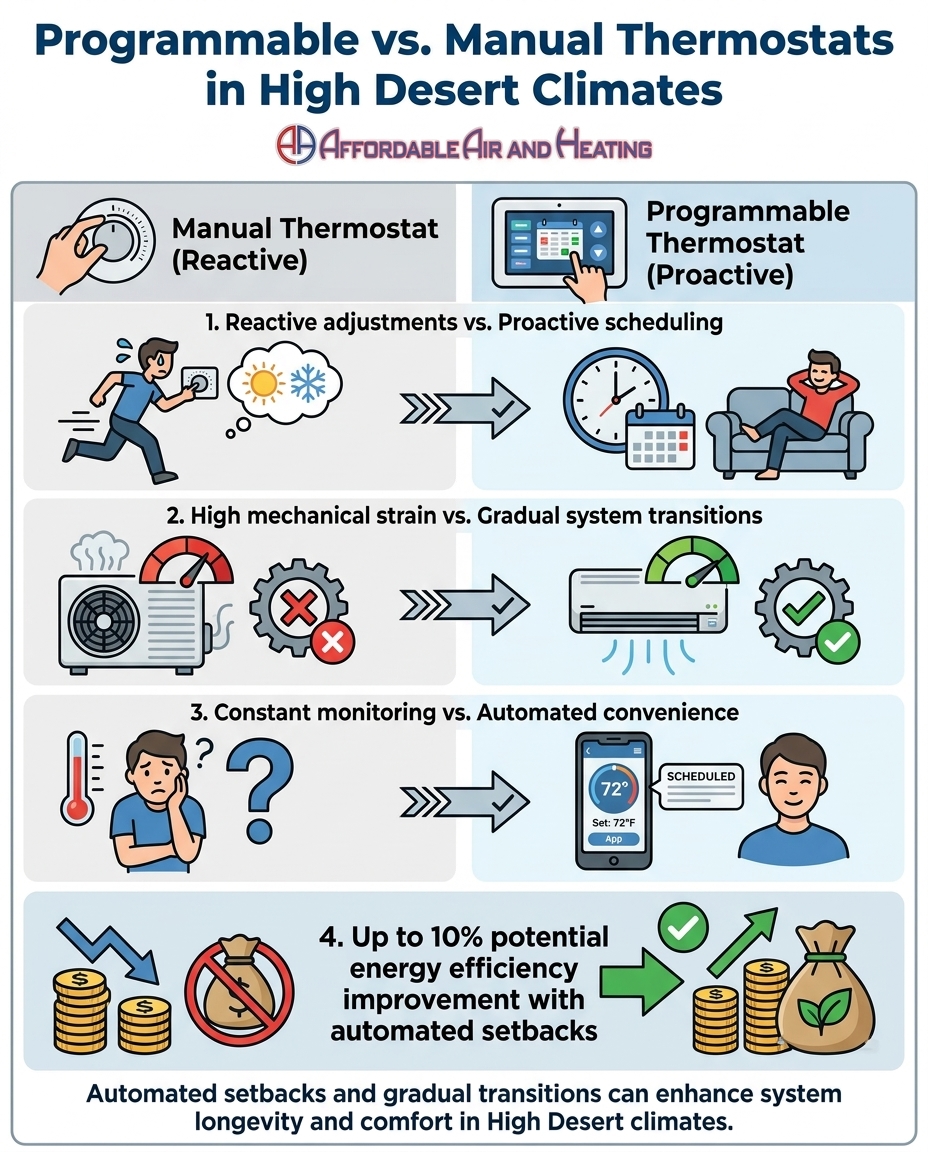
• Response to Temp Swings — Manual Thermostats: Highly reactive; only adjusts when physically changed by the user. — Programmable Thermostats: Proactive; adjusts automatically based on pre-set daily schedules.
• HVAC System Strain — Manual Thermostats: High strain due to sudden, large temperature gap recoveries. — Programmable Thermostats: Reduced wear through gradual, anticipated system transitions.
• User Effort — Manual Thermostats: Requires constant monitoring and manual dial adjustments. — Programmable Thermostats: Automated convenience; set the schedule once per season.
• Energy Efficiency — Manual Thermostats: Lower; often results in over-heating or over-cooling the space. — Programmable Thermostats: Higher; utilizes automated setbacks to reduce unnecessary run times.
Breaking Down the Comparison
When we look at the response to temperature swings, manual thermostats fail to provide the seamless comfort required in a volatile climate. Because they rely on human input, they allow the house to become too hot or too cold before any action is taken. Programmable units eliminate this lag time entirely.
Regarding system strain, the difference is profound. A manual thermostat acts like a driver constantly slamming on the gas pedal and then the brakes. A programmable thermostat acts like cruise control, gently maintaining speed and efficiency. This reduction in strain directly translates to fewer breakdowns and a longer lifespan for your heating and cooling equipment.
Is Upgrading Your Thermostat Always Necessary?
Despite the clear advantages of automation, the newest technology isn't a universal requirement for every single home. As a homeowner in the Lancaster High Desert, you deserve honest diagnostics about your equipment. The goal is to advise you on whether an upgrade is a genuine investment for your specific setup, rather than pushing a blind upsell for technology you might not actually need.
There are several scenarios where keeping a manual thermostat still makes sense:
• Constant Occupancy: If someone is always home and prefers a single, unwavering temperature 24 hours a day, the scheduling features of a programmable unit may go largely unused.
• Highly Insulated Properties: Homes with exceptional insulation and sealed envelopes lose heat very slowly, making the rapid temperature swings of the high desert less impactful on the indoor climate.
• Simpler, Older Heating Units: Some older, single-stage wall heaters or baseboard systems do not benefit significantly from advanced staging or adaptive recovery features.
Evaluating Whole-Home Health
Before committing to a thermostat upgrade, it is vital to evaluate the entire system's health. Sometimes, what feels like a thermostat failure is actually a completely different issue. If certain rooms are always freezing while others are sweltering, the problem might stem from poor ventilation, leaky ductwork, or inadequate insulation.
A new thermostat cannot fix poorly designed airflow. If your home suffers from excessive dust, lingering odors, or uneven heating, exploring comprehensive indoor air quality solutions and ductwork inspections might provide a better return on investment than simply swapping out the wall control. Always ensure your foundational HVAC infrastructure is sound before adding new control technology.
Frequently Asked Questions
How do you manage a thermostat during fall temperature swings?
The most effective way to manage fall temperature swings is to utilize a programmable schedule that anticipates the weather changes. Set your system to begin warming the house about 30 minutes before the sun sets and the outdoor temperature drops. This prevents the system from having to play catch-up when the house suddenly gets cold. If you have a manual unit, try to make small, two-degree adjustments rather than large jumps to reduce system strain.
Does a programmable thermostat reduce HVAC wear and tear?
Yes, a programmable thermostat significantly reduces mechanical wear and tear on your HVAC equipment. By using proactive scheduling, the thermostat allows the system to reach target temperatures gradually. This prevents the heavy, full-capacity running cycles that occur when a manual thermostat is suddenly turned up by five or ten degrees at once.
Is upgrading from a manual thermostat worth the investment?
Upgrading is generally worth the investment if you have a predictable daily routine, spend time away from home for work, or sleep better at cooler temperatures. The energy savings from programming automated setbacks usually pay for the cost of the thermostat within the first year or two. However, if your home is occupied 24/7 and you never change the temperature, a manual unit may still serve you adequately.
Does constantly adjusting a manual thermostat use more energy?
Yes, constantly adjusting a manual thermostat up and down uses more energy than maintaining a steady schedule. When you make a large adjustment, the system runs continuously at maximum output to bridge the temperature gap. Automated systems use gradual adjustments and setbacks, which consume far less energy over a 24-hour period.
How do 40-degree daily temperature swings affect indoor climate sensors?
Extreme 40-degree daily temperature swings force indoor climate sensors to constantly recalibrate and trigger system cycles. In a manual setup, the sensor only reads the current reality, often resulting in a lag between when the room gets cold and when the heat kicks on. Programmable sensors use algorithms to anticipate these drastic drops, keeping the indoor environment stable despite the chaos outside.
Make the Right Choice for Your Home
Surviving the unpredictable fall weather of the high desert requires equipment that can adapt quickly and efficiently. Whether you choose to maintain your manual setup or upgrade to a programmable unit, ensuring your system is responsive and healthy is the ultimate goal. Schedule a thorough inspection today to guarantee your home remains perfectly comfortable, no matter how drastically the temperatures shift outside.