Should You Repair or Replace Your Air Conditioner in the Antelope Valley?
Deciding should I repair or replace my air conditioner in the Antelope Valley is one of the most important home comfort decisions you'll face — especially when summer temperatures regularly push past 100°F and a failed AC isn't just uncomfortable, it's a health risk.
Here's a quick answer to help you decide:
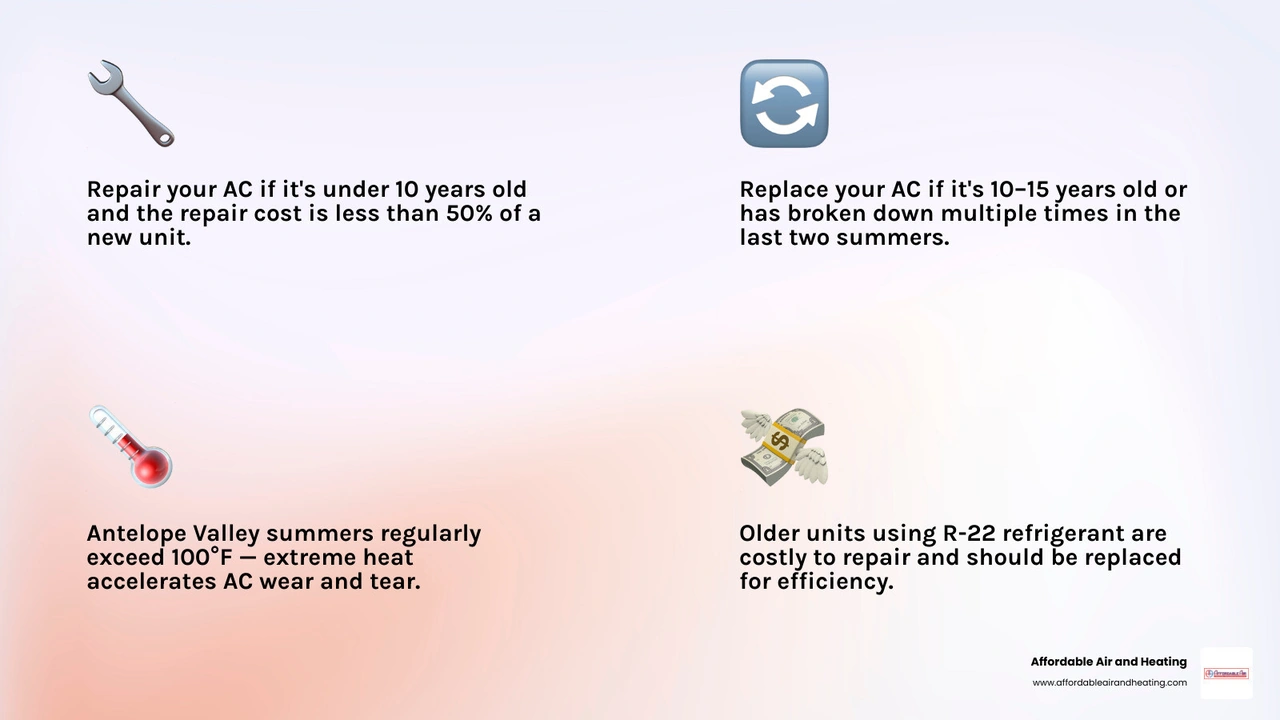
Repair your AC if:
- It's less than 10 years old
- The repair is minor and inexpensive
- It hasn't broken down repeatedly in the past two years
- It's still running on a compatible, available refrigerant
Replace your AC if:
- It's 10–15 years old or older
- Repair costs exceed 50% of the cost of a new unit (the "50% Rule")
- It's broken down multiple times in the last two seasons
- It still uses R-22 refrigerant, which is no longer produced
- Your energy bills keep climbing despite regular maintenance
The Antelope Valley's extreme desert climate — with scorching summers, high winds, and heavy dust — puts far more stress on AC systems than in milder regions. That means your unit may wear out faster than the national average, and the stakes of making the wrong call are higher.
I'm Vito, and in this guide I'll walk you through every factor you need to consider so you can make the smartest, most cost-effective decision for your home.
Easy should i repair or replace my air conditioner in the antelope valley word list:
- ac repair vs replace — decision guide
- how much ac repair is too much before replacing the unit
- how to decide if ac repair is worth the money in a hot climate
The Antelope Valley Climate Factor: Why Your AC Struggles
Living in Palmdale, Lancaster, Rosamond, or Antelope Acres means dealing with some of the most demanding weather in Southern California. The High Desert climate presents unique environmental challenges that directly impact how long your cooling system lasts and how hard it has to work.
First, there is the unrelenting summer heat. With temperatures frequently climbing well into the triple digits, your air conditioner must run almost continuously during the peak afternoon and evening hours. This constant operation accelerates mechanical wear and tear.
Second, the Antelope Valley is notorious for high winds and blowing desert dust. This airborne dust settles directly into your outdoor condenser unit, coating the sensitive coils and clogging the fins. When dust blankets these coils, it acts as an insulating barrier, preventing the system from releasing heat efficiently. This forces the compressor to work twice as hard, drawing more electricity and pushing operating temperatures to dangerous levels.
Over time, this intense combination of extreme heat and dust degradation can cause a system's efficiency to plummet much faster than it would in a coastal climate. To understand how age and weather combine to impact your monthly bills, you can read more about how Does AC Efficiency Drop as It Ages in Extreme Heat.
Key Factors: Should I Repair or Replace My Air Conditioner in the Antelope Valley?
When evaluating whether to schedule another service call or invest in a brand-new system, we recommend looking at several key performance indicators. To help simplify this decision, we have put together a general decision matrix:
| Decision Factor | Lean Toward Repair | Lean Toward Replacement |
|---|---|---|
| System Age | Under 10 years old | 10 to 15+ years old |
| Frequency of Breakdowns | Rare or first-time issue | Multiple breakdowns in the last 2 years |
| Refrigerant Type | R-410A | R-22 (Phase-out complete) |
| The "50% Rule" | Repair cost is less than 50% of replacement | Repair cost is more than 50% of replacement |
| Energy Bills | Stable and manageable | Rising steadily every summer |
| Overall Comfort | Even cooling throughout the home | Hot spots, humidity, and weak airflow |
For a more detailed breakdown of these criteria, check out our comprehensive AC Repair vs. Replace Decision Guide to see how your system measures up.
Age and Lifespan of Your Cooling System
In milder climates, a well-maintained central air conditioner might comfortably last 15 to 20 years. However, in the harsh environment of the Antelope Valley, the realistic expected lifespan of an AC unit is usually closer to 10 to 12 years.
By the time an air conditioner reaches this age, its internal components have endured thousands of hours of high-temperature operation. The fan motors, capacitors, and compressor valves naturally degrade. As of July 2026, modern standards for energy efficiency and environmental safety have also advanced significantly. Keeping a system running past its prime often means settling for outdated technology that costs more to run than a modern equivalent.
If your system is approaching or has surpassed its tenth year, it is highly beneficial to look at the bigger picture. You can explore our expert insights on When to Consider AC Replacement to determine if your unit has reached the end of its useful life.
Frequency of Breakdowns and Reliability
Think back over the past two summers. How many times have you had to call an HVAC technician to get your home cool again?
If your air conditioner experiences a single, isolated breakdown — such as a failed start capacitor or a worn-out fan belt — a simple repair is almost always the right path. However, if you find yourself dealing with repeat breakdowns season after season, those individual service calls quickly add up to a significant financial burden.
A pattern of frequent breakdowns is a clear warning sign that the system's overall structural integrity is failing. When one old component is replaced, the next weakest link in the chain is likely to fail next under the stress of our summer heat. Learn more about drawing the line by reading How Much AC Repair is Too Much Before Replacing the Unit.
Signs Your AC Needs Immediate Attention
Before you can decide between repairing or replacing, you need to recognize the warning signs your air conditioner is sending. Some symptoms indicate a system that is struggling but fixable, while others point to terminal system failure:
- Weak Airflow: If you feel very little air coming out of your registers, your blower motor may be failing, or there may be a severe block in your ductwork.
- Warm Air: If the air blowing from your vents is lukewarm even when the thermostat is set to cool, the system is not successfully removing heat.
- Strange Noises: Squealing, grinding, clanking, or banging sounds indicate loose or failing mechanical parts inside the compressor or fan motor.
- Spiking Utility Bills: A sudden, unexplained jump in your monthly electricity bill is a classic sign of a system losing its operational efficiency.
If you are experiencing these issues, we have put together a guide on How to Decide If AC Repair Is Worth the Money in a Hot Climate to help you weigh your immediate comfort against long-term costs.
When to Choose Repair for Minor Issues
Not every air conditioner problem requires a complete system replacement. In fact, many common issues can be resolved quickly and affordably by a professional technician. You should generally opt for a repair if your system is experiencing:
- Clogged Condensate Lines: Algae and dust can block the drain line, causing water to back up. Cleaning the line is a quick, routine fix.
- Thermostat Calibration Issues: Sometimes, the AC is perfectly fine, but the thermostat is miscommunicating. Replacing or recalibrating the thermostat is simple.
- Worn Fan Belts or Pulleys: If your indoor or outdoor fan is squealing, replacing a belt is a straightforward, low-cost maintenance task.
- Minor Electrical Failures: Blown fuses, burnt contactors, or failed start/run capacitors are incredibly common repairs that can be completed in a single visit.
How to Answer: Should I Repair or Replace My Air Conditioner in the Antelope Valley Based on Efficiency?
If your older AC unit is still running but your summer electricity bills are making you wince, efficiency should be the driving factor in your decision.
Older air conditioners operate at much lower efficiency levels than modern units. This means they must consume far more electricity to deliver the same amount of cooling. By upgrading to a modern system, you can immediately reduce your monthly cooling costs while enjoying a more comfortable, evenly cooled home.
For homeowners in Palmdale and surrounding desert areas, upgrading is often the most financially sensible path because of how much we rely on our air conditioning. If you are ready to see how a modern system can transform your home comfort, learn more about our options for AC Replacement in Palmdale, CA.
The Ultimate Question: Should I Repair or Replace My Air Conditioner in the Antelope Valley When Facing Major Component Failure?
If your system has suffered a catastrophic failure of a major component — such as a cracked heat exchanger, a failed compressor, or a leaking evaporator coil — the repair versus replacement decision becomes much more critical.
This is especially true if your older system still operates on R-22 refrigerant. The chemical phase-out of R-22 is complete, meaning this older refrigerant is no longer manufactured or imported. Because the remaining supply is incredibly scarce, the cost to repair a refrigerant leak and recharge an R-22 system is exceptionally high.
Investing a significant amount of money into recharging an obsolete system that could experience another leak next month is rarely a wise investment. In these scenarios, transitioning to a modern, eco-friendly system is almost always the best long-term financial decision.
Upgrading for Efficiency: SEER Ratings and Refrigerant Phasing
When you begin looking at replacement options, you will encounter terms like SEER2 and modern refrigerant standards.
SEER (Seasonal Energy Efficiency Ratio) measures how efficiently an air conditioner converts electricity into cooling comfort. In 2023, the Department of Energy updated these standards to SEER2, which utilizes more rigorous testing procedures to reflect real-world operating conditions.
While older systems in the Antelope Valley might have SEER ratings as low as 10 or 12, modern entry-level systems start at 14.3 SEER2 (equivalent to 15 SEER), with high-efficiency models reaching well over 20 SEER. Upgrading from an old 10 SEER system to a high-efficiency SEER2 system can slash your cooling-related electricity usage significantly.
Additionally, modern systems use eco-friendly refrigerants that do not deplete the ozone layer and are highly efficient at heat transfer, ensuring your home stays cooler with less wear on the equipment.
Home Comfort, Ductwork, and Insulation Considerations
An air conditioner does not operate in a vacuum; it is part of a larger home comfort ecosystem. When deciding whether to repair or replace, it is vital to evaluate your home's ductwork and insulation.
In many older homes across Lancaster, Quartz Hill, and Saugus, ductwork can develop leaks, cracks, or disconnected joints over time. If you install a brand-new, high-efficiency AC unit but connect it to leaky ducts running through a hot attic, much of your newly cooled air will escape before it ever reaches your living spaces.
Similarly, poor attic insulation allows heat from the desert sun to radiate directly down into your home, forcing your AC to run longer. When we assess a home for a potential replacement, we look at the entire system — including the ductwork, airflow balance, and insulation — to ensure your new investment delivers the maximum possible comfort and efficiency.
Frequently Asked Questions About Antelope Valley AC Systems
How long does an air conditioner typically last in the desert heat?
Due to the extreme heat, high winds, and heavy dust of the Antelope Valley, the average lifespan of a central air conditioner is typically 10 to 12 years. Regular professional maintenance can help extend this lifespan, but systems past 12 years of age generally experience declining efficiency and more frequent mechanical failures.
What are the benefits of upgrading to a high-SEER AC unit?
Upgrading to a high-SEER (or SEER2) air conditioner provides several key benefits:
- Significantly lower monthly utility bills during the hot summer months.
- More consistent indoor temperatures with fewer hot or cold spots.
- Enhanced humidity control and quieter overall operation.
- Greater reliability and peace of mind during extreme heatwaves.
Are there rebates or financing options available for new AC installations?
Yes! There are various federal tax credits, local utility rebates, and manufacturer incentives available for installing energy-efficient cooling systems. Additionally, we offer flexible financing solutions to make a system replacement manageable for your household budget. To explore how you can comfortably fit a new system into your monthly budget, read about How HVAC Financing Makes AC Replacement Affordable in the Antelope Valley.
Conclusion
Making the decision to repair or replace your air conditioner is about balancing immediate comfort, long-term reliability, and your monthly household budget.
At Affordable Air and Heating, we have been family-owned since 1996, helping homeowners throughout the Antelope Valley — including Acton, Ana Verde, Canyon Country, Castaic, Lake Hughes, Lancaster, Newhall, Palmdale, Quartz Hill, Rosamond, Santa Clarita, Saugus, Stevenson Ranch, and Valencia — stay comfortable in every season. We pride ourselves on providing honest, professional assessments without high-pressure sales tactics.
If you are struggling to decide the best path forward for your home's cooling system, let our experienced team help. We will perform a comprehensive inspection of your current system, explain your options clearly, and help you make the absolute best choice for your family's comfort.
Contact us today to schedule your system assessment and keep your home cool all summer long with Affordable Air and Heating Air Conditioning Services.