What to Do When Your AC Freezes Over on a 100-Degree Day


Discovering Ice on Your AC During a Peak Summer Heatwave
Summer in the Antelope Valley is unforgiving, and when the forecast hits triple digits, your cooling system is your only refuge. If you are wondering what to do when your AC freezes over on a 100-degree day, you are certainly not alone. Finding a thick block of ice encasing your outdoor lines or indoor evaporator coil while your home feels uncomfortably warm is incredibly jarring. If you need immediate HVAC system solutions or reliable air conditioning repair services, turn your system off and reach out.
The immediate reaction for most homeowners is pure panic. It feels completely counter-intuitive to see ice forming on a machine when the sun is blazing outside. You might assume that the compressor has completely failed or that you are looking at a catastrophic replacement bill. However, discovering ice on your system is usually a symptom of a specific airflow or pressure imbalance, rather than a completely dead unit.
During peak 100-degree summer heat, your air conditioner is working overtime. The system is under immense strain, running continuously to maintain a comfortable indoor temperature. When that constant operation is paired with even a slight restriction in airflow, the delicate balance of heat exchange is thrown off.
The most important thing to remember right now is that safe thawing is your immediate priority. Acting quickly and calmly can prevent permanent mechanical damage. Before you explore permanent repairs or worry about the cost of a new system, you must stop the cooling cycle and allow the ice to melt naturally. Taking the right steps in the first few minutes after discovering the ice will protect your compressor and set the stage for a proper diagnostic assessment.
Why Your AC Freezes When It's 100 Degrees Outside
To understand why a machine turns into a block of ice during a heatwave, you have to look at how the cooling process actually works. Air conditioners do not create cold air; instead, they remove heat from the air inside your home. They do this by passing warm indoor air over a super-cooled evaporator coil filled with liquid refrigerant.
The Physics of Restricted Airflow
When your system has proper airflow, the warm air from your house blows across the evaporator coil. The refrigerant absorbs that heat, turns into a gas, and travels outside to release the heat. However, when airflow is blocked or restricted, there is not enough warm air blowing over the coil to keep the refrigerant warm. As a result, the evaporator coil temperature rapidly drops below 32 degrees Fahrenheit.
Because the air inside your home naturally contains humidity, condensation forms on the cold coils—much like water droplets forming on the outside of a cold glass of water. When the coil drops below freezing, that normal condensation instantly turns to ice. Once a thin layer of ice forms, it acts as an insulator, blocking even more airflow and causing the coil to get even colder. Running the unit constantly at maximum capacity during a heatwave only accelerates this freezing process.
The Lancaster CA / High Desert Factor
The local climate plays a massive role in how quickly this happens. The Lancaster CA / High Desert region features elevated airborne dust, loose sand, and dry particulate matter. This environmental reality means that air filters clog much faster here than they do in coastal or humid regions. A dirty air filter can reduce your system's efficiency by up to 15 percent, acting as the primary catalyst for restricted airflow and subsequent freezing.
• Normal Operation — Airflow Status: Unrestricted and steady — Coil Temperature: Above 32°F (typically 40°F) — Condensation Result: Drips safely into the drain pan
• Restricted Operation — Airflow Status: Blocked by dust or closed vents — Coil Temperature: Below 32°F (freezing) — Condensation Result: Instantly freezes on the metal fins
• Severe Freeze-Up — Airflow Status: Completely blocked by solid ice — Coil Temperature: Deep freeze — Condensation Result: Ice spreads to outdoor refrigerant lines
When the system is starved for air due to a clogged filter, the heat exchange process halts. The refrigerant remains too cold, the condensation freezes, and the cycle compounds until the entire unit is encased in ice.
Immediate Steps to Safely Thaw Your Frozen AC Unit
If you have just discovered a frozen coil or ice on your outdoor lines during peak 100-degree summer heat, you need to execute a safe triage protocol. Do not wait for the system to fix itself. Follow these steps immediately to protect your equipment.
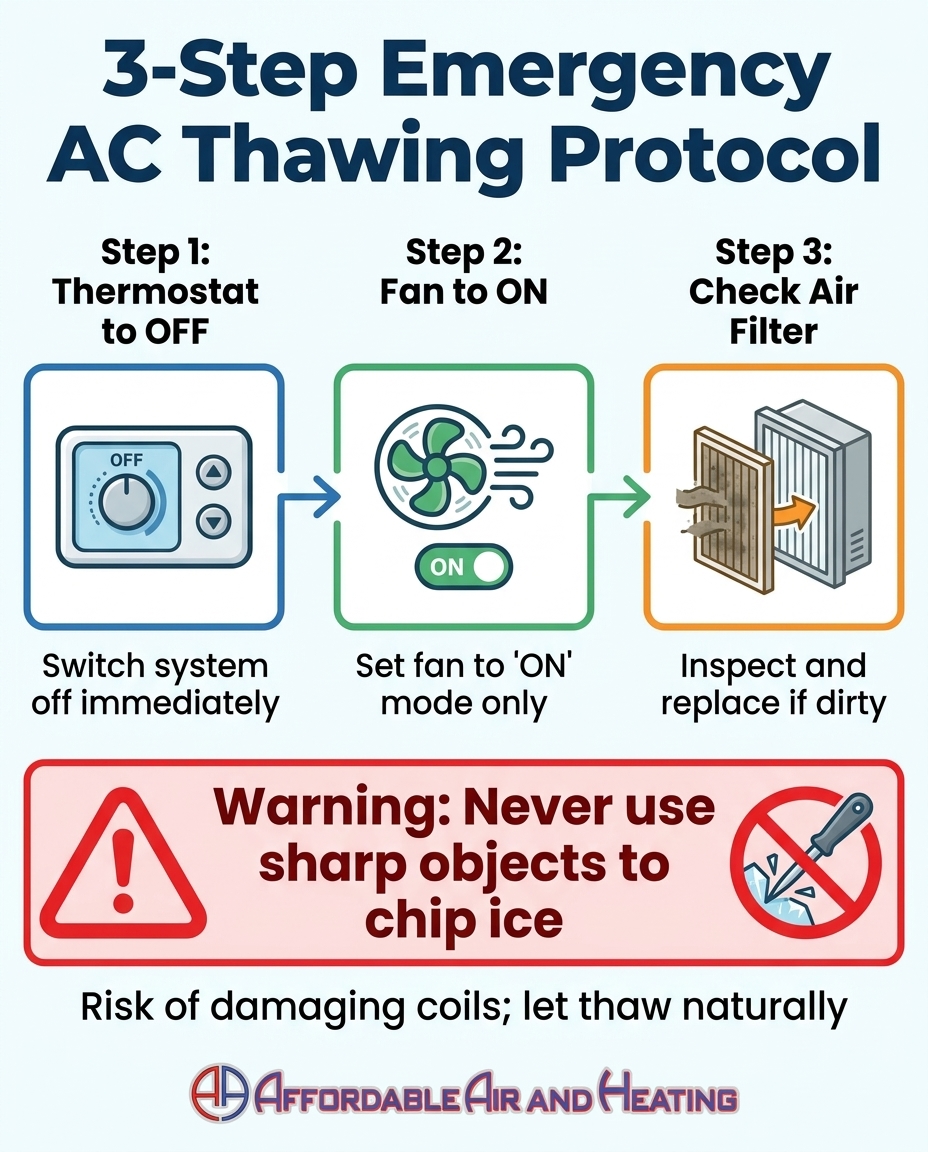
1. Turn the thermostat from COOL to OFF immediately. This is the most critical step. Turning the system off stops the compressor from running and halts the flow of cold refrigerant to the indoor coil. If you leave the cooling cycle on, the ice will only continue to build, putting immense strain on the compressor motor.
2. Turn the fan setting from AUTO to ON. While the cooling cycle must be off, you want the indoor blower fan to keep running. By switching the fan to the ON position, you force warm indoor air to continuously blow over the frozen coils. This steady stream of warm air will significantly accelerate the melting process.
3. Locate and inspect your air filter. While the unit is thawing, pull out your indoor air filter. Hold it up to a light source. If you cannot see light passing through the material, it is completely clogged with dust and debris. Replace it with a clean filter immediately. A fresh filter restores the necessary airflow the system needs to function without freezing.
4. Check all supply registers and return vents. Walk through your home and ensure that every single vent is fully open. Sometimes, homeowners close vents in unused rooms to save energy, but this actually restricts overall airflow and increases pressure inside the ductwork. Make sure no heavy furniture, rugs, or curtains are blocking the return grilles.
Once you have completed these steps, you must wait. Depending on the severity of the ice buildup, a complete thaw can take anywhere from a few hours to a full day. Place a few old towels around the base of the indoor unit, as the melting ice can sometimes overwhelm the condensate drain pan and cause minor water pooling.
Crucial Mistakes to Avoid When Thawing Evaporator Coils
When your house is heating up rapidly, it is incredibly tempting to speed up the thawing process by any means necessary. However, taking matters into your own hands with aggressive DIY tactics usually results in catastrophic damage. Patience is always cheaper than a replacement compressor.
• Never use sharp objects to chip away the ice: The evaporator coils are made of highly delicate copper or aluminum tubing covered in thin metal fins. If you use a knife, screwdriver, or ice pick to break the ice, you will almost certainly puncture the coil. A punctured coil allows all the refrigerant to escape into the atmosphere, turning a simple airflow issue into a massive, expensive repair.
• Avoid using heat guns or hair dryers: Applying direct, high heat to a frozen HVAC unit is incredibly dangerous. The intense heat can easily melt the plastic components surrounding the coil, warp the drain pan, and severely damage sensitive electrical wiring. Furthermore, the rapid temperature change can cause the metal tubing to crack due to thermal shock.
• Do not leave the AC running while frozen: This is the most common and most destructive mistake. When the evaporator coil is frozen, the refrigerant cannot absorb heat and turn from a liquid into a gas. Instead, cold liquid refrigerant travels backward through the lines and enters the outdoor compressor. Just as ductless mini splits use coolant in a precise liquid-to-gas cycle, traditional central systems rely on the compressor to pump gas, not liquid. When liquid hits the compressor—a phenomenon known as "liquid slugging"—it destroys the internal valves and completely ruins the motor.
The golden rule of thawing: Do no harm. Let the ambient air from the blower fan do the work. It may take time, but protecting the integrity of your refrigerant lines and compressor is the ultimate goal.
Signs Your Thawed AC Needs Professional Diagnostics
Once the ice has completely melted and you have installed a clean air filter, you can switch the thermostat back to COOL. If the system runs smoothly and cools the house without forming new ice, a clogged filter was likely the only culprit. However, if the ice returns within a few hours or days, you are dealing with a deeper mechanical failure that requires professional intervention.
When to Call for Emergency Help
If the unit freezes again after thawing, the problem goes beyond simple airflow restriction. The two most common underlying causes are low refrigerant levels and a failing blower motor.
Low Refrigerant: If your system has a leak, the pressure inside the evaporator coil drops significantly. This pressure drop forces the temperature of the coil below freezing, regardless of how clean your filter is. Refrigerant does not "use up" or evaporate over time; if it is low, there is a physical hole in the copper lines that must be located, sealed, and recharged by a licensed technician.
Failing Blower Motor: If the indoor fan motor is weak, dying, or covered in thick grime, it cannot push enough air over the coils. Even with a brand-new filter, a struggling motor will result in a frozen system.
During July peak heatwaves, HVAC units run at maximum capacity and simply cannot afford to operate with compromised mechanical parts. When you schedule professional cooling services, expect the technician to perform thorough airflow measurements, electrical testing on the motor, and precise refrigerant pressure checks. Affordable Air and Heating provides honest, cost-effective diagnostics in the Antelope Valley, so that a frozen coil doesn't leave your family sweating through the weekend.
Frequently Asked Questions About Frozen Air Conditioners
Why is my AC freezing up in hot weather?
Air conditioners freeze in hot weather primarily due to restricted airflow or low refrigerant levels. When the system runs continuously during a heatwave, it needs a constant supply of warm indoor air blowing over the coils to keep the refrigerant warm. If a dirty filter blocks that air, the coil temperature drops below freezing, turning normal condensation into solid ice.
How long does it take for an AC unit to unfreeze?
A frozen AC unit typically takes anywhere from 2 to 24 hours to completely thaw. The timeline depends heavily on the thickness of the ice buildup and the ambient temperature inside the home. You can significantly speed up the process by turning the cooling cycle off and leaving the indoor fan switched to the ON position.
Can I pour warm water on my frozen AC unit?
No, pouring warm water on a frozen AC unit is highly discouraged. While it might melt the ice quickly, introducing large amounts of water to a system full of high-voltage electrical components is extremely dangerous. Additionally, sudden temperature changes can cause thermal shock, potentially cracking the delicate metal fins and refrigerant lines.
Will a frozen AC fix itself if I turn it off?
The ice will melt naturally if you turn the system off, but the root cause will not fix itself. If the freezing was caused by a dirty air filter, you must replace the filter before turning the system back on. If the freezing was caused by a refrigerant leak or a failing blower motor, the unit will simply freeze again as soon as you restart the cooling cycle.
How often should I change my filter during a desert heatwave?
During extreme heatwaves in a desert climate, you should check your filter every 30 days. The combination of constant system operation and high levels of airborne dust means filters clog much faster than the standard 90-day recommendation. Frequent filter changes are the easiest way to prevent mid-summer freeze-ups.
Restore Your Home's Comfort Safely and Quickly
Dealing with a frozen cooling system in the middle of a brutal summer is stressful, but knowing what to do when your AC freezes over on a 100-degree day puts you in control. Always remember to prioritize safety: keep the system completely off until the ice has melted, leave the blower fan running to help the thaw, and never use sharp tools to chip away at the coils.
Proactive filter checks and ensuring your vents remain fully open are your best defenses against future breakdowns. If you have thawed the unit, changed the filter, and the system is still struggling to keep up with the extreme heat, do not force it to run. Schedule a professional inspection immediately to protect your compressor and restore your home's comfort reliably.