The Chain Reaction of a Dirty Flame Sensor in Your Gas Furnace


When the Heat Stops Before It Starts: The Frustration of Furnace Lockouts
Your thermostat clicks, the burners roar to life, but within seconds, everything shuts down—a classic symptom of the chain reaction of a dirty flame sensor in your gas furnace. At Affordable Air and Heating, we know it is incredibly frustrating when the heat stops before it really starts, especially during those harsh November first cold snaps when you need reliable warmth the most. Many homeowners assume this rapid on-and-off cycle is a random mechanical glitch or a sign of a failing system. However, this sudden shutdown is actually a deliberate safety mechanism triggered by one specific, vital component. The flame sensor acts as a critical checkpoint inside your heating system, and it often falls victim to invisible buildup over the summer months. Instead of repeatedly resetting your thermostat and hoping the system stays on, it is essential to understand why this lockout happens and diagnose the root cause.
For expert help keeping your HVAC system running smoothly and safely all season long, professional diagnostics are always the best first step.
The Anatomy of a Heating Cycle: What Should Happen
Before you can understand why your furnace keeps shutting down, you need to know what a normal heating cycle looks like. Modern gas furnaces are complex machines that follow a strict, automated sequence of events. If any step in this sequence fails or reports an error, the system halts immediately. Here in the Lancaster / Antelope Valley High Desert, our team knows that understanding how your system operates can help you spot trouble early and know when it is time to call us for professional heating services.
The standard ignition sequence follows these precise steps:
1. The Call for Heat: Your thermostat detects that the room temperature has dropped below your set point. It sends an electrical signal to the furnace control board to initiate the heating cycle.
2. The Draft Inducer Motor Starts: Before any gas is released, a small fan called the draft inducer turns on. This clears out any residual, unburned gases from the heat exchanger and ensures proper airflow through the exhaust flue.
3. The Igniter Warms Up: Once the control board verifies the inducer is running properly, it sends power to the hot surface igniter. This component glows white-hot, reaching temperatures high enough to ignite natural gas.
4. The Gas Valve Opens: With the igniter glowing, the gas valve opens, releasing fuel over the burners. The gas meets the hot igniter and combusts, creating a steady row of blue flames.
5. The Flame Sensor Verifies Ignition: The flame sensor sits directly in the path of the fire. It uses a process called "flame rectification" to detect the presence of a steady burn. If it senses the flame, it tells the control board to keep the gas flowing.
6. The Blower Motor Engages: Finally, once a steady flame is verified and the heat exchanger warms up, the main blower motor turns on to distribute that warmth throughout your home.
When everything works perfectly, this entire sequence takes less than a minute. But when the flame sensor fails to do its job, the sequence breaks down at step five.
• Draft Inducer — Primary Function: Clears exhaust gases — What Happens if it Fails: Furnace will not attempt to ignite at all.
• Hot Surface Igniter — Primary Function: Creates heat for combustion — What Happens if it Fails: Gas valve opens, but no flame is created.
• Flame Sensor — Primary Function: Verifies the flame exists — What Happens if it Fails: Burners light, but shut off after a few seconds.
The Invisible Saboteur: How Airborne Dust Creates a Carbon Barrier
Why does a perfectly good sensor suddenly stop working? The answer usually lies in the air circulating through your home. Furnaces sit dormant for months during the scorching summer. During this downtime, they act as a collection point for airborne particulate matter pulled through your ductwork. Even with a good air filter, microscopic particles inevitably make their way into the burner compartment.
Living in the Lancaster / Antelope Valley High Desert means dealing with high winds and fine airborne desert dust. Over our years of servicing local heating systems, we have seen firsthand how this specific environment accelerates the fouling of sensitive internal HVAC components compared to milder climates. The ultra-fine silica sand and desert soil get pushed into homes by the wind, settling on the cold metal rod of the flame sensor.
When the burners ignite for the first time in the season, the intense heat hits that dormant layer of dust. Instead of burning away, the 3,000-degree flame bakes this microscopic particulate matter directly onto the metal. Over a few weeks, this baked-on layer transforms into a tough carbon barrier.
Why this carbon barrier is a problem:
• It acts as an insulator: Carbon blocks electrical currents, effectively "blinding" the sensor to the flame.
• It builds up quickly: In dusty climates, a clean sensor can become coated in just one season.
• It is completely invisible: To the naked eye, the sensor might look perfectly fine, even when it is heavily coated in carbon.
Managing the airborne particulates in your home is the best defense against this rapid buildup. Exploring professional indoor air quality solutions can significantly reduce the amount of dust that reaches your furnace, keeping your internal components cleaner for longer.
The Chain Reaction: Microamps, Shutdowns, and Lockouts
To understand the core of the problem, we have to look at the exact mechanical sequence of the failure. The flame sensor does not actually measure heat; it measures electrical current. Fire contains ionized gases, which allow a very small electrical current to pass through it.
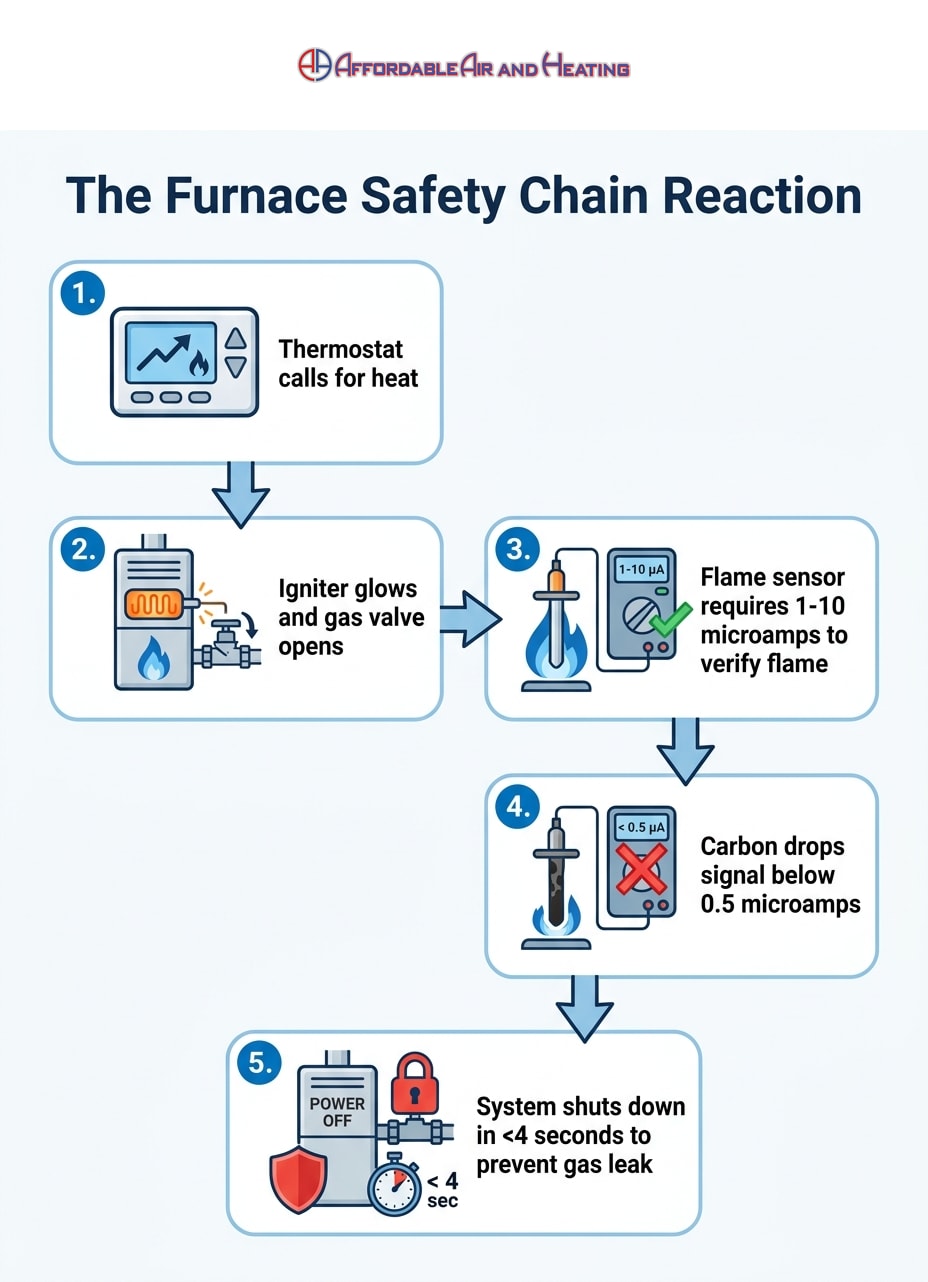
A clean flame sensor generates a tiny direct current—usually between 1 to 10 microamps—when it is engulfed in fire. A microamp is one-millionth of an amp, meaning this is an incredibly delicate electrical signal. The current travels from the sensor rod, through the flame itself, and grounds out on the metal face of the burner.
When the carbon buildup from the High Desert dust coats the sensor, it acts as an electrical insulator. The electrical signal struggles to pass through the carbon barrier, causing the microamp reading to drop steadily. Once the signal drops below the minimum safety threshold (often 0.5 microamps), the control board registers a "no flame" condition. As far as the furnace's computer is concerned, the fire has blown out.
If you are repeatedly dealing with this cycle during those November first cold snaps, our technicians typically find that you are experiencing the first stages of a dirty sensor. For a deeper look at why systems turn on and off rapidly, understanding the process of diagnosing gas furnace short-cycling can provide more context.
Why the 4-Second Rule Matters
When the control board stops receiving the microamp signal, it reacts instantly. Within 4 seconds, the system snaps the gas valve shut. This rapid response is exactly what causes the symptom of the system turning on, roaring to life, and immediately shutting right off.
After the system shuts down, it will usually try to light again. It purges the gases, glows the igniter, and opens the valve. Once again, the sensor fails to read the flame, and the valve closes. After three or four failed attempts in a row, the furnace enters a "hard lockout" mode. It shuts down completely and refuses to run until it is professionally reset, leaving your house cold.
Why This Nuisance Shutdown is Actually Protecting Your Home
While a furnace lockout is incredibly annoying—especially when you are shivering in your living room—it is important to reframe this frustrating breakdown. This sudden shutdown is actually a critical, life-saving safety mechanism doing exactly what it was designed to do.
Imagine if the flame sensor did not exist. If the burners failed to light, or if a strong draft blew the flames out, the gas valve would simply stay open. Raw, unburned natural gas would pour into the heat exchanger, travel through your ductwork, and accumulate inside your home. The risk of a catastrophic explosion or severe carbon monoxide exposure would skyrocket.
The reality behind the lockout:
• It proves the logic board works: The lockout is proof that the furnace's internal computer is functioning perfectly. It is simply being blinded by environmental dirt.
• It prevents fuel buildup: Snapping the valve shut in under 4 seconds ensures no unburned gas escapes into your living space.
• It prevents major damage: Running a furnace with compromised safety switches can lead to cracked heat exchangers and ruined equipment.
Reassure yourself that a lockout is a protective measure, not necessarily a sign of a catastrophic mechanical failure. Here in the Lancaster / Antelope Valley High Desert, it is one of the most common reasons our service crews see systems shut down in the late fall, and it is entirely preventable.
Honest Diagnostics: Cleaning vs. Unnecessary Replacements
When your furnace locks out, you need a lasting solution. Properly diagnosing a flame sensor issue requires specialized tools. A professional technician uses a digital multimeter equipped to read precise microamp levels. By placing the meter in series with the sensor wire, they can see exactly how much current is flowing through the flame. If the reading is below 1.0 microamps, they know the carbon barrier is the culprit.
The quick fix you should avoid: Never attempt DIY cleaning with household abrasives like sandpaper or emery cloth. These rough materials create microscopic scratches and deep grooves in the metal casing of the sensor. While it might work for a few days, those scratches act like a magnet for dust, causing the sensor to foul even faster in the future. Removing and handling the sensor also requires navigating delicate gas lines and high-voltage wiring, which must be left to a licensed professional.
Working with a trusted local team like Affordable Air and Heating means you get honest, transparent diagnostics. Our professional technicians will safely extract, clean, and test the sensor to restore the safety sequence, rather than immediately upselling you on an expensive, unnecessary replacement part. Many times, we find that a perfectly functional sensor just needs an expert cleaning with specialized materials to get your heat running again.
To avoid this mid-winter headache entirely, proactive care is the best approach. Joining our preventative maintenance membership ensures your flame sensor is professionally cleaned and tested before the cold weather ever arrives, keeping your system reliable throughout the Lancaster / Antelope Valley High Desert winters.
Restoring Your Heating Reliability Safely
Understanding the chain reaction of a dirty flame sensor in your gas furnace takes the mystery out of sudden shutdowns. When you know that your system is actively protecting your home from unburned gas, the temporary loss of heat becomes a little easier to manage. The microscopic carbon barrier created by airborne dust is a natural byproduct of our environment, but it does not have to leave you out in the cold.
Professional maintenance is the safest, most effective way to clear that carbon barrier, restore the proper microamp signal, and reset your system's safety logic. By scheduling a proactive tune-up with our team before those harsh November first cold snaps hit, you can ensure your heating system runs uninterrupted through the coldest months. A clear, non-technical understanding of your furnace's safety role empowers you to make the right call for your home's comfort and safety.
Frequently Asked Questions
What happens if a flame sensor is dirty?
If a flame sensor is dirty, it cannot detect the presence of the burner flame due to a layer of insulating carbon. The furnace's control board will assume the fire has gone out and will shut the gas valve immediately to prevent a dangerous leak. This results in the furnace turning on for a few seconds and then shutting right back off.
Why does my furnace turn on and shut right off?
This rapid on-and-off cycle is usually caused by a safety mechanism tripping, most commonly a fouled flame sensor. When the sensor fails to read the flame's electrical current, the system cuts the fuel supply within 4 seconds. It will try a few times before going into a complete safety lockout.
Can dust cause a furnace to stop working?
Yes, airborne dust is a primary cause of furnace breakdowns. When dormant dust settles on the flame sensor and is exposed to the intense heat of the burners, it bakes into a hard carbon shell. This carbon acts as an electrical insulator, blinding the sensor and forcing the furnace to shut down.
How do you fix a furnace lockout?
A furnace lockout is a safety feature that requires professional diagnostics to resolve properly. A licensed technician will use a multimeter to test the microamp readings, safely extract and clean the flame sensor using specialized non-abrasive materials, and reset the control board to restore your heat.
How often should a flame sensor be checked in dusty climates?
In dusty regions like the High Desert, we recommend checking and professionally cleaning your flame sensor at least once a year. Scheduling this maintenance in the early fall ensures the dormant summer dust is removed before it has a chance to bake onto the sensor during the first cold snap.