OEM vs. Aftermarket HVAC Parts: Why We Sourced a Specific Fan Motor for a Same-Day Fix


Sudden Breakdown: When Your Furnace Fails and Factory Parts Are Delayed
When your system fails during a chilly fall night, you quickly find yourself weighing the pros and cons of OEM vs. Aftermarket HVAC Parts: Why We Sourced a Specific Fan Motor for a Same-Day Fix. Are you staring at a thermostat that refuses to climb while the temperature outside rapidly drops? When your furnace blower motor fails during the initial October heating-startup, you immediately face a critical decision. Do you wait days for a factory-original component to ship, or do you authorize a universal alternative to restore your heat today? This is a common dilemma for homeowners who discover a heating failure just as the weather turns cold. The sudden stress of a freezing house is compounded by the news that the exact brand-name motor your system needs is sitting on a backorder list three states away.
Addressing this breakdown requires a clear understanding of your options. At Affordable Air and Heating, our team frequently encounters this exact scenario during Lancaster's fall transition, and we know firsthand that a cold house is more than just an inconvenience; it disrupts your entire routine and forces you to rely on inefficient space heaters. Whether you are looking to upgrade your entire HVAC system or you simply need immediate heating repair services, knowing the difference between factory and universal components empowers you to make the safest, most effective choice for your home.
OEM vs. Universal Aftermarket Motors: Understanding the Difference
To make an informed decision about your furnace repair, it helps to understand what the terminology actually means. In the heating and cooling industry, the word "aftermarket" carries an unfair stigma. Many homeowners assume that an aftermarket part is a cheap, low-quality knockoff. In reality, high-quality universal parts are standard practice across the industry, applying to heating systems just as much as they do to air conditioning repairs.
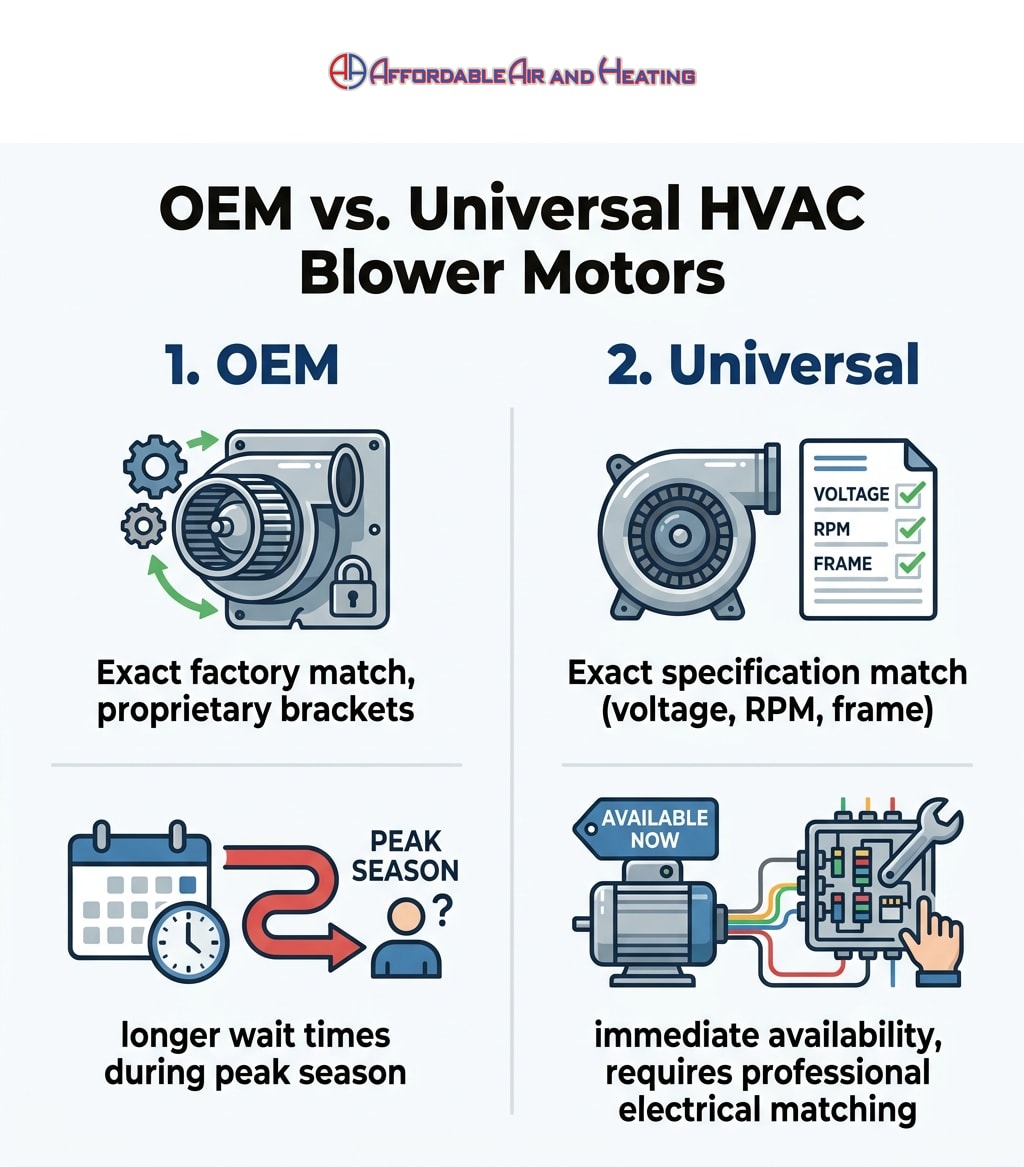
Original Equipment Manufacturer (OEM) parts are built specifically for a single brand or a specific model line. They often feature proprietary wiring harnesses or unique mounting brackets designed to slide right into that exact unit. Universal aftermarket parts, on the other hand, are manufactured by top-tier electrical companies to fit a wide variety of systems. Interestingly, the massive electrical manufacturers that produce high-end universal motors are frequently the exact same companies contracted by major HVAC brands to build their OEM motors in the first place.
What Makes a Part 'OEM'?
• Brand-specific engineering: OEM components are designed with exact proprietary plugs and brackets that match one specific furnace model.
• Supply chain limitations: Because they are specialized, these parts often require ordering directly from a manufacturer's regional supply house rather than being stocked on a local truck.
• Predictable installation: The proprietary connections mean the part plugs in exactly as the old one did, requiring less field modification by the technician.
The Reality of 'Universal' Parts
• Strict industry standards: Universal motors are built to match exact electrical and physical specifications, ensuring safe and reliable operation.
• Immediate availability: These components are designed to be carried on a technician's truck, allowing for same-day emergency repairs.
• Broad compatibility: By utilizing standardized wiring leads and adjustable mounting hardware, a single high-quality universal motor can safely replace dozens of different OEM models.
• Availability — OEM Blower Motor: Often requires ordering; subject to factory delays. — Universal Aftermarket Motor: Typically stocked on technician trucks for immediate use.
• Compatibility — OEM Blower Motor: Fits specific brand/model exclusively. — Universal Aftermarket Motor: Fits multiple brands using standardized specifications.
• Installation — OEM Blower Motor: Plug-and-play with proprietary harnesses. — Universal Aftermarket Motor: Requires professional electrical matching and wiring.
• Quality — OEM Blower Motor: Factory-certified standard. — Universal Aftermarket Motor: Built to strict industry standards by major manufacturers.
The Supply Chain Reality During Peak Seasonal Transitions
You might wonder why a standard furnace part would be on backorder in the first place. The answer lies in the predictable surge of system failures that occur during the October heating-startup phase. For months, your furnace has sat completely dormant. Dust has settled on the blower wheel, and the lubricants inside the motor bearings may have begun to dry out. When thousands of homeowners turn on their heating systems for the first time during the same chilly week, a massive wave of mechanical failures hits the local service industry simultaneously.
This sudden spike in demand quickly depletes the stock at local supply houses. A regional distributor that normally carries enough brand-specific OEM parts to last a month might sell out in a matter of days. Once the local shelves are empty, your technician has no choice but to order the part directly from the factory or a distant national hub. Depending on the day of the week and current freight logistics, that shipping process can leave a home without heat for several days to over a week.
In this context, utilizing a high-quality universal motor is not a budget compromise; it is a strategic necessity. By maintaining a robust inventory of standardized, universal components, professional HVAC technicians can bypass the factory bottlenecks entirely. This proactive approach ensures that a sudden mechanical failure doesn't translate into a prolonged, uncomfortable waiting period for the homeowner.
Why Waiting Isn't an Option in the High Desert
The urgency of restoring heat is entirely dependent on where you live. In our years serving the Lancaster CA High Desert, the team at Affordable Air and Heating has seen firsthand how the climate presents unique challenges that make prolonged heating outages genuinely dangerous. The region is known for extreme diurnal temperature shifts during the fall transition. You might experience a comfortable, sunny afternoon where temperatures hover in the mid-70s, only to watch the thermometer plummet to near-freezing levels as soon as the sun goes down.
The rapid loss of thermal mass: When the ambient temperature drops sharply outside, the thermal mass of your home begins to lose heat rapidly. Without a functional furnace to push warm air through the ductwork, the interior temperature can drop to uncomfortable and unsafe levels within just a few hours. This is especially concerning if your household includes infants, elderly family members, or individuals with compromised immune systems who are highly sensitive to cold environments.
Enduring a freezing night wrapped in blankets while waiting for a delivery truck is not a viable solution. The primary goal of any local HVAC professional is to protect the health and safety of the household by achieving a same-day fix. Because the high desert climate is so unforgiving after dark, opting for a precisely matched universal motor is often the safest and most responsible choice you can make. If your system fails abruptly, you can contact us for same-day emergency service to evaluate your options immediately.
How Professionals Safely Match Universal Blower Motors
A common concern homeowners have is whether a universal part will actually work seamlessly with their existing system. The short answer is yes, provided it is selected and installed by a licensed professional. Technicians do not simply grab a random motor off the truck and force it to fit. They follow a rigorous, highly technical process to ensure the replacement component matches the original factory specifications perfectly. This exactness is crucial for system safety and longevity, and it is a major reason why motor replacement should never be attempted as a DIY project.
The value of having standard universal parts readily available applies year-round. For example, our team helped one local homeowner who experienced an AC breakdown on a Saturday last summer. Because our technician was able to retrieve the required universal part directly from our shop rather than waiting for a factory shipment, the system was fully running again by the afternoon. That exact same principle applies when your furnace fails on a freezing fall night—immediate, expert sourcing is the key to restoring comfort.
Here is how professionals ensure a safe, exact match:
1. Verifying the Voltage: The new motor must perfectly align with the voltage supplied by the system's control board (typically 115V or 208/230V). A mismatch here will cause immediate failure.
2. Matching the Horsepower (HP): The technician checks the data plate on the failed motor to match the exact horsepower rating, ensuring the new motor has enough strength to push air through the ductwork without overworking.
3. Confirming the RPM and Speeds: Blower motors operate at specific Revolutions Per Minute (RPM). The replacement must match this speed to maintain the correct airflow across the heat exchanger.
4. Determining Rotation Direction: Motors can spin clockwise or counter-clockwise. A professional ensures the universal motor is wired to spin in the correct direction for your specific blower wheel.
5. Sizing the Frame: The physical dimensions matter. The technician matches the frame size (such as a standard 48Y frame) so the motor physically fits securely inside the existing blower housing.
Matching Electrical Specifications
Beyond the motor itself, the surrounding electrical components must be evaluated. Universal motors often require a specific run capacitor to operate efficiently. A technician will verify that the capacitor rating matches the new motor's strict requirements, replacing it if necessary. They will also inspect the system for related electrical stress, similar to how they might evaluate AC contactor failure symptoms during a cooling repair, ensuring the entire circuit is safe before restoring power.
Ensuring Physical Compatibility
Physical compatibility goes beyond just the frame size. The technician must confirm that the shaft length and diameter perfectly fit the existing blower wheel. If the shaft is too long, it can be carefully cut to size. They will also use universal mounting brackets to secure the motor safely, ensuring there is no excess vibration that could cause noise or long-term damage to the furnace cabinet.
Warranty Concerns: Will a Universal Part Void My Coverage?
When discussing aftermarket parts, the conversation inevitably turns to warranties. Many homeowners hesitate to authorize a universal motor because they fear it will void the manufacturer's warranty on their entire HVAC system. Fortunately, consumer protection laws (such as the Magnuson-Moss Warranty Act) generally prevent manufacturers from voiding an entire system warranty simply because an aftermarket replacement part was used, provided the part was installed correctly by a licensed professional and did not directly cause damage to other components.
The Pros of Choosing Universal:
• Immediate comfort: You bypass supply chain delays and restore heat to your home the very same day.
• Independent coverage: The new high-quality universal motor will come with its own manufacturer warranty, typically lasting for one year, protecting you against immediate defects.
• Proven reliability: Because they are built to strict industry standards, these motors often last just as long as the original factory components.
The Cons and Trade-offs:
• Part-specific warranty loss: If your original blower motor was still under warranty, you generally cannot get the factory to pay for a universal replacement. You are trading the financial coverage of the factory warranty for the speed of an immediate repair.
• Installation complexity: Because universal motors lack proprietary wiring harnesses, the technician must manually wire and configure the motor, requiring specialized professional expertise.
Ultimately, you have to weigh the cost of waiting against the value of immediate heat. If your system fails during the October heating-startup and the factory part is two weeks away, paying out-of-pocket for a universal motor is often the most practical solution to keep your household safe and comfortable. Always have your technician check your specific warranty status before making a final decision.
Frequently Asked Questions About HVAC Replacement Parts
Is a universal blower motor as good as an OEM factory part?
Yes, a high-quality universal blower motor is just as reliable as an OEM part when selected and installed correctly. These motors are manufactured by major electrical companies to meet strict industry standards for performance and safety. As long as the physical and electrical specifications perfectly match your original equipment, a universal motor will provide years of dependable service.
Why do OEM furnace parts take so long to arrive during the fall?
OEM furnace parts experience severe supply chain bottlenecks during the fall because thousands of systems are turned on simultaneously, leading to a spike in regional breakdowns. Local supply houses quickly deplete their brand-specific inventory during this rush. Once local stock is gone, technicians must order directly from factories or distant hubs, which introduces significant shipping and processing delays.
Do aftermarket parts void my existing HVAC warranty?
Using a high-quality aftermarket part generally does not void the warranty on your entire HVAC system. Consumer protection laws dictate that a manufacturer cannot void your overall coverage unless they can prove the aftermarket part directly caused damage to the rest of the unit. However, the specific aftermarket part will not be covered by the original furnace manufacturer; it will carry its own separate warranty.
How do professionals ensure a universal motor is safe for my furnace?
Professionals ensure safety by performing an exact specification match before installation. They verify that the universal motor's voltage, horsepower, RPM, rotation direction, and frame size perfectly align with your system's requirements. They also test the surrounding electrical components, such as the run capacitor, to guarantee the new motor operates within safe electrical tolerances.
What should I do if my heater fails at night and parts are delayed?
If your heater fails at night and OEM parts are delayed, prioritize your family's safety by contacting a licensed 24/7 HVAC professional immediately. In cold climates like the Lancaster CA High Desert, you should ask your technician if a universal aftermarket motor is available on their truck for a same-day fix. Do not attempt to source or install electrical components yourself.
Making the Right Call for Your Home's Comfort
Dealing with a broken furnace is stressful enough without the added burden of factory backorders and shipping delays. While OEM parts are excellent components designed specifically for your system, high-quality universal motors represent a safe, reliable, and entirely necessary alternative during emergency breakdowns. The rigorous matching process utilized by licensed technicians ensures that these aftermarket options perform flawlessly, maintaining the exact airflow and efficiency your system requires.
A cold house doesn't have to stay cold just because of seasonal supply chain bottlenecks. As we move deeper into the October heating-startup season, knowing that you have options can provide immense peace of mind. If you are facing a sudden breakdown, don't resign yourself to freezing nights. Reach out to a certified HVAC professional to evaluate your failed motor, discuss your warranty status, and explore the same-day replacement options that will safely restore your home's warmth and comfort.