How We Diagnose Short-Cycling in Gas Furnaces Without Replacing Unnecessary Parts


The Frustration of a Furnace That Won't Stay Running
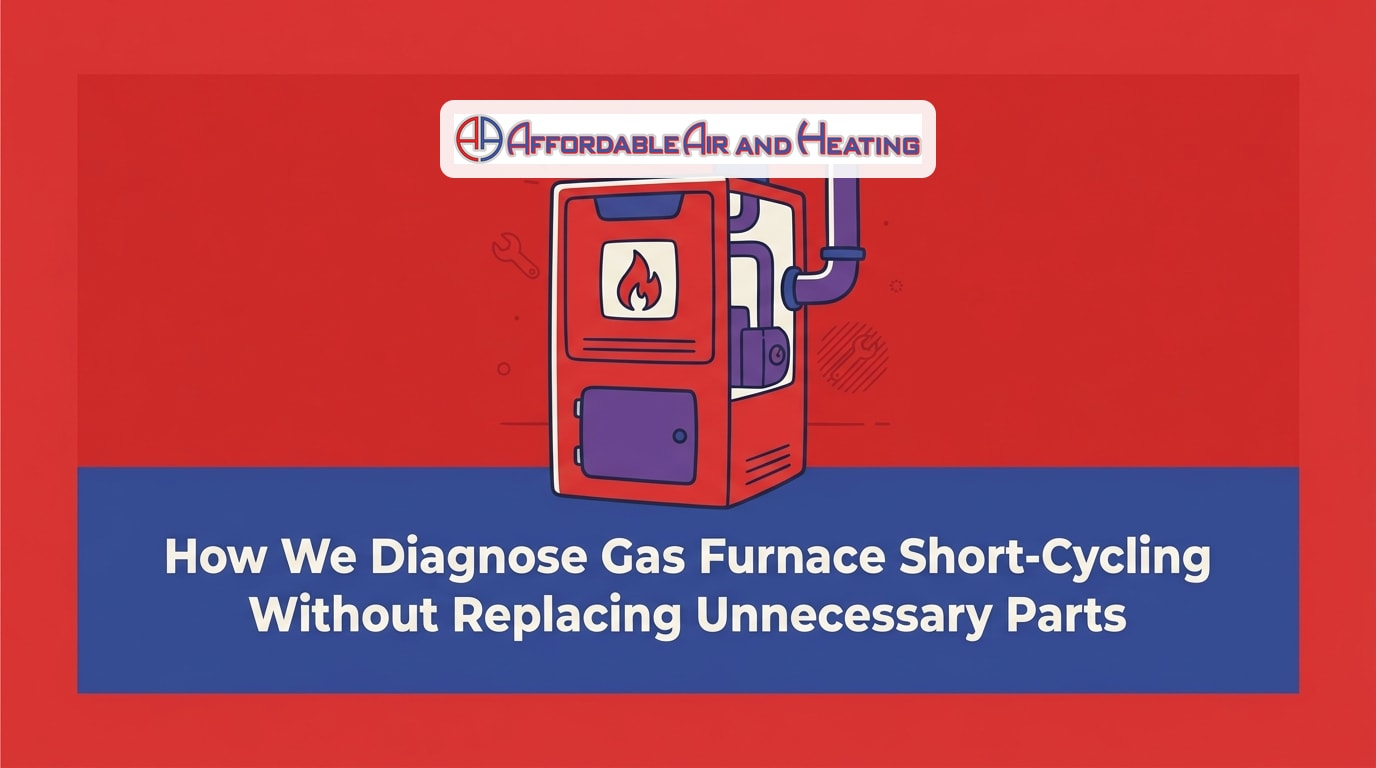
You bump up the thermostat on one of the first cold October nights, eager for a wave of warm air. The heater rumbles to life, but before you can even get comfortable, the system abruptly clicks off. A few minutes later, it tries again, only to fail just as fast. If you are dealing with a heater that refuses to stay on, understanding how we diagnose short-cycling in gas furnaces without replacing unnecessary parts is the first step toward restoring your home's comfort.
When your system struggles to stay running, professional HVAC System Services and thorough Heating Repair and Diagnostics are essential.
The reality of the situation: This rapid on-and-off behavior is not just a nuisance designed to leave you shivering. Short-cycling is actually a critical safety mechanism built into modern heating systems. Your furnace is actively shutting itself down because an internal sensor detects a condition that could lead to severe mechanical damage or a safety hazard.
At Affordable Air and Heating, we see this exact scenario play out every autumn. When faced with this frustrating symptom, the most important decision a homeowner makes is choosing a professional who values methodical testing over quick guesses. It is incredibly common for inexperienced technicians to assume a major component has failed, leading to expensive and entirely avoidable repair bills. By relying on thorough, component-level testing, our team protects homeowners from paying for parts they do not actually need.
Understanding the Mechanics of Furnace Short-Cycling
To understand why a system shuts down prematurely, it helps to know what a normal startup sequence looks like. A gas furnace does not simply ignite all at once. It follows a strict, step-by-step process orchestrated by the main control board. If any single step fails to report back correctly, the board immediately halts the process. This abrupt halt is what we call short-cycling.
It is important to differentiate between a heating cycle that is merely brief—perhaps because the thermostat is located too close to a heat register—and a true system lockout where the furnace actively cuts power to the gas valve. While cooling systems have their own unique behaviors, which you can read about in our guide on Why Your AC Keeps Turning On and Off, gas heating failures usually revolve around specific safety checkpoints.
The 30-Second Ignition Cycle
A typical furnace startup takes about 30 to 60 seconds and follows a very specific order of operations. First, the thermostat sends a call for heat. Next, the draft inducer motor turns on to clear any lingering gases out of the heat exchanger and ensure proper ventilation. Once the system verifies the inducer is running, the igniter begins to glow red-hot (or a spark starts firing).
Only after these preliminary steps does the gas valve open to release fuel over the burners. The short-cycle interruption typically occurs right at this moment. The burners light, you hear the familiar "whoosh" of flames, and then—within seconds—the gas valve clicks shut and the flames die. The system recognized a failure at the final safety checkpoint and aborted the cycle.
Built-In Safety Lockouts
Modern heating equipment is highly intelligent and tracks these failed attempts. If a furnace tries to ignite and fails three or four times in a row, the control board will enter a "hard lockout" state.
What a hard lockout means: The system will completely refuse to attempt another ignition for a set period, usually one to three hours, or until the power to the unit is manually reset. This is a vital safety feature designed to prevent raw, unburned gas from pooling inside the combustion chamber after repeated failed ignition attempts.
How Environmental Dust Triggers Fall Heating Failures
Many early-season heating failures have less to do with broken machinery and more to do with the local environment. In our years of providing HVAC services throughout the Lancaster high desert, we have learned that living here means dealing with significant amounts of airborne particulate matter. During the long, dry summer months, high winds push fine dust into every crevice of a home, including the ductwork and the internal cabinet of your dormant heating system.
For six to eight months, the furnace simply acts as a collection point. Fine layers of desert dust settle over sensitive electrical components, sensors, and switches. When you finally switch the thermostat to "heat" in the fall, that accumulated dust acts as a microscopic insulator.
This environmental reality is exactly why so many systems across our Antelope Valley Service Areas experience issues during their first startup of the year. Our technicians routinely find that the components themselves are not broken, cracked, or degraded; they are simply too dirty to read the electrical signals required to keep the system running. Recognizing this pattern is why we focus heavily on cleaning and precise electrical testing rather than jumping straight to catastrophic part failures.
The Flame Sensor: A Common Culprit Requiring Precise Measurement
One of the most frequent victims of summer dust buildup is the flame sensor. This small, metal rod sits directly in the path of the burner flames. Its entire job is to detect the presence of a safe, established fire. If the gas valve opens but the flame sensor does not detect a fire within a few seconds, it signals the control board to immediately shut off the gas, preventing a dangerous buildup of unburned fuel.
When microscopic layers of carbon or high-desert dust coat this sensor, it loses its ability to conduct electricity. The fire is burning perfectly fine, but the dirty sensor cannot "feel" it, tricking the furnace into shutting down. Because this component operates on highly sensitive electrical currents, our seasoned professionals at Affordable Air and Heating use a methodical process to verify its operation.
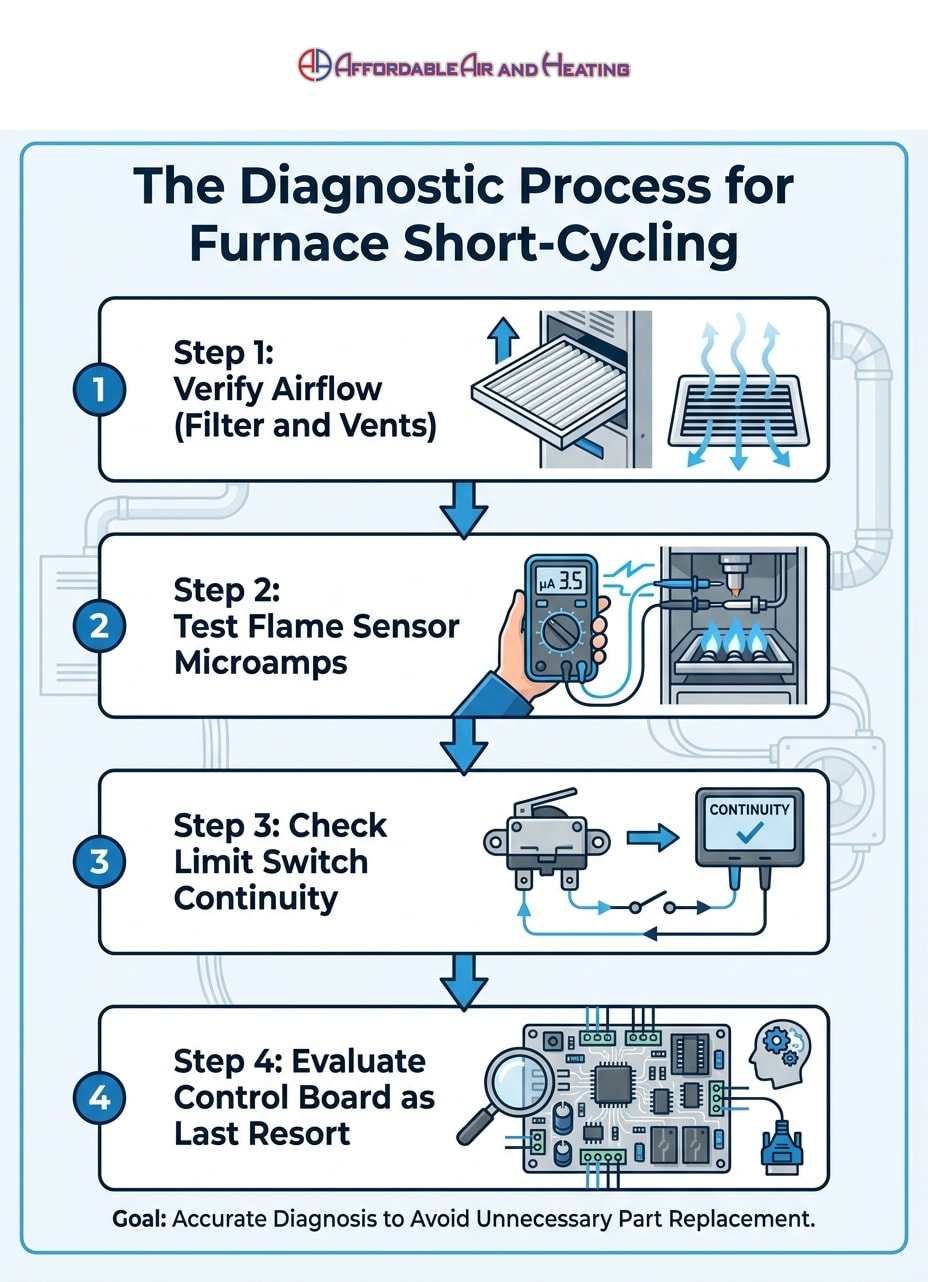
1. Isolating the circuit: Our technician safely disconnects the specific wire leading to the flame sensor to prepare for inline testing.
2. Configuring the multi-meter: We set specialized diagnostic tools to measure direct current in microamps (millionths of an amp), as standard settings are not sensitive enough for this component.
3. Capturing the reading: The technician initiates a heating cycle and captures the exact flame sensor microamp reading during the brief three-second window while the burners are lit.
4. Comparing against specifications: We compare that precise numerical reading against the manufacturer's baseline to determine if the sensor is failing, merely dirty, or functioning perfectly.
Why Visual Inspections Aren't Enough
A common mistake is assuming a flame sensor is fine simply because it looks metallic and clean to the naked eye. The layer of silica or carbon required to insulate a microamp electrical signal is often invisible. This is why visual inspections alone are entirely inadequate. Taking a true microamp reading is the only definitive way to verify functionality and prevent misdiagnosing the issue as a much more severe electrical failure within the main board.
Evaluating the Limit Switch for Airflow Restrictions
While the flame sensor monitors the fire, the high-limit switch monitors the temperature. The limit switch is a critical safety device designed to protect the heat exchanger—the metal barrier that separates the breathable air in your home from the toxic combustion gases—from dangerous overheating.
If the internal temperature of the furnace cabinet climbs too high, the limit switch trips, immediately cutting power to the gas burners while leaving the blower fan running to cool the system down. This results in a classic short-cycle symptom. The vast majority of the time, our team finds that a tripping limit switch is caused by severe airflow restrictions that trap heat inside the unit.
• Clogged air filters: A filter packed with summer dust prevents cool return air from flowing over the heat exchanger, causing temperatures to spike rapidly.
• Closed supply vents: Shutting vents in unused rooms increases static pressure and drastically slows down the total volume of air moving through the system.
• Blocked return grilles: Furniture or rugs placed over return vents starve the equipment of the air it needs to regulate its internal temperature.
During an Affordable Air and Heating diagnostic visit, our technicians test the limit switch for electrical continuity to ensure it has not failed in the "open" position. We highly advise homeowners never to repeatedly reset a furnace that is tripping its limit switch. Forcing an overheating system to run over and over again stresses the metal heat exchanger, eventually leading to permanent cracks and the risk of carbon monoxide exposure.
Why Diagnostic Integrity Means Avoiding the "Parts Cannon"
In the heating and cooling industry, there is a notorious practice known as firing the "parts cannon." This happens when a technician is unsure exactly why a system is short-cycling, so they begin guessing. They replace the most obvious, and often most expensive, parts one by one until the symptom magically disappears.
The main control board is the most frequent victim of the parts cannon. Because the control board acts as the brain of the furnace, receiving signals from every sensor and switch, a lazy diagnostic process will simply blame the board when a cycle fails. However, as our experienced technicians know, the board is usually just doing its job—shutting down the system because a much cheaper, smaller sensor told it to.
• The "Parts Cannon" — Typical Methodology: Guessing the cause and replacing expensive components (like the main board) without verifying failure. — Impact on the Homeowner: High out-of-pocket costs for parts that were not actually broken, plus lingering unreliability.
• Methodical Testing — Typical Methodology: Using multi-meters to test individual safety circuits, microamps, and continuity before condemning parts. — Impact on the Homeowner: Accurate, cost-effective repairs that address the true root cause of the short-cycle.
Our team's steadfast commitment to thorough testing saves homeowners money. By taking the time to test individual safety circuits, we can often resolve a short-cycle with a simple cleaning or a minor sensor replacement. This philosophy of diagnostic integrity applies across all the equipment we service, ensuring you are protected from unnecessary costs whether we are testing a traditional gas furnace or performing Heat Pump Installation and Service.
Frequently Asked Questions About Furnace Short-Cycling
What is the most common cause of a furnace short cycling?
The most common cause of short-cycling is restricted airflow due to a dirty air filter. When the filter is clogged, heat gets trapped inside the furnace cabinet, causing the high-limit safety switch to trip and shut down the burners. Following closely behind dirty filters are dirty flame sensors, which fail to detect the burner flames and shut off the gas valve as a safety precaution.
Can a bad flame sensor cause short cycling?
Yes, a malfunctioning or dirty flame sensor is a primary cause of short-cycling. If the sensor cannot detect the electrical current of the flame within a few seconds of ignition, it assumes there is no fire. To prevent raw gas from pouring into your home, it immediately instructs the control board to close the gas valve, abruptly ending the heating cycle.
Why does my furnace turn on for 30 seconds then shut off?
A furnace shutting off after 30 seconds is usually failing its initial safety sequence. During those first 30 seconds, the system is checking that the draft inducer is venting properly, the igniter is hot, and the flame is established. If any of those checkpoints fail to verify, the control board halts the sequence immediately to prevent a safety hazard.
Will a dirty filter cause short cycling?
Yes, a dirty air filter is a frequent trigger for short-cycling. A clogged filter blocks the flow of cool return air from entering the system, which means the heat generated by the burners cannot be pushed into your home. The trapped heat rapidly raises the internal temperature of the furnace until the high-limit switch trips and shuts the system down.
How can I tell if my control board is actually bad?
A control board should only be condemned after a professional has thoroughly tested and ruled out all other safety switches, sensors, and wiring. Because the board controls the entire system, symptoms of a bad board mimic the symptoms of a bad sensor. Only precise electrical testing with a multi-meter can definitively prove that the board is failing to send or receive voltage correctly.
Ensuring Reliable Heat with Professional Diagnostics
Dealing with a heating system that turns on and off rapidly is stressful, but it is important to remember that short-cycling is usually a symptom of a safety mechanism doing exactly what it was designed to do. The equipment is protecting itself, and your home, from overheating or unburned gas.
Understanding our professional diagnostic process provides peace of mind. You now know that a proper technician from Affordable Air and Heating will rely on methodical testing—like checking microamps and continuity—rather than quick guesses. If you notice these symptoms in your home, do not settle for the parts cannon approach. By knowing exactly how we diagnose short-cycling in gas furnaces without replacing unnecessary parts, you can feel confident that your system will be repaired accurately, honestly, and reliably.