What Is Wrong When Your AC Keeps Turning On and Off
If your ac keeps turning on and off, what is wrong is almost always one of a handful of diagnosable problems — and the good news is that several of them are things you can check yourself right now.
Here are the most common reasons your AC is short cycling:
- Dirty or clogged air filter — restricts airflow, causes overheating, triggers a safety shutoff
- Thermostat problems — low batteries, poor placement, or faulty calibration sends false signals
- Low refrigerant levels — a leak drops system pressure, tripping a safety switch
- Failing capacitor or electrical fault — prevents the unit from completing a normal startup
- Dirty condenser coils — traps heat in the outdoor unit, causing it to overheat and shut down
- Oversized AC unit — cools the space too quickly, cycling off before removing humidity
- Frozen evaporator coils — ice buildup cuts airflow and forces the system to shut off
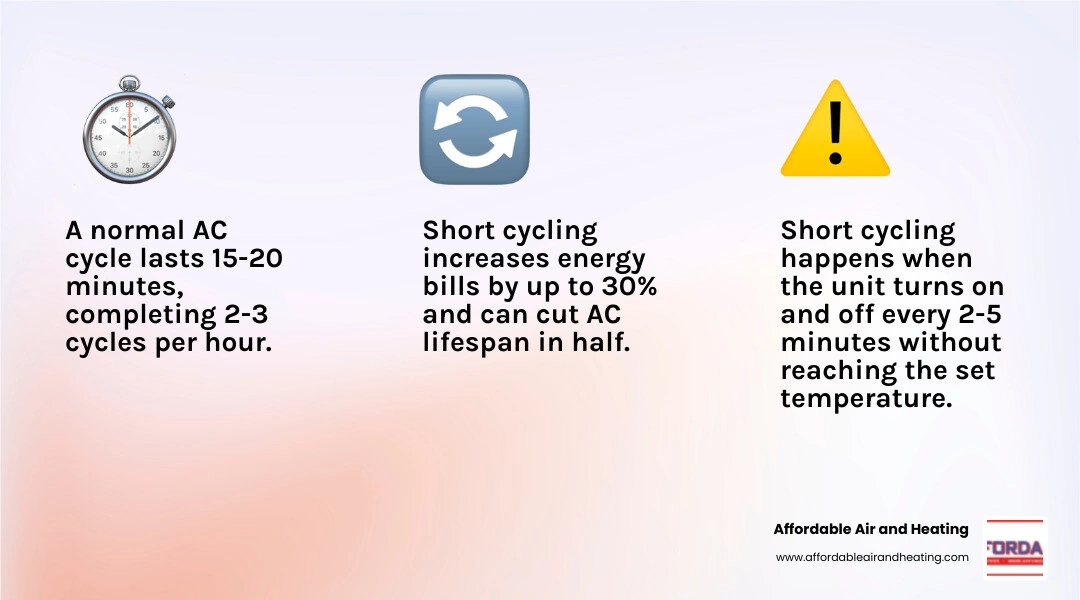
A normal AC cycle runs between 15 and 20 minutes, completing two to three cycles per hour. When your system is kicking on and off every two to five minutes without ever reaching your set temperature, that is short cycling — and it puts serious stress on your compressor, the most expensive part of your system.
Short cycling can raise your energy bills by up to 30% and cut your AC's lifespan in half. In the extreme heat of the Antelope Valley, that is not a problem you want to ignore.
Read on and we will walk you through exactly how to diagnose what is happening with your system.
Ac keeps turning on and off what is wrong basics:
Understanding AC Short Cycling and Why It Is a Problem
To understand why your air conditioner is acting like a hyperactive light switch, we first need to look at what a healthy cooling cycle actually looks like.
Under normal operating conditions, your air conditioner turns on, runs for roughly 15 to 20 minutes to evenly distribute cool air throughout your home, and then shuts down once the thermostat's target temperature is satisfied. In moderate weather, this happens two or three times an hour.
When your system is short cycling, it turns on, runs for a brief window—often just two to five minutes—and then abruptly shuts off. A few minutes later, it tries all over again.

This rapid-fire behavior is more than just an annoying background noise. It is a mechanical emergency for several reasons:
- Extreme Compressor Wear: The compressor is the heart of your air conditioning system. It is also the most expensive component to replace. Starting up an AC unit draws significantly more electrical current and generates more internal heat than running it continuously. A compressor designed to start three times an hour that suddenly starts twelve times an hour will wear down its internal components at an alarming rate, potentially cutting its overall lifespan from 15 years down to just 5 to 7 years.
- Skyrocketing Energy Bills: Because your AC draws a massive surge of electricity every single time it boots up, constant restarts will cause your utility bills to skyrocket. Homeowners dealing with short cycling often see their energy bills jump by 20% to 30% in a single billing cycle.
- Terrible Humidity Control: Air conditioners don't just cool the air; they also act as large dehumidifiers. To remove moisture from your indoor air, the evaporator coils need to stay cold long enough for water vapor to condense on them. Short run times prevent this process from happening. The result is a home that feels muggy, clammy, and generally uncomfortable, even if the thermometer says it is cool.
To help you troubleshoot this issue before it leads to a catastrophic system breakdown, we have put together a comprehensive guide on diagnosing what is going on behind the scenes. If you want to run through some basic checks yourself first, you can read our guide on AC Troubleshooting Before Calling a Pro.
AC Keeps Turning On and Off What Is Wrong
When an ac keeps turning on and off what is wrong usually comes down to one of three categories: restricted airflow, safety switch activation, or electrical failure. Modern air conditioning systems are built with highly sensitive safety features designed to shut the system down immediately if something goes wrong, preventing total compressor failure.
Below is a quick reference table comparing the most common causes of short cycling, their typical symptoms, and how they are resolved:
| Common Cause | Primary Symptom | DIY Troubleshooting Step | Professional Solution |
|---|---|---|---|
| Clogged Air Filter | Low airflow from vents, ice on indoor lines | Check filter; replace if you cannot see light through it | Airflow correction, ductwork inspection |
| Thermostat Issues | Faded display, unit cycles randomly | Replace batteries; check for nearby draft sources | Reposition thermostat; recalibrate or replace unit |
| Low Refrigerant | Ice on coils, lukewarm air, hissing sounds | Inspect copper lines for ice or oily residue | Locate leak, seal the leak, and recharge refrigerant |
| Failing Capacitor | Hum or click before shutting down immediately | Reset breaker once; do not attempt DIY electrical work | Replace run or start capacitor |
| Dirty Condenser Coils | Cycling only on extremely hot days | Clear 2 feet of space around outdoor unit; hose off debris | Deep chemical coil cleaning |
| Oversized AC Unit | Very short run times, humid indoor air | Time the cooling cycles on a hot day | Complete Manual J load calculation; replace system |
How a Dirty Air Filter Answers: AC Keeps Turning On and Off What Is Wrong
It might sound too simple to be true, but a dirty air filter is responsible for roughly 40% to 60% of all short cycling service calls.
Your air conditioner needs a steady, high-volume stream of warm indoor air flowing over its indoor evaporator coils to function. The refrigerant inside these coils absorbs the heat from the air. If your air filter is packed with dust, pet dander, and desert pollen, that airflow is choked off.
Without enough warm air passing over the evaporator coil, the refrigerant inside gets incredibly cold. This causes any moisture on the coil to instantly freeze, turning the coil into a solid block of ice.
As the ice builds up, it restricts the remaining airflow even further. To prevent the entire system from freezing solid and destroying the compressor, a safety switch or thermal overload sensor will trip, shutting the unit down. Once the unit shuts off, the ice begins to melt slightly. The safety switch resets, the system turns back on, runs for a minute, freezes again, and shuts down.
If you suspect this is happening, turn your system off immediately to let the coils thaw. You can learn more about how to check for this in our article on AC Not Cooling But Running What to Check First.
Thermostat Issues: AC Keeps Turning On and Off What Is Wrong
Your thermostat is the brain of your HVAC system. If the brain is sending mixed signals, the rest of the body will behave erratically.
There are three primary ways a thermostat can cause your AC to turn on and off rapidly:
- Poor Placement: If your thermostat is installed in a bad location—such as in direct sunlight, directly beneath an air vent, near a drafty window, or close to heat-producing appliances like an oven—it will experience "ghost readings." For example, if a blast of cold air from a nearby vent hits the thermostat, it will think the house is cooled and shut the system down. A few minutes later, as the surrounding air warms up, it turns the AC back on.
- Low Batteries: Many homeowners don't realize that digital thermostats rely on batteries to communicate with the HVAC system. When these batteries start to die, the thermostat can drop its connection to your AC unit intermittently, causing the system to start and stop without warning.
- Faulty Calibration: Over time, the internal sensors of a thermostat can drift out of calibration. It may struggle to accurately read the ambient temperature of your home, leading to erratic cycling.
If you are experiencing these issues in the Lancaster area, you can read our specialized guide on how to Fix AC Short Cycling Lancaster to get your system back on track.
Low Refrigerant Levels and System Leaks
There is a common misconception that air conditioners "consume" refrigerant the way a car burns gasoline. In reality, your AC is a sealed system. The refrigerant simply cycles back and forth between your indoor and outdoor units, absorbing and releasing heat.
If your refrigerant level is low, it means you have a leak.
When refrigerant escapes through a tiny crack in your copper lines, the overall pressure within the system drops. Your air conditioner is equipped with a low-pressure safety switch designed to protect the compressor. When the pressure drops below a safe threshold, the switch trips and shuts the system down.
Once the system stops running, the internal pressure naturally rises slightly, resetting the switch. The compressor kicks back on, the pressure immediately drops again, the switch trips, and the cycle repeats.
Running an AC with low refrigerant levels is incredibly dangerous for your compressor, as it relies on the cool refrigerant gas to keep from overheating. If you suspect a leak—often indicated by a bubbling or hissing sound near the refrigerant lines, or ice forming along the copper tubes—turn the system off immediately and call for professional help. You can read about other warning signs in our article on Signs You Need AC Repair.
Electrical Problems and Failing Capacitors
If your air conditioner turns on, runs for only a few seconds, and then shuts down with a click or a humming sound, you are likely dealing with an electrical failure.
The most common electrical culprit is a failing capacitor. Think of capacitors as large, temporary batteries that store up electrical energy.
- Start Capacitor: Provides the massive electrical boost required to get the heavy compressor motor spinning from a dead stop.
- Run Capacitor: Delivers a continuous, steady stream of electrical energy to keep the compressor and fan motors running smoothly during the cooling cycle.
When a run capacitor begins to fail—often due to age, extreme summer heat, or electrical surges—it can no longer supply the steady voltage your compressor needs to stay running. The compressor will start, overheat almost instantly due to voltage fluctuations, and trip its internal thermal overload switch.
Additionally, corroded electrical wiring, loose connections, or a failing control board can interrupt the low-voltage signals sent between your thermostat and your outdoor unit, causing the system to cycle on and off rapidly. Because capacitors hold dangerous amounts of electrical voltage even after the power is turned off, electrical diagnostics should always be left to a licensed professional.
Dirty Condenser Coils and Overheating
While the indoor evaporator coil absorbs heat from your home, the outdoor condenser coil has the job of releasing that heat into the outside air.
During the spring and summer in the Antelope Valley, wind-blown dust, dry leaves, and cottonwood debris can build up on the delicate aluminum fins of your outdoor unit. This creates an insulating blanket over the coils.
When the condenser coils are dirty, the heat trapped inside the refrigerant cannot escape. This causes the internal temperature and pressure of the outdoor unit to rise rapidly. To prevent the compressor from literally cooking itself from the inside out, a high-pressure safety switch will trip, shutting the unit down.
Once the outdoor fan runs for a bit and the unit cools down, the safety switch resets, and the system attempts to start up again. This cycle of overheating and cooling down is particularly common on the hottest summer days when the outdoor temperatures are already pushing the system to its limits.
Incorrectly Sized AC Units
Sometimes, an ac keeps turning on and off not because a part is broken, but because the system itself was poorly planned from day one.
In the HVAC world, bigger is not always better. If an air conditioner is too large (oversized) for the square footage of your home, it will cool your living spaces incredibly fast. The system turns on, blasts the house with freezing air, satisfies the thermostat in under five minutes, and shuts down.
Because the run times are so short, the system never has a chance to pull humidity out of the air. This results in rapid temperature swings, high indoor humidity, and massive wear and tear on your equipment.
To determine the exact size system your home needs, a technician must perform a detailed Manual J load calculation, which takes into account your home's square footage, insulation levels, window placement, and local climate. If you are trying to decide whether to fix your current system or upgrade to a properly sized unit, check out our AC Repair vs Replace Decision Guide.
How to Prevent AC Short Cycling with Routine Maintenance
The easiest way to deal with an AC that keeps turning on and off is to prevent the issue from happening in the first place. Fortunately, a little bit of regular upkeep goes a long way.
Here is a simple, highly effective maintenance checklist to keep your system running smoothly all summer long:
- Stick to a Filter Schedule: In our dusty desert climate, you should check your air filter once a month. If you have pets or suffer from allergies, replace it every 30 to 60 days. A clean filter is your system's best defense against airflow restrictions.
- Keep the Outdoor Unit Clear: Maintain at least a two-foot clearance around your outdoor condenser unit. Trim back any desert shrubs, clear away weeds, and regularly sweep away dead leaves or debris that accumulate against the metal grates.
- Clean Your Condensate Drain: Pouring a cup of white vinegar down your AC's condensate drain line once a month during the summer can prevent algae buildup. This keeps your float switch from tripping and shutting down your system due to standing water.
- Schedule Annual Professional Tune-Ups: Having a professional technician inspect your system every spring is the absolute best way to catch failing capacitors, slow refrigerant leaks, and dirty coils before they turn into a short-cycling nightmare.
To learn more about what is included in a professional check-up, check out our guide on AC Service What to Expect and discover the long-term Benefits of Routine AC Service.
Frequently Asked Questions About AC Short Cycling
How many times per hour should my AC cycle?
Under normal operating conditions, a properly sized and healthy air conditioner should complete two to three cycles per hour. Each of these cooling cycles should last between 10 and 20 minutes. If your system is turning on and off more than four or five times an hour, or if its individual run times are consistently under 8 minutes, your system is short cycling and needs professional attention.
Can I run my AC if it is short cycling?
No. If you notice your air conditioner is short cycling, you should turn it off at the thermostat immediately. Continuing to run a system that is cycling rapidly puts extreme stress on the compressor and electrical components. What might start as a simple, inexpensive fix—like replacing a dirty filter or a failing capacitor—can quickly turn into a highly expensive compressor replacement if the system is allowed to keep short cycling.
Does short cycling increase my energy bills?
Yes, significantly. Your air conditioner draws three to five times more electrical current during the first minute of startup than it does while running continuously. When your system is constantly restarting, it consumes massive amounts of electricity without ever running long enough to efficiently cool your home. To learn more about how extreme weather impacts your system's run times and energy use, read our article on AC Running Constantly in Desert Heat.
Conclusion
When your ac keeps turning on and off, it is your system's way of screaming for help. Whether it is a simple fix like swapping out a dusty air filter or a more complex issue like a refrigerant leak or a failing capacitor, addressing the problem early is the key to protecting your compressor and keeping your energy bills under control.
At Affordable Air and Heating, we have been keeping families comfortable across the Antelope Valley since 1996. As a family-owned business, we pride ourselves on delivering honest, dependable, and energy-efficient HVAC solutions at prices you can afford. We proudly serve homeowners in Lancaster, Palmdale, Santa Clarita, Quartz Hill, Acton, Rosamond, and the surrounding areas.
If your air conditioner is acting up and you want to know what to expect during a professional visit, check out our guide on AC Service What to Expect.
Don't let a short-cycling AC leave you sweating in the desert heat. Schedule Professional AC Repair Today with the local experts at Affordable Air and Heating, and let us get your home back to the cool, comfortable sanctuary it should be!