Why Your AC Runs Constantly in Desert Heat (And What to Do About It)
If you've noticed your ac running constantly in desert heat, you're not alone — and you're not imagining it. Here's the short answer:
Is it normal? Sometimes yes. Sometimes it's a warning sign.
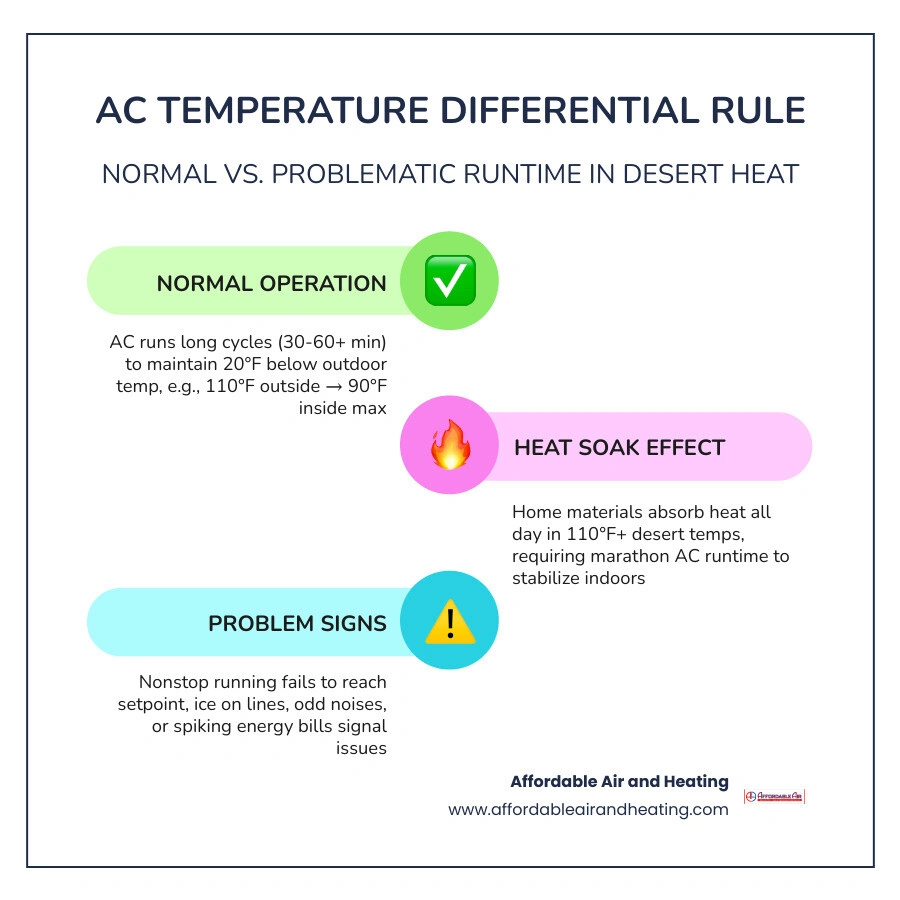
- Normal: Your AC runs for long stretches (or even all day) during triple-digit heat because it's working against a temperature gap that exceeds what most systems are designed to handle. AC units are built to cool indoor air roughly 20°F below outdoor temperatures — but when it's 115°F outside and you want 75°F inside, that's a 40°F gap. Physics makes that hard.
- Potentially a problem: If your AC runs nonstop but your home still won't reach the set temperature, or you notice ice on the lines, unusual noises, or a sudden spike in your energy bill, something is likely wrong.
The Antelope Valley is one of the harshest environments an air conditioner can face. Palmdale and Lancaster homeowners routinely deal with temperatures above 110°F, heavy dust, intense UV exposure, and attic temperatures that can push past 150°F on a hot afternoon. Under those conditions, even a well-maintained system works harder than it would almost anywhere else in the country — logging up to 4,000 to 5,000 cooling hours per year, compared to just 800 to 1,500 hours in milder climates.
This guide breaks down exactly why your AC keeps running, how to tell normal operation from a real problem, and what you can do to protect your system before the heat takes its toll.
Is It Normal for Your AC to Run Constantly in Desert Heat?
As we move through May 2026, the first major heatwaves are likely hitting the Santa Clarita and Antelope Valleys. When the mercury climbs toward 110°F, your home begins to suffer from "heat soak." This is when the very bones of your house—the framing, the drywall, and the furniture—absorb heat all day. To combat this, your AC has to work in "marathon mode" just to keep the indoor temperature stable.
In these extreme conditions, continuous operation is often a sign that your system is successfully "fighting the good fight." Modern high-efficiency systems are actually designed for longer cycles at lower speeds. This is more efficient than "short cycling," where the system turns on and off frequently, causing massive wear and tear.
However, there is a fine line between a hard-working unit and a failing one. To help you distinguish, we’ve put together a quick comparison:
FeatureNormal Long Run TimeProblematic Constant RunningIndoor TempReaches or stays near the setpoint.Temperature keeps climbing despite AC running.Air TemperatureAir from vents feels 15-20°F cooler than room air.Air from vents feels lukewarm or weak.System SoundSteady hum of the fan and compressor.Grinding, squealing, or frequent "clicking."Energy BillExpected seasonal increase.Massive, unexplained spike compared to last May.VisualsClean copper lines (maybe some sweat).Ice formation on the outdoor unit or indoor coils.
If your system is running but the house is getting hotter, you need to Detect AC Issues Early in Palmdale before a total breakdown occurs.
Why Your AC Is Running Constantly in Desert Heat
In the Antelope Valley, our climate doesn't just provide heat; it provides a cocktail of stressors that can shave years off an HVAC system's life. While the national average lifespan for an AC is 15 to 20 years, systems in high desert areas like Lancaster and Rosamond often fail in just 10 to 16 years.
The Sandpaper Effect of Desert Dust and Low Humidity
Desert dust isn't just "dirt." It’s often composed of microscopic mineral shards that act like sandpaper on your AC’s moving parts. When this grit gets into motor bearings or settles on the delicate fins of your condenser coils, it creates friction and heat.
Furthermore, when dust mixes with even a tiny bit of moisture on your indoor evaporator coil, it can create a "bio-slime." This sludge restricts airflow and can lead to AC Not Cooling Properly Palmdale, forcing the system to run indefinitely to compensate for the lack of heat exchange.
Mechanical Stress and the Paperclip Effect
We often talk about the "paperclip effect" in the HVAC industry. Just like bending a paperclip back and forth until it snaps, the extreme diurnal temperature swings in the desert (where it might be 105°F during the day and 65°F at night) cause metal components to expand and contract rapidly.
This stress leads to micro-leaks in refrigerant lines. Additionally, intense UV radiation (often hitting levels of 10 or 11) makes plastic components and wiring insulation brittle. When these parts fail, you might encounter AC Fan Problems Solutions that require professional intervention.
Undersized Systems and Attic Heat Gain
If your home has had a room addition or if the original builder didn't perform a proper "Manual J" load calculation, your system may be undersized. An undersized unit will ac running constantly in desert heat simply because it doesn't have the "BTU muscle" to remove heat as fast as the desert sun adds it.
This is made worse by attic temperatures. In cities like Santa Clarita or Palmdale, an unventilated attic can reach 150°F. If your ductwork is running through that "pizza oven" without proper insulation, the air you just paid to cool is warmed back up before it ever hits your living room. This can account for a 20% to 30% loss in cooling efficiency. Why Proper AC Installation Matters becomes very clear when you realize a poorly sized or installed system will never win the battle against the sun.
Warning Signs Your AC Running Constantly in Desert Heat Is a Problem
When your AC is running non-stop, you should keep an eye (and ear) out for these specific red flags. These indicate that the "marathon" has turned into a "medical emergency" for your HVAC unit.
Frozen Coils and Refrigerant Leaks
It sounds like a paradox: how can an AC freeze up when it's 110°F outside? It happens because of restricted airflow or low refrigerant. If the evaporator coil gets too cold because it can't "breathe" (due to a dirty filter) or because the refrigerant levels are low, moisture in the air turns to ice.
Once ice forms, it acts as an insulator, preventing the system from cooling your home at all. If you see white frost on the copper lines, turn the system off immediately and look into Why My AC Freezing Up in Santa Clarita. You may also need a technician to Detect Refrigerant Leaks AC Units, as AC systems are closed loops and should never "run out" of coolant.
Unusual Noises and Electrical Failures
In the high desert, the outdoor unit (the condenser) has to dump an incredible amount of heat. If the fan motor is struggling with grit or the capacitor is failing due to the heat, you’ll hear it.
- Grinding/Squealing: Usually indicates motor bearings failing due to dust infiltration.
- Clicking/Humming: Often a sign of a failing capacitor or electrical contactor.
- Frequent Breaker Trips: This is a major warning sign. If your system is pulling too much power, it’s likely overheating.
Don't ignore these sounds; check our guides on how to Fix Loud AC Noises Valencia and Solving AC Breaker Tripping Lancaster to prevent a total compressor burnout.
Maintenance Strategies to Reduce Runtime and Extend Lifespan
You can’t change the weather in the Antelope Valley, but you can change how your home responds to it. Proactive maintenance is the only way to ensure your system survives the 4,000+ cooling hours it logs every year.
High Desert Filtration and Coil Cleaning
In dusty areas like Quartz Hill or Antelope Acres, a standard air filter can clog in as little as 30 days. A clogged filter is the #1 reason for an ac running constantly in desert heat because it chokes the airflow.
- Filter Choice: Use a MERV 8 to 11 filter. It’s strong enough to catch desert dust but doesn't restrict airflow as much as "hospital-grade" filters.
- The 30-Day Rule: Check your filter every month. If it looks gray or furry, replace it.
- Coil Rinse: After a windstorm or haboob, gently rinse your outdoor condenser coils with a garden hose (never a pressure washer!). This removes the "insulation" of dust that traps heat inside your unit.
For a deeper clean, a professional AC Tune Up Maintenance in Canyon Country CA can restore up to 15% of your system's efficiency.
Efficiency Hacks for Antelope Valley Homeowners
Reducing the "load" on your AC will naturally reduce its runtime. Here are our favorite desert-tested tips:
- The 78°F Rule: Every degree you set your thermostat below 78°F can increase your energy usage by 6-8%. During a heatwave, 78°F with a ceiling fan feels like 74°F.
- Shading: If your outdoor unit is on the west side of the house, it’s baking in the afternoon sun. Building a trellis or shade structure can lower the intake air temperature by 10-20°F. Just ensure you leave at least 24 inches of clearance for airflow.
- Window Management: Close the blinds on south and west-facing windows by 10:00 AM. Up to 30% of heat gain comes through the glass.
- Fan Settings: Ensure your thermostat fan is set to "Auto," not "On." The "On" setting circulates air constantly, which can actually pull humidity and heat back into the house when the compressor isn't running.
- Ceiling Fans: Run them counter-clockwise to create a wind-chill effect. However, fans cool people, not rooms—turn them off when you leave! If you have vaulted ceilings, keep in mind How High Ceilings Impact the Efficiency of Your Air Conditioning as they require more air volume to be moved.
When to Call a Professional for Your Desert HVAC System
Sometimes, DIY tips aren't enough. If your system is more than 12 years old and the repair bills are starting to mount, it might be Time for an AC Replacement. In the desert, we often recommend the "50% rule"—if the repair costs half as much as a new unit, it's time to upgrade. However, for units over 12 years old in our climate, that threshold should probably be closer to 30-40%.
Modern units are specifically "derated" for high-altitude areas like Acton or Lake Hughes, ensuring they perform correctly even in thinner air. If you're struggling with AC Thermostat Troubleshooting in Lancaster or your system simply won't turn on, it's time to bring in the experts.
Whether you need a simple recharge or a full HVAC Services Near Canyon Country, getting a professional opinion can save you from a "no-cool" emergency in the middle of July.
Frequently Asked Questions about Desert AC Performance
How often should I change my filters during peak dusty seasons?
In the Antelope Valley, you should check your filters every 30 days. During the windy months or if you live near open desert/construction sites, you will likely need to replace them monthly. Using a MERV 8-11 filter provides the best balance of dust capture and airflow for our local climate.
Does shading my outdoor unit actually help extend its life?
Yes, but only if done correctly. Shading the unit from the direct afternoon sun reduces the thermal load on the cabinet, which can easily reach 150°F. However, you must maintain at least 24 inches of clearance on all sides and never "box in" the unit, as it needs constant airflow to dump heat. A simple trellis or a nearby tree (that doesn't drop too many leaves) is ideal.
Why can't my AC keep my home at 70°F when it's 115°F outside?
This comes down to the laws of physics. Most AC systems are designed to create a 20-degree temperature differential between the outdoor air and the indoor air. When it’s 115°F outside, asking for 70°F requires a 45-degree differential. Your system will run constantly to try and reach that goal, likely failing and causing excessive wear. Setting your thermostat to a more realistic 78°F helps the system maintain a manageable cycle.
Conclusion
Living in the high desert means your air conditioner is the most important appliance in your home. When you face an ac running constantly in desert heat, while some long runtimes are normal, they shouldn't come at the cost of your comfort or your system's health.
At Affordable Air and Heating, we’ve been family-owned and operated since 1996. We understand the unique challenges of the Antelope Valley because we live here too. From Palmdale to Santa Clarita, we provide energy-efficient solutions and affordable maintenance to keep your home a sanctuary from the sun.
Don't wait for a total breakdown in the middle of a triple-digit afternoon. Schedule your professional air conditioning service today and let us ensure your system is ready to survive whatever the desert throws at it.