Why the Best Thermostat Settings to Save Money During an Antelope Valley Summer Can Cut Your Cooling Costs Significantly
The best thermostat settings to save money during an Antelope Valley summer come down to a few key numbers that the U.S. Department of Energy and desert climate experts consistently recommend:
Quick Answer: Recommended Antelope Valley Summer Thermostat Settings
| Situation | Recommended Setting |
|---|---|
| At home during the day | 78°F |
| Away from home (4+ hours) | 85°F |
| Sleeping at night | 76–78°F |
| Extreme heat days (110°F+) | 80–82°F max when away |
Every 2 degrees you raise your thermostat above its baseline can save you between 5% and 10% on your cooling costs — and in a place like Palmdale or Lancaster, where summer temperatures routinely push past 105°F and sometimes spike above 110°F, those degrees add up fast on your monthly bill.
Here's the problem most Antelope Valley homeowners run into: generic energy-saving advice was written for milder climates. It doesn't account for the extreme daytime heat, the dramatic overnight temperature drops, or the Southern California Edison time-of-use rate structure that affects what you actually pay depending on when your AC runs. Getting your thermostat settings right for this specific climate — not just any climate — is where the real savings happen.
In this guide, we'll walk you through exactly how to set your thermostat for each part of the day, how to use smart technology to automate those savings, and what complementary habits make your AC work less while keeping your home comfortable all summer long.
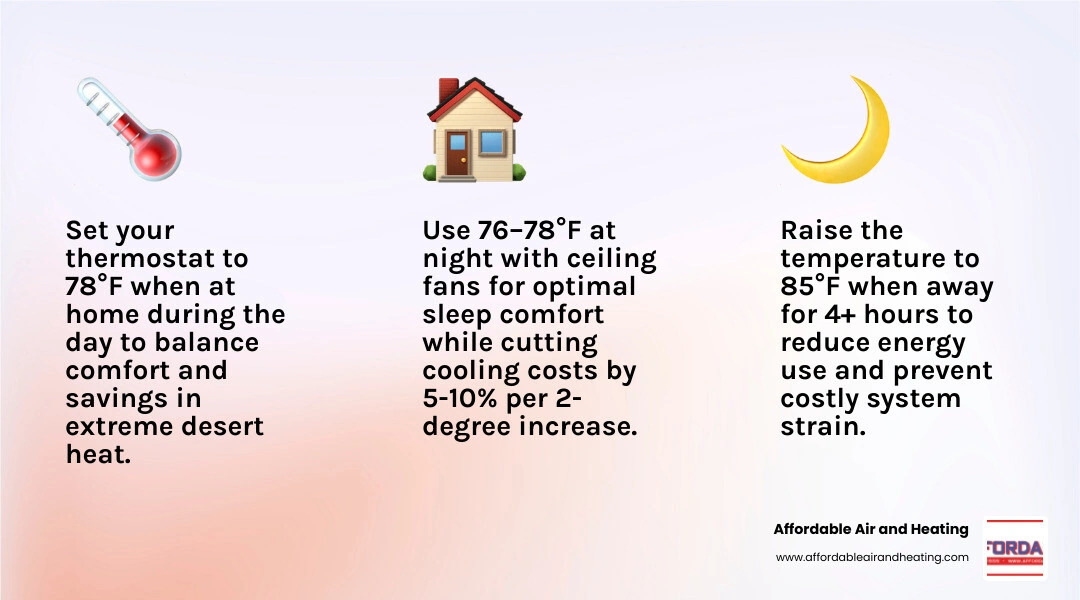
Key terms for best thermostat settings to save money during an antelope valley summer:
The Best Thermostat Settings to Save Money During an Antelope Valley Summer

Living in communities like Palmdale, Lancaster, Rosamond, or Quartz Hill means dealing with a unique high-desert climate. Unlike coastal Los Angeles, our summers are characterized by intense dry heat, relentless sun exposure, and massive diurnal temperature swings — where the afternoon high can easily top 108°F, but the overnight low drops by 30 degrees or more.
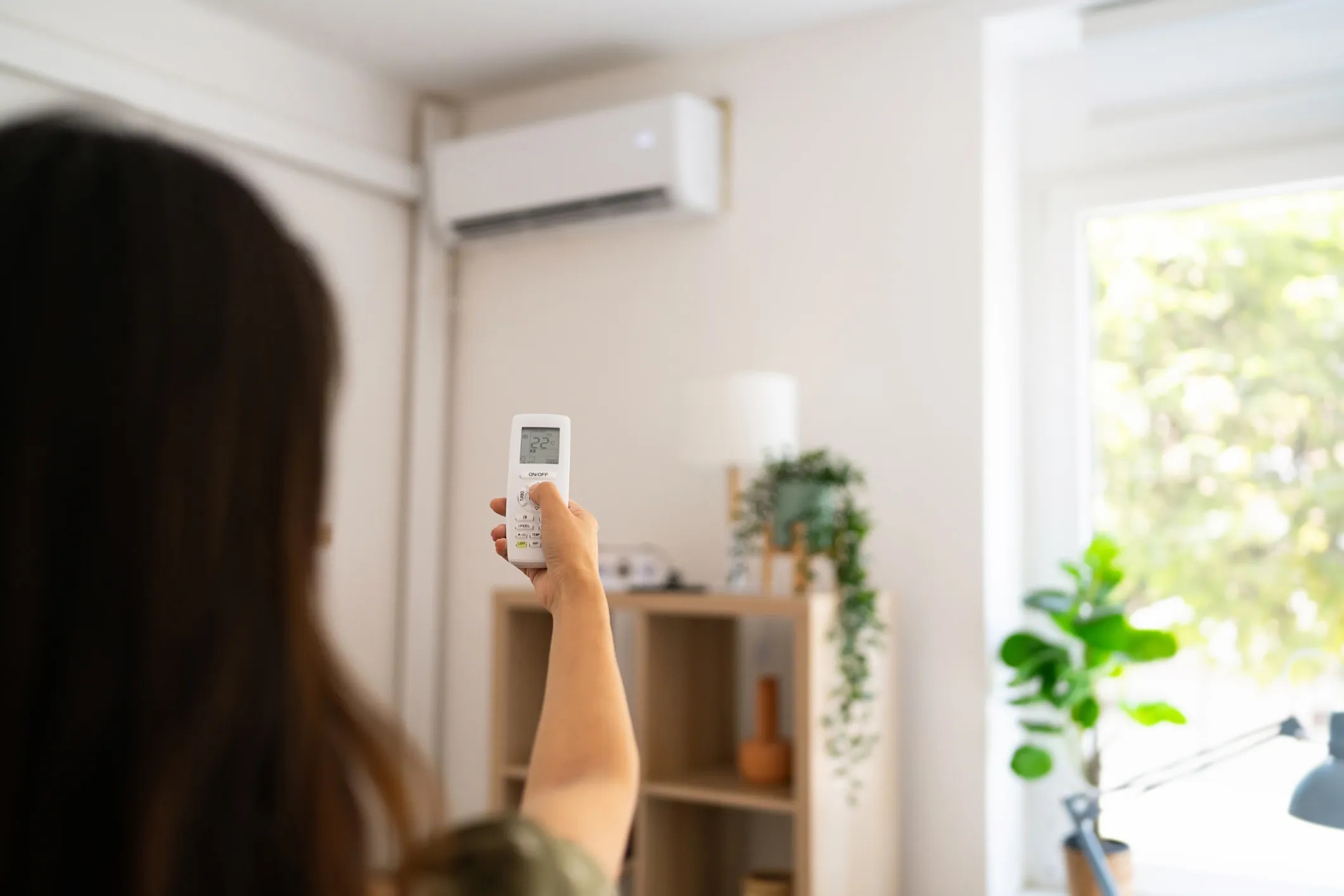
Because of these extreme swings, standard national advice doesn't always translate perfectly to our local homes. However, the U.S. Department of Energy’s golden rule remains the best starting point: setting your thermostat to 78°F when you are at home during the summer balances essential comfort with noticeable energy savings.
When your indoor temperature sits closer to the outdoor temperature, your home actually absorbs heat at a slower rate. If it is 105°F outside and your thermostat is set to 68°F, the extreme temperature difference forces heat to rush through your walls and windows, making your AC work constantly. By maintaining a baseline of 78°F, you slow down this thermal transfer, giving your cooling system a much-needed break. If you are struggling with high utility costs, understanding why is my electric bill so high in an Antelope Valley summer is the first step toward reclaiming control over your household budget.
Daytime and Nighttime Settings for Maximum Comfort
During the daytime, keeping your thermostat at 78°F is highly effective, especially if you acclimate your body gradually. If you are used to keeping your home at 72°F, try raising the setting by one degree each day. Within a week, you will find that 78°F feels perfectly comfortable, especially because our desert air has very low humidity.
When the sun goes down, the high desert treats us to cooler night breezes. You can take advantage of this by adjusting your nighttime thermostat settings to 76°F or 78°F. Because our bodies naturally cool down during sleep, you don't need to chill the entire house to 70°F to get a good night's rest. Instead, running a bedroom ceiling fan can make you feel about 4 degrees cooler through wind chill, allowing you to sleep soundly at a higher thermostat setting without wasting energy.
Our unique climate requires a strategic approach. To learn more about how our local weather patterns impact your HVAC equipment, check out our detailed guide on how the Antelope Valley desert climate affects your AC system.
Why Turning Your AC Off When Away is a Costly Mistake
One of the most common and expensive myths we encounter in the Antelope Valley is that you should turn your air conditioner completely off when you leave for work or a day trip. It sounds logical: if you aren't home, why run the system?
However, in places like Acton, Lancaster, or Santa Clarita, turning the system off entirely during a heatwave is a recipe for an astronomical utility bill and a severely strained compressor. When you turn your AC off on a 105°F day, your home’s walls, furniture, flooring, and drywall absorb heat all day long. By the time you return home at 5:00 PM, your indoor temperature could easily be 95°F or higher.
When you finally switch the AC back on, your system has to work at maximum capacity for several hours just to remove the stored heat from your home's structural mass. This intense, prolonged operation can cause your system to overheat or short-cycle. To understand if your system is working harder than it should, read our article on whether is it normal for AC to run nonstop when temperatures exceed 100 degrees.
Instead of turning the system off, the best thermostat settings to save money during an Antelope Valley summer involve raising the temperature to 85°F when you are away for four hours or more. This prevents your home from turning into an oven while ensuring your AC only needs a short, efficient run cycle to bring the temperature back down to a comfortable 78°F when you return.
Leveraging Smart Technology and Time-of-Use Strategies
If you are still adjusting your thermostat manually throughout the day, you are likely leaving a significant amount of money on the table. Upgrading to a smart or programmable thermostat is one of the most effective 8 ways to reduce your monthly utility bills because it automates your energy savings without requiring you to constantly think about it.
Smart thermostats do more than just follow a schedule; they learn your daily habits, monitor local weather conditions, and provide detailed energy usage reports. Many models use geofencing technology, which tracks your smartphone’s location to automatically raise the temperature when you leave a certain radius around your home and lower it just before you pull back into the driveway.
Pre-Cooling Your Home to Beat Southern California Edison Peak Rates
For homeowners in the Antelope Valley, managing cooling costs isn't just about how much electricity you use — it is also about when you use it. Southern California Edison (SCE) utilizes Time-of-Use (TOU) rate plans, where electricity prices spike significantly during peak hours, typically between 4:00 PM and 9:00 PM.
To avoid paying premium rates during the hottest part of the day, you can use a strategy called "pre-cooling." Here is how it works:
- The Pre-Cool Phase (12:00 PM to 4:00 PM): Set your thermostat to 74°F or 75°F during the cheaper, off-peak midday hours. This cools down your home's thermal mass (walls, furniture, and air) using lower-cost electricity.
- The Coast Phase (4:00 PM to 9:00 PM): When the expensive peak window begins, raise your thermostat setting to 82°F or 83°F. Because your home was pre-cooled, your AC will rarely need to cycle on during these expensive hours, allowing you to "coast" through the peak period on stored cool air.
- The Night Phase (After 9:00 PM): Once peak hours end, return your thermostat to your preferred nighttime sleeping temperature.
This load-shifting strategy keeps money in your pocket while reducing stress on our local electrical grid. If you are wondering how different types of systems handle these extreme cycles, you might want to read about whether can a heat pump handle triple digit temperatures in the Antelope Valley.
Programming the Best Thermostat Settings to Save Money During an Antelope Valley Summer
To maximize your savings, program a consistent weekday schedule into your smart thermostat that aligns with your household's routine:
- 6:00 AM – 8:00 AM (Waking Up): Set to 78°F. Take advantage of the cooler morning air by opening windows briefly if the outdoor temperature is pleasant, then close up the house before the heat starts to rise.
- 8:00 AM – 4:00 PM (Away/Work): Set to 85°F (or pre-cool to 75°F between 12:00 PM and 4:00 PM if you are on an SCE Time-of-Use plan).
- 4:00 PM – 9:00 PM (Peak Hours/Evening): Set to 80°F or 82°F to limit energy consumption during expensive peak hours. Use ceiling fans in occupied rooms to maintain comfort.
- 9:00 PM – 6:00 AM (Sleeping): Set to 76°F or 78°F.
Always keep your thermostat set to Auto fan mode rather than On. The "On" setting runs your system's blower fan continuously 24/7, which can add significant costs to your monthly electric bill and blow humidity back into your home.
Complementary Habits to Boost Your AC Efficiency
Even the best thermostat settings to save money during an Antelope Valley summer can only do so much if your home is actively fighting against your air conditioner. Up to 30% of unwanted heat enters your home through your windows. By implementing a few simple habits, you can keep your home cooler naturally and reduce the load on your HVAC system to prevent unexpected AC bill spikes in summer.
- Install Energy-Efficient Window Treatments: Installing energy-efficient cellular shades can block up to 80% of solar heat gain. Keep these shades closed on south- and west-facing windows during the hottest hours of the day to keep the sun from baking your living areas.
- Utilize Ceiling Fans Correctly: Ensure your ceiling fans are rotating counterclockwise during the summer. This creates a downward draft that produces a cooling effect on your skin. Fans cool people, not rooms — turn them off when you leave the room to save electricity.
- Upgrade Your Attic Insulation: Upgrading to R-38 or R-49 attic insulation acts as a protective barrier against the scorching desert sun, saving some households up to $600 a year in overall heating and cooling costs.
- Minimize Indoor Heat Sources: Avoid using your oven, stove, or clothes dryer during the hottest afternoon hours. Opt for outdoor grilling, microwave cooking, or using smaller appliances like air fryers, which generate significantly less indoor heat.
Maintaining Your HVAC System for Optimal Thermostat Performance
Your thermostat is only as accurate as the HVAC system it controls. If your system is neglected, it won't be able to achieve your programmed settings efficiently, leading to longer run times and higher energy bills.
A dirty, clogged air filter restricts airflow and forces your system to work much harder, which can increase your energy bill by up to 15%. We highly recommend checking your air filter monthly during the peak summer months of June through September and replacing it as soon as it looks dusty.
Additionally, ductwork issues can quietly drain your wallet. The average home loses about 30% of its conditioned air through leaks, gaps, and loose connections in the ductwork. Sealing these leaks ensures that the cool air you pay for actually reaches your living spaces instead of escaping into your hot attic. Investing in the benefits of regular AC maintenance keeps your system clean, safe, and running at peak efficiency all summer.
Avoiding Common Mistakes with the Best Thermostat Settings to Save Money During an Antelope Valley Summer
When temperatures soar past 100°F in Lancaster or Palmdale, it is easy to make quick decisions that end up costing you money. Here are three common mistakes to avoid:
- Cranking the Thermostat Down to 60°F: Many homeowners believe that setting the thermostat to an extremely low temperature will cool the house down faster. In reality, air conditioners run at the exact same speed regardless of the setting. Setting it to 60°F will only force the system to run longer, wasting energy and putting unnecessary strain on the compressor.
- Using Permanent Holds: If you have a programmable thermostat, try to avoid using the "Hold" or "Permanent Hold" features to bypass your schedule. It is easy to forget you set a hold, which can cause your system to run at daytime comfort levels even when you are away.
- Leaving the Fan on "On": Running the blower fan continuously can wear out the motor prematurely and add extra costs to your monthly power bill. Keep the fan set to "Auto" so it only runs when your system is actively cooling.
If you notice your system is struggling to reach your desired temperature even with the correct settings, ensuring your system gets AC efficiency with timely repair can prevent a minor issue from turning into a major breakdown.
Frequently Asked Questions About Antelope Valley Summer Cooling
What is the ideal thermostat setting for sleeping during a desert summer?
The U.S. Department of Energy recommends setting your thermostat between 76°F and 78°F for sleeping. Because desert nights often bring a welcome drop in outdoor temperatures, you can pair this setting with a bedroom ceiling fan rotating counterclockwise to create a wind chill effect, making you feel several degrees cooler without having to lower your thermostat and increase your energy bill.
How much can I save by raising my thermostat by a few degrees?
For every 2 degrees you raise your thermostat setting, you can save between 5% and 10% on your summer cooling costs. Over the course of a hot Antelope Valley summer, making small, gradual adjustments to your daily schedule can lead to substantial savings on your monthly utility bills.
Should I set my thermostat fan to "On" or "Auto"?
You should always keep your thermostat fan set to "Auto" during the summer. The "Auto" setting ensures the fan only runs when your air conditioner is actively cooling your home. Leaving it on "On" runs the blower fan continuously, which increases your electricity bill and can blow moisture back into your living spaces, raising indoor humidity levels.
Conclusion
Maximizing your summer savings in the high desert doesn't mean you have to suffer through the heat. By implementing the best thermostat settings to save money during an Antelope Valley summer, utilizing smart scheduling, and practicing energy-saving habits, you can keep your home comfortable while keeping your utility bills under control.
At Affordable Air and Heating, we have been family-owned since 1996, proudly serving our neighbors throughout Palmdale, Lancaster, Santa Clarita, Stevenson Ranch, Saugus, and the surrounding communities. We specialize in providing affordable, energy-efficient HVAC solutions, professional maintenance, and flexible financing options to keep your home running smoothly all year long.
If you want to ensure your system is fully optimized for the summer heat, Schedule professional air conditioning services today or give our friendly team a call!