When Late-Summer Landscaping Chokes Your Cooling System
If you are researching how landscaping choices affect your outdoor AC unit, you are likely dealing with a frustrating problem: your cooling equipment is running nonstop, but the house still feels uncomfortably warm. You might check the thermostat, change the indoor filter, and wonder why the temperature refuses to drop. Often, the culprit is sitting right in your backyard. Our technicians at Affordable Air and Heating see this pattern constantly: fast-growing yard vegetation silently encroaches on the outdoor unit throughout the spring and early summer, eventually suffocating the equipment right when you need it most.
By the time the August late-summer peak heat arrives and kids are heading back to school, those beautifully full privacy shrubs and overgrown bushes turn into a serious mechanical liability. Your HVAC system requires a massive, continuous volume of fresh air to function properly. Unobstructed airflow is a strict mechanical necessity, not just an aesthetic preference. When plants, vines, or tall grasses block the metal fins on the outside of your air conditioning unit, the system cannot exhaust the heat it removes from your home. The result is a cascading series of performance drops, skyrocketing utility bills, and eventual component failure.
The Physics of Heat Dissipation (Why Your Condenser Needs Room to Breathe)
To understand why a few overgrown branches cause such massive problems, you have to look at how cooling actually works. An air conditioner does not simply "make cold air" out of nowhere. Instead, it acts like a sponge for thermal energy. It extracts indoor heat from your rooms, absorbs it into the chemical refrigerant, and pumps that boiling hot refrigerant outside to be cooled down.
The large metal box in your yard is called the condenser. Its sole job is to reject that trapped indoor heat into the outdoor air. The large fan on top pulls ambient air through the sides of the unit, across the hot coils, and blows the exhausted heat straight up into the sky. If you are curious about how shade impacts your outdoor unit's efficiency, the short answer is that natural airflow always matters far more than keeping the unit out of the sun.
In our years working on HVAC systems throughout the Lancaster high desert environment, we've found that extreme ambient temperatures mean the condenser is already working near its absolute thermal limit. The air outside is already hot, making efficient heat rejection absolutely critical. When bushes block the side vents, the fan cannot pull enough fresh air across the coils.
The Role of the Condenser Coil
The condenser coil is a network of delicate metal fins designed to maximize surface area. Rapid air exchange is required to cool the hot refrigerant flowing inside those coils. If physical obstructions like dense shrubs trap the exhausted heat, the unit is forced to re-ingest the exact same hot air it just tried to blow away.
• Clear Perimeter — Airflow Status: Unobstructed intake and exhaust — Cooling Performance: Maximum efficiency and dehumidification — Risk of Damage: Low (normal wear and tear)
• Partial Blockage — Airflow Status: Struggling intake, recirculating heat — Cooling Performance: Longer run cycles, higher energy bills — Risk of Damage: Moderate (strain on fan and compressor)
• Severe Overgrowth — Airflow Status: Choked intake, trapped exhaust — Cooling Performance: System runs constantly but blows warm air — Risk of Damage: High (thermal overload, motor burnout)
This localized heat trap causes the pressure inside the system to spike dangerously high, forcing the equipment to work twice as hard just to maintain a basic level of cooling.
The Non-Negotiable Two-Foot Minimum Clearance Rule
Manufacturers design these systems with specific airflow tolerances in mind. While milder coastal climates might occasionally forgive a slight violation of manufacturer clearance guidelines, high-desert extremes make strict adherence to the rules vital to prevent catastrophic failure. Leveraging Affordable Air and Heating's local expertise, our team always reminds homeowners that a two-foot minimum clearance is the absolute baseline for survival in this region. We've replaced far too many burnt-out compressors simply because they were suffocated by neglected yardwork.
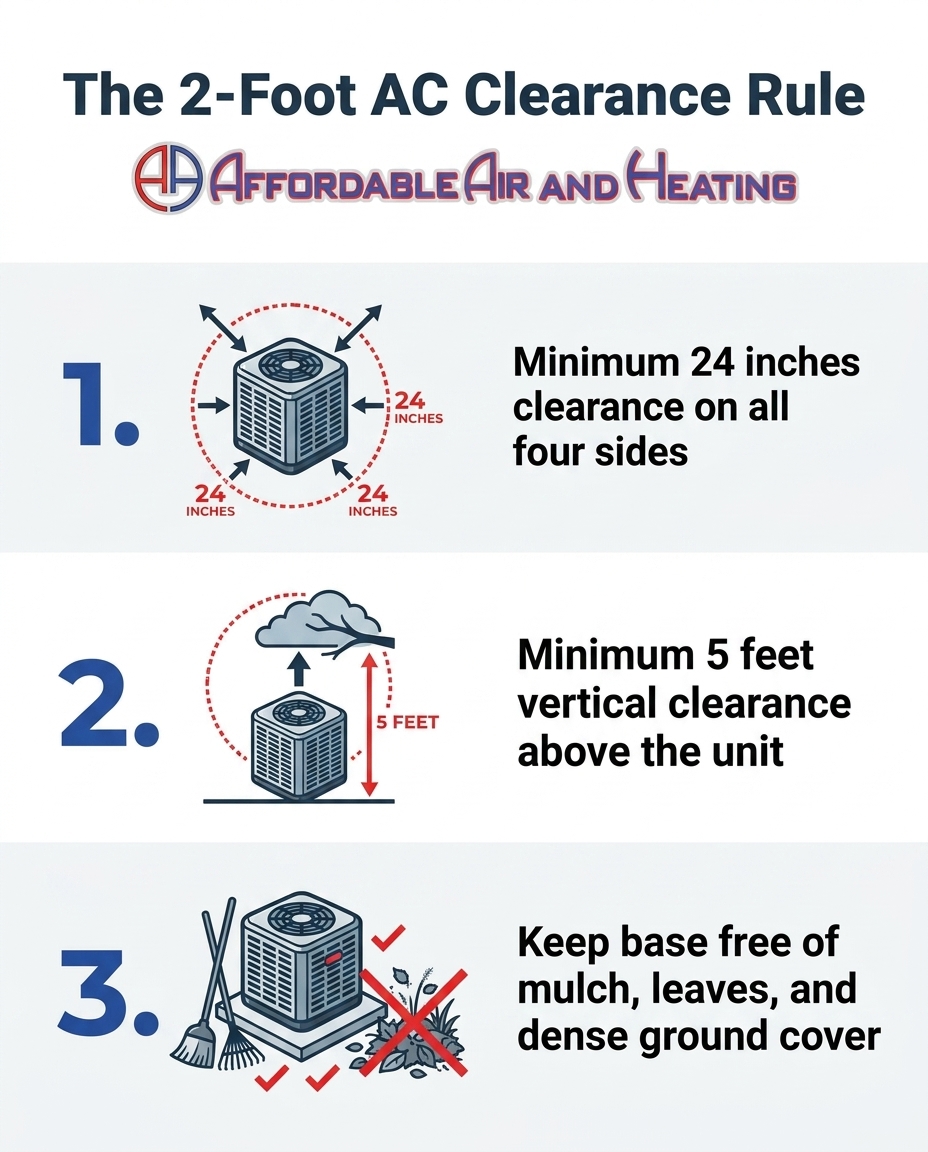
This universal standard dictates that you must maintain at least 24 inches of completely clear space on all four sides of the outdoor unit. This buffer zone ensures the fan can draw in enough ambient air without fighting against leaves, branches, or fencing.
Vertical clearance is just as critical. You need a minimum of 5 feet of open sky directly above the fan. If low-hanging tree branches or a solid patio roof sit too close to the top of the unit, the upward blast of hot exhaust air hits the barrier and bounces right back down into the intake vents.
Measuring Your Defensible Space
Maintaining this zone requires proactive landscaping. Here is how to keep the perimeter secure:
1. Measure from the metal: Take a tape measure and mark 24 inches outward from the outer casing of the unit. This entire circle must remain empty.
2. Account for rapid growth: Do not trim bushes exactly to the 24-inch line. Trim them back to 36 inches so they have room to grow between your yard maintenance sessions without immediately choking the unit again.
3. Clear the ground: Keep the immediate base free of thick mulch, deep gravel, and dusty ground cover that can easily get sucked into the lower fins.
Drought-Tolerant Landscaping: Beautiful for Yards, Dangerous for Equipment
Water-conscious landscaping is incredibly popular and practical in our area, but our installation teams frequently notice that the specific plants chosen often clash directly with HVAC requirements. Drought-tolerant privacy bushes like oleander, juniper, and certain fast-growing sages are excellent for property lines, but they are disastrous when planted next to a condenser.
These plants grow rapidly in the spring and create dense, impenetrable walls of foliage. By the time the August late-summer peak heat hits, they have often swallowed the outdoor unit entirely. Furthermore, the dusty conditions of the high desert lead to the rapid accumulation of debris on condenser coils when ground cover is too sparse or plants shed dry leaves constantly.
A common scenario in the Lancaster area is an air conditioner that isn't blowing cool air because the outdoor unit is completely encased in overgrown dry brush. Once the blockage is cleared and the system is reset, the air conditioner often works perfectly again. The equipment isn't broken; it's simply suffocating.
Managing Late-Summer Debris
Even if you don't have large bushes, late-summer yard debris poses a massive threat. Dry leaves, loose twigs, and airborne dust easily get sucked against the metal fins by the powerful pull of the condenser fan.
• The danger of dry leaves: When leaves plaster themselves against the intake vents, they act like a blanket, instantly insulating the coils and trapping heat inside.
• The August audit: Late summer requires a dedicated landscaping audit. Walk around your unit and pull away any tumbleweeds, dry grass clippings, or shedding leaves that have gathered at the base.
• Safe shading vs. dangerous obstruction: A tall tree providing high-canopy shade 15 feet away is beneficial. A dense shrub planted two feet away to "hide the ugly AC unit" is a mechanical hazard.
The Mechanical Consequences of an Air-Starved System
Allowing landscaping to choke your system does not just result in a warmer house; it causes severe internal damage that drastically shortens the lifespan of the equipment. When airflow is restricted, the compressor—the expensive heart of your cooling system—is forced to run longer and hotter to achieve the same temperature drop.
This constant strain leads directly to higher utility bills because the system loses its energy efficiency. More importantly, it causes premature wear and tear on essential electrical components. The fan motor has to work twice as hard to pull air through blocked fins, and the run capacitor degrades rapidly under the intense, trapped heat.
A pattern often seen during the late-summer back-to-school transition is severe overheating. Airflow restrictions from neglected landscaping can cause the equipment to overheat repeatedly, and the thermal strain can burn out a component such as the fan motor. Clearing the perimeter around the unit helps prevent it from happening.
Overheating and Component Failure
Whether you rely on a traditional air conditioner or a heat pump, the mechanical consequences of trapped heat are identical.
• Thermal overload: Compressors have built-in safety switches that shut the system down if it gets too hot. If your AC runs for ten minutes, shuts off abruptly, and blows warm air, it may be tripping its thermal overload sensor due to trapped exhaust.
• Strain on the fan motor: Pulling air through a wall of dense leaves places immense physical drag on the fan blades, eventually burning out the motor's internal windings.
• Voided warranties: Ignoring manufacturer clearance rules can actually void your equipment warranty. If a compressor dies because it was buried in overgrown ivy, the manufacturer will likely deny the replacement claim due to improper maintenance.
Protecting Your System Inside and Out
It is easy to view the outdoor unit as a separate entity from the vents inside your home, but the system functions as one continuous loop. An overworked, air-starved outdoor unit directly degrades the entire system's ability to cool and dehumidify your living spaces.
If the outdoor coils cannot release heat efficiently, the indoor coils cannot absorb heat effectively. This leads to a clammy, uncomfortable indoor environment. Furthermore, when dust and fine debris bypass the outdoor fins because the main airflow paths are blocked, that dirt coats the internal mechanisms. This not only ruins efficiency but can negatively impact your indoor air quality over time as the system struggles to manage humidity.
It is crucial to differentiate between DIY landscaping maintenance and professional mechanical maintenance. Trimming the bushes back to maintain a two-foot minimum clearance is a job every homeowner should handle regularly. However, if your unit has been running while choked by debris for months, the delicate aluminum fins are likely packed with deep-seated dirt. Cleaning those coils requires professional chemical treatments and calibrated water pressure. Using a high-pressure garden hose on the coils yourself can bend the fins flat, causing permanent airflow restriction.
Frequently Asked Questions About AC Clearance and Landscaping
How far should plants be from an AC unit?
You must maintain at least 24 inches of clearance on all sides of the outdoor unit. This two-foot perimeter ensures the fan can pull in enough fresh air to cool the internal components. Additionally, you need at least five feet of vertical clearance above the unit so hot exhaust air can escape without bouncing off low-hanging branches.
Why does my AC need clearance?
Your AC needs clearance to allow sufficient airflow for the condenser coils to reject heat efficiently. The system cools your home by moving indoor heat outside, and if the outdoor unit cannot breathe, that heat stays trapped inside the equipment. Restricted airflow forces the compressor to work harder, leading to higher energy bills and premature breakdowns.
Can bushes cause my AC to overheat?
Yes, dense bushes block the intake of ambient air, trapping heat and causing the compressor to overheat. When plants grow too close to the metal vents, the system ends up recycling its own hot exhaust air instead of pulling in fresh air. This thermal loop causes internal pressures to spike, eventually triggering the system's safety shutoff switches.
Can I put a fence around my AC unit?
Yes, but it must be louvered or slatted to allow airflow, and built outside the two-foot minimum clearance zone. A solid wooden fence or brick wall placed too close will suffocate the system just as badly as dense shrubs. Always ensure any decorative enclosure has wide gaps to allow steady cross-ventilation.
Should an AC condenser be in the sun or shade?
While shade can marginally help reduce the ambient temperature around the unit, natural airflow is far more important; never sacrifice clearance for shade. Planting a tree close to the unit just to keep the sun off it usually causes more harm than good due to shedding leaves and blocked wind. If you want to provide shade, use a high-canopy tree planted well away from the equipment.
How often should I trim the landscaping around my outdoor unit?
Check the area monthly during the peak growing season and trim as soon as vegetation enters the two-foot zone. Fast-growing drought-tolerant plants can easily bridge a two-foot gap in a matter of weeks during the spring and summer. Staying proactive prevents the foliage from ever touching the metal casing.
Ensure Peak Performance Before the Next Heatwave
The connection between trimmed landscaping and optimal cooling is undeniable. When you maintain a strict two-foot perimeter around your outdoor equipment, you allow the system to breathe, reject heat efficiently, and keep your utility bills under control. Especially as we face the brutal August late-summer peak heat, your air conditioner needs every mechanical advantage it can get to keep your home comfortable.
Take ten minutes today to walk outside with a pair of pruning shears and clear the defensible space around your condenser. If you notice that the unit has been running choked by dust, debris, or overgrown bushes for most of the season, a simple trim might not be enough. Reach out to the team at Affordable Air and Heating to schedule a professional inspection and coil cleaning. We will undo the strain, ensure your system is running at peak capacity, and give you the clear, actionable guidelines you need to protect your investment for years to come.