Does Shade on the Outdoor Unit Improve Efficiency in Hot Desert Climates?
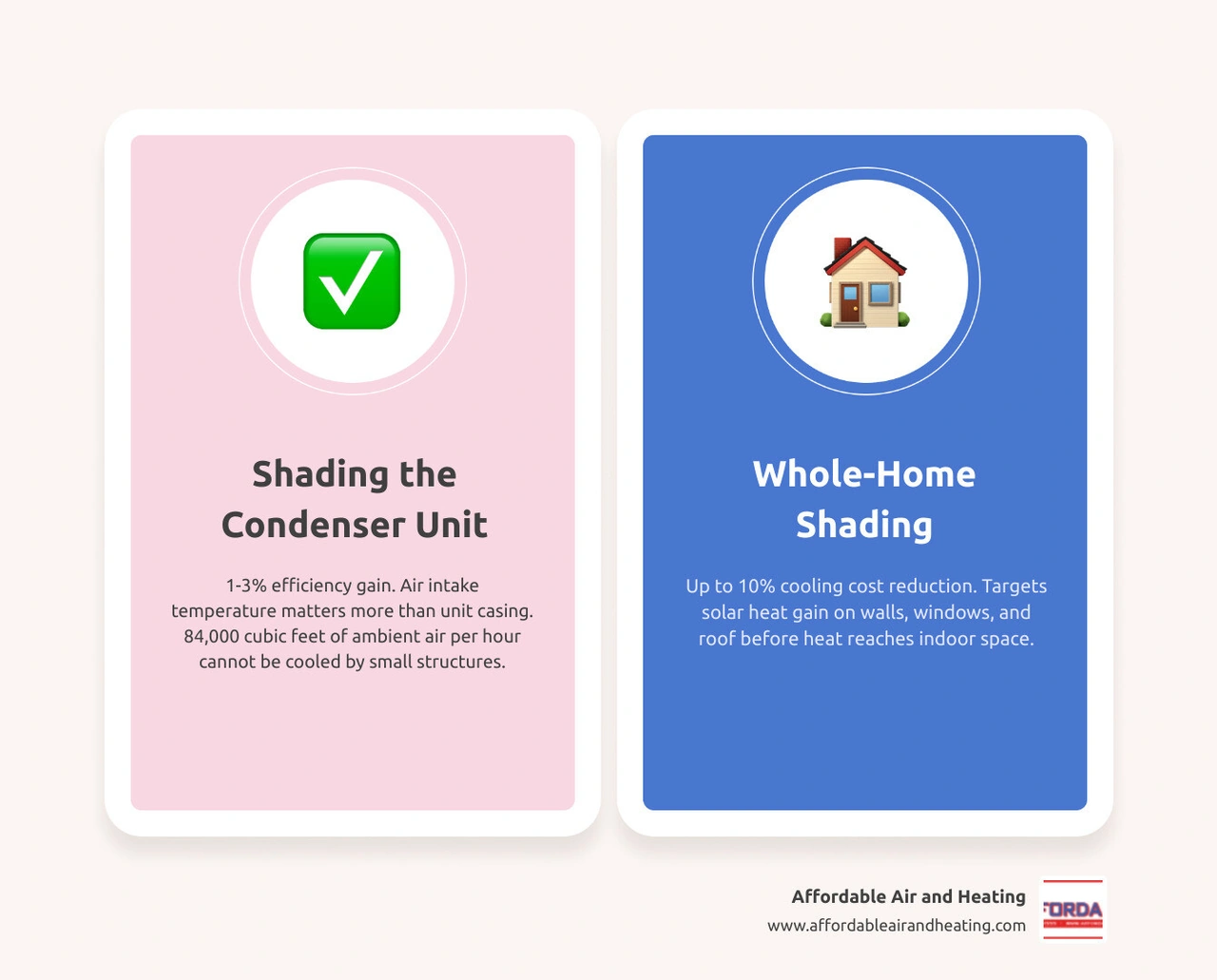
Does shade on the outdoor unit improve efficiency in hot desert climates — and is it worth the effort? The short answer is: yes, but only slightly. Research consistently shows the efficiency gain from shading the condenser unit itself is modest, typically falling between 1% and 3%. For Antelope Valley homeowners dealing with brutal summer temperatures, that number may feel disappointing — especially when energy bills are already through the roof.
Here is a quick breakdown of what the research actually says:
- 1–3% efficiency gain from shading the condenser unit directly (Florida Solar Energy Center, 1996)
- Up to 1% improvement found in a Kuwait Institute for Scientific Research study
- Less than 5% increase expected in most residential applications
- Up to 10% reduction in cooling costs is possible — but only when shading strategies target the whole home, not just the unit
- Airflow restriction from poorly placed shade structures can actually reduce efficiency more than direct sun exposure causes
The bigger picture? Shading the condenser unit is not the efficiency breakthrough many homeowners hope for. The air temperature flowing into the unit matters far more than whether the unit casing itself is in the sun. And since a typical 3-ton AC condenser moves around 84,000 cubic feet of air per hour, no small shade structure can meaningfully cool that volume of ambient air.
That said, shade still plays a real role in desert climates — it just needs to be applied in the right places and the right way. Understanding the difference between shading the unit and shading your home is where the real savings begin.
Essential does shade on the outdoor unit improve efficiency in hot desert climates terms:
- why is my electric bill so high in an antelope valley summer
- best thermostat settings to save money during an antelope valley summer
- ac bill spikes in summer
Living in places like Palmdale, Lancaster, or Rosamond means pushing your cooling system to its absolute absolute limits. When the high desert sun beats down, it is completely natural to look for any DIY trick to give your system a helping hand. However, to understand why localized shading does not yield massive savings, we have to look at the unique mechanics of how your system interacts with the local environment. For a deeper look at these regional challenges, check out our guide on How the Antelope Valley Desert Climate Affects Your AC System.
Why Direct Sun Has Minimal Impact on Condenser Efficiency
To understand why direct sunlight does not completely destroy your air conditioner's efficiency, we have to look at the difference between the temperature of the unit's metal casing and the temperature of the air entering the system.
When your AC is running, the outdoor condenser unit has one primary job: to dump the heat collected from inside your home out into the surrounding air. This heat rejection process relies on a thermodynamic gradient. The greater the temperature difference between the hot refrigerant circulating inside the condenser coils and the outdoor air being pulled through those coils, the easier it is for the system to dump that heat.
Direct sunlight absolutely heats up the metal casing (the chassis) of your AC unit. It can make the metal too hot to touch. However, the heat transfer that cools your home does not happen through the metal cabinet; it happens via the air being pulled across the internal coils. Because the air is moving through the unit at such an incredibly high velocity, it does not spend enough time inside the cabinet to absorb heat from the sun-warmed metal casing.
In other words, the temperature of the incoming ambient air matters infinitely more than the temperature of the unit casing. While direct sun does add a small amount of extra thermal load to the cabinet, it is a drop in the bucket compared to the massive heat exchange occurring inside. To learn more about how extreme temperatures and environmental wear affect your system over time, read about Does Extreme Heat and Desert Dust Shorten AC Life Expectancy.
Airflow Volume vs. Localized Shading
The physical reason localized shading structures fail to make a major dent in your energy bills comes down to pure volume. Your air conditioner is an atmospheric wind machine.
A typical 3-ton residential AC condenser moves roughly 2,800 cubic feet of air per minute (CFM). If your system runs for a combined 30 minutes out of every hour during a hot afternoon in Santa Clarita or Castaic, it processes approximately 84,000 cubic feet of air in that single hour. If it runs continuously during peak 105°F heat, that volume jumps to a staggering 168,000 cubic feet of air per hour.
Think of that volume like a giant, invisible river of air flowing through your backyard. Building a small wooden awning or hanging a canvas shade sail directly over the unit does nothing to cool down that massive, fast-moving river. The air entering the sides of the condenser is pulled from the wider backyard microclimate. Unless you can cool down the entire microclimate of your yard, the air entering the unit will remain at the ambient outdoor temperature, regardless of whether a shadow is cast over the top of the metal box.
When the local temperature climbs, trying to cool down the air directly around the unit with a small shade structure is like trying to cool down a bonfire with an ice cube. If your system is struggling to keep up with these massive air-processing demands, you may want to read our article on why you have an AC Running Constantly in Desert Heat.
The Risks of Improper Shading: When Shade Reduces Efficiency
While building a DIY cover or canopy over your AC unit seems like a harmless weekend project, it is actually one of the easiest ways to accidentally destroy your system's efficiency and drive up your utility bills.

The greatest threat to your air conditioner's performance is not the sun — it is restricted airflow. Your condenser operates by pulling air in through the grated sides, drawing it across the cooling coils, and blasting the super-heated exhaust air straight out of the top fan. If you build a solid structure, a low-hanging roof, or a dense enclosure around the unit, you risk trapping that hot exhaust air.
When hot air cannot escape freely, it pools under the shade structure and is drawn back down into the side intakes. This phenomenon is known as "hot air recirculation" or "short-circuiting." Instead of cooling the coils with 100°F outdoor air, your unit begins pulling in its own 120°F exhaust air. This forces the compressor to work twice as hard, sky-rockets your energy consumption, and can cause the system to overheat and shut down entirely.
To prevent this, you must strictly follow manufacturer clearance guidelines:
- Side Clearance: Maintain a minimum of 24 inches (2 feet) of completely unobstructed space on all sides of the unit to allow adequate intake airflow.
- Top Clearance: Maintain a minimum of 60 inches (5 feet) of clear, open space directly above the top of the unit to allow the hot exhaust to escape vertically.
For homes in windy desert areas like Lancaster and Quartz Hill, keeping these clearances free of wind-blown debris is just as critical as the structure itself. You can find practical advice on managing these local elements in our guide on How to Protect Your Outdoor AC Unit from Antelope Valley Wind and Dust.
Does Shade on the Outdoor Unit Improve Efficiency in Hot Desert Climates Without Restricting Airflow?
Is it possible to shade your AC unit safely and see that modest 1% to 3% efficiency bump? Yes, but only if you design the shade structure with maximum ventilation in mind.
If you are going to build or install a shade structure, it must be positioned high enough and wide enough that it acts solely as a sun block, not an air barrier. The structure should never fully enclose the unit. Using highly breathable materials, like a high-density polyethylene (HDPE) shade sail or a widely spaced wooden trellis, allows wind to pass through freely, preventing hot air from becoming trapped.
Additionally, keeping the coils clean is far more important for maintaining proper airflow and heat transfer than any shade structure will ever be. In our sandy desert climate, dust acts as an insulating blanket on your coils, forcing the unit to work harder. Learn more about this by reading How Desert Dust Affects Mini Split Filter and Coil Performance.
Effective Shading Strategies and Structures for Desert Climates
If you decide to move forward with shading your outdoor AC unit, choosing the right structure and materials is critical to withstand the intense UV rays and high winds of the high desert. Below is a comparison of the most common shade options:
| Shade Structure Type | Wind Resistance | UV Durability | Airflow Safety | Best Use Case |
|---|---|---|---|---|
| Alumawood / Metal Awning | Excellent | Excellent | Good (if mounted high) | Mounted to home wall at least 5 feet above the unit |
| Wooden Trellis / Lattice | Moderate | Good (requires sealant) | Excellent | Placed on the west/south sides with 24-inch clearance |
| High-Quality Shade Sail | Poor (unless taken down in high winds) | Moderate (degrades over years) | Excellent | Anchored high above the unit to block late afternoon sun |
| Deciduous Trees / Large Shrubs | Good | Natural | Excellent (if kept pruned) | Planted at least 10 feet away to prevent leaf debris |
When selecting materials for locations like Rosamond or Acton, cheap plastics and fabrics will rapidly degrade under intense desert UV exposure. Furthermore, always check with local building codes or your Homeowners Association (HOA) before constructing permanent structures, as some areas have strict guidelines regarding visible utility covers or setbacks.
While optimizing your outdoor unit's environment is helpful, it is important to remember that indoor thermal dynamics play a much larger role in how hard your system has to work. If your home has poor thermal boundaries, your AC will run constantly regardless of what is happening outside. Read more on this in our article How Poor Insulation Makes Your AC Run Constantly in Hot Inland Climates.
Does Shade on the Outdoor Unit Improve Efficiency in Hot Desert Climates Better Than Whole-Home Shading?
If you want to see a double-digit reduction in your summer cooling costs, you should redirect your efforts from shading the AC unit to shading your actual home.
Strategic home shading can lower indoor temperatures and reduce your overall cooling load by up to 20% to 25%. This is because shading your home prevents solar heat gain from entering through your windows and radiating through your walls.
The most effective home shading strategies include:
- Planting deciduous trees on the south and west sides of your home to block intense afternoon sun.
- Installing exterior window awnings or solar screens to block heat before it ever touches your window glass.
- Creating a shaded microclimate around your home using drought-tolerant landscaping, which naturally cools the surrounding air through evapotranspiration.
Preventing heat from entering your living space in the first place is always more efficient than trying to remove it after it is already inside. Of course, keeping your system running at peak performance also requires keeping up with mechanical repairs. Learn more about maintaining system health with our article on AC Efficiency with Timely Repair.
Frequently Asked Questions About AC Shading
Does shading the AC unit extend its lifespan or reduce maintenance needs?
Yes, but not primarily because of temperature reductions. The real benefit of shading your outdoor unit is protecting it from intense UV radiation and physical weathering.
The harsh desert sun breaks down plastic wire wraps, degrades the rubber insulation on your refrigerant lines, and can cause the paint and protective coatings on your unit to peel over time. By blocking direct sunlight, you can prevent this material degradation and keep your outdoor components intact longer.
However, shade cannot replace regular, professional upkeep. To ensure your system survives the summer heat, read about the Benefits of Routine AC Service.
What is the best side of the house to install an outdoor AC unit?
If you are installing a new system or relocating an old one, the ideal location for your outdoor condenser is on the north side of your home. The north side receives the most natural, consistent shadow throughout the day, keeping the unit out of direct sunlight without the need for artificial structures.
If the north side is not an option, the east side is the second-best choice. An east-facing unit will receive morning sun when temperatures are still cool, and will be naturally shaded by your home’s structure during the brutal afternoon heat when the system has to work the hardest. Avoid west and south installations whenever possible. For more insights on seasonal system placement and care, check out our guide on the Importance of Seasonal AC Maintenance.
Can planting shrubs around the condenser improve efficiency?
You can plant shrubs near your unit, but you must do so with extreme caution. On the positive side, living plants release moisture into the air through evapotranspiration, which can slightly lower the local air temperature around the condenser.
On the negative side, plants drop leaves, twigs, and sap, which can quickly clog your condenser coils and restrict airflow. If you plant shrubs, ensure they are drought-tolerant, low-shedding varieties, and keep them planted at least 3 to 4 feet away from the unit. Regular pruning is required to maintain the necessary 24-inch clearance. To keep your system running smoothly year-round, consult our guide on How Often Should You Service Your Air Conditioner in a Desert Climate.
Conclusion
When it comes to keeping your home cool in the unforgiving desert heat, shading your outdoor AC unit can provide a minor efficiency boost of 1% to 3% — but only if it is done correctly. An improper shade structure that blocks airflow or traps hot exhaust air will quickly do more harm than good, leading to higher energy bills and potential system breakdowns.
Instead of relying on DIY shading tricks, the most reliable way to lower your cooling bills and protect your equipment is through professional system design, proper home insulation, and regular maintenance. At Affordable Air and Heating, we have been helping families across the Antelope Valley stay comfortable since 1996. As a family-owned business, we pride ourselves on offering energy-efficient solutions, honest advice, and flexible financing options tailored to our local desert climate.
Whether you need a seasonal tune-up, a system repair, or a complete high-efficiency system upgrade, our team is here to help. Schedule professional AC services today and let us keep your home comfortable all summer long!