What Is Included in a Professional AC Tune-Up (Quick Answer)
What is included in a professional AC tune-up goes far beyond swapping out a filter — and if you're a homeowner in the Antelope Valley, knowing exactly what you're paying for can mean the difference between a system that lasts 20 years and one that gives out in 10.
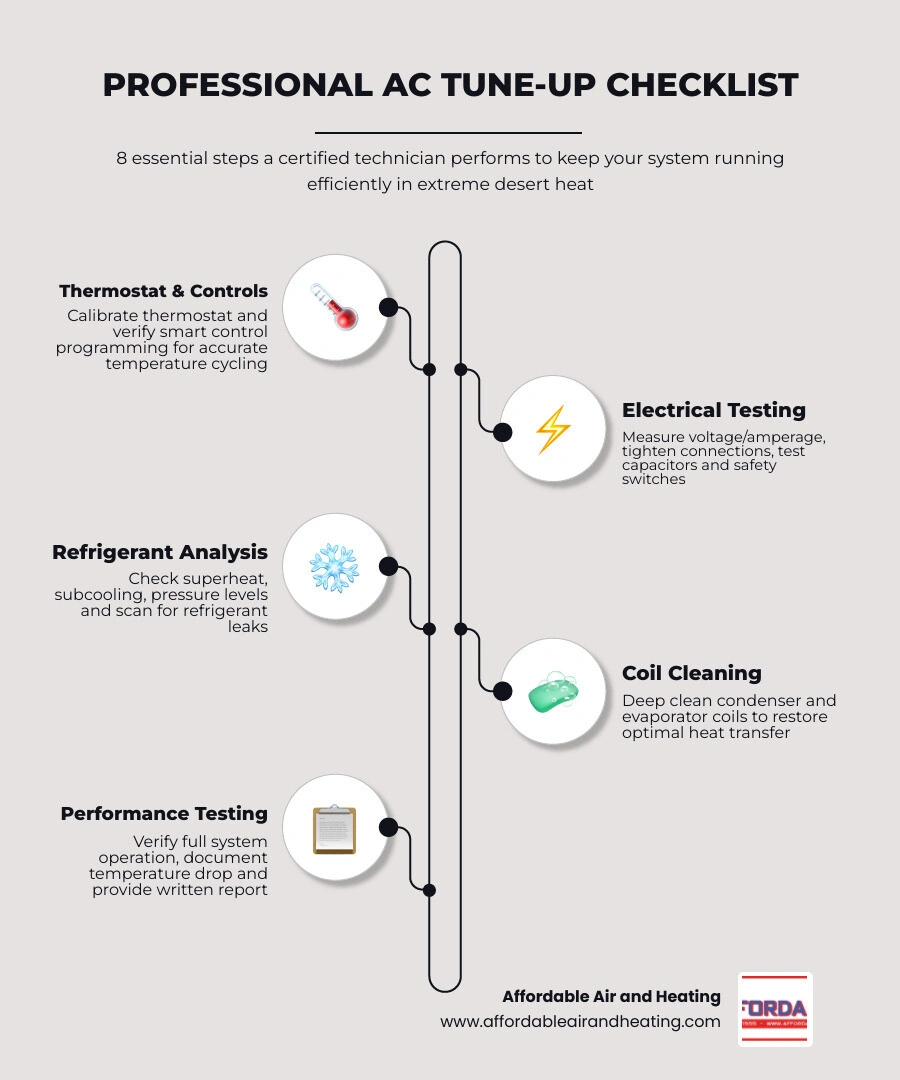
Here's a quick look at the 8 core items a certified technician should cover during a professional AC tune-up:
- Thermostat calibration and smart controls verification
- Electrical connections and safety controls testing
- Refrigerant level and pressure analysis
- Condenser and evaporator coil deep cleaning
- Condensate drain line clearing and inspection
- Mechanical components lubrication and inspection
- Airflow verification and ductwork visual inspection
- Comprehensive system performance testing and documentation
Most tune-ups take between 60 and 90 minutes when performed by a qualified technician. A quick 20-minute visit that only includes a visual once-over is not a professional tune-up — and in the desert heat of the Antelope Valley, that distinction matters.
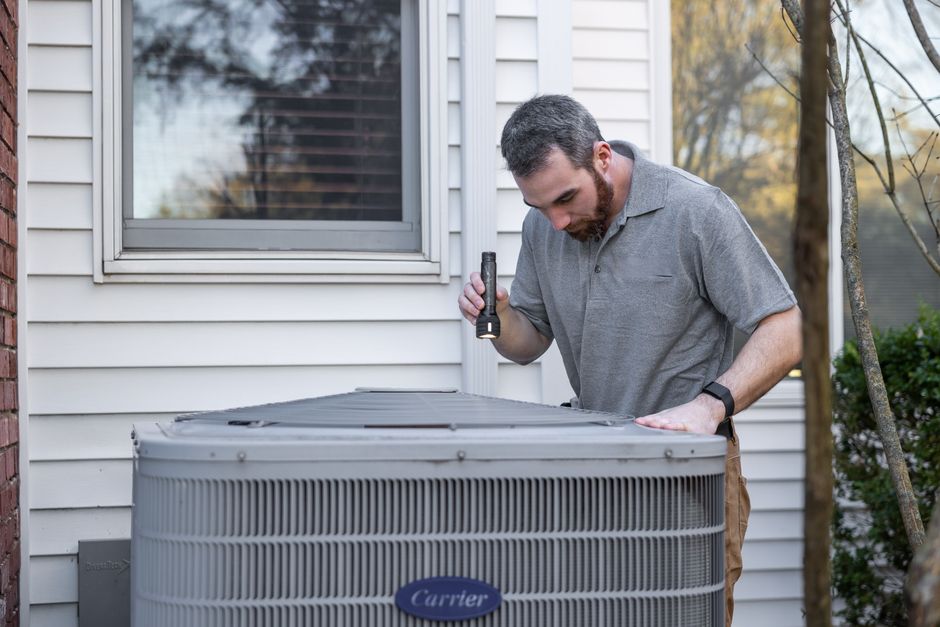
Think of it like a physical exam for your AC. Your doctor doesn't just check one thing and send you home. A real tune-up is a full system checkup — cleaning, testing, measuring, and documenting — so small problems get caught before they turn into expensive repairs or a full system failure on the hottest day of the year.
What Is Included in a Professional AC Tune-Up vs. Basic DIY Maintenance?
Many homeowners wonder if they can handle their cooling maintenance themselves. While we always encourage hands-on home care for the simple things, there is a massive difference between what you can safely do at home and what a professional technician brings to the table.
To help visualize this, let’s look at how DIY upkeep stacks up against a professional, multi-point inspection:
| Maintenance Task | DIY Homeowner Capable? | Professional Service Scope |
|---|---|---|
| Air Filter Replacement | Yes (Recommended every 30-90 days) | Evaluated for fit, airflow restriction, and MERV rating compatibility. |
| Refrigerant Level Check | No (Requires EPA certification) | Measured using subcooling and superheat formulas to detect microscopic leaks. |
| Electrical Safety Testing | No (High-voltage hazard) | Amperage and voltage testing, capacitor capacitance reading, and terminal tightening. |
| Coil Deep Cleaning | No (Delicate fins easily damaged) | Chemical wash of outdoor condenser coils and indoor evaporator coil inspection. |
| Condensate Line Clearing | Partial (Can clear basic surface debris) | High-pressure clearing, drain pan disinfection, and safety float switch testing. |
| Thermostat Calibration | No (Requires diagnostic tools) | Verification of temperature offset, cycling rates, and smart home communication. |
The biggest takeaway here is that DIY maintenance is primarily preservative, while professional maintenance is diagnostic. Changing your air filter is incredibly important — in fact, we have put together some Essential AC Maintenance Tips to help you keep your system breathing easy between our visits. However, a filter swap cannot tell you if your compressor's start capacitor is on the verge of dying or if you have a slow refrigerant leak that will cause the system to freeze up when the July heat hits Lancaster or Palmdale.
When our professional team performs a tune-up, we aren't just looking to see if the system turns on. We are looking at the overall health of the machinery to optimize its energy efficiency, protect your manufacturer warranty, and prevent catastrophic failures before they happen.
The 8-Item Professional AC Tune-Up Checklist
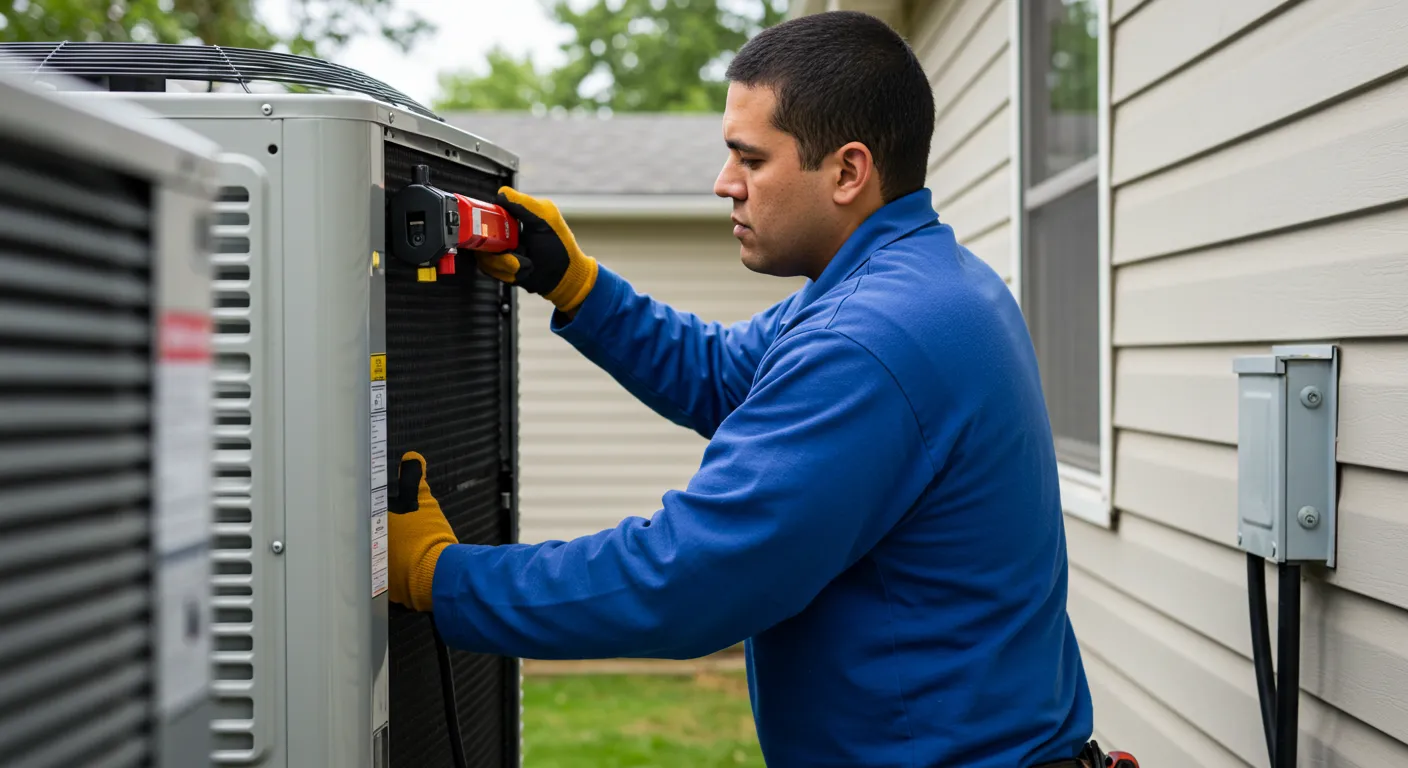
When you schedule seasonal service, you should always know exactly what to expect. A comprehensive, professional visit is highly systematic. Every step is designed to build upon the last, ensuring that no wire is left loose and no speck of desert dust is left to insulate your system's vital components. If you are preparing for your first maintenance visit of the year, you can read more about what happens during our appointments in our guide on AC Service: What to Expect.
Let's dive deep into the eight core items that make up a truly professional AC tune-up.
1. Thermostat Calibration and Smart Controls Verification
Your thermostat is the brain of your entire heating and cooling system. If the brain isn't communicating accurately with the body, you end up with comfort issues, high energy bills, and unnecessary wear and tear.
During this step of the tune-up, we:
- Verify Temperature Accuracy: We use highly sensitive digital thermometers to measure the actual temperature in your home and compare it to what your thermostat reads. If it is off by even a couple of degrees, your system will run longer than it needs to or shut down before your home is truly comfortable.
- Test System Cycling: We monitor how the system starts up, runs, and shuts down to ensure it isn't "short-cycling" (turning on and off too rapidly), which is incredibly tough on your compressor.
- Check Smart Thermostat Settings: If you have upgraded to a smart or programmable thermostat, we verify that the Wi-Fi connection is stable, the firmware is updated, and the schedule is optimized for your daily routine.
2. Electrical Connections and Safety Controls Testing
Air conditioners run on high-voltage electricity. Over time, the constant vibration of the system running can cause electrical connections to loosen. Loose connections lead to increased electrical resistance, which causes wires to overheat, components to burn out, and can even pose a fire hazard.
To prevent this, our technicians perform the following electrical checks:
- Measure Voltage and Amperage: We test the voltage and amperage draw on your compressor, outdoor fan motor, and indoor blower motor. If these motors are drawing too many amps, it is a clear warning sign that they are working too hard and are nearing the end of their lifespan.
- Tighten Electrical Terminals: We inspect and tighten all electrical connections and wire harnesses to ensure clean, safe power delivery.
- Test Capacitors: The capacitor is like a temporary battery that gives your motors the extra push they need to start up. Failing capacitors are one of the most common causes of summer AC breakdowns. We measure their capacitance (measured in microfarads) to ensure they are within the manufacturer's safe operating limits.
- Inspect the Contactor: The contactor is the switch that controls power to the compressor and outdoor fan. We inspect it for "pitting" or burn marks, which can cause the contacts to stick and run your system continuously.
- Verify Safety Controls: We test safety switches, such as high-pressure limit switches and condensation overflow switches, to ensure your system will automatically shut down safely if a major issue occurs.
3. Refrigerant Level and Pressure Analysis
Refrigerant is the lifeblood of your air conditioner. It is the chemical compound that actually absorbs the heat from inside your home and carries it outside. A common myth is that air conditioners "use up" refrigerant over time. In reality, your AC is a closed system — if your refrigerant is low, it means you have a leak.
During a professional tune-up, we:
- Measure Pressures and Temperatures: We connect specialized manifold gauges to measure the exact pressure of the refrigerant. We calculate superheat and subcooling to determine if the system is charged exactly to the manufacturer's specifications.
- Analyze System Efficiency: If the refrigerant charge is off by even 10%, your system's efficiency can drop by up to 20%, resulting in higher utility bills and weaker cooling.
- Check for Leaks: If we detect low pressures, we don't just "top it off." Federal environmental laws prohibit adding refrigerant to a leaking system without performing leak detection. We use electronic leak detectors to locate the source of the leak so it can be properly repaired.
4. Condenser and Evaporator Coil Deep Cleaning
Your air conditioner doesn't actually create "cold." Instead, it removes heat from your indoor air. This heat exchange happens at the coils: the indoor evaporator coil absorbs the heat, and the outdoor condenser coil releases it.
Because the outdoor unit is exposed to the elements, it acts like a giant vacuum cleaner, sucking in dirt, leaves, pollen, and our famous Antelope Valley dust. When a layer of grime builds up on these coils, it acts as an insulating blanket, preventing the heat from escaping.
Our deep cleaning process includes:
- Applying Commercial Coil Cleaner: We use specialized, self-rinsing chemical cleaners to break down baked-on dirt and grease without damaging the delicate aluminum fins.
- Rinsing the Coils: We gently wash away the dirt and cleaning agents using low-pressure water to avoid bending the fins.
- Fin Straightening: If any of the aluminum fins on the outdoor unit have been bent by wind, debris, or accidental bumps, we use a specialized "fin comb" to carefully straighten them, restoring optimal airflow.
- Evaporator Coil Inspection: We inspect the indoor evaporator coil for dust accumulation or microbial growth. Because this coil is cold and damp, keeping it clean is vital for both heat transfer and your home's indoor air quality.
5. Condensate Drain Line Clearing and Inspection
As your AC cools your home, it also dehumidifies the air. The moisture that condenses on the cold evaporator coil drips down into a drain pan and flows out of your home through a condensate drain line.
Because this line is constantly wet, it is the perfect breeding ground for algae, mold, and sludge. If the drain line becomes clogged, the water has nowhere to go. It will back up, overflow the drain pan, and can cause thousands of dollars in water damage to your ceilings, walls, and floors. In fact, a clogged condensate drain is the number one cause of water damage associated with residential cooling systems!
To keep your home safe, we:
- Flush and Clear the Line: We use pressurized air or specialized vacuums to clear out any algae or debris buildup from the drain line.
- Inspect the Drain Pan: We check the primary and secondary drain pans for cracks, rust, or standing water.
- Test the Float Switch: We test the emergency safety float switch. If the drain ever does clog, this switch will instantly shut down your AC before a single drop of water overflows onto your drywall.
6. Mechanical Components Lubrication and Inspection
An air conditioner is made of many moving parts that experience constant friction during our long, hot summers. Without proper lubrication and inspection, these parts will wear down prematurely, leading to loud squealing noises, overheating, and mechanical failure.
During this phase of the tune-up, we:
- Lubricate Bearings and Motors: While many modern motors are permanently sealed, older systems have lubrication ports that require regular drops of high-quality oil to keep them spinning smoothly.
- Inspect Blower Assembly: We check the blower motor and blower wheel for dirt buildup. A dirty blower wheel cannot move air efficiently and can become unbalanced, causing vibrations that damage the motor bearings.
- Check Fan Blades: We inspect both the indoor blower fan and the outdoor condenser fan blades for cracks, balance issues, or wobble.
- Evaluate Belt Tension: If your system utilizes a belt-driven blower motor, we inspect the belt for cracking, fraying, and proper tension, adjusting or recommending replacement as needed.
7. Airflow Verification and Ductwork Visual Inspection
You could have the most powerful, brand-new air conditioner on the market, but if the cool air can't travel through your home efficiently, you won't feel comfortable. Airflow is just as important as the refrigeration process itself.
We verify your airflow by:
- Measuring Static Pressure: We measure the resistance to airflow within your ductwork. High static pressure means your system is working too hard to push air, which strains the blower motor and drives up energy use.
- Checking Vent Temperatures: We measure the temperature drop across the evaporator coil. Ideally, the air coming out of your supply vents should be 15 to 20 degrees cooler than the air entering your return vents.
- Visual Ductwork Inspection: We perform a visual check of your accessible ductwork. According to ENERGY STAR, the average home loses 20 to 30 percent of its conditioned air through leaks, holes, and poorly connected ducts. We look for loose joints, tears in flexible ducting, and fallen insulation that could be letting your expensive cool air escape into your attic or crawlspace.
8. Comprehensive System Performance Testing and Documentation
Once all the individual components have been cleaned, tightened, and tested, it is time to put the entire system through its paces. We run a complete operational cycle to ensure everything works together in perfect harmony.
At the end of your professional tune-up, we don't just pack up our tools and leave. We provide you with a comprehensive, written report detailing:
- All System Measurements: Including voltage, amp draws, capacitor readings, and refrigerant pressures.
- Current System Health: An honest assessment of your system’s condition.
- Technician Recommendations: If we spotted a component that is starting to fail (like a weakened capacitor), we will document it and explain your options. This allows you to make a planned, stress-free repair on your own schedule, rather than dealing with an emergency breakdown on a 105-degree afternoon.
Why Seasonal Maintenance Matters in the Antelope Valley
Living in places like Palmdale, Lancaster, Quartz Hill, or Rosamond means dealing with a unique and demanding climate. Our summers aren't just warm — they are punishingly hot, dry, and incredibly dusty. This high-desert environment puts an immense amount of strain on residential cooling systems.
When temperatures routinely climb past 100 degrees, your air conditioner has to work twice as hard to keep your indoor spaces liveable. This makes the Importance of Seasonal AC Maintenance absolutely paramount for local homeowners. Skipping your annual checkup in our climate is a recipe for high energy bills and early system replacement. If you live in the heart of the valley, scheduling regular AC Maintenance Palmdale CA is your best line of defense against summer breakdowns.
Understanding What Is Included in a Professional AC Tune-Up for Local Climates
In our high-desert climate, dust is one of the biggest threats to your comfort system. Fine desert sand easily penetrates outdoor units, coating condenser coils and finding its way into electrical contactors. This dust acts as an insulator, forcing your compressor to run hotter and use more electricity.
When we perform AC Maintenance Rosamond CA or service homes in Acton and Lake Hughes, we pay special attention to clearing away this fine desert sediment. By thoroughly washing the coils and cleaning out electrical cabinets, we protect your system from the unique environmental hazards of our beautiful, dusty region.
How Regular Service Helps Boost Your AC's Lifespan
An air conditioner is a major financial investment for any household. While a neglected system in our harsh climate might only survive 10 to 12 years before a major component like the compressor fails, a well-maintained system can easily last 15 to 20 years.
Routine professional tune-ups drastically reduce the wear and tear on your equipment. Catching a failing capacitor early prevents it from damaging your expensive compressor. Keeping the coils clean prevents the motor from overheating. By investing in regular preventative care, you can successfully Boost Your AC's Lifespan and enjoy the long-term Benefits of Regular AC Maintenance for years to come.
Frequently Asked Questions About AC Maintenance
What is included in a professional AC tune-up compared to a simple recharge?
A professional AC tune-up is a comprehensive, multi-point health check and cleaning of your entire cooling system. It includes electrical testing, safety checks, coil cleaning, drain line flushing, and overall system optimization.
A "refrigerant recharge" is simply adding more chemical coolant to your system. Legally and mechanically, a recharge should never be done without first finding and repairing the leak, as air conditioners do not consume refrigerant. A simple recharge ignores dirty coils, loose electrical connections, and failing motors, leaving your system vulnerable to major breakdowns.
How often should I schedule a professional cooling system tune-up?
We strongly recommend scheduling a professional AC tune-up once per year, ideally in the early spring before the intense summer heat sets in. This ensures your system is clean, safe, and running at peak efficiency before you rely on it daily.
For heat pumps or systems that provide both heating and cooling year-round, bi-annual maintenance (once in the spring and once in the fall) is highly recommended. Regular visits keep your utility bills low and ensure you enjoy all the Benefits of Routine AC Service.
How long does a professional air conditioner maintenance visit take?
A thorough, professional AC tune-up typically takes between 60 and 90 minutes. The exact timeframe depends on the size of your system, the location of your indoor and outdoor units (such as a tight attic or crawlspace), and when the system was last serviced. If our technician discovers a component that requires repair or replacement, it may take a bit longer to walk you through our findings and perform the necessary work.
Conclusion
When the summer sun beats down on the Antelope Valley, your home should be a cool, relaxing sanctuary. Understanding what is included in a professional ac tune-up empowers you as a homeowner to make smart, proactive decisions for your family's comfort and your household budget.
At Affordable Air and Heating, we have been family-owned and operated since 1996. We are proud to serve our neighbors across the region, including Lancaster, Palmdale, Santa Clarita, Canyon Country, Saugus, Newhall, Stevenson Ranch, Valencia, Castaic, Acton, Rosamond, Quartz Hill, Lake Hughes, Antelope Acres, and Ana Verde. We are committed to providing affordable prices, energy-efficient solutions, and flexible financing options to keep your home comfortable all year long.
If your cooling system is ready for its annual safety check and cleaning, don't wait for a heatwave to find out if it can handle the strain. Schedule your professional AC Maintenance Lancaster CA with our friendly, experienced team today!