The Impact of Blocked Return Vents on Your Furnace's Limit Switch


When Your Furnace Shuts Down Prematurely on a Freezing Night
Experiencing the impact of blocked return vents on your furnace's limit switch usually starts with a sudden, frustrating chill in your home. You hear the thermostat click, the system fires up, and warm air begins to flow—but just a few minutes later, the burners shut down completely while the fan continues to blow cold air. This rapid on-and-off behavior is known as short-cycling, and it is one of the most common reasons homeowners believe their heating system has suffered a catastrophic mechanical failure.
As a team that has spent years working on residential HVAC systems, we know firsthand that when temperatures plummet in the Lancaster CA high desert, a sudden loss of overnight heating is more than just an inconvenience; it is an immediate comfort emergency. The steep drop in nighttime temperatures means your home loses heat rapidly, and a furnace that cannot run for a full cycle will leave you shivering. However, our technicians frequently discover that many of these seemingly urgent breakdown calls are not actually mechanical failures at all. Instead, they are simple airflow starvation issues that trigger your system's internal safety mechanisms. Understanding how your system breathes and protects itself can save you unnecessary stress and help you restore your home's comfort quickly. When you are looking for reliable HVAC services or need professional heating repair, checking your home's airflow first is always the smartest initial step.
How Your Furnace Breathes: The Role of Return Air
To understand why your heating system shuts down prematurely, you first need to understand how it handles air. A residential heating system does not simply create heat out of nothing; it operates on a continuous loop of circulation. It pulls cold air from inside your home, heats it up, and pushes it back out. If any part of this breathing process is restricted, the entire thermal balance of your equipment is thrown off. In our experience servicing the dry climate of the Lancaster CA high desert, maintaining optimal airflow is also a critical component of managing your overall home comfort and efficiency.
Supply vs. Return Vents
Your home is equipped with two distinct types of vents, and knowing the difference is vital for troubleshooting heating issues. Supply vents are the active delivery system. These are typically smaller registers located on your walls, ceilings, or floors that actively blow conditioned, heated air into your living spaces. You can feel the breeze when you place your hand over them.
Return vents, on the other hand, are the intake system. These grilles are usually much larger than supply vents and are typically located on low walls, in hallways, or on the floor. They do not blow air; instead, they passively pull cold air from your rooms back through the ductwork to the equipment. If you hold a piece of tissue paper near a return grille while the system is running, the suction will pull the paper against the metal louvers.
• Primary Function — Supply Vents: Pushes heated air into the room — Return Vents: Pulls cold air back to the furnace
• Size and Appearance — Supply Vents: Smaller registers, often with adjustable louvers — Return Vents: Larger, flat grilles, usually fixed in place
• Typical Location — Supply Vents: Ceilings, high walls, or under windows — Return Vents: Low walls, hallways, stairwells, or floors
• Airflow Sensation — Supply Vents: Active outward breeze you can easily feel — Return Vents: Gentle inward suction pulling air back
Understanding this distinction is crucial because many homeowners unintentionally block their return vents, assuming that as long as the supply vents are open, the room will get warm. In reality, blocking the return vent chokes off the air supply that your equipment desperately needs to function safely. If you have concerns about the quality of the air circulating through these vents, exploring indoor air quality solutions can help you maintain a cleaner, healthier breathing loop.
The Heat Exchanger's Need for Consistent Airflow
At the heart of your heating system lies the heat exchanger. This is a series of metal tubes or coils that get extremely hot during the combustion process. As the return ductwork pulls cold air from your home, the blower motor forces that cold air over the hot exterior of the heat exchanger. The air absorbs the heat, cooling the metal down in the process, and then travels through the supply ducts to warm your rooms.
This process requires a very specific, continuous volume of incoming air. The return air acts as the primary cooling mechanism for the heat exchanger itself. If you restrict the intake air, the heat exchanger cannot shed its heat fast enough. The internal temperature of the equipment will begin to rise rapidly, creating a dangerous situation that the system must immediately address to prevent profound damage.
The Hidden Culprit: Furniture Placement and Airflow Starvation
Mechanical failures certainly happen, but one of the most common triggers for airflow starvation is entirely behavioral. Seasonal changes in how we use our homes often inadvertently cause severe heating problems. We rarely think about our ductwork when decorating, but the placement of everyday household items can completely suffocate a heating system.
When a large object is placed in front of or directly over a return grille, the blower motor has to work significantly harder to pull air through the restricted opening. This creates an immediate physical strain on the motor, but more importantly, it drastically reduces the volume of air that actually reaches the heat exchanger. The result is a system that is starving for air, struggling to breathe, and rapidly overheating.
Preparing for Guests
A pattern we see often is that the most frequent instances of blocked returns happen during November holiday home prep. As homeowners prepare to host family and friends, living spaces are often rearranged to accommodate larger gatherings. This is when our team typically sees airflow issues spike.
• Moving the couch: Pushing a large sofa flush against a wall to open up floor space in the living room often covers a low-wall return grille completely.
• Setting up guest beds: Inflating an air mattress or moving a heavy guest bed over a floor return in a spare bedroom cuts off a massive amount of intake air.
• Laying down rugs: Rolling out a new, festive area rug over a hallway floor grate creates an airtight seal that the blower motor cannot overcome.
• Hanging heavy drapes: Installing thick, floor-length curtains for the winter can easily drape over baseboard return vents, choking off the air supply.
During November holiday home prep, it is incredibly easy to overlook these large, flat grilles when making room for extra seating or decorations. Because the system might have been running perfectly fine just a week prior, homeowners rarely connect the sudden heating failure to the new position of the living room sofa. The equipment is simply reacting to the new, restricted environment it has been forced into.
What is a Furnace Limit Switch and Why Does it Trip?
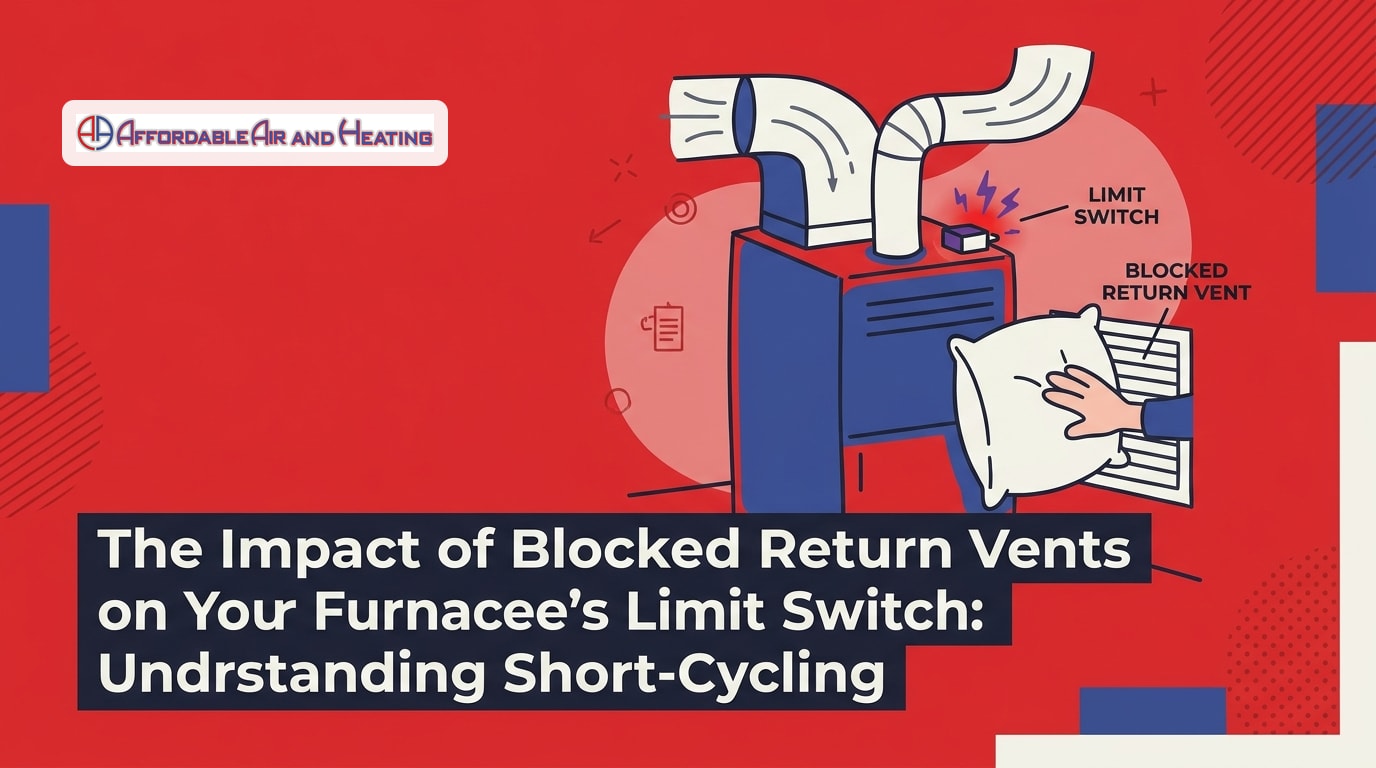
When airflow is choked off and the internal temperature of your heating equipment begins to skyrocket, a critical safety device steps in to prevent disaster. This device is called the high limit switch. Far from being a nuisance, this small component is the primary line of defense protecting your home from severe damage.
The high limit switch is a temperature-sensing probe located just above the heat exchanger in the plenum (the main chamber where air is heated before being distributed). It operates continuously while the burners are active, monitoring the exact temperature of the air surrounding the heat exchanger. If you are dealing with a system that keeps shutting off during the cold nights in the Lancaster CA high desert, our technicians can almost guarantee that this switch is doing exactly what it was engineered to do.
The Safety Mechanism
The limit switch typically features a bimetallic disc that reacts to heat. Under normal operating conditions, with plenty of cool return air flowing over the heat exchanger, the internal temperature remains stable and safe. The switch remains closed, allowing the electrical circuit to power the gas valve and keep the burners firing.
However, if airflow drops because a return vent is blocked, the heat cannot escape the plenum. As the internal temperature spikes rapidly, the bimetallic disc inside the limit switch warps from the intense heat. This physical warping breaks the electrical circuit, instantly shutting off the gas valve and extinguishing the burners. This action is what we refer to as the limit switch "tripping."
Temperature Thresholds
Heating systems are not designed to withstand unlimited heat. Most residential systems have strict safety limits set by the manufacturer to ensure safe operation. The high limit switch is typically calibrated to trip when plenum temperatures reach dangerous levels, usually between 170 and 200 degrees Fahrenheit.
Exceeding these temperature thresholds is incredibly dangerous. If the limit switch did not exist, or if it failed to trip, the metal heat exchanger would continue to absorb heat until it warped, cracked, or completely fractured. A cracked heat exchanger is a fatal diagnosis for a heating system and, more importantly, it allows deadly carbon monoxide gases from the combustion process to leak directly into the air being circulated through your home. Therefore, a tripping limit switch is not a sign of a "broken" switch; it is a sign of a perfectly functioning safety system preventing a major hazard.
From Blocked Vent to System Shutdown: The Chain Reaction
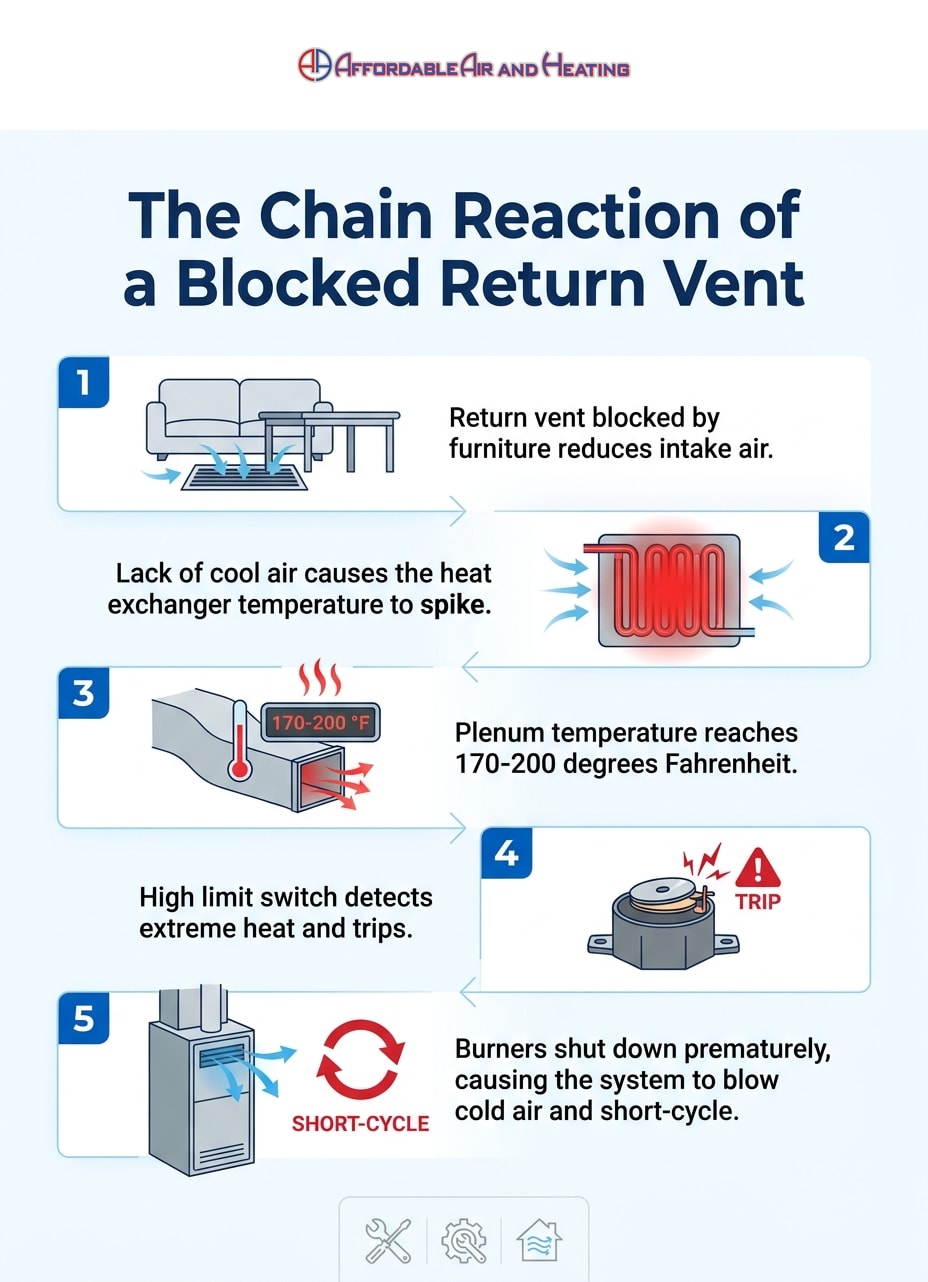
Understanding the sequence of events helps demystify why your system behaves the way it does when it short-cycles. It is not a random glitch; it is a precise, mechanical chain reaction triggered by your home's environment. Here is exactly what happens from the moment a vent is covered during November holiday home prep to the moment your house goes cold.
1. Airflow is Restricted: A piece of furniture, a heavy rug, or a closed door blocks a primary return vent, drastically reducing the volume of cool air entering the ductwork.
2. Temperature Skyrockets: The thermostat calls for heat, and the burners fire up. However, without enough cool air passing over the heat exchanger to strip the heat away, the internal temperature of the plenum rises exponentially.
3. The Limit Switch Trips: The temperature-sensing probe detects that the heat has surpassed the manufacturer's safety threshold (typically 170 to 200 degrees Fahrenheit). The switch physically opens the circuit, immediately shutting off the gas valve and stopping the burners.
4. The Blower Continues to Run: Even though the burners are off, the blower fan continues to run. The system does this intentionally to push the remaining dangerous heat out of the plenum and cool the heat exchanger down safely. During this time, you will feel cold or lukewarm air blowing from your supply vents.
5. The System Short-Cycles: Once the plenum cools down, the limit switch resets and the blower turns off. But because the house never reached the target temperature on your thermostat, the system almost immediately tries to start the whole process over again. This rapid on-and-off loop is short-cycling.
Repeated overheating cycles are incredibly hard on your equipment. The constant strain of trying to pull air through a blocked vent, combined with the rapid expansion and contraction of overheated metal, causes severe wear and tear on other internal components. Over time, this stress can lead to secondary failures, such as a failing furnace fan motor, which will require significant professional repair.
Troubleshooting Short-Cycling Before Calling a Professional
The frustration of a cold house often leads homeowners to immediately dial for emergency repairs. However, because airflow starvation is so frequently caused by environmental factors inside the home, there are several safe, non-technical steps you can take to diagnose the problem yourself. At Affordable Air and Heating, we believe in honest, transparent diagnostics—teaching you how to check your environment first so you can avoid paying for an unnecessary emergency repair call just because a couch was moved during November holiday home prep.
Visual Inspection of Vents
Your first step should always be a thorough walk-through of your home to inspect the breathing points of your system.
• Locate all return vents: Find every large return grille in your home. Check the low walls, the hallways, and the floors.
• Clear the perimeter: Ensure there is at least two feet of unobstructed clearance around every return vent. Move couches, beds, toy boxes, and heavy drapes away from the grilles.
• Check the supply registers: While the return vents are the most critical for intake, closed supply vents also increase internal pressure. Make sure all supply registers are fully open and unobstructed by rugs or furniture.
• Inspect the air filter: A severely clogged air filter restricts airflow just as badly as a couch blocking a vent. Pull your filter out and hold it up to the light. If you cannot see light passing through the material, it is choked with dust and must be replaced immediately.
When to Stop and Call an Expert
If you have cleared all your vents, replaced a dirty filter, and restored proper airflow, your system should return to normal operation. However, if the short-cycling continues, it is time to stop troubleshooting and call for help. Repeatedly tripping the limit switch over days or weeks can cause the switch itself to wear out and fail permanently, or there may be a deeper mechanical issue like a failing blower motor or a cracked heat exchanger.
Crucial Safety Warning: You should never attempt to bypass, reset, or replace the limit switch manually. This component is a critical life-safety device. Bypassing it removes the only protection your home has against a catastrophic fire or carbon monoxide leak. Diagnosing and replacing a faulty limit switch requires the specialized tools and training of a licensed professional. If your system continues to fail after basic airflow checks, reach out to our experts serving the Lancaster service area for safe, accurate diagnostics.
Frequently Asked Questions About Furnace Airflow and Limit Switches
What happens if a return vent is blocked?
Blocking a return vent drastically reduces the amount of cold air pulled into your heating system. This starves the equipment of the air it needs to cool its internal components. Without proper airflow, the system will overheat rapidly, strain the blower motor, and eventually trigger safety sensors that shut the entire system down.
Can a blocked vent cause a furnace to shut off?
Yes, a blocked vent is one of the most common reasons a heating system shuts off prematurely. When the equipment cannot pull in enough air, the internal heat exchanger overheats. To prevent a fire or a cracked heat exchanger, the system's high limit switch will detect the extreme heat and instantly shut off the gas burners.
Why does my furnace limit switch keep tripping?
Your limit switch keeps tripping because the internal temperature of your heating equipment is exceeding safe limits, usually between 170 and 200 degrees Fahrenheit. This is almost always caused by severe airflow restriction. Common culprits include deeply clogged air filters, furniture blocking return vents, or a failing blower motor that cannot push enough air through the system.
How do you fix a furnace that keeps overheating?
The first step to fixing an overheating system is to check your home's airflow. Ensure all return and supply vents are completely unobstructed by furniture, rugs, or drapes, and replace your air filter if it is dirty. If clearing the airflow pathways does not stop the overheating, you must call a licensed professional to inspect the system for mechanical failures or a worn-out safety switch.
Why shouldn't I just reset or bypass a tripping limit switch myself?
You should never bypass or manually tamper with a limit switch because it is a critical life-safety device designed to protect your home. In the cold climate of the Lancaster CA high desert, heating systems run frequently, and bypassing the switch removes the system's ability to shut down when it overheats. This can directly result in a cracked heat exchanger, carbon monoxide leaks, or a severe fire hazard. Only a licensed technician should handle internal safety controls.
Restore Your Home's Comfort with Proper Airflow
Maintaining clear return vents is the absolute simplest and most effective way to prevent your heating system from overheating and short-cycling. The limit switch is a vital safety feature protecting your home, and when it trips, it is usually begging for room to breathe. Whether you are doing your November holiday home prep or just rearranging the living room, always remember to give your vents plenty of clearance. If you have checked your filters and moved your furniture but your system is still struggling to keep you warm, do not hesitate to reach out to our team at Affordable Air and Heating for professional diagnostics. A clear explanation of your system's mechanics and a thorough inspection will ensure your home stays safely heated all season long.