Why Desert Dust Is Quietly Destroying Your Mini Split System
How desert dust affects mini split filter and coil performance is something every Antelope Valley homeowner needs to understand — especially when summer temperatures routinely push past 100°F and the air carries a constant load of fine silica particles.
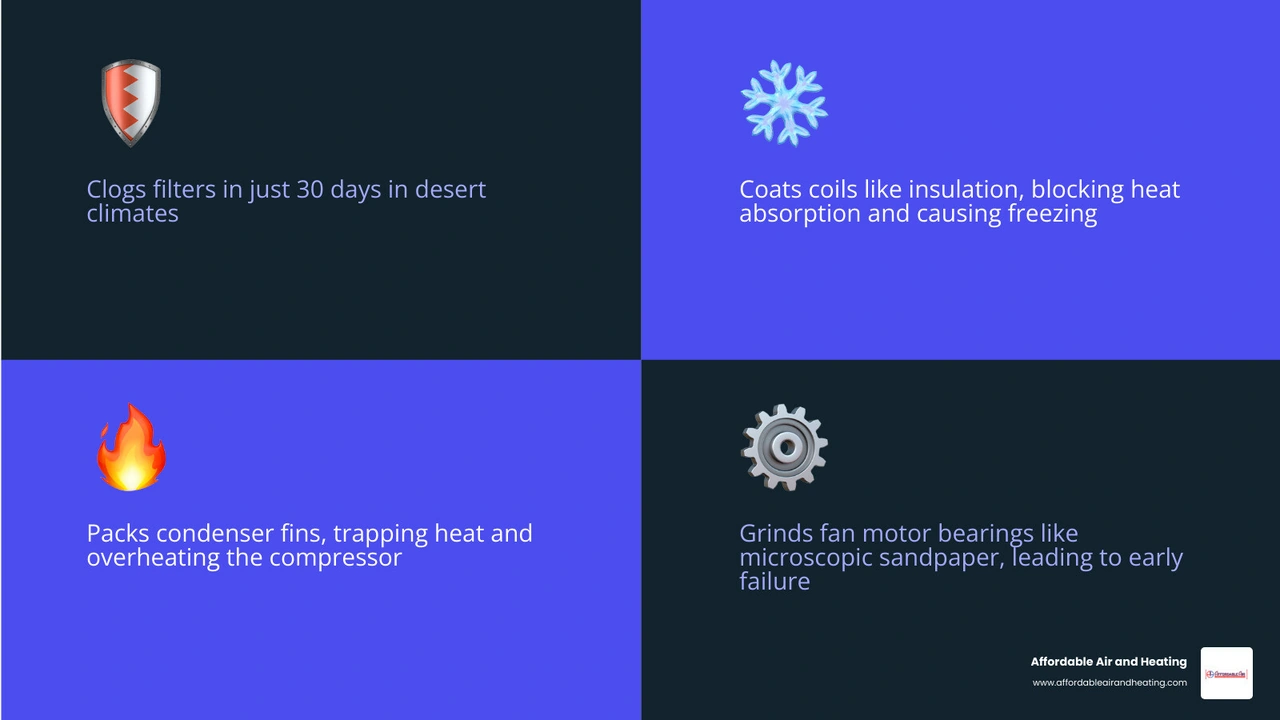
Here's a quick snapshot of what's happening inside your system right now:
| What Desert Dust Does | Why It Matters |
|---|---|
| Clogs filters in as little as 30 days | Forces the system to work harder, raising energy bills |
| Coats evaporator coils like an insulating blanket | Blocks refrigerant from absorbing heat, causing freezing or poor cooling |
| Packs into condenser coil fins | Traps heat in the refrigerant, overworking the compressor |
| Grinds into fan motor bearings | Causes premature wear and mechanical failure |
| Bypasses low-efficiency filters | Settles deep inside the unit where it's hardest to remove |
Desert dust isn't just ordinary household dust. The particles here in the Antelope Valley — many as small as 2 to 10 microns, smaller than a human skin cell — are loaded with silica. That silica acts like microscopic sandpaper on every surface it touches inside your mini split. In climates with more moisture and less wind, a standard filter might last 60 to 90 days. In high-desert environments, that same filter can be choked out in 30 days or less.
Left unchecked, that buildup doesn't just reduce comfort. It can shorten your system's lifespan by years, spike your monthly energy bills, and lead to compressor failures that are costly to fix.
This guide walks you through exactly what's happening inside your system, what warning signs to watch for, and what you can do to protect your investment.
Why Desert Dust is Uniquely Damaging to Mini Split Systems

When we talk about dust in places like Palmdale or Lancaster, we aren't talking about soft lint or textile fibers. Desert dust is primarily composed of pulverized rock and minerals, specifically silica. These particles are incredibly small, often ranging between 2 and 10 microns. To put that in perspective, a human hair is about 70 microns wide.
Because these particles are so fine and sharp, they create a "sandpaper effect" inside your ductless system. As the fan pulls air in, these microscopic shards of glass-like silica grind against the delicate aluminum fins of your coils and the precision bearings of your fan motors. This leads to abrasive wear that can physically erode the metal over time. To maximize mini split efficiency, you have to keep this grit out of the internal machinery.
Furthermore, the placement of your unit matters. If you don't optimize your ductless AC placement, you might be positioning your intake right in the path of prevailing winds that carry the heaviest dust loads.
How desert dust affects mini split filter and coil performance through infiltration
Desert dust doesn't just sit on surfaces; it infiltrates. Because our air is so dry, static electricity levels are high, which causes dust to cling to plastic housings and metal fins like a magnet.
Fine PM2.5 (particulate matter smaller than 2.5 microns) and PM10 particulates are light enough to stay airborne for days. When your mini split is running, it creates a slight negative air pressure inside the room. If there are any gaps in your home's building envelope—around windows, doors, or even the hole where the refrigerant lines pass through the wall—the system will pull that fine dust inside. Once it passes the initial filter, it settles deep in the "guts" of the machine. This is why following mini split maintenance tips Palmdale residents can rely on is vital for keeping the air clean and the system running.
The Impact of Dust Accumulation on Filters and Airflow
The first line of defense for any mini split is the air filter. In most parts of the country, you can get away with cleaning these every few months. In the Antelope Valley, that's a recipe for a breakdown.
| Climate Type | Filter Inspection Frequency | Average Lifespan/Cleaning Cycle |
|---|---|---|
| Moderate/Humid | Every 60-90 Days | 3 Months |
| High Desert (AV) | Every 15-30 Days | 1 Month |
| After a Haboob | Immediate | Immediate |
When dust clogs these filters, airflow is restricted. Your mini split's blower motor has to work twice as hard to pull air through a choked filter, which leads to motor strain and increased electrical consumption. We often recommend using filters with a MERV 8 to 11 rating if your system supports them, as they balance the need to catch fine dust without suffocating the unit. Following ductless AC maintenance best practices includes checking these filters religiously.
Warning signs that desert dust is affecting your mini split system's filter and coil performance
How do you know if the dust is winning the battle? Your system will usually try to tell you before it quits entirely.
- Reduced Airflow: If the air coming out of the louvers feels "lazy" or weak even on high settings, your filters or indoor coils are likely packed with dust.
- Musty or "Dirty Sock" Odors: Desert dust is hygroscopic, meaning it absorbs moisture. When it settles on a damp evaporator coil, it creates a muddy sludge that can grow bacteria, leading to unpleasant smells.
- Strange Noises: If you start troubleshooting mini split noises and hear grinding or whistling, it could be grit in the bearings or air struggling to pass through a clogged coil.
- Error Codes: Modern units are smart. If the airflow is too restricted, you may need to troubleshoot mini split errors that indicate high pressure or fan motor issues.
- Temperature Swings: Dust buildup on the coils prevents the system from reaching its set point, often resulting in uneven cooling with ductless ACs.
How desert dust affects mini split filter and coil performance: From Clogs to Coil Freezing
It sounds like a paradox: how can an air conditioner freeze when it's 105°F outside in Santa Clarita or Palmdale? The answer lies in heat transfer.
Your mini split uses refrigerant to absorb heat from your indoor air. This happens at the evaporator coil. For this process to work, a specific volume of warm air must pass over the cold coils. When how desert dust affects mini split filter and coil performance manifests as a thick layer of grime on the fins, it acts as insulation. The refrigerant stays too cold because it can't "grab" the heat from the room. Eventually, the condensation on the coil turns to ice.
As the ice grows, it further blocks airflow, creating a localized "refrigerator" inside your wall unit that can eventually damage the compressor. Understanding do ductless mini splits use coolant (refrigerant) helps you realize that the system is a delicate balance of pressures. Dust throws that balance off, leading to a massive drop in SEER (efficiency) and a spike in your energy bills. This is especially problematic if you optimize home with mini split zones, as one dirty unit can drag down the efficiency of the whole multi-zone system.
The role of haboobs and storms in how desert dust affects mini split filter and coil performance
In the Antelope Valley, we don't just get "dusty days"—we get haboobs. These massive dust storms can pack 60 mph winds that drive sand and silt deep into your outdoor condenser unit.
While the indoor unit handles the cooling, the outdoor unit is responsible for releasing that heat. If the condenser coils are caked in desert mud, the heat stays trapped. This causes the compressor to overheat and short-cycle. Furthermore, the mixture of dust and the small amount of moisture in the air can create a "bio-slime" or "muddy sludge" that clogs your drain lines. If you aren't staying on top of mini split drainage maintenance Palmdale residents need, you might find water leaking down your interior walls.
Protective Measures and Maintenance Schedules for High-Dust Climates
Living in a desert climate means your maintenance schedule needs to be more aggressive than the manufacturer's "standard" suggestions. We recommend the following to keep the dust at bay:
- Bimonthly Filter Checks: During the windy spring and hot summer months, check your filters every two weeks. If they look grey or fuzzy, clean them immediately.
- Outdoor Rinsing: After a major wind storm, gently rinse your outdoor condenser unit with a garden hose. Never use a pressure washer, as it will flatten the delicate aluminum fins.
- Shading and Placement: If possible, place your outdoor unit on the north side of your home or under a shading structure. This reduces the thermal load and can help shield it from some wind-blown debris.
- Manage Indoor Humidity: Use mini split humidity solutions Palmdale to keep indoor air at a level where dust is less likely to stay airborne or become "sticky" on the coils.
- Professional Deep Cleaning: At least once a year (ideally twice in the high desert), have a professional perform a deep clean. We use non-acidic, professional-grade cleaners that dissolve the silica-based grime without eating away at the metal.
If your system is older and constantly struggling with dust-related repairs, keep the "50% Rule" in mind: if the repair costs more than 50% of the value of a new unit, it’s time to consider an upgrade to a more dust-resistant, modern model.
Frequently Asked Questions about Desert Dust and Mini Splits
How often should I clean my mini split filters in the Antelope Valley?
In our local area, including Palmdale and Lancaster, you should check your filters every 30 days at a minimum. During the peak of summer or after a period of high winds, checking them every two weeks is a safer bet to prevent airflow restriction.
Can desert dust cause my mini split coils to freeze in 100-degree weather?
Yes! In fact, high heat makes it more likely. When dust blocks the airflow, the refrigerant in the evaporator coil cannot absorb enough heat from your room. The temperature of the coil drops below freezing, and the moisture in the air turns to ice, even if it's scorching outside.
What is the best way to protect my outdoor unit during a dust storm?
The most effective thing you can do is turn the system off during the height of the storm. This prevents the fan from actively "sucking" the dust into the coil fins. Once the storm passes, give the outdoor unit a gentle rinse with a hose before turning it back on.
Conclusion
Understanding how desert dust affects mini split filter and coil performance is the key to a long-lasting, efficient cooling system in the Antelope Valley. From the abrasive nature of silica particles to the risk of coil freezing, the desert environment is tough on HVAC equipment. However, with regular filter cleanings and professional seasonal tune-ups, your mini split can continue to provide superior comfort for years to come.
At Affordable Air and Heating, we’ve been family-owned since 1996, serving our neighbors in Acton, Santa Clarita, Palmdale, and beyond. We understand the unique challenges our climate poses and specialize in energy-efficient solutions that stand up to the heat and the dust.
Experience the benefits of mini splits without the headache of dust-related breakdowns. Schedule your professional mini split maintenance today and keep your home's air clean, cool, and affordable.