When Your AC Can't Keep Up: Undersized AC Unit Signs and Problems in a Hot Desert Climate
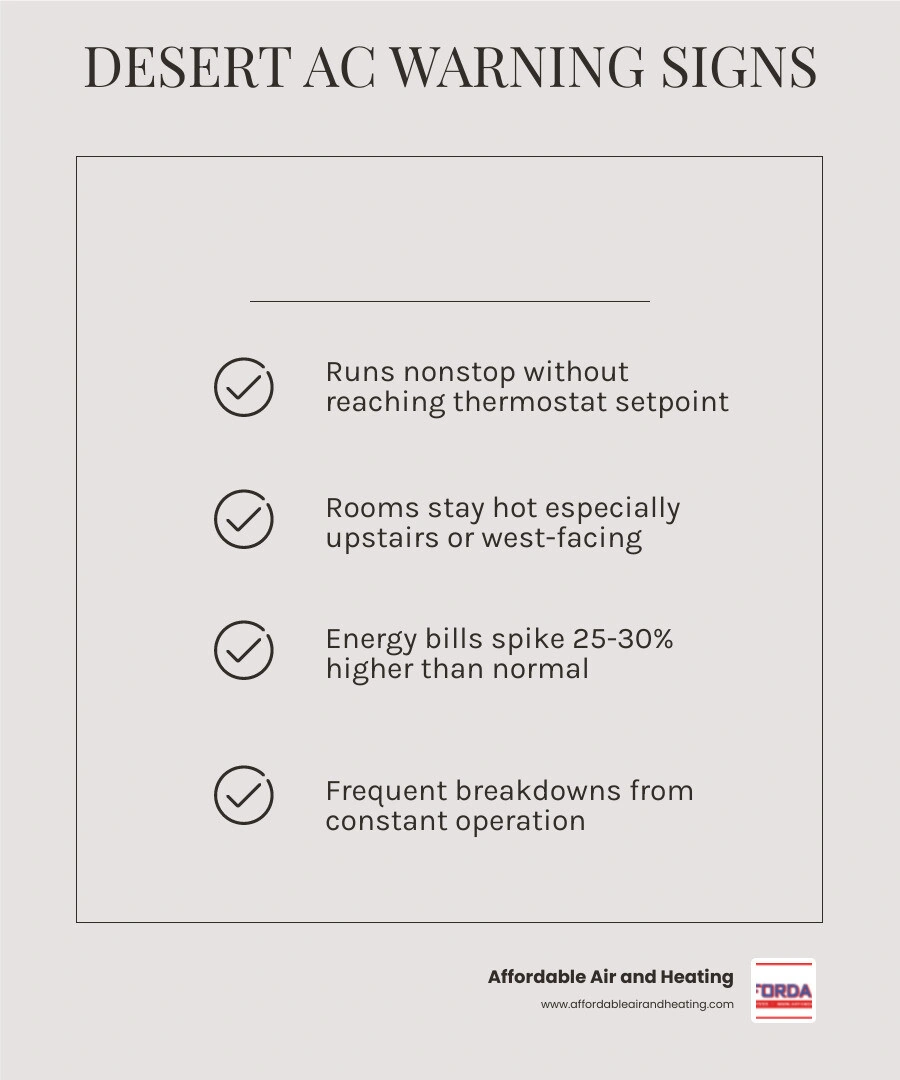
The most common undersized ac unit signs and problems in a hot desert climate include:
- AC runs constantly without ever reaching the thermostat setpoint
- Rooms stay hot — especially upstairs, west-facing, or far from the air handler
- Energy bills spike even when you haven't changed your habits
- Weak airflow from supply vents during peak afternoon heat
- Uneven cooling with noticeable temperature differences between rooms
- Frequent breakdowns from a system that never gets a rest
If you live in the Antelope Valley or anywhere across the Mojave Desert region, you already know that summer is not gentle. Temperatures routinely climb past 100°F — and on the worst days, well past 110°F. When your air conditioner is not properly sized for that kind of heat load, it does not just fall behind. It runs itself into the ground trying to catch up, and it never quite does.
Picture this: it is 4 PM in July. Your thermostat is set to 76°F. Your AC has been running since early morning. The living room feels tolerable, but the back bedrooms are pushing 84°F. The system never shuts off. That is not a maintenance problem. That is a sizing problem — and in a desert climate, the consequences go far beyond discomfort.
An undersized unit running nearly nonstop can raise your energy costs by 25 to 30% compared to a correctly sized system, and the mechanical wear from that constant operation often leads to major component failures within just a few years. Understanding the signs early can save you from a full system breakdown in the middle of peak summer heat.
Undersized ac unit signs and problems in a hot desert climate terms made easy:
- ac running constantly in desert heat
- how poor insulation makes your ac run constantly in hot inland climates
- is it normal for ac to run nonstop when temperatures exceed 100 degrees
Undersized AC Unit Signs and Problems in a Hot Desert Climate
Operating a cooling system in a hot, dry climate is vastly different from running one in a humid coastal region. In the high desert areas we serve — including Palmdale, Lancaster, and Santa Clarita — the thermal load on a home can be relentless. When an air conditioner is too small for the space it is trying to cool, several distinct symptoms emerge.
The most glaring issue is the nonstop operation. On a typical summer afternoon in Quartz Hill or Acton, a properly sized air conditioner should run in cycles of 15 to 20 minutes, shutting off once it hits the target temperature. An undersized unit, however, will run continuously. It simply lacks the cooling capacity (measured in British Thermal Units, or BTUs) to remove heat as fast as the desert sun transfers it through your walls, windows, and roof.
This leads directly to a persistent "thermostat gap." You might set your thermostat to 75°F, but the display refuses to drop below 81°F during the hottest hours of the day. Because the system is running at a 90% or higher duty cycle, your energy bills will skyrocket. An undersized system running nonstop can easily increase monthly utility costs by 25% to 30% compared to a correctly sized unit that cycles normally.
Furthermore, you will notice severe uneven cooling. The rooms closest to the indoor blower motor might feel mildly cool, while rooms with west-facing windows or vaulted ceilings turn into virtual saunas.
To help you understand whether your system is behaving normally or showing signs of being too small, we have put together this comparison table:
| Symptom / Behavior | Properly Sized AC System | Undersized AC System |
|---|---|---|
| Run Cycle Duration | 15–20 minutes per cycle, then shuts off | Runs continuously for hours without stopping |
| Thermostat Accuracy | Reaches and maintains set temperature | Stays 5°F to 10°F warmer than the setpoint |
| Room-to-Room Comfort | Consistent, even cooling throughout the home | Severe hot spots, especially in west-facing rooms |
| Energy Bills | Predictable, seasonal changes | Spikes drastically due to constant operation |
| Component Lifespan | Lasts 12–15 years with regular maintenance | Often suffers major failures within 2–5 years |
| Evaporator Coil Status | Cold and moisture-free (or lightly draining) | Prone to freezing over due to continuous running |
Identifying Undersized AC Unit Signs and Problems in a Hot Desert Climate
Diagnosing an undersized air conditioner requires looking beyond a warm room. As professional HVAC technicians, we use several diagnostic methods to determine if a system is truly lacking capacity.
One of the first tests is measuring the temperature split. This is the difference in temperature between the air entering your return vents and the air blowing out of your supply vents. In a healthy, properly functioning system, this split should be between 16°F and 22°F. If your temperature split is within this range but your home is still hot, it means the air conditioner is doing its job of cooling the air, but it simply does not have enough capacity to handle the overall volume of heat in the home.
We also look closely at room-by-room temperature variances. In older homes across Castaic, Newhall, or Saugus, thermal imaging cameras can reveal rapid heat gain through uninsulated attics or older windows. If certain rooms are consistently 8°F to 10°F warmer than the rest of the house, it is a sign that the system cannot keep up with localized heat loads. If you suspect your system is falling short, you can read more about what to look for in our guide on AC Not Cooling Properly Palmdale.

Mechanical Damage from Undersized AC Unit Signs and Problems in a Hot Desert Climate
Running an undersized air conditioner is not just bad for your comfort and wallet; it is devastating to the equipment itself. Air conditioners are mechanical systems with moving parts, electrical contacts, and chemical refrigerants. They are designed to cycle on and off, which allows components to cool down and lubricate properly.
When a system runs 24/7 in 105°F heat, the mechanical wear is accelerated exponentially. The most common victim is the compressor — the heart of your AC system. The compressor relies on the returning cool refrigerant gas to keep its internal motor cool. When an undersized system runs continuously under high thermal loads, the compressor overheats, causing the lubricating oil to break down. This leads to premature compressor burnout, a highly expensive failure.
Another common issue is frozen evaporator coils. It sounds counterintuitive that an air conditioner would freeze up when it is 110°F outside, but it happens frequently. Because the system runs nonstop, the continuous flow of refrigerant can cause the coil temperature to drop below freezing, especially if airflow is even slightly restricted by desert dust. Once ice begins to form, it acts as an insulator, blocking heat transfer and eventually causing the entire system to stop cooling altogether.
Additionally, the blower motor inside your furnace or air handler will wear out much faster. Instead of running for a combined 8 to 10 hours a day, it is forced to run for 18 to 24 hours daily. This continuous duty cycle easily cuts the expected lifespan of your system in half. A properly sized AC system should last 12 to 15 years, but an overworked, undersized unit in the desert often suffers catastrophic failure within just 2 to 5 years. For more on how our local climate impacts system durability, check out our article on Does Extreme Heat and Desert Dust Shorten AC Life Expectancy.
The Physics of Desert Cooling: Altitude, Air Density, and Sensible Heat
Sizing an air conditioner in coastal California is relatively straightforward because the air is dense, humid, and rarely reaches extreme temperatures. However, when you move inland to high-desert regions like Lancaster, Palmdale, or Acton, the physics of cooling changes dramatically.
First, let's talk about elevation and air density. As elevation increases, the air becomes thinner. Thinner air has fewer molecules per cubic foot, which means it cannot hold or transfer heat as effectively as dense, sea-level air.
To put this in perspective, look at how altitude affects standard AC cooling capacity across the West:
- At sea level, an AC unit operates at 100% of its rated capacity.
- At 4,226 feet above sea level (like Salt Lake City), the thinner air cuts an AC unit's cooling capacity by roughly 13%.
- At 7,500 feet (like Park City), a 3-ton AC unit loses 22% of its rated capacity, performing like a 2.3-ton unit.
In the Antelope Valley, our elevations range from roughly 2,300 feet in Lancaster and Palmdale to over 3,300 feet in Acton. This means a standard 3-ton air conditioner installed here automatically loses roughly 7% to 10% of its rated cooling capacity right out of the box due to altitude derating alone. If an installer uses a basic sea-level sizing chart without adjusting for our local elevation, the system is guaranteed to be undersized from day one.
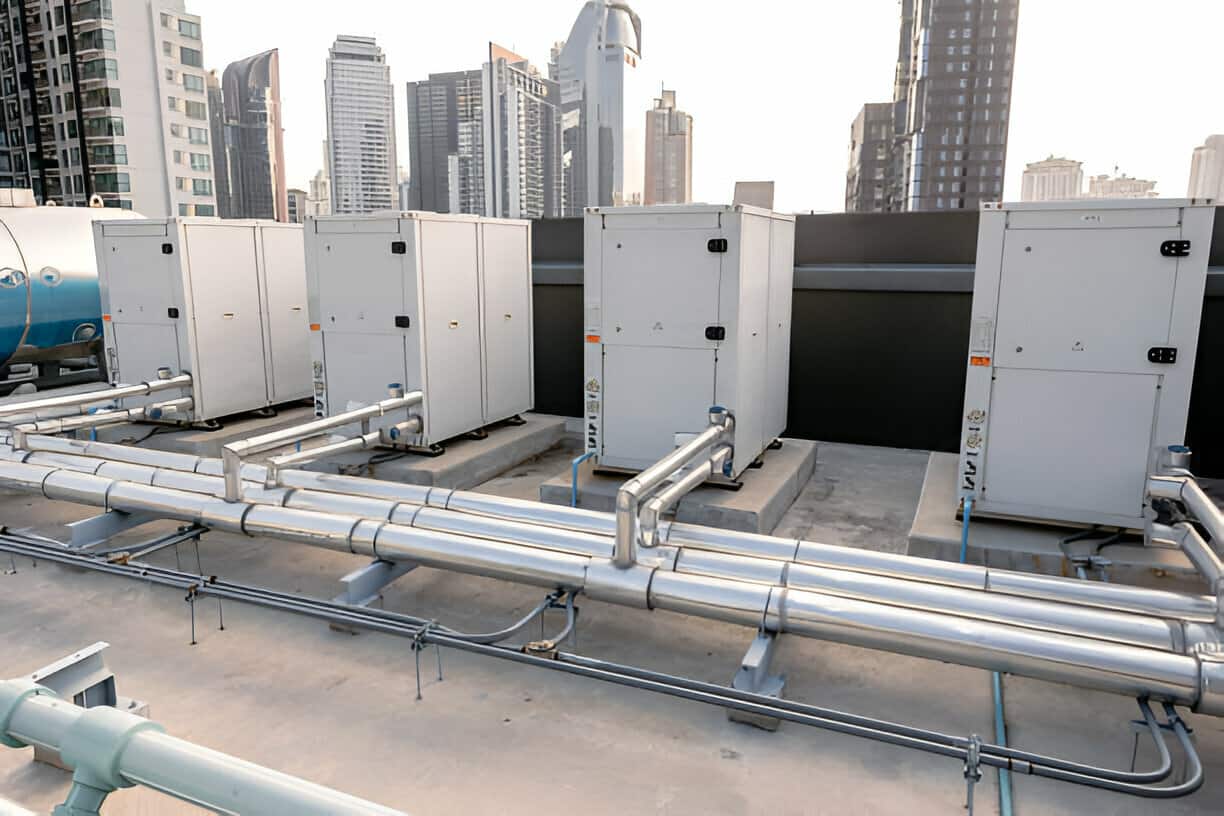
The second physical factor is the difference between sensible cooling and latent cooling.
- Sensible cooling is the process of lowering the actual air temperature that you read on a thermometer.
- Latent cooling is the process of removing moisture (humidity) from the air.
In humid climates, an air conditioner has to spend a massive amount of its energy removing water vapor from the air before the indoor temperature can actually drop. In our dry desert climate, the air is already extremely dry. This means almost 100% of the air conditioner’s capacity is dedicated to sensible cooling (lowering the temperature).
While this sounds like an advantage, it means the system must handle rapid, intense heat gain. Dry desert air allows solar radiation to pass through the atmosphere with very little filtration, causing attics and roofs to heat up incredibly fast. Attics in Palmdale can easily reach 160°F on a July afternoon. This massive thermal pressure pushes heat through your ceilings and ductwork, requiring an incredibly robust and precisely sized system to keep up. You can read more about these unique environmental challenges in our post on How the Antelope Valley Desert Climate Affects Your AC System.
Diagnosing Sizing Issues vs. Other Common HVAC Problems
Before you assume your air conditioner is undersized, it is important to rule out other common mechanical issues. Many HVAC problems mimic the symptoms of an undersized unit, and misdiagnosing the issue can lead to unnecessary and expensive equipment replacements.
One of the most common culprits is leaky or restricted ductwork. According to industry statistics, leaky ducts can waste up to 30% of an HVAC system's overall efficiency. If your ducts are pulling in 140°F air from your attic or blowing cooled air into your crawlspace, your AC will run constantly and struggle to cool the home, making it look undersized when the equipment is actually the correct size.
Another issue is a low refrigerant charge. If your system has a slow leak, the drop in refrigerant pressure reduces the system's cooling capacity. The symptoms — constant running, warm air from the vents, and frozen coils — are identical to those of an undersized unit. However, a technician can easily distinguish between the two by measuring the system's operating pressures and superheat/subcooling levels.
To help you narrow down what might be happening with your system, keep an eye out for these diagnostic indicators:
- Dirty Air Filters: A heavily clogged filter restricts airflow, leading to weak air output, frozen coils, and long run times. Always check your filter first.
- Fouled Condenser Coils: In the desert, wind-blown dust and sand coat the outdoor condenser unit. A mere 0.042-inch layer of desert dust on your outdoor coils can reduce heat transfer efficiency by 21%, forcing the unit to run nonstop.
- Short Cycling: If your AC is turning on and off every few minutes, it is likely oversized or dealing with a failing control board, rather than being undersized. You can learn more about this specific issue in our guide: AC Keeps Turning On and Off What Is Wrong.
If you are noticing these symptoms, it is best to consult a professional to perform a thorough diagnostic check. For a complete list of warning signs that require professional attention, see our article on Signs You Need AC Repair.
How to Prevent Undersizing: Manual J Calculations and Home Efficiency
The only accurate way to prevent an undersized air conditioner is to perform a professional Manual J load calculation. This is the industry-standard scientific protocol developed by the Air Conditioning Contractors of America (ACCA).
Many cut-rate installers rely on outdated "rules of thumb," such as allocating 1 ton of cooling capacity for every 500 or 600 square feet of living space. In a hot desert climate, these shortcuts are highly inaccurate. A modern, tightly sealed home in Stevenson Ranch might only need 1 ton of cooling per 900 square feet, while an older, poorly insulated home in Lancaster with vaulted ceilings and large west-facing windows might require 1 ton per 400 square feet.
A true Manual J calculation takes into account a wide range of specific variables:
- The exact local climate data and design temperatures
- Home orientation (which direction the windows face to calculate solar heat gain)
- Insulation R-values in the attic, walls, and floors
- Window specifications (single-pane, double-pane, U-factor, and solar heat gain coefficient)
- Ceiling heights and total interior volume
- Heat generated by occupants and household appliances
To learn more about how sizing works and why these calculations are so critical, you can explore our AC Sizing Guide for Optimal Comfort and our detailed Guide to BTUs and What Size AC You Need.
Additionally, factors like architectural design play a massive role in load requirements. For instance, high ceilings and direct sunlight can completely change the amount of cooling your home needs. We break this down in detail in our article, Does Ceiling Height and Sun Exposure Affect What Size AC You Need.
If you discover your system is only slightly undersized, you may not need to replace the entire unit immediately. Improving your home's thermal envelope can sometimes reduce the heat load enough to bring a borderline system into an acceptable operating range. Sealing duct leaks, adding radiant barriers in the attic, and upgrading insulation can significantly lower the demand on your air conditioner. To understand how insulation impacts your system's run times, read How Poor Insulation Makes Your AC Run Constantly in Hot Inland Climates.
Frequently Asked Questions about Desert AC Sizing
Can improving insulation fix an undersized AC unit?
Yes, but only if the system is slightly undersized (by about 10% to 15%, or half a ton at most). Upgrading your attic insulation from R-19 to R-49 or R-60 and performing comprehensive air sealing can significantly reduce the amount of heat entering your living space. This lowers the overall cooling load, which can allow a borderline system to successfully keep up on hot days.
However, if your system is significantly undersized — such as having a 2-ton unit on a home that requires a 3.5-ton system — no amount of insulation will solve the problem. In those cases, equipment replacement is the only viable option. For a deeper look at this, read How Poor Insulation Makes Your AC Run Constantly in Hot Inland Climates.
How does low humidity affect desert AC performance?
Because desert air contains very little moisture, your air conditioner does not have to spend much energy dehumidifying the air (latent cooling). Instead, almost all of its capacity goes toward lowering the actual air temperature (sensible cooling). This allows the system to drop the indoor temperature quickly when it is running properly.
However, the lack of humidity also means dry materials in your home (like wood framing, furniture, and drywall) hold less moisture and can absorb and release heat rapidly. This leads to quick indoor temperature spikes the moment the AC cycles off, putting extra pressure on the system to cycle back on. You can read more about how these dry-climate dynamics work in our article on How the Antelope Valley Desert Climate Affects Your AC System.
When should I replace rather than repair an undersized AC?
You should consider replacing your system if:
- It is more than 10 to 12 years old and struggling to cool the home
- You are facing frequent, expensive repairs (such as a failing compressor or a leaking evaporator coil)
- Your monthly energy bills are consistently high during the summer
- The system was incorrectly sized from the start and has never kept the home comfortable
If you are trying to decide whether to invest in another repair or upgrade to a new, energy-efficient system, we recommend checking out our AC Repair vs Replace Decision Guide and our article on When to Consider AC Replacement.
Conclusion
Living with an undersized air conditioner in the hot desert climate of the Antelope Valley is a recipe for high energy bills, frequent breakdowns, and constant discomfort. When summer temperatures soar, a properly sized air conditioning system is not just a luxury — it is a critical home utility.
If your system is running constantly, struggling to keep your home cool, or causing your utility bills to spike, it is time for a professional assessment. At Affordable Air and Heating, we have been serving families across Palmdale, Lancaster, Santa Clarita, and the surrounding desert communities since 1996. As a family-owned business, we specialize in providing honest, accurate load calculations and energy-efficient cooling solutions tailored to our unique high-desert climate.
Do not spend another summer sweating through the heatwaves. Let our experienced, licensed technicians evaluate your home's cooling needs and help you find the perfect system fit. Contact us today to schedule your professional AC evaluation by visiting our Air Conditioning Services Page.