When AC Repair Costs More Than It's Worth: Know When to Replace
Knowing how much AC repair is too much before replacing the unit is one of the most important — and stressful — decisions you'll face as a homeowner, especially when temperatures in the Antelope Valley are pushing past 100°F and your system keeps breaking down.
Here's a quick answer to help you decide right now:
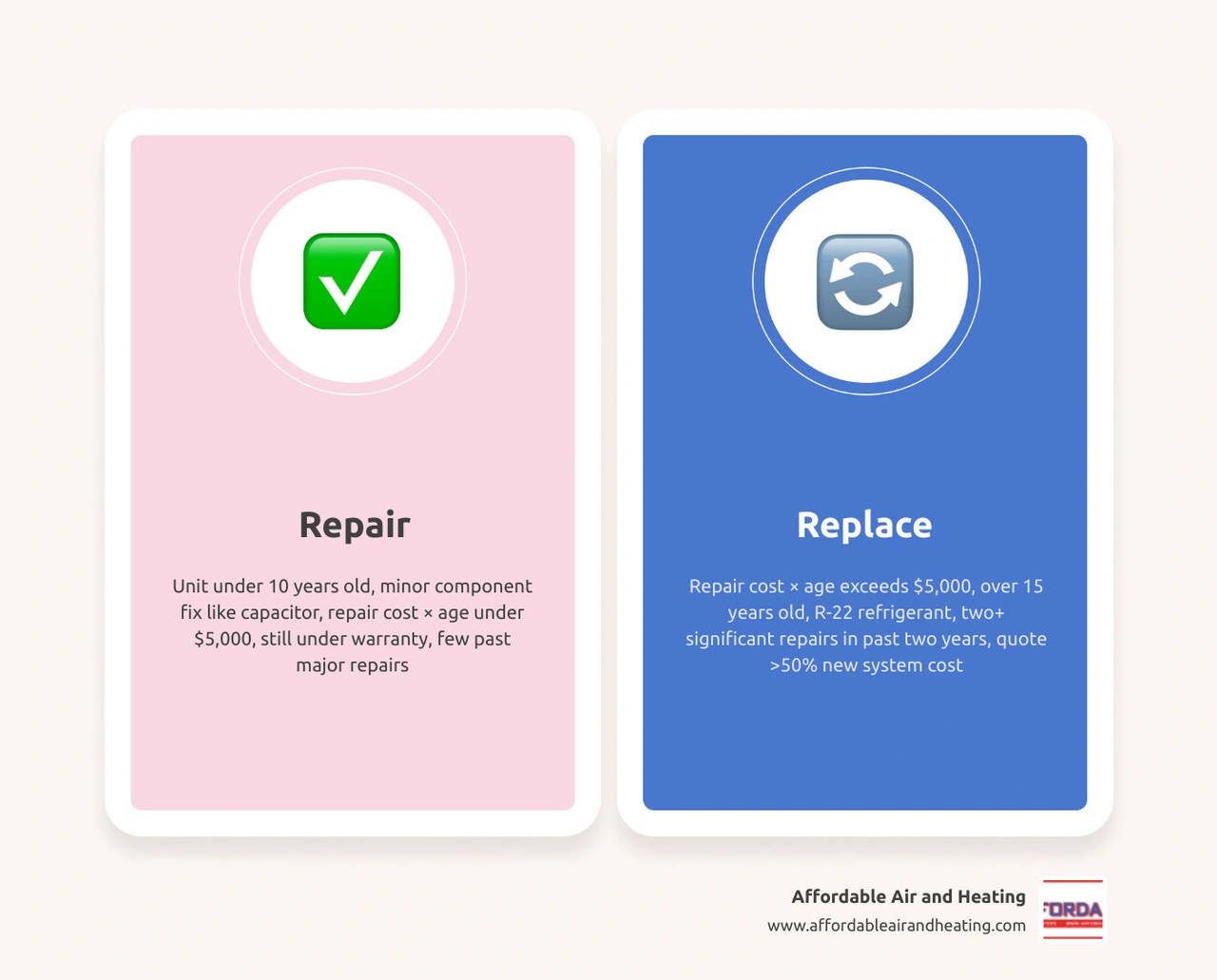
Replace your AC if any of these are true:
- Your unit is over 15 years old and needs a major repair
- Your system uses R-22 (Freon) refrigerant
- You've had two or more significant repairs in the past two years
- The repair is extensive and the system is past its prime
Repair your AC if most of these are true:
- Your unit is under 10 years old
- The repair is a minor component (capacitor, contactor, thermostat)
- You've had few or no major repairs in recent years
- Your system is still under warranty
Most homeowners don't realize how fast small repair bills add up — or how much an aging, inefficient system is quietly inflating their energy bills every single month. The right call isn't always obvious in the moment, but a few straightforward guidelines can make it much clearer.
In this guide, we'll walk you through exactly how to make that call with confidence.
Related content about how much ac repair is too much before replacing the unit:
- ac repair vs replace — decision guide
- how energy savings from a new ac offset replacement in california
- how to decide if ac repair is worth the money in a hot climate
How Much AC Repair Is Too Much Before Replacing the Unit: The Age and Repair Ratio
When you are staring at a repair estimate, it is easy to let emotion take over. You might think, "I just want my home cool again right now!" But taking a step back to look at the math can save you a lot of hassle in the long run. One of the most reliable neutral tie-breakers in our industry is comparing the age of the system against the severity of the repair.
The System Age Factor
If your system is nearing the end of its expected lifespan, investing in a major repair is rarely the most practical choice.
- Find your system's age: Check the manufacture date on the outdoor unit's nameplate. If it is faded, you can decode the serial number (the first few digits usually represent the week and year of manufacture).
- Get a professional repair recommendation: Ask your technician for a complete diagnostic write-up.
Let's look at two realistic scenarios to see this guideline in action:
- Scenario A (The Healthy Mid-Lifer): You have an 8-year-old air conditioner in Palmdale that needs a standard fan motor repair.
- Verdict: Since the unit is under a decade old and the repair is straightforward, repairing the unit is a smart, practical move.
- Scenario B (The Aging Money Pit): You have a 12-year-old system in Lancaster that needs a major compressor replacement.
- Verdict: Since the system is older and requires a critical component replacement, investing in a brand-new, energy-efficient system is often the wiser path.
While system age is an excellent starting point, it doesn't factor in things like safety risks, rising utility bills, or obsolete refrigerants. To get a complete picture of your system's health, it helps to check out our comprehensive AC Repair vs Replace Decision Guide.
Evaluating Major Component Failures
When major, critical components fail—such as the compressor, the evaporator coil, or the entire air handler—the required service can be extensive. Investing a massive amount of resources into a system that is already past its prime is rarely a good investment.
Think of it like an old car: if your 15-year-old sedan needs a brand-new transmission, you probably wouldn't fix it. You would put those resources toward a reliable new vehicle. Your home comfort system deserves the same logical approach. By replacing a severely compromised unit, you gain a fresh manufacturer's warranty, modern efficiency, and long-term peace of mind. For a deeper dive into evaluating these major failures, read our guide on When to Consider AC Replacement.
Key Indicators That Your Air Conditioner Is Nearing End-of-Life
A failing air conditioner rarely goes quiet. Before it breaks down completely, it will usually drop hints that its operational lifespan is drawing to a close. Knowing these red flags can help you plan a replacement on your own terms, rather than dealing with an emergency breakdown in the middle of a scorching July afternoon.
Keep an eye out for these classic signs of system decline:
- Frequent, compounding breakdowns: If you feel like you have your local HVAC technician on speed dial, your system is likely entering a "repair spiral."
- Inconsistent cooling and weak airflow: Some rooms feel like an icebox while others feel like a sauna.
- Strange noises: Squealing, grinding, or clunking sounds indicate that internal bearings or motors are failing.
- Unusual odors: Musty smells point to biological growth inside the ductwork or evaporator coil, while burning smells indicate electrical malfunctions.
- Spiking energy bills: If your utility costs are rising steadily even though your usage habits haven't changed, your system is working twice as hard to do half the job.
If you are noticing these symptoms in your home, it is time to take action. Learn more about identifying these warning signs in our article on Signs Your AC is in Need of Repair.
How Much AC Repair Is Too Much Before Replacing the Unit Based on System Age?
Age is more than just a number when it comes to central air conditioners. Nationally, central AC units typically last 15 to 20 years. However, in demanding environments like the Antelope Valley—including hot spots like Palmdale, Lancaster, and Quartz Hill—heavy seasonal demand can shorten that operational lifespan significantly, often bringing it down to 10 to 15 years.
As a system crosses the decade mark, wear and tear on its internal components accumulates rapidly. Even if you diligently schedule annual maintenance, the physical toll of cooling a home against triple-digit heat waves eventually catches up to the equipment.
If your system is over 10 to 12 years old and requires multiple major repairs, the cumulative costs will almost always exceed the price of a full system replacement. At this stage, repairing one part often just passes the stress down the line, causing another weak component to fail shortly after. To understand how age factors into your system's reliability, explore our resource on When Your AC Needs Replacement.
Refrigerant Phase-Outs and Obsolete Systems
Environmental regulations play a massive role in deciding how much AC repair is too much before replacing the unit. If your air conditioner was installed before 2010, there is a very high probability that it uses R-22 refrigerant (commonly known as Freon).
The EPA fully phased out the production and import of R-22 in 2020 because of its ozone-depleting properties. Today, the only available R-22 is reclaimed or sourced from pre-existing stockpiles, causing its cost to skyrocket. If your older unit develops a refrigerant leak, recharging it can cost an absolute fortune. Investing in a leak repair and recharge on an R-22 system is generally considered a poor financial decision, as that money is better spent upgrading to a modern system.
Furthermore, the industry is currently undergoing a phase-down of R-410A (the refrigerant that replaced R-22) in favor of newer, lower-GWP (Global Warming Potential) alternatives like R-454B and R-32. While R-410A systems remain completely legal to own, maintain, and service, the cost of R-410A will naturally rise over the coming decade. Upgrading to a modern system now ensures your home is equipped with the latest, future-proof technology. If you are nursing an old, leaking unit, check out our advice on why you shouldn't hesitate: Don't Wait on AC Repair.
Efficiency, Climate, and Cumulative Costs of Frequent Repairs
When deciding whether to repair or replace, many homeowners focus entirely on the upfront cost of the repair. What they often overlook is the ongoing, monthly cost of keeping an inefficient system running.
Air conditioner efficiency is measured by the SEER2 (Seasonal Energy Efficiency Ratio 2) rating. Older systems, typically rated between 10 and 13 SEER, consume 30% to 50% more energy than modern systems rated SEER 16 to 20+. By upgrading to a high-efficiency system, you can slash your monthly cooling costs immediately.
| Older SEER Rating | Modern SEER2 Rating | Estimated Cooling Energy Savings |
|---|---|---|
| 10 SEER | 16.0 SEER2 | 37% Savings |
| 10 SEER | 14.3 SEER2 | 30% Savings |
| 13 SEER | 16.0 SEER2 | 18% Savings |
| 13 SEER | 18.0+ SEER2 | 27% – 35% Savings |
To see how these efficiency gains apply to homes in warm regions, read our detailed breakdown: How to Decide if AC Repair is Worth the Money in a Hot Climate.
How Much AC Repair Is Too Much Before Replacing the Unit in Hot Climates?
In the Antelope Valley and Santa Clarita Valley, our summers are unforgiving. Communities like Palmdale, Lancaster, Acton, and Castaic regularly experience prolonged stretches of triple-digit heat. In this kind of climate, your air conditioner isn't just a luxury—it is a critical safety utility.
Because our systems run for months on end, they age faster than systems in milder coastal climates. A minor issue like a dirty coil or a weak capacitor can quickly escalate into a catastrophic compressor failure under the strain of a 105°F afternoon. If your AC is struggling to keep up, blowing lukewarm air, or cycling on and off constantly, it is under immense stress. Learn more about troubleshooting these climate-specific cooling struggles here: AC Not Cooling Properly.
Hidden and Long-Term Costs of Delaying Replacement
Delaying an inevitable AC replacement can actually cost you more over time. When you try to stretch the life of a dying system, you subject yourself to several hidden costs:
- Emergency Service Fees: AC units rarely break down on a mild, pleasant Tuesday morning. They fail on holiday weekends or during peak heat waves when emergency diagnostic rates are active.
- The Cumulative Repair Spiral: A minor electrical fix this month, a fan motor next summer, and a refrigerant top-off the following year. Before you know it, you've spent the equivalent of a significant down payment on a new system, but you still have an old, unreliable unit.
- Compromised Indoor Air Quality: Older systems often struggle to manage humidity and can harbor dust, pollen, and dander within their aging components.
If you are caught in this cycle, it might be time to break free. Read our guide on identifying when it is finally Time for an AC Replacement.
When to Choose Repair vs. Full System Replacement
We always advocate for the most practical and honest solution for your home. Replacement isn't always the answer! There are many times when choosing to repair your air conditioner is absolutely the right call.
When to Repair:
- The unit is under 10 years old: Most systems still have plenty of reliable operational life left at this stage.
- The problem is minor: Components like run capacitors, contactors, thermostats, and condensate drains are simple to replace and do not indicate systemic failure.
- The system is under warranty: If the manufacturer is covering the cost of the replacement parts, repairing the unit is almost always the best path.
- The system has been well-maintained: If you have scheduled regular tune-ups and the unit has a clean bill of health, a single breakdown is likely just a fluke.
If you do decide that replacement is the best path forward, we recommend reviewing our comprehensive AC Replacement Guide to understand what to expect during the process.
Questions to Ask Your HVAC Contractor Before Deciding
Before you sign off on a major repair or a brand-new system installation, protect your investment by asking your HVAC contractor these essential questions:
- "Did you perform a Manual J load calculation?"
- Why it matters: Never let a contractor simply look at your old unit and install the exact same size. If you've upgraded your insulation, sealed your ducts, or replaced windows, your home's cooling load may have changed. An oversized system will short-cycle and fail prematurely, while an undersized system will run constantly.
- "Are you replacing both the indoor and outdoor units?"
- Why it matters: Replacing only the outdoor condenser while leaving an old indoor evaporator coil in place is a recipe for disaster. Unmatched systems operate at significantly reduced efficiency, can void your manufacturer's warranty, and are highly prone to premature failure.
- "What warranties are included with this installation?"
- Why it matters: A reputable installation should come with a robust manufacturer's parts warranty (typically 10 years when registered) as well as a labor warranty backed by the installing company.
- "Are there flexible financing options or energy rebates available?"
- Why it matters: Upgrading to high-efficiency equipment often qualifies you for federal tax credits and local utility rebates, making the upgrade much more affordable.
The Role of Preventative Maintenance in Extending Lifespan
The single best way to delay a costly replacement and keep your repair bills to an absolute minimum is consistent, professional preventative maintenance. Just like changing the oil in your car, your air conditioner needs regular attention to run efficiently.
During a professional maintenance visit, a technician will clean your condenser coils, check refrigerant levels, test electrical connections, lubricate moving parts, and catch minor issues before they turn into major, system-ending breakdowns. Regular professional maintenance can extend your air conditioner's operational lifespan by 3 to 5 years, ensuring you get every bit of value out of your investment. To learn more about how simple upkeep pays off, read about the Benefits of Regular AC Maintenance.
Frequently Asked Questions about AC Replacement Timing
Is it better to replace both the AC and furnace at the same time?
Yes, in the vast majority of cases, replacing both systems simultaneously is highly recommended. Your air conditioner and furnace share critical components, including the blower motor, duct system, and electrical infrastructure. By replacing them together, you ensure a perfectly matched system that operates at peak efficiency, saves on labor costs compared to two separate installations, and prevents a scenario where an old, failing furnace ruins a brand-new AC unit.
How often is too often for AC repairs?
An air conditioner should not require annual repairs. If you find yourself scheduling two or more significant repairs over a rolling two-year period, your system is entering a repair spiral. At this point, the component integrity of the system is compromised, and continuing to patch it up is usually a waste of money compared to investing in a reliable replacement.
Can regular maintenance delay a full system replacement?
Absolutely. Consistent, professional preventative maintenance twice per year (spring for your AC, fall for your heating) is the absolute best way to maximize your system's lifespan. Keeping the coils clean, electrical connections tight, and airflow unobstructed reduces strain on the compressor, which is the heart of your system and the most expensive component to replace.
Conclusion
Deciding how much AC repair is too much before replacing the unit doesn't have to be a guessing game. By factoring in your system's age, the frequency of breakdowns, and the long-term energy savings of modern SEER2 systems, you can make a choice that keeps your home comfortable and your finances secure.
At Affordable Air and Heating, we've been helping our neighbors throughout the Antelope Valley and Santa Clarita Valley make these decisions since 1996. As a family-owned business, we pride ourselves on delivering honest recommendations, dependable service, energy-efficient solutions, and flexible options to fit your household needs.
Whether you need a quick, reliable repair in Lancaster, Castaic, or Palmdale, or you are ready to explore a high-efficiency replacement system, we are here to help.
Ready to see where your cooling system stands? Explore our professional Air Conditioning Services or contact us today to schedule an expert, no-obligation evaluation of your home comfort system!