Is It Normal for AC to Run Nonstop When Temperatures Exceed 100 Degrees?
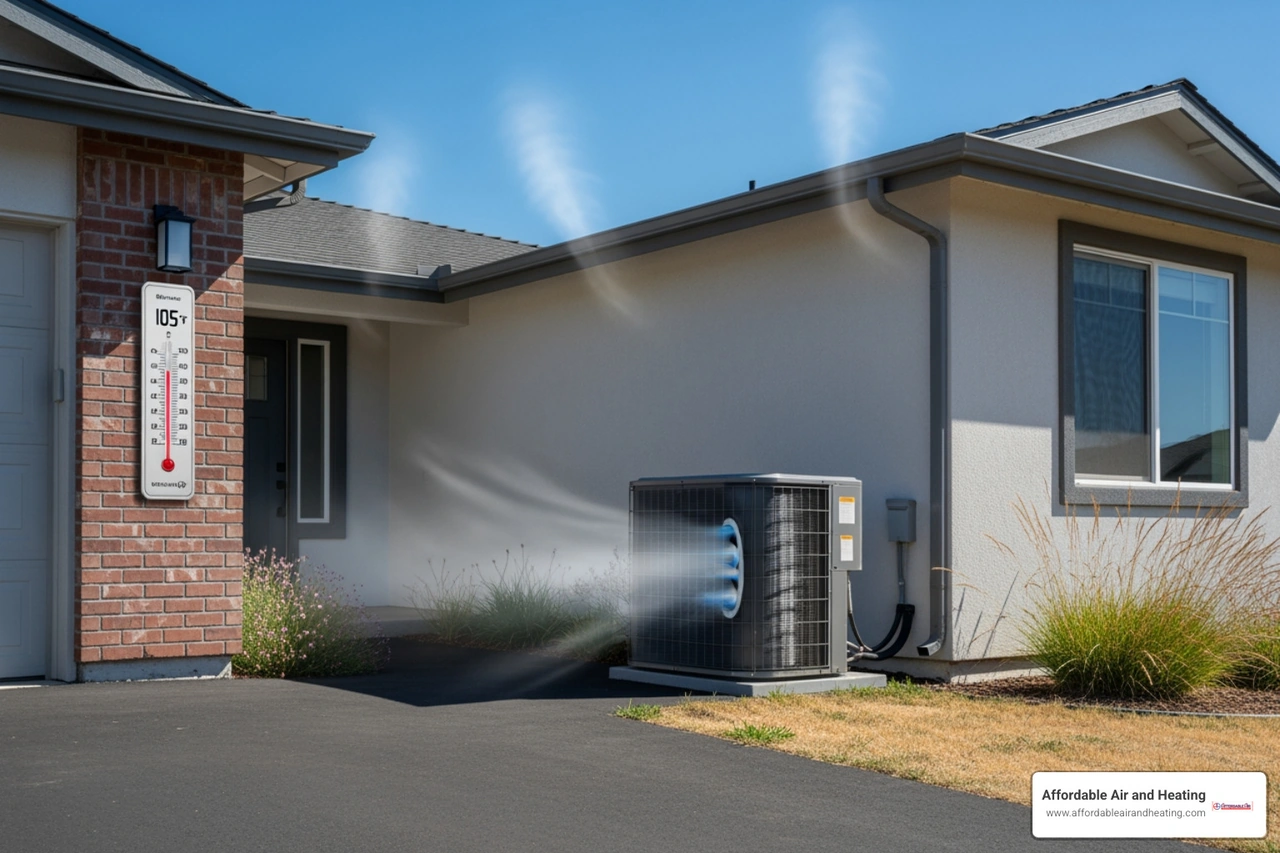
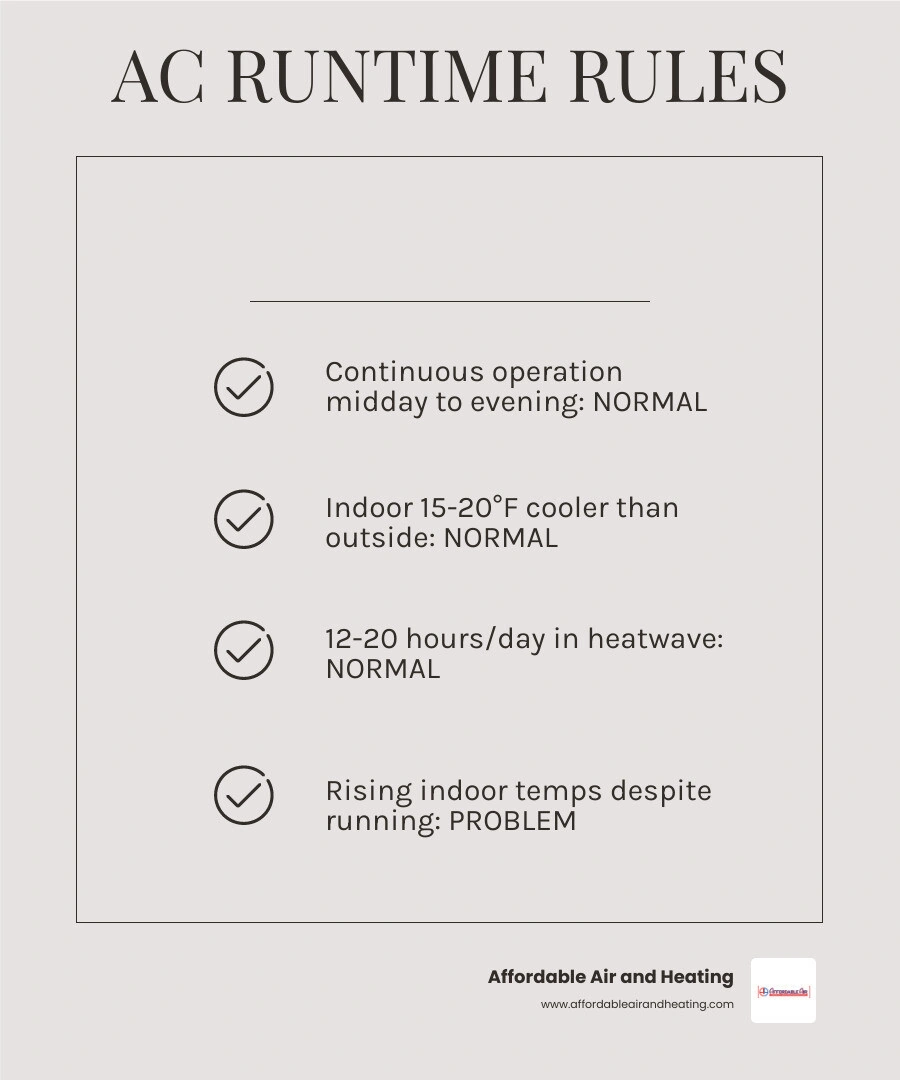
Is it normal for AC to run nonstop when temperatures exceed 100 degrees? Yes — and if you live in the Antelope Valley, it happens every summer. When outdoor temps climb past 100°F, your air conditioner is not broken. It is doing exactly what it was built to do: fight an enormous wall of heat, hour after hour, to keep your home livable.
Here is the short answer most homeowners need:
Quick Answer: AC Runtime in 100°F+ Heat
SituationNormal or Not?AC runs continuously from midday through eveningNormalIndoor temp stays 15–20°F cooler than outsideNormal (80°F indoors when it's 100°F out is expected)AC runs 12–20 hours per day during a heatwaveNormalIndoor temps keep rising despite AC runningPossible problemWarm air blowing from ventsPossible problemAC runs nonstop even at night in mild tempsPossible problem
Most residential AC systems are designed to maintain about 20 degrees cooler indoors than the outdoor temperature. So on a 105°F Antelope Valley afternoon, getting your home down to 85°F is a sign your system is actually working hard and doing its job. Expecting 68°F or 72°F indoors when it is scorching outside puts your system in an impossible position.
That said, nonstop runtime is not always just about the heat. Dirty filters, refrigerant issues, poor insulation, or an undersized unit can all force your AC to run around the clock — even when it should not have to. Knowing the difference between "working hard" and "working broken" is exactly what this guide is for.
Is it normal for ac to run nonstop when temperatures exceed 100 degrees?
In the high desert climates of Lancaster, Palmdale, and Santa Clarita, we are no strangers to the triple-digit mark. When you hear your outdoor condenser unit humming from 11:00 AM until long after the sun sets at 8:00 PM, your first instinct might be to worry about a breakdown. However, is it normal for ac to run nonstop when temperatures exceed 100 degrees? In the vast majority of cases, the answer is a resounding yes.
Air conditioners are sized based on "design temperatures"—the average summer highs for our specific region. They aren't usually sized for the absolute record-breaking peaks because a system large enough to instantly cool a home when it’s 115°F outside would be "oversized" for the rest of the year, leading to humidity problems and short cycling.
When the mercury hits 100°F, your home absorbs heat through the roof, windows, and walls at an incredible rate. Your AC must run continuously just to keep up with this "heat gain." If your system is not cooling properly in Palmdale, it may simply be that the outdoor load has exceeded the unit's maximum capacity to move heat out of the house.
Why your AC runs nonstop when temperatures exceed 100 degrees
To understand why the runtime becomes continuous, we have to look at how an AC actually works. It doesn't "create cold"; it removes heat. This happens via the refrigerant cycle. Refrigerant absorbs heat from your indoor air at the evaporator coil and carries it to the outdoor condenser unit to be released.
As outdoor temperatures rise, it becomes harder for the condenser to "dump" that heat into the already hot outside air. This makes the cycle less efficient. Furthermore, your AC has a second job: removing humidity. In May 2026, as we see shifting climate trends leading to more humid "monsoonal" surges in the Antelope Valley, your AC has to spend more energy wringing moisture out of the air before it can effectively lower the temperature. If the system can't reach thermal equilibrium (the point where it removes heat as fast as the sun adds it), it will simply stay on. If you suspect the cycle is failing due to a leak, you may need to detect refrigerant leaks in your AC unit to restore performance.
Realistic cooling expectations for desert climates
Living in areas like Santa Clarita or Rosamond requires a bit of a perspective shift regarding thermostat settings. The "20-degree rule" is the industry standard: most residential units are designed to create a 20-degree difference between the outdoor air and the indoor air.
If it is 105°F in Lancaster, your AC is doing a fantastic job if it keeps your living room at 80°F or 82°F. If you have your thermostat set to 72°F on a day like that, the unit will never reach the target, and therefore, it will never turn off. This is why we highly recommend an AC tune-up and maintenance in Canyon Country before the peak of summer hits; a clean, well-oiled machine has a much better chance of pushing that 20-degree limit to 22 or 23 degrees.
Signs Your Constant Runtime is a Problem vs. Normal Behavior
While nonstop running is often normal, it can sometimes mask a developing mechanical failure. You need to watch for "red flags" that indicate the system is struggling for the wrong reasons.
- Rising Indoor Temperatures: If the AC is running nonstop but the indoor temperature is actually going up (e.g., it was 78°F at noon and now it's 84°F at 4:00 PM), something is wrong.
- Warm Air from Vents: The air coming out of your registers should be roughly 15-20 degrees cooler than the air entering the return vent. If it feels lukewarm, your compressor might not be engaging.
- Frozen Coils: If you see ice on the copper lines leading to the outdoor unit or on the indoor coils, your AC is likely suffering from restricted airflow or low refrigerant. You should investigate why your AC is freezing up in Santa Clarita immediately to avoid compressor damage.
- Strange Sounds: Grinding, squealing, or banging sounds are never normal, regardless of the heat. If you hear these, check out how to fix loud AC noises in Valencia before the part fails completely.
Troubleshooting an AC running nonstop when temperatures exceed 100 degrees
Before you panic, there are several "DIY" checks you can perform. Often, the reason for a struggling AC is surprisingly simple:
- The Air Filter: A dirty filter is the #1 cause of service calls. It chokes the system, forcing it to run longer to move the same amount of air.
- The Outdoor Unit: Is it buried under dead leaves or overgrown shrubs? Your condenser needs "room to breathe" to release heat. Spraying the coils gently with a garden hose can also help wash away desert dust and improve efficiency.
- Thermostat Issues: Sometimes the sensor is simply off. If you’re having trouble, troubleshoot your AC thermostat in Lancaster to ensure it's sending the right signals.
- Airflow: Ensure all your supply vents are open. Closing vents in unused rooms actually increases pressure and can cause the system to work harder, not less. For more tips, read our guide on AC troubleshooting before calling a pro.
When to call a professional technician
If you’ve checked the filter and the outdoor unit and the house is still getting warmer, it’s time to call in the experts. Certain issues, like a failing capacitor or a refrigerant leak, cannot be fixed safely by a homeowner.
If your system is tripping the breaker in Lancaster, do not keep flipping it back on; this is a sign of a dangerous electrical overcurrent. Similarly, if your AC won't turn on at all in Santa Clarita, a professional diagnostic is the only way to ensure a long-lasting repair.
How to Help Your AC Survive a Triple-Digit Heatwave
When it's 100+ degrees, your AC is running a marathon. You wouldn't ask a marathon runner to carry a heavy backpack, so don't make your AC work harder than it has to.
Heatwave Management Strategies
ActionImpactWhy it worksSet Thermostat to 78°F+HighReduces the "gap" the AC has to bridge.Close Blinds/CurtainsMediumBlocks up to 30% of radiant heat from the sun.Use Ceiling FansMediumCreates a 4-degree "wind chill" effect on your skin.Pre-cool the HomeHighLower the temp to 72°F at 6:00 AM so the AC starts the day "ahead."
If you notice the indoor air isn't moving well even with the AC on, you might be dealing with AC fan problems, which can severely limit the system's ability to distribute cool air.
Reducing indoor heat load
Your AC isn't just fighting the sun; it's also fighting you. Every time you run the dryer, the dishwasher, or the oven, you are adding thousands of BTUs of heat directly into your home. In the Antelope Valley, we recommend doing laundry and heavy cooking after 8:00 PM or before 10:00 AM.
Additionally, check for air leaks. Cold air escaping through a gap under the door is literally throwing money away. Sealing these leaks and ensuring your condensate line is clear can also prevent AC water leaks in Palmdale, which often happen when a system runs for 15 hours straight and produces massive amounts of condensation.
Long-term efficiency upgrades
If your AC is more than 10-15 years old, it was likely built for a different era of energy standards. Modern systems with high SEER2 ratings are much better equipped for nonstop operation.
- Variable-Speed Compressors: Unlike standard units that are either "100% on" or "off," these units can throttle down to 30% or 50% capacity. This allows them to run nonstop very efficiently, maintaining a perfectly steady temperature without the big energy spikes of starting and stopping.
- Smart Thermostats: These can learn your schedule and automatically adjust for peak demand times in California, saving you money while keeping you comfortable.
- Proper Sizing: If your system has always struggled, it might be undersized. A professional load calculation can determine if you need a larger unit or if you need to fix AC short cycling issues caused by an oversized unit.
Frequently Asked Questions about Extreme Heat AC Performance
How many hours a day should my AC run in 100-degree weather?
It is perfectly normal for an AC to run 12 to 16 hours a day during a heatwave. On days exceeding 105°F, it is common for the unit to start running at noon and not click off until 9:00 or 10:00 PM. This "continuous duty" is expected behavior during peak summer months.
Is it bad for the compressor to run all day?
As long as the system is well-maintained and has proper airflow, compressors are designed to handle long runtimes. In fact, starting and stopping (cycling) actually causes more wear and tear on a compressor than running at a steady state. The real danger is running nonstop when there is a problem, like a dirty coil, which causes the compressor to overheat.
Will my energy bill spike from continuous running?
Yes. Every degree you set your thermostat below 78°F can increase your cooling costs by about 8%. During a 100-degree week, your "duty cycle" (the percentage of time the AC is on) jumps from maybe 50% to nearly 90%. To keep costs manageable, use the "pre-cooling" method and keep your filters crystal clean.
Conclusion
At Affordable Air and Heating, we’ve been keeping the Antelope Valley cool since 1996. We know that when the temperature hits 100 degrees in Acton, Lancaster, or Santa Clarita, your peace of mind is just as important as your thermostat reading.
Remember: is it normal for ac to run nonstop when temperatures exceed 100 degrees? Usually, yes! It’s just your system doing the heavy lifting to keep your family safe. However, if that constant running is paired with rising temperatures, odd noises, or frozen pipes, don't wait for the system to fail completely.
Whether you need a quick repair in Quartz Hill or a full system upgrade in Stevenson Ranch, our family-owned team is here to provide energy-efficient, affordable solutions tailored to our unique desert climate.
Contact our team for expert air conditioning services in the Antelope Valley today and let us help you stay comfortable all summer long!