Why the Antelope Valley Desert Climate Is So Hard on Your AC System
How the Antelope Valley desert climate affects your AC system is something every Lancaster and Palmdale homeowner needs to understand — especially heading into another brutal summer. This region pushes residential HVAC equipment harder than almost anywhere else in California, combining 100°F+ heat, fine blowing dust, tumbleweed-choked outdoor units, and near-freezing winter nights into one relentless cycle of wear and strain.
Here's a quick summary of the key ways the High Desert climate impacts your AC:
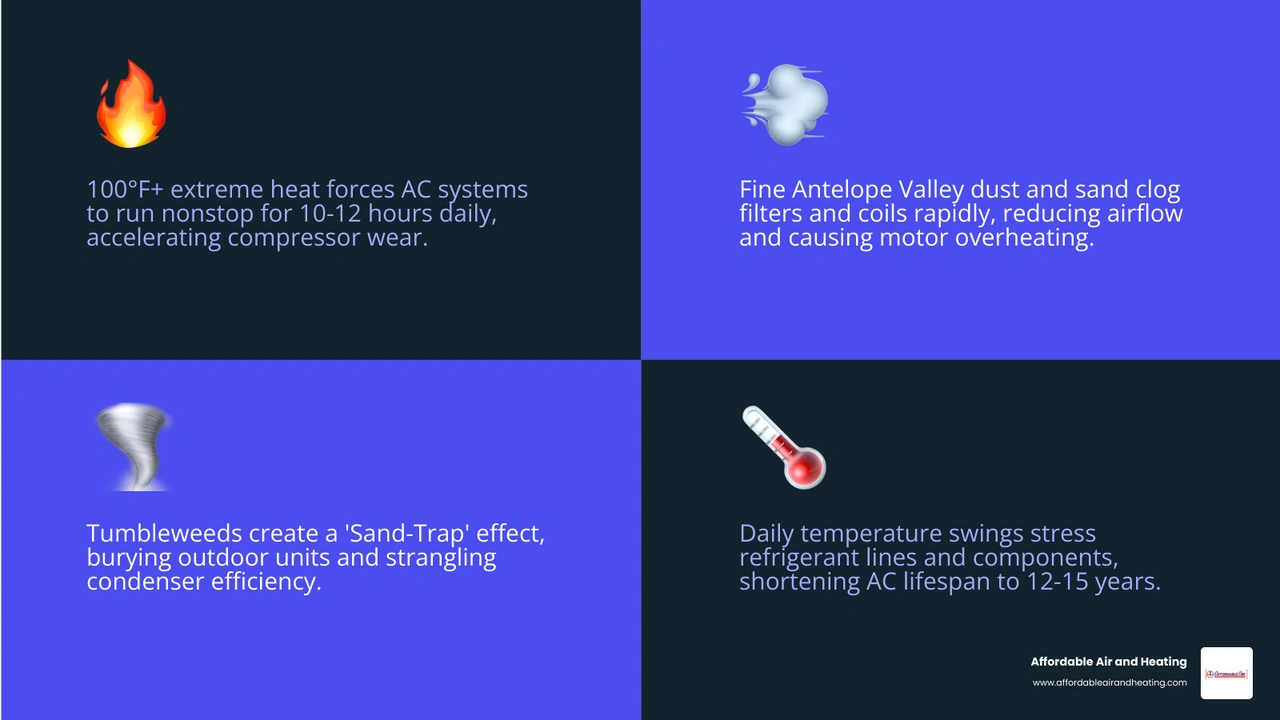
- Extreme heat (100°F+): Forces your system to run nonstop, accelerating compressor wear and raising energy bills
- Fine dust and sand: Clogs filters and coil fins rapidly, reducing airflow and causing motors to overheat prematurely
- The "Sand-Trap" Effect: Tumbleweeds and dust can bury outdoor condenser units, strangling efficiency
- Temperature swings: Hot days followed by cold winter nights stress refrigerant lines and electrical components year-round
- High pollen and particulates: Degrade indoor air quality and demand more frequent filter changes than in coastal climates
- Shorter system lifespan: Desert AC units typically last 12–15 years versus 15–20 years in milder California climates
One West Lancaster homeowner described it well — a single windstorm blew enough dust into the vents to cause a complete AC failure. A professional cleaning brought the system back, but the damage had already been done to the motor. That story isn't unusual here.
Whether your system is struggling to keep up on triple-digit afternoons or your utility bills are climbing faster than the thermometer, understanding what's happening inside your equipment is the first step toward fixing it.
The Unique Challenges of High Desert Heat and Dust
Living in areas like Lancaster and Palmdale means coexisting with a landscape that is as beautiful as it is harsh. The Antelope Valley is famous for its 100°F+ summers, but for your air conditioner, those temperatures are a daily battle for survival. Unlike coastal regions where the AC might kick on for a few hours in the afternoon, High Desert systems often run for 10 to 12 hours straight just to maintain a livable indoor temperature.
Beyond the heat, we have the "AV Dust." This isn't your average household dust; it’s a fine, silty sand that can penetrate the smallest crevices. When the wind picks up in Quartz Hill or Antelope Acres, that sand is sucked directly into your HVAC system. This leads to a cascade of issues, from clogged internal components to poor Indoor Air Quality Lancaster CA. If you hear your unit grinding or struggling, you likely need AC Repair Lancaster CA before a small dust problem becomes a total motor burnout.

I'm worried about the dust in Lancaster. How can I improve my home's air quality?
If you feel like you're dusting your furniture every single day, imagine what's happening inside your lungs and your AC unit. To combat the desert's fine particulate matter, we recommend moving beyond standard fiberglass filters. Switching to a higher MERV (Minimum Efficiency Reporting Value) rating can trap significantly more pollen and sand. However, be careful—filters that are too thick can actually restrict airflow in older systems.
Regular AC Service Lancaster CA is the best way to ensure your filtration is optimized. We can help you select the right filter and check your ductwork for leaks where desert dust might be sneaking in.
Why do AC systems struggle more during Antelope Valley heat waves?
When triple-digit temperatures hit, your AC doesn't just "create cold." It works by removing heat from inside your home and dumping it outside. When it's 110°F on your patio, the outdoor unit has a much harder time releasing that heat. This is known as poor heat expulsion.
The system has to work at maximum capacity for hours, which can lead to thermal overload. This is a primary reason for Solving AC Breaker Tripping Lancaster. If your system is pulling too much power trying to fight the heat, it will trip the breaker to prevent a fire—a clear sign the desert climate is winning.
How the Antelope Valley Desert Climate Affects Your AC System
The sheer physics of the desert are stacked against your HVAC. In August 2024, ground temperatures in Lancaster were recorded as high as 150°F. Your outdoor condenser unit sits just inches above that radiating heat. This creates massive compressor strain, as the unit is essentially trying to cool itself down with hot, shimmering air.
We also see the "Sand-Trap" effect frequently. This occurs when the wind blows tumbleweeds against your outdoor unit, which then act as a net to catch sand and debris. Within a few weeks, your unit can be literally buried, killing its efficiency. Regular AC Maintenance Lancaster CA is vital to clear these obstructions and Fix AC Short Cycling Lancaster before the constant stopping and starting destroys your compressor.
Understanding how the Antelope Valley desert climate affects your AC system during heat waves
During a heat wave, your AC experiences "high duty cycles." This means it’s running nearly 100% of the time. In milder climates, the system gets to rest, allowing lubricants to settle and components to cool down. In the High Desert, that rest period doesn't exist. This leads to accelerated wear on capacitors and fan motors. If you notice your AC Not Cooling Properly Palmdale, it’s often because a small electrical component has literally "cooked" under the relentless sun.
How the Antelope Valley desert climate affects your AC system and energy bills
It’s no secret that utility bills in Palmdale and Lancaster can triple during the summer. When how the antelope valley desert climate affects your ac system becomes a financial burden, it’s usually due to efficiency loss. A system clogged with sand or low on refrigerant has to run 30% longer to achieve the same cooling effect. Proactive AC Maintenance Antelope Acres CA ensures you aren't paying for wasted energy.
My AC is struggling with the Palmdale heat. Is it time for a high-efficiency replacement?
If your unit is more than 10 years old, it was likely built under older SEER (Seasonal Energy Efficiency Ratio) standards. Modern units are now rated under SEER2, which is a much more stringent testing standard that accounts for the high-pressure conditions we see in the desert.
Upgrading to a high-SEER2 unit can save you up to 30% on your utility bills. In the desert, where we use our AC 2-3 times more than people on the coast, those savings add up fast. If you're tired of constant repairs, AC Replacement Lancaster CA or a fresh AC Installation Lancaster CA can provide the "desert-ready" reliability you need.
TABLE: Energy Consumption Comparison in Desert Climates
| Unit Type | SEER Rating | Estimated Monthly Summer Bill* | Expected Lifespan in AV |
|---|---|---|---|
| Old Standard | 10 SEER | $450 - $600 | 10-12 Years |
| Modern Entry | 14.3 SEER2 | $320 - $400 | 12-15 Years |
| High Efficiency | 18+ SEER2 | $220 - $280 | 15+ Years |
*Estimates based on average 1,500 sq ft home during July/August peak.
Benefits of 'Desert-Ready' HVAC Upgrades
The best systems for our climate often feature variable-speed compressors. Unlike traditional units that are either "all on" or "all off," variable-speed systems can dial their power up or down. This is perfect for the High Desert, where you might need a little cooling in the morning but maximum power by 3:00 PM.
We also see many residents moving toward Heat Pump Installation Antelope Acres CA. Modern heat pumps are incredibly efficient at both cooling and heating, handling our freezing winter nights and scorching summers with ease. For specific rooms or additions, Mini Split AC Antelope Acres CA offers targeted cooling without the energy loss associated with desert ductwork.
Improving Home Insulation for Extreme Temperatures
Even the best AC will struggle if your home is "leaking" cold air. In the Antelope Valley, attic temperatures can reach 160°F. If your Insulation Lancaster CA is thin or old, that heat radiates directly through your ceiling. Adding blown-in insulation or spray foam, combined with weather stripping around doors, acts as a thermal barrier that keeps the desert where it belongs—outside.
Essential Maintenance to Prevent Premature Motor Burnout
In the desert, maintenance isn't a luxury; it's a survival tactic for your machinery. The most important thing you can do is change your air filters every 30 to 45 days. During peak wind and dust seasons, you might even need to do it every 30 days. A clogged filter forces the blower motor to work twice as hard, leading to a "cascading failure" where one part burns out another.
You also need to keep your outdoor coils clean. When sand coats the metal fins of your condenser, it acts as an insulator, trapping heat inside the system. Professional AC Service Antelope Acres CA includes a deep cleaning of these coils. This also helps Prevent AC Water Leaks in Palmdale, as a struggling system can cause the evaporator coils to freeze and then thaw, flooding your drain pan.
The 'Sand-Trap' Effect and Your Outdoor Unit
We can't stress this enough: check your outdoor unit after every windstorm. Tumbleweeds love to lodge themselves between the unit and your house. This blocks airflow, causing the system to overheat in minutes. If you find your unit is acting up, a quick AC Repair Antelope Acres CA call can clear the debris and check for any damage caused by the obstruction.
Professional Tune-Ups for High Desert Reliability
A desert tune-up should be more comprehensive than a standard one. We focus on:
- Refrigerant levels: High heat causes pressure changes that can expose tiny leaks.
- Capacitor testing: These are often the first things to "pop" during a heat wave.
- Electrical inspections: Ensuring all connections are tight and haven't been compromised by heat expansion.Regular Heat Pump Maintenance Antelope Acres CA ensures that your dual-purpose system is ready for the 40-degree temperature swings we often see in a single 24-hour period.
Vehicle AC Precautions for Desert Travel on US-395
If you’re driving between Victorville and Olancha on US-395, you’re crossing one of the most demanding stretches of road in the country. The heat here doesn't just affect your home; it's a major threat to your vehicle's AC and engine. When you stop at a light in 110°F heat, your car's AC compressor is working at its absolute limit while receiving very little natural airflow.
How to Manage Your Car's AC During Extreme Heat
To protect your vehicle, try to travel during off-peak hours—early morning or after sunset. If you must drive during the day, don't just blast the AC on "Max" immediately. Open the windows for a minute to let the 140°F trapped air escape first. If you notice your engine temperature gauge climbing while the AC is on, turn the AC off and, if necessary, turn on the heater to help pull heat away from the engine. It’s uncomfortable, but it can save you from a breakdown.
Emergency Steps for Overheating Vehicles
If your car overheats on US-395:
- Pull over safely: Get as far off the road as possible.
- Seek shade: Use an umbrella if you have one; sitting in a car at 120°F is dangerous.
- Stay hydrated: Always carry extra water for yourself and your radiator.
- Cooling Centers: If you are near Lancaster or Palmdale, head to a public library or senior center to cool down while you wait for a tow.
Frequently Asked Questions about Antelope Valley AC Systems
What are the most common signs of AC failure in the High Desert?
Weak airflow is usually the first sign—often caused by a dust-clogged filter or a failing blower motor. If your vents are blowing warm air, you likely have a refrigerant issue or a compressor that has overheated. Listen for unusual grinding or squealing noises, which usually indicate that sand has gotten into the bearings. Finally, "short cycling" (the unit turning on and off rapidly) is a major red flag.
How often should I change my air filters in Lancaster or Palmdale?
While the package might say "90 days," that doesn't apply to the Antelope Valley. During the peak summer season or after a major dust storm, you should change them every 30 days. If you have pets or high pollen allergies, check them every 3 weeks.
Where can I find cooling centers during an AC breakdown?
If your AC fails during a heat wave, don't risk heat stroke. The Lancaster Regional Library, the Antelope Valley Senior Center, and various public facilities in Palmdale serve as official cooling centers. You can also visit local shopping malls or movie theaters to stay safe while waiting for repairs.
Conclusion
The Antelope Valley desert climate is unforgiving, but your home comfort doesn't have to suffer. At Affordable Air and Heating, we’ve been family-owned and operated since 1996, which means we’ve seen every "Sand-Trap" and dust-clogged motor the High Desert can throw at us. We specialize in "desert-ready" solutions that are built to withstand 110°F afternoons and freezing winter nights.
Whether you need a quick repair in Antelope Acres or a full high-efficiency system installation in Lancaster, we are here to provide affordable, reliable service. Don't let the desert heat take you by surprise this year.
Ready to upgrade to a desert-tough system? Contact our experts today.