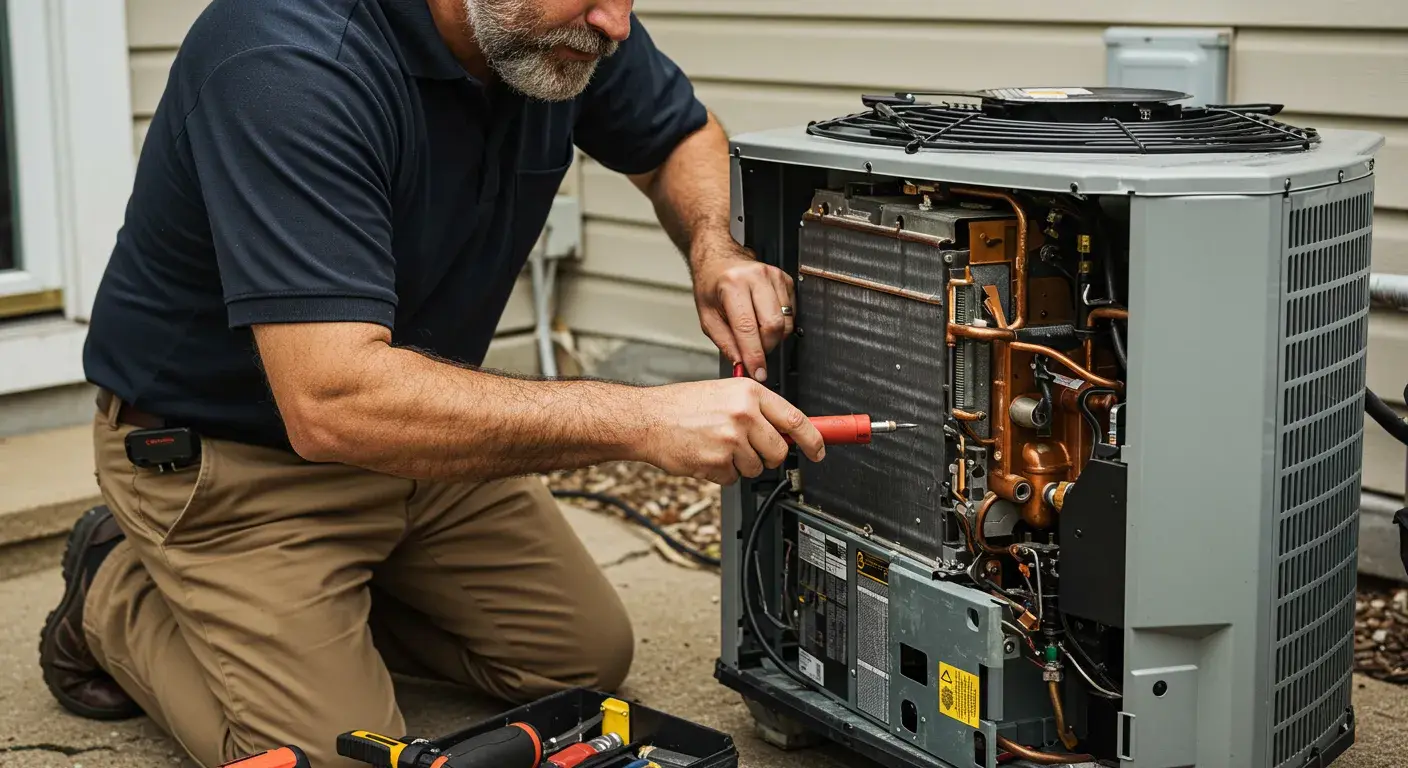
My AC is freezing up in the middle of summer. Who can fix a frozen evaporator coil in Lancaster?
A frozen evaporator coil in desert heat sounds like a contradiction — but it's one of the most common AC problems Antelope Valley homeowners face every summer. If your system is blowing warm air, you're noticing ice on the copper lines, or there's a puddle forming around your indoor air handler, your evaporator coil may be frozen solid.
Here's the quick answer to what causes it:
- Dirty or clogged air filter — the most common cause, responsible for roughly 60% of frozen coil cases
- Low refrigerant from a leak — causes pressure to drop, pushing coil temperatures below freezing
- Hard water mineral scale — builds up on coil fins, blocking heat exchange
- Blocked or closed vents — restricts airflow and starves the coil of warm return air
- Failing blower motor — reduces airflow gradually, often without obvious warning signs
The cruel irony is that extreme desert heat makes the problem worse, not better. When it's 105°F outside, your system runs almost nonstop — and any small restriction in airflow or refrigerant pressure compounds quickly into a full freeze-up. Running the system while it's frozen can turn a simple filter swap into a major compressor replacement.
The sections below walk you through exactly what's happening inside your system, how to tell what's causing it, and what to do right now if you've discovered ice.

Frozen evaporator coil in desert heat what causes it terms at a glance:
- AC troubleshooting before calling a pro
- AC not cooling but running what to check first
- Circuit breaker tripping when AC turns on what to do
The Summer Paradox: Frozen Evaporator Coil in Desert Heat What Causes It?
It seems completely counterintuitive. The California sun is blazing down on Lancaster or Palmdale, the dry wind is howling, and your outdoor thermometer is pushing past triple digits. Yet, inside your home's air handler, your air conditioner has literally turned itself into an ice block. How is this thermodynamically possible when it is so hot outside?
To understand this summer paradox, we have to look at how an air conditioner actually works. Your AC does not "create" cold air. Instead, it functions as a heat transfer loop, removing heat from your indoor air and releasing it outdoors.
The indoor evaporator coil is the heart of this process. Extremely cold, low-pressure liquid refrigerant circulates through the copper tubing of the evaporator coil. As warm, dusty return air from your home is blown across this coil, the refrigerant absorbs the heat from the air. This heat transfer causes the refrigerant to evaporate into a gas, while the newly cooled air is distributed back into your living spaces.

However, this process relies on a delicate balance of pressure, airflow, and temperature. If anything disrupts the system's ability to transfer heat from your indoor air to the refrigerant, the temperature of the physical evaporator coil will rapidly drop below 32°F.
Because your air conditioner also naturally dehumidifies the air as it cools, moisture begins to condense on the cold metal fins of the coil. Under normal circumstances, this condensation drips harmlessly into a drain pan. But when the coil's surface temperature drops below freezing, that condensation instantly freezes into a layer of frost.
In the extreme high-heat conditions of July 2026, your system is subjected to AC Running Constantly in Desert Heat. This continuous operation means that once a tiny layer of frost forms, it has no time to melt. The ice acts as a thick insulating blanket, preventing what little warm air is left from reaching the refrigerant. This triggers a rapid, compounding feedback loop: the coil gets even colder, more moisture freezes, and within hours, your evaporator coil is completely encased in a solid block of ice.
Airflow Restrictions and Desert Dust Clogging Your System
When investigating a frozen evaporator coil in desert heat what causes it, airflow restriction is the absolute first place you should look. In fact, nearly 60% of all frozen coil cases are caused by simple airflow neglect.
Your evaporator coil requires a constant, heavy volume of warm indoor air passing over its fins to keep the refrigerant inside from getting too cold. If that airflow is choked off, the refrigerant will quickly drop the coil's temperature below the freezing point.
In our high-desert climate, airflow issues are heavily accelerated by our local environment. Dust, sandstorms, and fine particulate matter are constantly airborne throughout the Antelope Valley. When your system draws air in through the return vents, it carries this heavy dust load directly into your HVAC system. If your system is starved of air, the static pressure within your ductwork climbs, forcing your blower motor to work significantly harder against a wall of resistance. Over time, this high static pressure can degrade your blower motor capacitor or burn out the motor entirely, leading to a complete loss of airflow and an immediate freeze-up.
To keep your system running smoothly, it helps to understand How the Antelope Valley Desert Climate Affects Your AC System and how local dust storms demand a much stricter maintenance schedule than in other parts of the country.
How Dirty Filters Trigger a Frozen Evaporator Coil in Desert Heat What Causes It
The humble air filter is your system's primary shield against desert dust, but it is also the single most common cause of a frozen AC. When a filter becomes heavily loaded with dust, pet dander, and airborne debris, it acts like a solid wall, choking off the warm return air that your evaporator coil desperately needs.
Many homeowners purchase high-efficiency filters with MERV ratings of 13 or higher, believing they are doing their system a favor. However, in a dusty desert environment, these tightly woven filters clog incredibly fast and create massive airflow restrictions. We generally recommend using high-quality MERV 8 to MERV 11 filters, which provide excellent filtration without dangerously restricting your system's airflow.
If you live in windy areas like Santa Clarita, Lancaster, or Palmdale, dust storms and seasonal winds can clog a standard filter in as little as six weeks. If you are wondering Why My AC Freezing Up in Santa Clarita, a quick check of your air filter is almost always the best starting point.

Hard Water Scale and Mineral Buildup on Desert Coils
While dusty filters are a well-known issue, there is a silent, desert-specific culprit that many homeowners completely overlook: hard water scale.
Water in the Antelope Valley and surrounding desert regions is notoriously hard, often containing high concentrations of calcium and magnesium minerals. Over years of operation, as your AC pulls moisture out of your home's air, this mineral-heavy water condenses on the evaporator coil. As the water drains away, it leaves behind microscopic mineral deposits.
Over time, these deposits accumulate into a tough, chalky layer of white scale on your copper tubing and aluminum coil fins. This scale acts as an extremely effective thermal insulator. Just like scale inside a water heater, it prevents the warm indoor air from effectively transferring its heat to the cold refrigerant inside the coil. Even if your air filter is brand new and your airflow is strong, the refrigerant remains too cold because the scale is blocking heat exchange, eventually driving the coil temperature below 32°F and starting the freezing process.
Refrigerant Leaks and Pressure Drops in Extreme Heat
If you have verified that your air filters are clean and your airflow is completely unrestricted, the next highly likely culprit is a refrigerant issue.
Your air conditioner is a sealed, closed-loop system. It does not "consume" or "use up" refrigerant over time. If your system is low on refrigerant, it is because a physical leak has developed somewhere in the copper lines, the outdoor condenser coil, or the indoor evaporator coil itself.
When a leak occurs, the overall volume of refrigerant in the system drops. This loss of volume causes a corresponding drop in suction pressure within the evaporator coil. According to the laws of thermodynamics, as the pressure of a gas drops, its temperature drops as well. When the pressure falls below its engineered design limit, the boiling point of the refrigerant drops below 32°F, turning your evaporator coil into an active ice machine.
Running an AC under these conditions is incredibly dangerous for your system. If the coil freezes, liquid refrigerant can fail to evaporate fully. This unevaporated liquid can travel back down the suction line directly into your outdoor compressor. Because compressors are designed to compress gas, not liquid, this phenomenon — known as "liquid slugging" — can instantly shatter the internal valves of your compressor, leading to a catastrophic system failure.
Understanding Why Is Your AC Unit Frozen is crucial to protecting your compressor before a minor leak turns into a complete system replacement.
Low Refrigerant Levels: Frozen Evaporator Coil in Desert Heat What Causes It
It seems counterintuitive that less cooling chemical would make a system get colder, but that is the exact physical reality of low refrigerant.
When your system has a proper, full charge of refrigerant, it evaporates evenly across the entire surface of the evaporator coil, maintaining a safe operating temperature above freezing. When the charge is low, the pressure drop causes the refrigerant to boil off almost immediately as it enters the coil. This creates a localized, super-cold zone right at the beginning of the coil. Moisture in the air freezes instantly on this specific section.
As ice builds up on the first few rows of the coil, it blocks the passage of air through those sections. This localized airflow blockage then starves the rest of the coil of warm air, causing the freezing to spread rapidly until the entire evaporator coil is encased in a solid block of ice.
If your system is running constantly but your home is steadily getting warmer, you should review our guide on AC Not Cooling But Running: What to Check First to determine if a refrigerant leak is actively icing your system.
How to Diagnose and Safely Thaw Your Frozen AC
If you suspect your system is frozen, you must take action immediately to prevent permanent damage to your compressor. Here is our step-by-step guide to safely diagnosing and thawing your system:
- Turn the AC Off Immediately: Go to your thermostat and switch the system from "Cool" to "Off". This stops the compressor from running and prevents further ice accumulation and potential liquid slugging.
- Switch the Fan to "On": Change your thermostat's fan setting from "Auto" to "On". This forces your indoor blower motor to run continuously, pulling warm indoor air across the frozen coil to speed up the melting process naturally.
- Never Use Artificial Heat: Do not attempt to speed up the process with a hairdryer, heat gun, or propane torch. The extreme thermal shock can warp your delicate aluminum fins and cause micro-cracks in your copper refrigerant lines, creating refrigerant leaks.
- Prepare for Water Melt: A fully frozen coil holds a massive volume of water. As it melts, this water will rush down into your condensate pan. Ensure your drain line is clear and place towels or buckets around your indoor air handler cabinet to prevent localized water damage to your ceiling, walls, or floors.
- Inspect the Air Filter: While the system is thawing, slide out your air filter. If you cannot clearly see light through it when holding it up to a light bulb, it must be replaced.
Once the system is completely thawed (which usually takes 4 to 12 hours depending on the severity of the ice), you can perform some basic diagnostics to determine whether you are dealing with an airflow restriction or a refrigerant leak:
| Symptom / Inspection | Likely Airflow Issue | Likely Refrigerant Leak |
|---|---|---|
| Air Filter Condition | Heavily clogged, dusty, or black | Clean or recently replaced |
| Supply Vents | Weak, barely noticeable airflow | Strong airflow, but the air is warm |
| Ice Location | Evenly distributed across the entire coil | Concentrated heavily at the start of the coil |
| System Behavior | Freezes up after several hours of running | Freezes up rapidly within 30 to 60 minutes of starting |
| Outdoor Copper Line | Cold and wet, but not iced | Encased in ice all the way to the outdoor unit |
Frequently Asked Questions About Frozen AC Coils in the Desert
How long does it take for a frozen AC coil to thaw in desert heat?
Depending on how thick the ice accumulation is, it typically takes between 4 and 6 hours for a frozen coil to thaw completely if you switch your thermostat fan setting to "ON" and turn the cooling mode "OFF". If the ice has grown so severe that it has traveled down the copper lines and into your walls, it can take up to 12 to 24 hours to melt fully. Do not turn the cooling mode back on until you are certain all ice has melted.
Can I run my AC if only the outdoor copper lines have ice?
Absolutely not. If you see ice forming on the large, insulated copper suction line connected to your outdoor condenser unit, it is a direct warning sign that your indoor evaporator coil is already completely frozen solid. Running your system in this state forces your compressor to work under extreme stress against blocked airflow, which can easily lead to liquid refrigerant backing up and destroying your compressor motor. Turn the system off immediately.
How often should I change my air filter in the Antelope Valley?
While standard manufacturer guidelines often suggest changing filters every 90 days, our local high-desert environment demands a much more frequent schedule. Because of the constant wind, blowing sand, and seasonal dust storms in cities like Lancaster, Palmdale, and Santa Clarita, we highly recommend checking your air filter once a month during the peak summer cooling season. Most desert homes require a fresh filter every 6 to 8 weeks to maintain proper static pressure and prevent coil freeze-ups.
Conclusion
A frozen evaporator coil in desert heat is a serious issue that requires prompt attention to prevent severe system damage. Whether your freeze-up is caused by a simple clogged filter, a buildup of hard water mineral scale, or a low refrigerant charge from a system leak, early diagnosis and proper thawing are key to protecting your investment.
At Affordable Air and Heating, we have been helping families throughout the Antelope Valley stay comfortable since 1996. As a family-owned business, we pride ourselves on delivering honest, energy-efficient solutions and reliable repairs to our neighbors in Lancaster, Palmdale, Santa Clarita, Saugus, Valencia, and the surrounding communities.
If your system is struggling to keep up with the summer heat, or if you are dealing with a persistently freezing coil, don't risk damaging your compressor. Schedule professional air conditioning services with our experienced team today, and we will get your home back to the cool, comfortable sanctuary it should be.