Why Your AC Is Running But Not Cooling — and What to Do Right Now
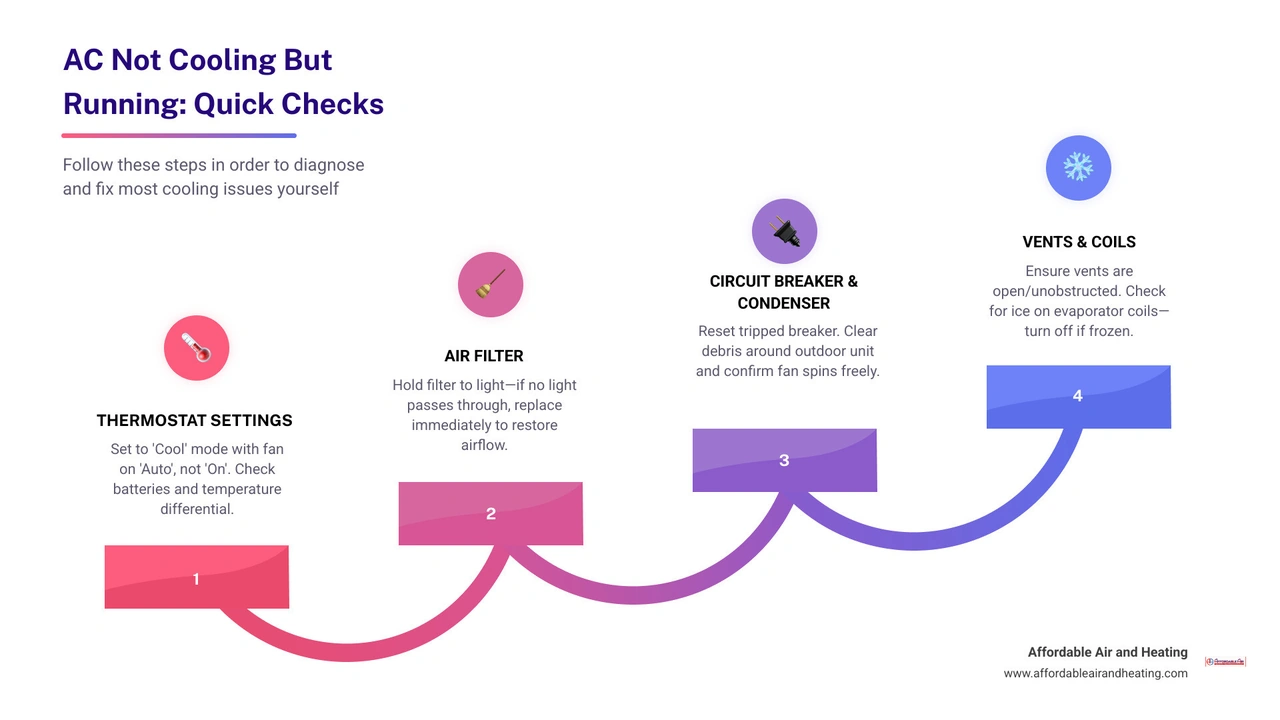
If you're dealing with ac not cooling but running, here's what to check first, in order:
- Thermostat settings — Make sure it's set to "Cool" mode with the fan on "Auto," not "On"
- Air filter — Hold it up to light; if no light passes through, replace it immediately
- Circuit breaker — Check if the breaker for your outdoor unit has tripped
- Outdoor condenser — Clear any debris and make sure the fan is spinning
- Supply vents and registers — Confirm all vents are open and unobstructed
- Frozen evaporator coil — Look for ice on the indoor unit or copper lines; turn the system off if you spot any
- Refrigerant leak signs — Listen for hissing or bubbling sounds near the indoor or outdoor unit
If none of these quick checks solve it, it's time to call a licensed HVAC technician.
There's a specific kind of frustration that hits when your AC is clearly running — the fan is blowing, the system is humming — but the air coming out just isn't cold. For homeowners in the Antelope Valley, where summer temperatures routinely push past 100°F, a cooling failure isn't just uncomfortable. It can be a genuine health concern.
The good news? Most of the time, the cause is something straightforward. A dirty air filter alone is responsible for roughly nine out of ten service calls for poor AC cooling. A simple thermostat setting — like the fan being switched to "On" instead of "Auto" — can make it feel like your system has stopped cooling entirely, even when nothing is actually broken.
This guide walks you through every realistic cause, starting with the easiest checks and working toward the issues that need a professional.
AC Not Cooling But Running: What to Check First
When May 2026 brings that familiar Antelope Valley heat, your air conditioner becomes the most important appliance in your home. If the unit is humming but the temperature is rising, we recommend a systematic approach. Before you assume the worst, there are several "low-hanging fruit" items you should inspect.

Why is my ac not cooling but running what to check first on the thermostat?
It sounds overly simple, but you would be surprised how many "no-cool" calls in Lancaster and Palmdale end with just a click of a button.
- Mode Verification: Ensure the thermostat is actually set to "Cool." During seasonal transitions, it's easy to forget it was left on "Heat" or "Off."
- The "Auto" vs. "On" Trap: This is a big one. If your fan is set to "On," the blower runs 24/7, even when the cooling cycle is off. This circulates unconditioned, humid air throughout your home, making it feel like the AC isn't working. Always keep it on "Auto."
- Temperature Differential: Set the temperature at least 5 degrees below the current room temperature to "call" for cooling.
- Dead Batteries: If your thermostat screen is blank or fading, it might not be sending the signal to the outdoor unit. Replace the batteries as a first step.
For more detailed steps, see our guide on AC Thermostat Troubleshooting in Lancaster.
Clogged air filters: ac not cooling but running what to check first for airflow
In the high-desert environment of Palmdale and Lancaster, dust is a constant battle. A dirty air filter is the culprit in nine out of ten service calls for poor cooling. When a filter is clogged, it acts like a wall, preventing air from reaching the evaporator coil.
- The Light Test: Remove your filter and hold it up to a light source. If you can’t see light passing through the fibers, it's finished.
- Energy Impact: Swapping a clogged filter for a clean one can reduce your air conditioner's energy consumption by 5% to 15%.
- Replacement Schedule: During peak summer months, check your filter every 30 days. If you have pets or live in a high-dust area like Antelope Acres, you may need to replace it more frequently.
If you've checked these and the air is still lukewarm, you may need to perform some AC Troubleshooting Before Calling a Pro to rule out power issues. Sometimes, a power surge from a summer storm can cause Solving AC Breaker Tripping Lancaster, where the indoor fan runs but the outdoor compressor stays off.
Troubleshooting Airflow and Ductwork Issues in Antelope Valley
Even if your AC is producing cold air, it won't do you any good if that air can't reach your living spaces. Airflow issues are often hidden but highly impactful.
Blocked Vents and Registers
We often find that homeowners accidentally block their own cooling. Ensure that furniture, heavy drapes, or rugs aren't covering supply registers or return vents. Closing vents in unused rooms is another common mistake; it doesn't save energy. Instead, it increases pressure in the ductwork, which can lead to leaks or a frozen coil.
The Hidden Loss: Ductwork Leaks
According to the Department of Energy, the average home loses 20-30% of its conditioned air through duct leaks. In places like Santa Clarita or Canyon Country, where ductwork often runs through hot attics, a leak means you are paying to cool your attic instead of your bedroom. If you notice weak airflow or some rooms are significantly warmer than others, you may be dealing with AC Not Cooling Properly in Palmdale due to duct integrity issues.
Checking the Outdoor Condenser and Indoor Evaporator Coils
Your AC doesn't "create" cold; it removes heat. This process relies on two sets of coils. If either set is dirty or obstructed, the heat transfer stops.
The Outdoor Condenser Unit
The outdoor unit needs to "breathe" to release the heat it gathered from inside.
- Clearance: Maintain at least a 2-foot perimeter around the unit. Trim back any shrubs, weeds, or grass.
- Cleaning: Use a garden hose (never a pressure washer!) to gently rinse away dust and debris from the fins.
- Fan Check: Ensure the fan on top of the unit is spinning. If it's stationary but the unit is humming, you might have a bad capacitor or fan motor.
The Indoor Evaporator Coil
If airflow is restricted by a dirty filter or low refrigerant, the indoor coil can drop below freezing. Moisture from the air then turns to ice, creating a literal block of ice that prevents cooling.
- Signs of Freezing: Look for frost on the copper refrigerant lines or water puddling around the indoor unit.
- The Thawing Process: If you see ice, turn the AC off immediately at the thermostat but turn the "Fan" to "On." This helps melt the ice. Do not restart the cooling until the ice is completely gone.
- Root Causes: For a deeper dive, read about Why My AC Freezing Up in Santa Clarita.
Recognizing Signs of Low Refrigerant or Electrical Failure
If your filters are clean and the coils are clear, the problem may be mechanical or chemical.
Refrigerant Leaks
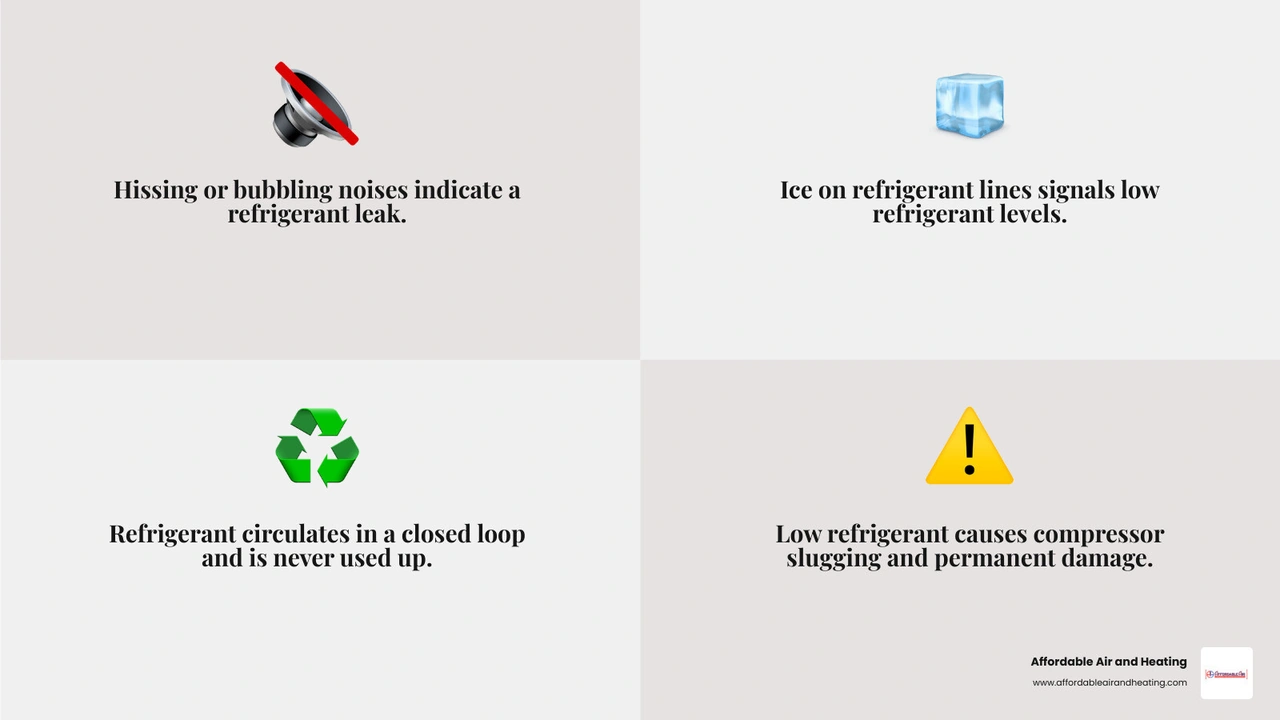
Refrigerant circulates in a closed-loop system; it is never "used up" like gasoline. If it is low, you have a leak.
- Symptoms: Hissing or bubbling noises, ice on the lines, and the AC running constantly without the temperature dropping.
- The Danger: Running a system with low refrigerant can cause "slugging," which permanently destroys the compressor.
- Professional Fix: You cannot DIY a refrigerant recharge. It requires EPA certification and specialized equipment to Detect Refrigerant Leaks AC Units.
Electrical Failures
Summer heat in the Antelope Valley puts immense stress on electrical components.
- Bad Capacitor: This part acts like a high-powered battery to jump-start the motor. If it fails, the unit may click or hum but won't start.
- Compressor Failure: This is the "heart" of the system. If it fails, the unit will run its fans but provide zero cooling.
When to Call a Professional for AC Repairs in Palmdale
While we encourage homeowners to handle basic maintenance, some jobs are simply too dangerous or complex for DIY.
| Symptom | Likely Cause | Fix Level |
|---|---|---|
| Lukewarm air, dirty filter | Airflow restriction | DIY (Replace Filter) |
| System won't start, blank screen | Thermostat batteries | DIY (Replace Batteries) |
| Unit hums but fan doesn't spin | Bad Capacitor | Professional |
| Hissing sound, ice on lines | Refrigerant Leak | Professional (EPA Required) |
| Frequent breaker trips | Electrical Short | Professional |
| AC keeps turning on and off | Short Cycling | Professional |
If your system is short cycling in Lancaster or won't turn on in Santa Clarita, it’s best to Detect AC Issues Early in Palmdale before a small part failure leads to a total system replacement.
Frequently Asked Questions About AC Cooling Problems
How long should it take for my AC to start cooling after basic checks?
Once you’ve resolved a simple issue like a dirty filter or a thermostat setting, you should feel a noticeable difference in air temperature within 15 to 30 minutes. Under normal conditions, a healthy AC should be able to lower your home's temperature by about 1 degree every 30 to 60 minutes.
Could my AC unit be undersized for my home?
If your AC runs constantly but never reaches the set temperature — especially after you've added a room or a sunroom — it might be undersized. AC capacity is measured in BTUs. If the unit is too small, it will struggle on days when the temperature exceeds 95°F, which is a common occurrence in our service area.
How do I prevent these AC cooling problems in the future?
The best defense is a good offense.
- Change filters monthly during the high-use summer season.
- Schedule annual maintenance. A spring tune-up allows us to check refrigerant levels, test capacitors, and clean coils before the heat hits.
- Keep the outdoor unit clear. Don't let weeds or storage items crowd the condenser.
Conclusion
Dealing with an ac not cooling but running what to check first doesn't have to be a nightmare. By checking your thermostat, air filters, and outdoor unit, you can often solve the problem yourself in under ten minutes. However, when the issue involves electrical components, refrigerant, or the compressor, you need an expert touch.
Since 1996, Affordable Air and Heating has been the family-owned choice for homeowners from Valencia to Rosamond. We pride ourselves on providing energy-efficient solutions and honest, affordable service to our neighbors throughout the Antelope Valley.
Don't spend another minute in the heat. If your DIY checks didn't do the trick, contact us today for Professional Air Conditioning Services. Whether you're in Palmdale, Lancaster, or Santa Clarita, we're here to restore your comfort.