Navigating Title 24 Requirements for Furnace Replacements in Los Angeles County


The Unexpected Red Tape of Pre-Winter Heating Upgrades
When your old heating system finally gives out in late fall, getting a reliable unit installed before the November freeze hits is your top priority—but navigating Title 24 requirements for furnace replacements in Los Angeles County can suddenly make a simple swap feel like a bureaucratic nightmare. You might assume that replacing a broken furnace is as straightforward as pulling out the old box and plugging in a new one. However, California state law and local county regulations dictate a much more rigorous process.
Finding out that your urgent heating upgrade requires state-mandated duct testing, local mechanical permits, and third-party verification can be frustrating. It feels like unnecessary red tape standing between you and a warm house. Yet, these regulations are not arbitrary hurdles. They are strict consumer protection measures designed to guarantee your new equipment operates safely and actually delivers the efficiency you are paying for.
Choosing to follow these legal requirements rather than risking the hazards of unpermitted work is the smartest decision a homeowner can make. To ensure your home stays comfortable and compliant, explore our comprehensive HVAC services, or learn more about our professional furnace replacement and heating installation.
Decoding California Title 24 Part 6 for Residential HVAC
The California Energy Commission (CEC) established the Title 24 Building Energy Efficiency Standards to reduce energy consumption across the state. While many homeowners associate these codes with brand-new construction, Part 6 of Title 24 specifically applies to residential alterations and additions. This means that if you are swapping out an old furnace, air handler, or air conditioning condenser, your project is legally classified as an alteration and must meet current energy codes.
The primary goal of Title 24 is to reduce strain on the state's energy grid and lower greenhouse gas emissions. However, the direct benefit to you as a homeowner is substantial. By enforcing strict installation standards, the state ensures that your new heating system operates at peak performance. Without these regulations, it is incredibly common for high-efficiency furnaces to be installed on failing, leaky duct systems, resulting in massive energy waste and poor indoor comfort.
Throughout Lancaster and greater Los Angeles County, building codes require contractors to verify that your home's air distribution system meets specific performance thresholds before the job is legally considered complete.
How Building Climate Zone 14 Influences Your Project
California is a massive state with wildly diverse weather patterns, ranging from coastal fog to scorching deserts. To enforce energy codes fairly, the CEC divided the state into 16 distinct Building Climate Zones. Each zone has tailored requirements based on its unique weather challenges.
Lancaster and parts of northern Los Angeles County fall into Climate Zone 14. This specific zone is characterized by extreme temperature fluctuations—intense summer heat followed by bitter winter cold. Because the heating and cooling demands in Zone 14 are so high, the state triggers strict compliance measures for HVAC replacements here. The regulations demand tighter duct sealing and rigorous efficiency checks because a poorly installed furnace in this zone will waste significantly more energy than the same system installed in a mild coastal climate.
The Los Angeles County Mechanical Permit Requirement
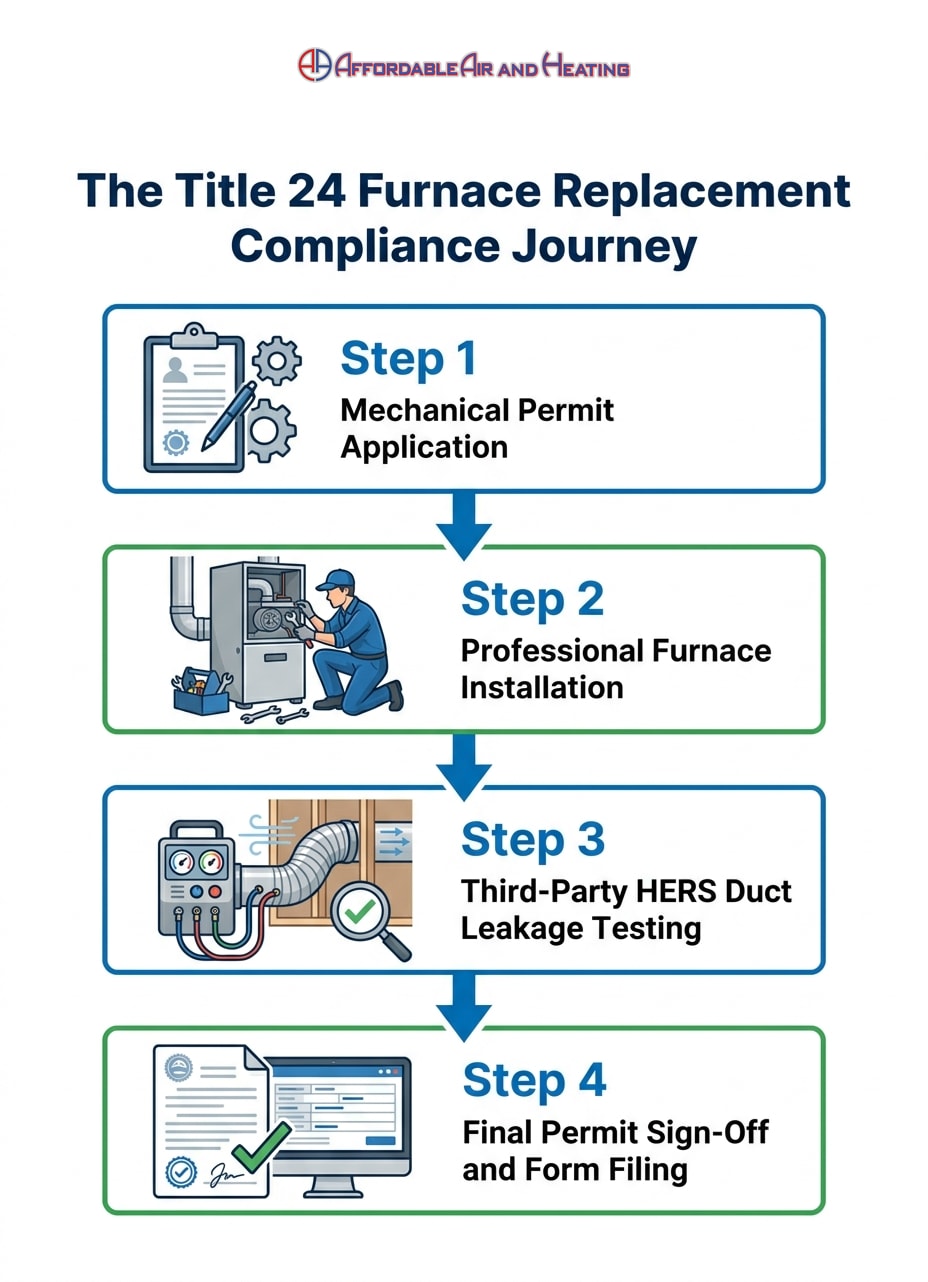
Before any wrenches are turned or old equipment is hauled away, a mechanical permit must be pulled through the appropriate local jurisdiction. For residents in unincorporated areas or specific municipalities, this falls under the Los Angeles County Department of Public Works Mechanical Code. Pulling a permit is the legal declaration that a licensed professional is performing the work according to current safety standards.
The permit process exists entirely for your safety. A furnace replacement involves highly sensitive components. An inspector will verify several critical safety factors once the installation is complete:
• Gas line integrity: Ensuring there are no microscopic leaks and that proper sediment traps are installed on the gas piping.
• Flue venting: Confirming that dangerous combustion byproducts, including carbon monoxide, are safely drafted out of the home and cannot backdraft into living spaces.
• Electrical connections: Checking that the high-voltage wiring and breakers are correctly sized to prevent fire hazards.
• Clearances: Verifying that the furnace has adequate space from combustible materials like wood framing or drywall.
Skipping the permit to save time or money carries severe risks for homeowners in Lancaster and greater Los Angeles County. Unpermitted work immediately voids most manufacturer warranties, meaning you will pay out of pocket if a part fails prematurely. Furthermore, if an unpermitted furnace causes a fire or property damage, your homeowners insurance can legally deny the claim. Finally, unpermitted mechanical work creates massive headaches when it is time to sell your property, often forcing you to pay retroactive penalty fees or completely redo the installation before a buyer's lender will approve the loan.
• Safety Verification — Permitted & Compliant Installation: Independent county inspection confirms gas and exhaust safety. — Unpermitted Installation: No oversight; high risk of carbon monoxide leaks or fire.
• Manufacturer Warranty — Permitted & Compliant Installation: Remains fully valid for the stated 10-to-20 year term. — Unpermitted Installation: Voided immediately due to lack of legal documentation.
• Home Resale Value — Permitted & Compliant Installation: Smooth escrow process; HVAC system is a documented asset. — Unpermitted Installation: Flags on inspection reports; buyer may demand replacement.
• Insurance Coverage — Permitted & Compliant Installation: Fully protected in the event of an equipment-related incident. — Unpermitted Installation: Claims can be denied due to illegal, undocumented modifications.
Demystifying Mandatory HERS Duct Leakage Testing
One of the most surprising requirements for homeowners facing a late fall or pre-winter November furnace replacement is the mandatory HERS test. HERS stands for Home Energy Rating System. Under Title 24, whenever you replace a central furnace or air handler, the state requires an independent, certified HERS rater to test your existing ductwork for leaks.
The state mandates this because ductwork is the delivery system for your expensive new furnace. Studies show that the average California home loses a massive percentage of its heated air through disconnected joints, torn flex ducts, and unsealed registers. Installing a brand-new, high-efficiency furnace on a leaky duct system is like pouring premium gasoline into a car with a hole in the fuel tank.
The diagnostic process is highly technical. The HERS rater will temporarily seal off all the supply and return registers inside your home. They then attach a calibrated fan—often called a duct blaster—to the main return opening. By pressurizing the entire duct system, the rater's computer measures the exact cubic feet per minute (CFM) of air escaping into unconditioned spaces like your attic or crawlspace. This test directly impacts your utility bills; passing the test guarantees you are only paying to heat the air that actually reaches your living room.
What Happens if Your Ducts Fail the Test?
Under current Title 24 regulations, a residential duct system must typically show no more than 15% total leakage, though specific targets can vary based on the scope of the project and whether the ducts are entirely new or existing. If your initial test reveals that 25% or 30% of your air is escaping, your system fails the compliance check.
When a failure occurs, remediation is required. The installation contractor must return to physically inspect the ductwork, applying specialized mastic sealant or foil tape to leaking joints, collars, and plenums. Once the repairs are made, the HERS rater performs the pressurization test again to verify the leakage has dropped below the state-mandated threshold. For homeowners looking to proactively improve their home's breathing environment, exploring indoor air quality and duct testing can address these issues before a major replacement.
Why Sealed Ductwork Matters in the High-Desert Climate
Regulatory compliance is one thing, but real-world comfort is what truly matters to your family. The physics of heat loss dictate that thermal energy always moves toward colder spaces. When your furnace generates heat, that warm air travels through metal or fiberglass ducts routed through unconditioned zones.
Lancaster's freezing winter nights and rapid temperature drops make tightly sealed ductwork absolutely critical to prevent severe heat loss. When the temperature in your attic drops to near-freezing, any heated air escaping through a loose duct joint is instantly lost to the atmosphere. Worse, the negative pressure created by those leaks can actively suck freezing, dusty attic air back into the duct system, forcing your new furnace to work twice as hard to maintain the thermostat setting.
Investing in a premium heating system is entirely wasted if the delivery mechanism compromises the output. By enforcing tight duct sealing, Title 24 compliance directly translates to faster heating times, consistent temperatures in every room, and a furnace that doesn't have to run constantly to keep you warm. This level of rigorous installation standard applies to all our service areas across Los Angeles County, ensuring every home can withstand the high-desert winter.
Translating the Compliance Paperwork: CF1R to CF3R
The sheer volume of paperwork involved in a legal furnace replacement can be intimidating. Los Angeles County and the state of California use a specific series of forms to track a project from initial design to final verification. Understanding what these acronyms mean can significantly reduce homeowner anxiety about the bureaucratic process.
1. CF1R (Certificate of Compliance): This is the initial design document. It outlines exactly what equipment is being installed, the efficiency ratings of the new furnace, and the specific Title 24 requirements that apply to your climate zone. This form must be registered before the mechanical permit is issued.
2. CF2R (Certificate of Installation): Completed by your installing HVAC contractor, this document verifies that the equipment was actually installed according to the CF1R design. It confirms that the correct model numbers were used and that basic installation standards were met.
3. CF3R (Certificate of Verification): This is the final piece of the puzzle, generated by the independent HERS rater. It proves that the mandatory duct leakage testing was performed and that the system passed the state requirements.
While this documentation seems daunting, you will rarely have to interact with the raw forms yourself. A professional contractor handles the digital registration, filing, and coordination with the local building department to close out the permit on your behalf.
Partnering with a Fully Compliant Local Contractor
Attempting to manage mechanical permits, register state compliance forms, and hire third-party raters on your own is a recipe for major delays and immense stress. The contrast between trying to navigate this legal maze independently versus hiring a full-service compliance expert is night and day.
Reputable contractors do not treat Title 24 as an afterthought. They build the cost and coordination of HERS testing and municipal permits directly into the initial project scope. When reviewing estimates for your home in Lancaster and greater Los Angeles County, always advise contractors to explicitly outline their compliance process. If a technician suggests skipping the permit to save you a few bucks, that is a massive red flag indicating they likely cut corners on the physical installation as well.
As a licensed local contractor, we handle all Title 24 compliance, mechanical permits, and HERS duct testing coordination upfront, ensuring your system meets legal standards with zero hidden fees or homeowner stress. We manage the entire timeline so you can focus on staying comfortable. Additionally, having properly documented, fully compliant paperwork is often a mandatory prerequisite if you plan to apply for generic energy rebates, federal tax credits, or local utility incentive programs for high-efficiency upgrades.
Working with professionals also means you get expert guidance on equipment selection. For example, before finalizing your project, we recommend understanding AFUE furnace efficiency ratings so you know exactly how your new, legally compliant system will perform during the coldest months of the year.
Frequently Asked Questions About LA County HVAC Compliance
Do I need a permit to replace a furnace in Los Angeles County?
Yes, a mechanical permit is legally required for all residential furnace replacements in Los Angeles County. This permit ensures that a licensed professional is handling dangerous components like high-voltage electricity, natural gas lines, and carbon monoxide exhaust flues. Skipping this permit can void your manufacturer warranty, complicate the future sale of your home, and create severe safety risks for your family.
What is HERS testing for a furnace?
HERS testing is an independent diagnostic evaluation of your home's ductwork, mandated by the state of California. A certified third-party rater seals your vents and uses a specialized fan to pressurize the system, measuring exactly how much air escapes into unconditioned spaces. This test verifies that your expensive heated air is actually reaching your living areas instead of leaking into the attic.
Why is duct testing required for HVAC replacement in California?
California requires duct testing to reduce statewide energy consumption and protect homeowners from inefficient installations. Connecting a high-efficiency furnace to a leaky, failing duct system forces the unit to overwork, wasting energy and inflating utility bills. By mandating leakage limits, the state ensures that the environmental and financial benefits of your new equipment are fully realized.
Does Title 24 apply to residential HVAC replacement?
Yes, Title 24 Part 6 applies directly to residential HVAC replacements and retrofits, not just new home construction. Because swapping a furnace or air conditioner alters the energy profile of your home, it triggers specific compliance measures based on your local building climate zone. These regulations govern equipment efficiency minimums and mandatory duct sealing standards.
Who is responsible for hiring the HERS rater during a furnace changeout?
While the homeowner is ultimately responsible for the compliance of their property, a reputable, licensed HVAC contractor will handle the hiring and coordination of the HERS rater for you. The contractor schedules the third-party testing as part of the installation process, ensuring the verification aligns with the permit closure timeline without adding extra stress to your plate.
Secure Your Winter Comfort with Lawful, Expert Installation
Discovering the legal requirements of a late fall or pre-winter November furnace replacement can be overwhelming, but Title 24 compliance is ultimately the key to maximizing the lifespan and efficiency of your new heating system. By ensuring your gas lines are safe, your exhaust flues are secure, and your ductwork is tightly sealed, these regulations guarantee that your home will stay reliably warm no matter how far the temperatures drop.
Navigating the red tape doesn't have to be a headache when you partner with the right local experts who manage the paperwork, testing, and permits on your behalf. If you are ready to upgrade your failing system without the stress of bureaucratic hurdles, reach out to our team today. We will handle the heavy lifting, ensuring your installation is fully compliant, deeply efficient, and ready to keep your family comfortable all winter long.
Customer Testimonials