Facing a Furnace Replacement Before Winter Hits
Your old heating system has been struggling for years, and now that the September pre-heating season is here, you know it might not survive another winter. Understanding the AFUE rating on your gas furnace is the first and most critical step when preparing for a replacement, but the technical jargon can quickly become overwhelming. When our technicians at Affordable Air and Heating visit homes across Lancaster, we often see homeowners feeling lost in a sea of numbers while contractors throw around percentages like 80% and 96% and the clock ticks down to the first cold front.
To help you navigate this transition, exploring comprehensive HVAC services can clarify your options for heating installation and repair.
The Pre-Winter Pressure
Replacing a furnace is a major decision for any homeowner. As the days grow shorter, the urgency to secure reliable heat increases. Unfortunately, this time crunch often leads to rushed decisions based on what sounds like the "best" number rather than what actually fits your home's unique needs. You want a system that will keep your family warm without wasting energy, but you also need a solution that makes sense for your specific climate and household layout.
The good news is that you do not need an engineering degree to make a smart, informed choice. Over our years serving the Antelope Valley, we've learned that by breaking down exactly what these efficiency ratings mean in practical terms, you can confidently choose the right system before the freezing nights arrive. Let our team clear away the confusion and look at how these ratings impact your daily comfort and long-term energy consumption.
Understanding the AFUE Rating on Your Gas Furnace: What It Actually Measures
AFUE stands for Annual Fuel Utilization Efficiency. It is the standard measurement used across the industry to determine how efficiently a gas furnace converts its fuel into usable heat for your home over the course of a typical year. The easiest way to think about AFUE is to compare it to the gas mileage in a vehicle. A car with higher miles per gallon travels further on the same amount of fuel. Similarly, a furnace with a higher AFUE rating produces more heat from the same amount of natural gas.
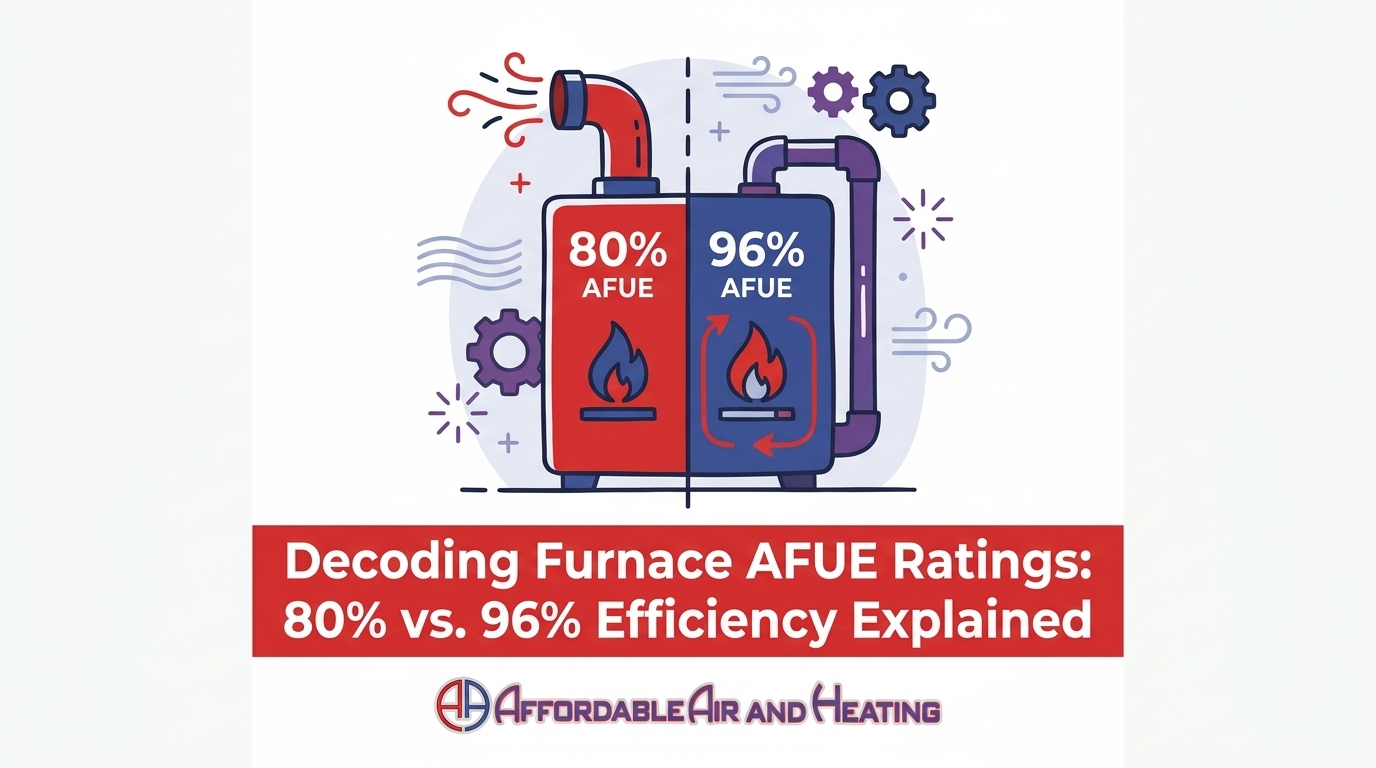
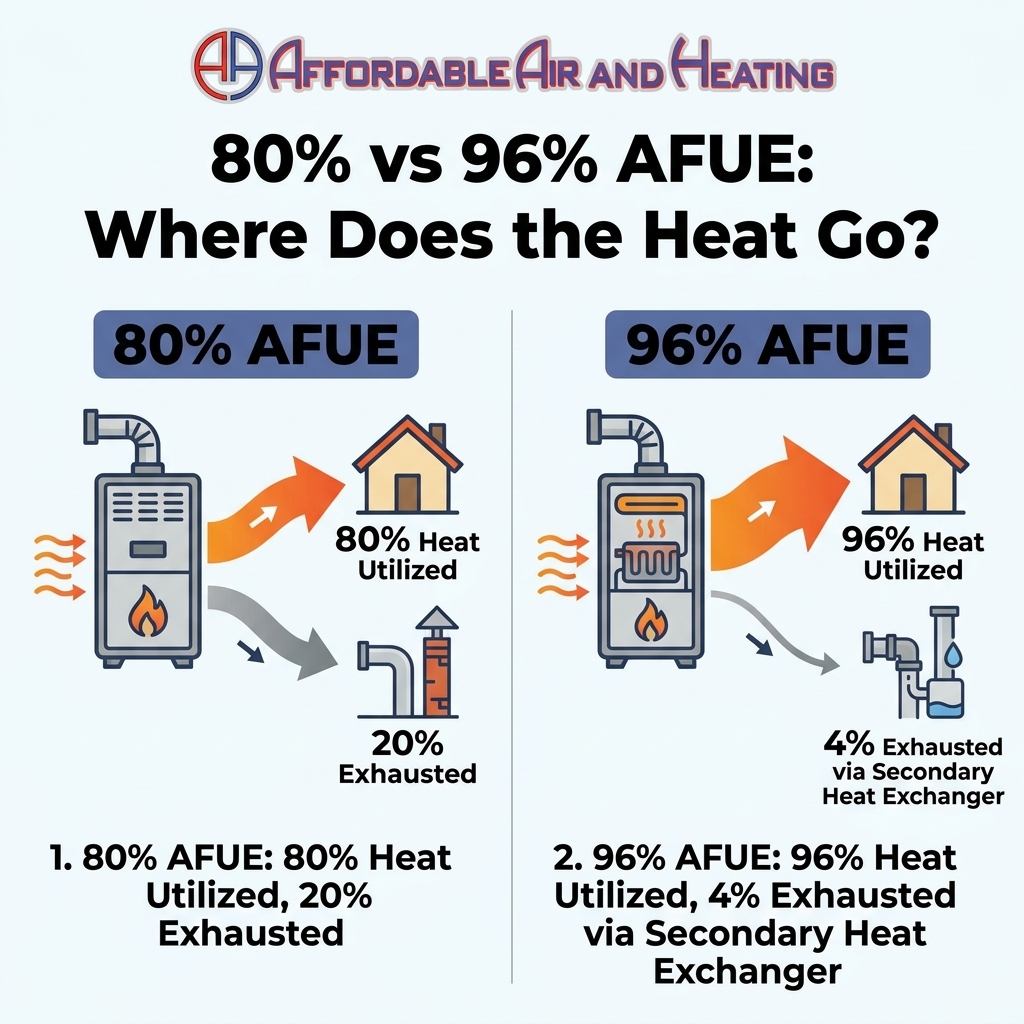
When you are looking at the choice between an 80% vs 96% AFUE furnace, you are looking directly at the ratio of utilized energy versus wasted energy. An 80% AFUE furnace successfully turns 80% of the gas it consumes into heat that warms your living space. The remaining 20% is lost, escaping out of your home through the exhaust flue along with the combustion gases. Conversely, a 96% AFUE furnace captures almost all of the heat, wasting only 4% of the fuel consumed.
Reading the Yellow EnergyGuide Label
If you want to know how your current equipment stacks up, the easiest method is to check the unit itself. The Department of Energy requires all modern heating equipment to display a bright yellow EnergyGuide label. This standardized sticker helps consumers compare energy utilization at a glance.
• Locate the label: It is typically adhered to the front or side panel of the furnace cabinet.
• Find the rating: Look for a large number followed by "AFUE"—this is your unit's official efficiency percentage.
• Compare the scale: The label usually includes a sliding scale showing how your model compares to the least and most efficient models currently on the market.
• Standard (80% AFUE) — Heat Utilized (Warms Your Home): 80% — Heat Wasted (Lost to Exhaust): 20%
• High-Efficiency (96% AFUE) — Heat Utilized (Warms Your Home): 96% — Heat Wasted (Lost to Exhaust): 4%
This clear breakdown shows that while both systems will successfully heat your home, they require vastly different amounts of raw fuel to achieve the exact same indoor temperature.
The Technical Differences: Standard vs. High-Efficiency Furnaces
The gap between an 80% and a 96% rating is not just a matter of tweaking a few internal settings; it comes down to a fundamental difference in how the machines are built. Standard 80% AFUE furnaces are known as non-condensing furnaces. They feature a single, primary heat exchanger. As the gas burns to create heat, the resulting combustion gases—which are still quite hot—are naturally vented up and out through a metal chimney or flue. That escaping heat is the 20% waste.
High-efficiency furnaces (anything 90% AFUE and above) are known as condensing furnaces. The secret to their incredible efficiency is the addition of a secondary heat exchanger. After the primary heat exchanger does its job, the combustion gases are routed into this secondary chamber. The furnace extracts the remaining heat from these gases until they cool down enough to condense into liquid water. By capturing this secondary burst of heat that would otherwise escape, the furnace pushes its utilization rate up to 96%.
Replacing an older, failing unit with modern technology drastically improves home comfort during those harsh freezing weeks. For example, our dispatch team recently took a call from a local homeowner during a freeze warning when their heating stopped working during the coldest week in memory. Our technicians assessed the unit, identified a bad relay, and ultimately recommended a full HVAC replacement. We installed a new, efficient HVAC unit, rapidly restoring their comfort and providing a much more reliable heat source for the rest of the winter.
Evaluating AFUE Ratings for the High Desert Climate
Efficiency ratings do not exist in a vacuum. To determine what is truly best for your home, you have to factor in the local weather. Evaluating AFUE ratings for the Lancaster / Antelope Valley high desert climate requires a different approach than sizing a system for a home in the snowy Midwest or the humid South.
In our years of keeping local homes comfortable, we've seen firsthand how the high desert's dramatic temperature swings affect heating demands. While our summers are notoriously hot, Lancaster's winter nights frequently drop into the 30s, requiring strong, reliable heating power. However, the overall heating season is relatively short compared to northern climates where a deep freeze can last for months on end. We experience intermittent, heavy heating demands rather than a sustained, constant drain on the furnace from November through March.
Because the heating season is shorter, the total volume of gas consumed annually is lower than in colder regions. This changes the math on total seasonal gas utilization. While a 96% AFUE furnace is objectively more efficient and wastes less fuel, our regional climate means an 80% unit is often perfectly adequate. If the furnace is only running heavily for a few months out of the year, the massive reduction in wasted fuel provided by a 96% unit might not be as critical as it would be for a home facing six months of blizzard conditions.
How Square Footage Dictates Your Heating Efficiency Needs
Beyond the weather outside, the size and layout of the space inside play a massive role in dictating your heating efficiency needs. Square footage directly impacts how hard your furnace has to work and how long its heating cycles need to be to maintain a comfortable temperature.
Larger homes naturally lose heat faster due to the increased surface area of walls, windows, and high ceilings. To compensate, a furnace in a large home must run for longer, more frequent cycles. In these expansive properties, the energy-saving benefits of a 96% AFUE furnace scale up significantly. Because the unit is consuming a high volume of gas to keep the large space warm, reducing the waste from 20% down to 4% yields a substantial drop in overall fuel consumption.
Key factors we evaluate that influence your home's heating load:
• Insulation quality: Well-insulated homes retain heat longer, reducing furnace run times.
• Window types: Single-pane windows leak heat rapidly, forcing the furnace to work harder.
• Ceiling height: Heat rises, meaning vaulted ceilings require more sustained heating power to warm the lower living areas.
• Ductwork condition: Leaky ducts can lose heated air before it ever reaches your rooms.
For smaller homes, condos, or exceptionally well-insulated spaces, the furnace simply does not need to run as often. In these scenarios, the difference in total fuel consumption between an 80% and a 96% unit over a short high desert winter may be negligible. Depending on your home's exact layout and heating demands, you might also want to explore alternative heating considerations, such as comparing a gas furnace vs. electric heat pump to see which technology best fits your space.
Balancing Upfront Investment with Long-Term Energy Utilization
When choosing between 80% and 96% AFUE, the decision often comes down to balancing the initial installation requirements against long-term operational efficiency. High-efficiency condensing furnaces require a higher initial investment. This is due to the advanced internal components—like the secondary heat exchanger—and the specific venting modifications required to install them safely.
Because a 96% AFUE furnace extracts so much heat from the exhaust gases, the remaining exhaust is cool and acidic. It cannot be vented up a traditional metal chimney, as the acidic condensation would eat through the metal. Instead, condensing furnaces must be vented directly outside using dedicated PVC piping, and they require a drainage line to handle the resulting water condensation. These installation upgrades add to the upfront scope of the project.
At the same time, replacing an ancient system can happen faster than you might think. Recently, our installation crew helped a local customer who returned from vacation to find their 30-year-old HVAC unit had completely died. We provided quotes and had a new system professionally installed in just one day, proving that modernizing your home's heating does not have to be a drawn-out ordeal.
At Affordable Air and Heating, we provide transparent, honest advice that a 96% AFUE unit is not universally mandatory; an 80% unit is often the most sensible choice for specific home sizes and budgets, avoiding the industry tendency to upsell. If a high-efficiency model is the right fit for your large home, exploring options for financing an upgrade can make the advanced technology much more accessible.
Navigating Incentives and Support
To further offset the initial investment, homeowners should look into available assistance programs. Generic equipment rebates or federal tax credits may apply to qualifying high-efficiency installations. We always encourage homeowners to check local utility programs for efficiency incentives that reward upgrading to 96% AFUE models. Professional guidance ensures the chosen system matches your home's exact heating load while maximizing any available incentives.
Common Questions About Furnace AFUE Ratings
What is a good AFUE rating for a gas furnace?
A good AFUE rating generally starts at 80% for standard models and goes up to 98% for premium high-efficiency models. The "right" rating depends heavily on your local climate and home size. In colder regions, 90% or higher is recommended, while 80% is often perfectly suitable for milder or shorter winters.
Is an 80% AFUE furnace good enough?
Yes, an 80% AFUE furnace is absolutely good enough for many homes, particularly in areas with shorter heating seasons like the high desert. If your home is well-insulated or smaller in square footage, an 80% unit will provide excellent, reliable comfort without the added installation complexities of a high-efficiency unit.
What does 96% AFUE mean practically?
Practically, a 96% AFUE rating means that for every unit of natural gas your furnace consumes, 96% of it is successfully converted into heat for your home, and only 4% is wasted through the exhaust. This high level of utilization results in significantly lower monthly energy consumption during heavy winter usage.
How do I find my current furnace's AFUE rating?
You can find your current furnace's AFUE rating by locating the bright yellow EnergyGuide label attached to the cabinet. If the label is missing, you can write down the model number from the data plate inside the front panel and look up the manufacturer's specifications online.
Do high-efficiency condensing furnaces require different venting?
Yes, high-efficiency condensing furnaces absolutely require different venting than standard units. Because they extract so much heat, the exhaust gases are cool and create acidic condensation, meaning they must be vented outside using specialized PVC piping rather than a standard metal chimney flue.
Making the Right Heating Choice for Your Home
Ultimately, the choice between an 80% and a 96% AFUE furnace comes down to understanding your specific climate usage and the square footage of your home. A massive, drafty house will benefit greatly from the fuel-saving power of a 96% unit, while a smaller, well-insulated home in the high desert will run perfectly fine on a standard 80% system.
Understanding the AFUE rating on your gas furnace gives you the power to make a confident, informed decision without being swayed by technical jargon or high-pressure sales tactics. Before the freezing weather settles in for the season, we encourage you to consult with our team at Affordable Air and Heating to evaluate your specific home layout. A clear, non-technical understanding of your home's energy utilization will ensure you stay warm and comfortable all winter long.