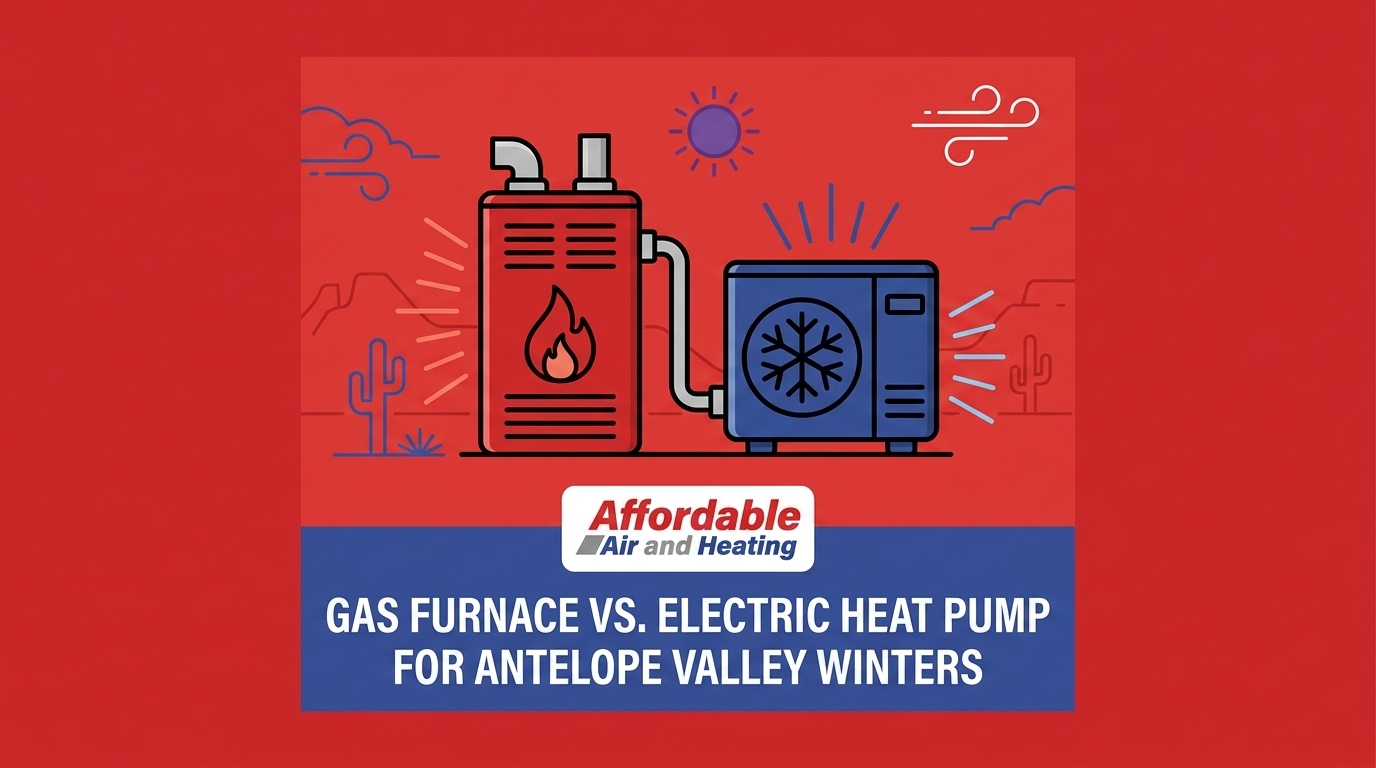
Gas Furnace vs. Electric Heat Pump for Antelope Valley Winters


The Myth of the Mild Southern California Winter
People outside of our region often assume that a Southern California winter just means wearing a light jacket when the temperature drops to 60 degrees. But if you live here, you know the reality is much harsher. When you are weighing a Gas Furnace vs. Electric Heat Pump for Antelope Valley Winters, you aren't planning for a mild coastal breeze—you are preparing for bone-chilling cold. At Affordable Air and Heating, we constantly remind our customers that the high desert plays by its own rules, and standard national advice often fails to account for our unique climate.
Many homeowners find themselves relying on aging HVAC systems that struggle to keep up as the seasons change. A pattern we see often is a homeowner hoping a heater that was making strange noises or running constantly last winter will somehow survive another year—which is a risky gamble. Deciding whether to replace an aging system requires balancing heavy, immediate heating power against long-term, year-round energy efficiency. You need a system that can handle the sudden plunge in temperature that happens the moment the sun goes down over the mountains.
Making this upgrade during the September pre-heating season transition is the smartest move you can make. Waiting until the first hard freeze hits usually means a rushed replacement when schedules are filling up. By starting your research now, you can explore all your heating services options without the stress of a freezing house pushing you into a rushed decision.
Understanding the Unique Heating Demands of the High Desert
The geography of the Lancaster and Antelope Valley high desert creates distinct heating requirements that you simply do not see in Los Angeles or coastal communities. Our elevation and lack of humidity mean that once the sun sets, the heat escapes into the atmosphere rapidly. You might enjoy a pleasant, sunny 65-degree afternoon, only to watch the thermometer plummet into the upper 20s by midnight.
In our years of working on homes throughout the Antelope Valley, our team typically sees these rapid diurnal temperature swings place an enormous amount of stress on older HVAC equipment. A system that sits idle all afternoon suddenly has to kick into high gear and run continuously just to maintain a basic level of indoor comfort. Sub-freezing overnight temperatures force your heating equipment to work at its maximum capacity. If your system has worn-out components, failing capacitors, or a cracked heat exchanger, these sudden extreme loads are exactly what cause mid-winter breakdowns.
During one of the coldest weeks, when the area is under a strict freeze warning, a heating system can stop working entirely. Having a reliable system that can recover indoor temperatures quickly after a sudden freeze is a big reason to plan your upgrade ahead of time.
Standard heating advice often suggests that basic heat strips or small space heaters are enough for California homes. That simply is not true for our service areas in the Antelope Valley. You need a primary heating source that is robust enough to fight off freezing temperatures night after night, while still operating efficiently enough to keep your monthly utility bills manageable.
The Traditional Powerhouse: Natural Gas Furnaces
For decades, natural gas furnaces have been the undisputed heavyweights of residential heating. They operate through combustion, burning natural gas in a controlled chamber to heat a metal heat exchanger. Your blower motor then pulls indoor air across this extremely hot metal, warms it up, and pushes it through your ductwork. In our experience servicing high desert properties, this method offers some distinct advantages, particularly when the temperature drops sharply.
The most noticeable characteristic of a gas furnace is the sheer intensity of the heat it produces. Because it relies on fire, a gas furnace can deliver air at the register that reaches 120 degrees Fahrenheit or higher. This creates a very fast, very noticeable sensation of warmth. If you walk inside from a freezing January night, standing over a furnace vent provides immediate relief.
Gas systems are traditionally known for their reliability during extreme cold snaps. Because they do not rely on extracting heat from the outdoor air, their heating capacity remains completely unaffected whether it is 40 degrees outside or 15 degrees outside. However, this heavy power comes with limitations. Gas furnaces rely entirely on fossil fuels, which subjects you to fluctuating natural gas prices. Furthermore, a furnace only provides winter utility. You will still need a completely separate air conditioning unit to survive the brutal high desert summers.
Pros of Gas Heating in Freezing Conditions
• Rapid temperature recovery: A gas furnace can raise the indoor temperature of a cold house very quickly, which is ideal if you turn your thermostat down while away at work.
• Familiar, intense heat delivery: The high register temperature provides the classic "blast of heat" that many homeowners associate with a properly working heater.
• Long lifespan with proper maintenance: Because a furnace only runs for a few months out of the year, the internal components often experience less wear and tear than systems that run year-round.
Can Modern Electric Heat Pumps Handle the Cold?
The most common question homeowners ask our team is whether an electric heat pump can actually keep a house warm when the thermometer dips below freezing. Historically, older heat pumps struggled in cold weather, leading to a reputation for blowing lukewarm air. However, modern HVAC technology has completely changed the landscape.
Unlike a furnace that burns fuel to create heat, a heat pump uses electricity and refrigerant to move heat from one place to another. Even when it feels freezing outside, there is still thermal energy in the ambient air. A modern heat pump absorbs this outdoor heat, compresses the refrigerant to increase its temperature, and transfers that warmth inside your home. It is a highly efficient process that uses significantly less energy than traditional heating methods.
You can learn more about the specific mechanical differences between heat pumps and furnaces, but the most important takeaway is that today's systems are built for extremes. According to Department of Energy data—and confirmed by what we see in the field—modern cold-climate heat pumps can maintain their full heating capacity even when temperatures drop down to 5 degrees Fahrenheit. This means they are more than capable of handling Lancaster's sub-freezing overnight temperatures.
The Inverter Technology Advantage
The secret to a modern heat pump's cold-weather performance is the inverter-driven compressor. Older systems operated on a simple on/off switch—they ran at 100% capacity until the house was warm, then shut off entirely. Inverter technology acts more like the accelerator pedal in a car.</p
• Variable speed operation: The compressor can ramp up or down in small increments, adjusting its speed precisely to match the heating demand of the home.
• Continuous temperature maintenance: Instead of blasting heat and then shutting off, an inverter heat pump runs continuously at a low, quiet speed, maintaining a perfectly even temperature without heavy cycling.
• Elimination of the "cold blow": Advanced defrost cycles and variable speeds have eliminated the uncomfortable drafty feeling associated with older heat pump models.
Perhaps the biggest advantage of a heat pump is its year-round utility. By simply reversing the flow of refrigerant, the same unit that kept you warm in January becomes a high-efficiency air conditioner in July, handling all your comfort needs from a single system.
Side-by-Side Comparison: Efficiency and Operating Costs
Choosing the right system requires looking past the initial installation day and considering the long-term operating costs. Energy efficiency is measured differently depending on the equipment. Gas furnaces are rated by AFUE (Annual Fuel Utilization Efficiency), which measures what percentage of the fuel is converted directly into usable heat. A standard modern furnace might have an 80% AFUE, meaning 20% of the energy is lost as exhaust.
Heat pumps are rated by HSPF2 (Heating Seasonal Performance Factor). Because heat pumps move heat rather than generate it, they can often deliver two to three times more heat energy to a home than the electrical energy they consume. This incredible efficiency can significantly lower your long-term operating costs, even if the upfront investment for a high-end heat pump is slightly higher.
When evaluating a heat pump installation, it is also worth asking about current utility rebate programs, such as Home Performance Plus for SCE customers, and GoGreen financing for qualifying energy-efficiency upgrades. Program availability changes, so ask us which are open.
Ultimately, the key to keeping costs down is matching the system size and type perfectly to your home's specific insulation, square footage, and ductwork. Our Affordable Air and Heating brand promise is built on ensuring homeowners get a system that expertly balances heavy desert heating demands with long-term operating efficiency, so you never pay for more equipment than you actually need.
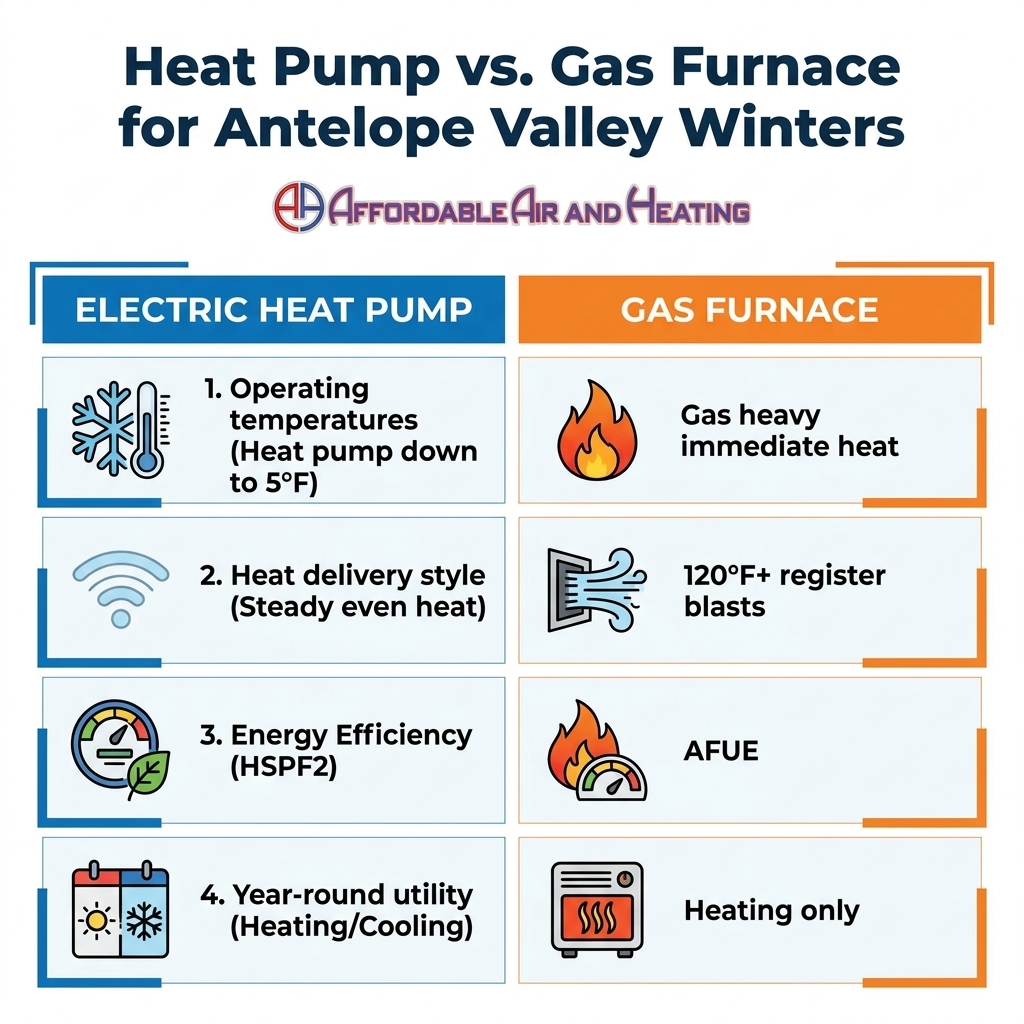
• Heat Delivery Style — Natural Gas Furnace: Intense, quick blasts of 120°F+ air — Modern Electric Heat Pump: Steady, continuous, even warmth
• Cold Weather Performance — Natural Gas Furnace: Unaffected by outdoor temperatures — Modern Electric Heat Pump: Maintains capacity down to 5°F
• Energy Efficiency Metric — Natural Gas Furnace: AFUE (percentage of fuel used) — Modern Electric Heat Pump: HSPF2 (ratio of heat output to electricity)
• Year-Round Utility — Natural Gas Furnace: Heating only (requires separate AC) — Modern Electric Heat Pump: Provides both heating and cooling
• Operating Costs — Natural Gas Furnace: Tied to fluctuating natural gas rates — Modern Electric Heat Pump: Highly efficient, leverages electricity
Lifespan, Maintenance, and the Dual-Fuel Option
When investing in new HVAC equipment, longevity is a major consideration. Because a gas furnace is only responsible for heating your home, it sits dormant for more than half the year. This limited run time often translates to a lifespan of 15 to 20 years, provided the system receives its annual tune-up. A heat pump, on the other hand, operates year-round, cooling your home in the summer and heating it in the winter. Because it works double duty, its overall lifespan is typically closer to 12 to 15 years.
Maintenance requirements also differ. A furnace needs a thorough inspection once a year in the fall to check the heat exchanger for cracks, test the burners, and ensure there are no carbon monoxide leaks. A heat pump requires maintenance twice a year—once before summer and once before winter—to keep the coils clean, check the refrigerant charge, and ensure the reversing valve functions properly.
If you are torn between the two technologies, our team often recommends the dual-fuel or hybrid system to our Lancaster clients. This setup pairs an electric heat pump with a natural gas furnace. Here is how it works:
1. Moderate Cold: When the outside temperature is in the 40s or 50s, the electric heat pump handles the heating, utilizing its high efficiency to keep your utility bills low.
2. The Balance Point: As the temperature drops toward freezing, the system reaches a pre-set "balance point."
3. Extreme Freezes: Once the temperature drops below that balance point, the system automatically shuts off the heat pump and activates the gas furnace, delivering heavy combustion heat to combat the sub-freezing overnight temperatures.
Regardless of which system you choose, professional installation is the single biggest factor in determining how long your equipment will last. One local homeowner returned from a winter vacation to find their 30-year-old HVAC unit had completely died. We provided a thorough quote and professionally installed a new unit in a single day. Proper sizing, careful ductwork evaluation, and precise refrigerant charging ensure that your system starts its lifespan on the right foot.
Timing Your Upgrade: Why Early Fall is the Critical Window
If your current heater has been struggling, the worst time to replace it is during the first hard freeze of the year. When temperatures drop rapidly in late fall, HVAC companies across the Antelope Valley experience a massive surge in emergency "no-heat" calls. Wait times increase, equipment availability shrinks, and you may find yourself shivering in your living room while waiting for an installation date.
The September pre-heating season transition is the critical window for making an upgrade. The weather is still mild enough that your home will stay comfortable during the hours it takes our crew to remove the old equipment and install the new system. Proactive scheduling allows you to carefully review your options, compare efficiency ratings, and make an educated choice without the pressure of an active emergency.
A proactive replacement provides immense peace of mind. Instead of listening to your old furnace rattle and wondering if it will survive the night, you can head into the winter months knowing your home is protected by reliable, high-efficiency technology. If your system is over 12 years old, requires frequent repairs, or struggles to maintain an even temperature, seek a professional assessment immediately before the severe weather arrives.
Frequently Asked Questions About High Desert Heating
Are heat pumps good for desert climates?
Yes, heat pumps are exceptionally well-suited for desert climates. Because the high desert experiences extreme heat in the summer and freezing temperatures in the winter, a heat pump's ability to provide both high-efficiency cooling and reliable heating makes it an ideal all-in-one solution. Modern inverter technology ensures they perform beautifully even during massive temperature swings.
Do I need a gas furnace if it freezes at night?
You do not strictly need a gas furnace just because temperatures drop below freezing at night. Modern cold-climate heat pumps are engineered to extract heat from the air even when it is as cold as 5 degrees Fahrenheit. However, some homeowners still prefer the intense, rapid heat delivery of a gas furnace, or they opt for a dual-fuel system to get the best of both worlds.
At what temperature does a heat pump become inefficient?
Older heat pumps would begin losing efficiency around 35 degrees Fahrenheit, but modern systems have pushed that boundary significantly lower. Today's high-efficiency, inverter-driven heat pumps can maintain 100% of their heating capacity in sub-freezing overnight temperatures. They typically do not experience a meaningful drop in efficiency until the temperature approaches zero degrees, which is extremely rare in the Antelope Valley.
Is a heat pump better than a furnace in California?
For most of California, a heat pump is considered the better option due to its high energy efficiency, year-round utility, and alignment with state energy goals. In the high desert specifically, a heat pump offers excellent long-term operating cost savings, though the "best" choice always depends on your home's specific insulation, existing ductwork, and your personal comfort preferences.
How quickly can a gas furnace heat a cold house compared to a heat pump?
A gas furnace will heat a cold house faster than a heat pump. Because a furnace delivers air at 120 degrees Fahrenheit or higher, it rapidly raises the ambient room temperature. A heat pump delivers air around 95 to 100 degrees Fahrenheit, which provides a steady, gradual warming process rather than a sudden blast of heat.
What is a dual-fuel heating system and is it right for Lancaster?
A dual-fuel system combines an electric heat pump with a natural gas furnace. The heat pump runs during mild or moderately cold weather to save on energy costs, and the gas furnace automatically takes over during extreme freezes. We frequently recommend this setup for Lancaster's climate, as it offers maximum efficiency during the day and heavy heating power for freezing nights.
Secure Your Winter Comfort with Affordable Air and Heating
Choosing the right heating system for the high desert requires more than just picking a box out of a catalog. Whether you decide on the heavy, immediate power of a traditional natural gas furnace or the year-round, high-tech efficiency of a modern electric heat pump, proper sizing and professional installation are the keys to long-term comfort. Lancaster's rapid temperature swings demand equipment that is specifically calibrated for our unique environment.
Our team at Affordable Air and Heating understands the specific challenges of Antelope Valley winters because we live and work here. We bring local expertise to every assessment, ensuring you get a climate-specific solution that handles the high desert extremes effortlessly. Do not wait for the first hard freeze to test your aging equipment. Contact us today to book a comprehensive estimate, and let us help you secure a warm, comfortable home before winter arrives.