Why Does My Heater Make a Popping Sound When It Turns On?


Startled by a Loud Pop on the First Cold Night? Don't Panic Just Yet
Is your furnace actually broken, or just waking up from a long summer nap? Why does my heater make a popping sound when it turns on? It is a question our team at Affordable Air and Heating fields from countless homeowners during that critical November pre-winter first heating cycle. You turn the thermostat up for the first time in months, wait for the warmth, and instead, you are greeted by a loud, startling bang echoing through the house. Naturally, a sudden loud noise from a gas appliance triggers immediate anxiety about catastrophic system failures or potential gas explosions.
The good news is that you do not need to panic. While a loud pop can certainly be unnerving, our technicians typically find it points to one of two distinct issues. One is a matter of basic, harmless physics happening inside your home's walls. The other is a combustion issue that requires professional attention. The key to keeping your home safe is understanding the critical decision point: determining whether the sound is normal acoustic expansion or a dangerous delayed ignition. Professional diagnostics can safely identify the root cause without the guesswork.
If you need an expert to evaluate your system immediately, our team provides comprehensive HVAC services to ensure your home remains safe and warm all winter long.
The Two Primary Culprits Behind Furnace Popping Noises
When our crews troubleshoot a sudden noise from a heating system, the first step is understanding what is actually happening behind the scenes. Furnaces and ductwork are constructed almost entirely of metal, and metal reacts dramatically to temperature changes and pressure. However, not all metal reactions are created equal. In our experience, the popping sounds you hear generally fall into two distinct categories: harmless thermal expansion of the metal ductwork, and dangerous delayed gas ignition inside the furnace cabinet.
Thermal expansion is a normal reaction to heat. As hot air rushes into cold metal ducts, the metal expands, creating a popping or pinging sound. Delayed gas ignition, on the other hand, is a hazardous buildup of natural gas in the combustion chamber that ignites all at once with a small boom. One requires absolutely no action, while the other requires immediate professional intervention. Guessing between the two is never worth the risk when natural gas is involved. If you suspect a combustion issue, scheduling professional heating system repair is the only safe next step.
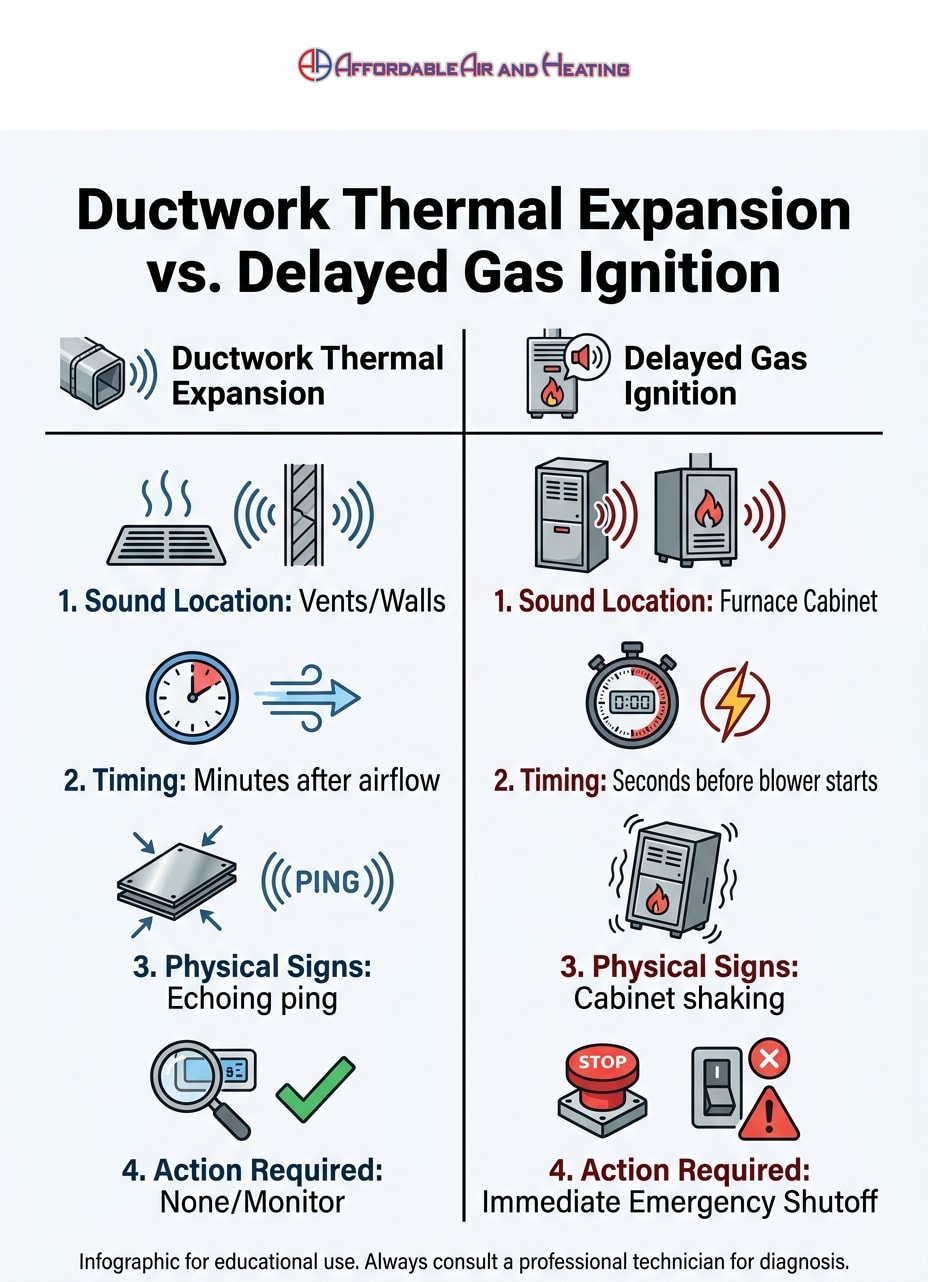
• Underlying Cause — Thermal Duct Expansion: Rapid temperature fluctuations causing metal duct expansion — Delayed Gas Ignition: Dirt or carbon buildup preventing immediate gas ignition
• Safety Risk Level — Thermal Duct Expansion: None (Harmless acoustic nuisance) — Delayed Gas Ignition: High (Risk of fire, cracked heat exchanger, or gas leak)
• Action Required — Thermal Duct Expansion: None, or minor acoustic dampening — Delayed Gas Ignition: Immediate system shutoff and professional repair
• Sound Description — Thermal Duct Expansion: Metallic pinging, popping, or echoing — Delayed Gas Ignition: Muffled boom, loud bang, or physical shaking
Harmless Thermal Expansion: Why Your Metal Ductwork Pops
If your popping noise is caused by thermal expansion, you can breathe a sigh of relief. This is largely a harmless acoustic nuisance, not a safety hazard. To understand why this happens, you have to look at the physics of your home's ventilation system. The ductwork running through your walls, attic, or crawlspace is typically made of thin sheet metal. When your furnace is off, this metal cools down to match the ambient temperature of the unconditioned spaces around it.
When the furnace kicks on, it suddenly blasts air that is significantly hotter than the metal itself. According to standard ASHRAE (American Society of Heating, Refrigerating and Air-Conditioning Engineers) guidelines, metal expands as it warms and contracts as it cools. This rapid temperature fluctuation causing metal duct expansion forces the sheet metal joints to shift. As the metal flexes outward against its fasteners and hangers, it creates a distinct, echoing metallic ping or pop. Once the ductwork reaches a steady temperature, the popping usually subsides.
For homeowners in Lancaster and surrounding service areas, our technicians see this phenomenon frequently. Lancaster's high desert climate features warm, sunny days followed by freezing winter nights. These extreme, rapid temperature drops maximize the physical expansion and contraction of sheet metal ducts. The colder the ductwork gets overnight, the more aggressively it will expand and pop when the morning heat hits it.
The Role of Extreme Temperature Shifts
Diurnal temperature swings—the difference between the daytime high and nighttime low—exacerbate metal fatigue and noise. When a home sits in a climate with extreme daily shifts, the ductwork is constantly expanding and contracting. This is why the popping sound is almost always most prominent during the very first heating cycles of the evening or early morning. The metal has had hours to cool and shrink, meaning the sudden introduction of hot air creates the maximum possible physical reaction.
Dangerous Delayed Gas Ignition: The 'Mini-Explosion' Effect
While ductwork popping is harmless, delayed gas ignition is a serious mechanical failure that requires immediate attention. To understand delayed ignition, you need to know how a furnace normally operates. When your thermostat calls for heat, the furnace opens a valve to release natural gas across the burners, and an igniter immediately lights that gas. It should be a smooth, instantaneous process.
However, a pattern we see often in poorly maintained systems is that the burners become coated in a layer of carbon, dust, or sulfur buildup, and the gas does not ignite right away. Instead, the gas valve remains open, allowing unburned natural gas to pool inside the enclosed combustion chamber. When the delayed spark finally catches, it ignites a much larger volume of gas all at once. This creates a localized bang—essentially a "mini-explosion" inside your furnace. You will often hear a muffled boom, feel the furnace cabinet physically shake, or even hear nearby doors and panels rattle.
Important Safety Warning: Never attempt to clean furnace burners, adjust pilot lights, or diagnose gas lines yourself. Natural gas is highly volatile, and DIY tampering can easily create deadly leaks. Always rely on a licensed professional for combustion issues.
Why Delayed Ignition is a Major Safety Hazard
Ignoring a delayed ignition problem leads directly to catastrophic system failure. The force of these repeated mini-explosions puts immense stress on the furnace's internal components. Over time, the physical shockwave can crack the heat exchanger. A cracked heat exchanger is one of the most dangerous HVAC failures possible, as it allows deadly, odorless carbon monoxide to leak out of the combustion chamber and circulate through your home's vents. Additionally, pooling gas creates a severe fire hazard every time the system turns on.
How to Tell the Difference: Timing and Location of the Sound
Because the consequences of ignoring delayed ignition are so severe, our team advises homeowners to use a clear, binary decision-making framework to assess their situation safely. You can usually determine whether you are dealing with rapid temperature fluctuations causing metal duct expansion or a dangerous gas buildup simply by observing the timing and location of the noise.
1. Assess the location of the sound: Walk around your home while the system is running. Is the popping sound coming from the vents in your ceiling, the walls, or the floors? If the noise is distributed throughout the house, it is almost certainly ductwork expansion. If the loud bang comes directly from the basement, attic, or closet where the furnace cabinet sits, you should treat it as an ignition emergency.
2. Assess the timing of the cycle: Pay close attention to when the pop occurs. Delayed gas ignition happens at the very beginning of the heating cycle—often seconds before the main blower fan even turns on to push air into the house. Conversely, ductwork expansion happens minutes after the warm air has already started flowing through the vents.
3. Observe physical signs of vibration: Stand near (but do not touch) the furnace when it starts up. Does the metal cabinet physically shake, shudder, or rattle when the pop occurs? Ductwork expansion will not shake the furnace itself. A shuddering cabinet is a hallmark sign of a gas ignition explosion.
4. Follow the golden rule of safety: If you cannot definitively prove that the sound is coming from the ductwork, assume it is the furnace. It is always better to have a professional confirm your system is safe than to ignore a potential gas hazard.
Why Summer Dust Buildup Triggers Late-Fall Heating Failures
You might wonder why delayed ignition is so incredibly common during the November pre-winter first heating cycle. The answer lies in what happens to your furnace during the long, idle summer months. Even when your heater is turned off, the air in your home continues to circulate around it. Over several months, household dust, pet dander, microscopic skin cells, and airborne cooking oils slowly settle inside the furnace cabinet.
This debris naturally coats the burner orifices and the delicate flame sensors. When you turn the system on for the first time in late fall, the furnace is forced to try and burn its way through this thick layer of summer buildup. The dirt physically blocks the gas from reaching the igniter in a timely manner, creating the exact pooling effect that causes the mini-explosion. The dirtier the burners, the longer the delay, and the louder the resulting bang.
This is exactly why we strongly recommend preventative care. Routine professional cleaning removes this dangerous buildup entirely before you ever turn the thermostat to "heat." By investing in routine heating maintenance before the freezing weather arrives, our technicians can scrub the burners, calibrate the gas pressure, and ensure that the ignition sequence happens instantly and safely.
Immediate Safety Steps: When to Shut Off Your System
If you have observed the timing and location of the popping sound and suspect that your furnace is suffering from delayed gas ignition, you must take immediate action. Continuing to run a furnace that is experiencing mini-explosions puts your heat exchanger, your home, and your family at risk. We advise following these strict safety boundaries to secure the system until a professional arrives.
• Step 1: Turn off the thermostat immediately. Switch the thermostat setting from "Heat" to "Off." This will break the electrical circuit and stop the furnace from attempting another heating cycle, preventing further gas from pooling.
• Step 2: Locate and shut off the gas valve. Find the gas supply line running to your furnace. There should be a manual shutoff valve located on the pipe near the unit. Turn the valve a quarter-turn so that the handle is perpendicular to the pipe, shutting off the fuel supply.
• Step 3: Do not attempt to open the cabinet. Do not unscrew the burner compartment, attempt to wipe down the sensors, or try to manually light the system. Disturbing the components can mask the diagnostic evidence the technician needs or accidentally damage fragile sensors.
• Step 4: Contact a licensed professional. Call for emergency HVAC diagnostics. Explain that you heard a loud bang from the cabinet and suspect delayed ignition. If you also notice your vents blowing warm air inconsistently, mention that to the dispatcher as well, as it helps build a complete diagnostic picture.
Comprehensive FAQ: Troubleshooting Heater Sounds
Is it normal for a heater to pop when it turns on?
Yes, it can be entirely normal if the sound is coming from expanding metal ducts. As warm air hits the cold sheet metal, rapid temperature fluctuations causing metal duct expansion create a pinging or popping noise in the walls and ceilings. However, it is never normal if the sound is a loud, forceful bang coming directly from the main furnace cabinet itself.
Why does my furnace sound like a small explosion?
A sound resembling a small explosion is the hallmark sign of delayed gas ignition. This occurs when dirt, carbon, or rust blocks the burners, preventing the natural gas from lighting immediately. The unburned gas pools in the combustion chamber until it finally reaches the igniter, catching all at once with a forceful, localized boom.
Can a furnace explode from delayed ignition?
While a catastrophic, full-house explosion is rare due to modern safety switches that shut the system down, the "mini-explosion" inside the cabinet is still highly dangerous. The repeated physical shockwaves can crack the metal heat exchanger over time. A cracked heat exchanger allows deadly carbon monoxide gas to leak out of the combustion chamber and directly into your home's breathing air.
How do I stop my ductwork from popping?
If the harmless popping of expanding metal is bothering you, professional duct insulation can help reduce the temperature shock that causes the metal to flex. An HVAC technician can also adjust the blower fan speed to introduce warm air more gradually. In some cases, installing flexible acoustic dampeners or canvas connectors between the furnace and the rigid ductwork may also mitigate the noise.
What is the most common cause of delayed ignition?
In our experience, the most common cause of delayed ignition is a simple lack of routine maintenance. Over the summer, idle burners collect dust, lint, and pet dander. When the system is turned on for the first time in the fall, this dirt blocks the gas flow. Other common causes include misaligned pilot lights, faulty electronic igniters, or incorrect gas pressure settings.
Get Safe, Professional Heating Diagnostics Today
Peace of mind is paramount when dealing with natural gas heating systems. While it is helpful to understand the difference between expanding ductwork and combustion issues, guessing between the two is never worth the risk to your home or your family. If you hear a startling noise during that critical November pre-winter first heating cycle, the smartest move is to let an expert evaluate the system.
At Affordable Air and Heating, we pride ourselves on being a safety-first authority by offering clear, upfront diagnostics without hidden fees to alleviate your homeowner anxiety. Our technicians will thoroughly inspect your heat exchanger, clean your burners, and test your ignition sequence to ensure everything is operating flawlessly. If delayed ignition has caused critical damage and you need a system replacement, keep in mind that generic federal tax credits and utility incentive programs may apply to qualifying heat pump installations—always verify current programs with your utility provider or a tax professional. Schedule your inspection today to ensure your heating system is safe, quiet, and ready for whatever winter brings.
Customer Testimonials