Why Is My AC Blowing Warm Air Right After a Power Outage?
Is your AC actually broken, or did a brief grid flicker just throw the system out of sync? If you are wondering why your vents are blowing warm air after a power outage, you are not alone. It is one of the most common—and most panic-inducing—scenarios homeowners face during the peak of summer. The power goes out for just a few seconds, the lights flicker back on, and your indoor fan immediately springs to life. You expect a rush of cold air, but instead, the vents start blasting warm, muggy air throughout the house.
Before you assume the compressor is permanently destroyed, take a deep breath. In many cases, the air conditioner is not actually broken. What you are experiencing is a common electrical desync caused by high-load summer grid flickers. When neighborhoods in Palmdale and surrounding areas experience severe heatwaves, the local electrical grid often strains under the immense demand. This strain leads to rolling brownouts or split-second power interruptions that can confuse your HVAC system's electrical components.
When the power is suddenly interrupted and forcefully restored, your air conditioner faces a massive surge of electricity. This surge frequently triggers built-in safety mechanisms designed to protect the most expensive parts of your cooling system. Rather than immediately calling for emergency repairs, a simple check of your electrical panel might be all it takes to get the cold air flowing again. As a trusted provider of affordable heating and air services, we want to help you understand exactly what happens to your system during a power interruption so you can troubleshoot safely and confidently.
Understanding the Indoor-Outdoor AC Desync
To understand why your vents are blowing warm air while the system sounds like it is running, you have to look at how a central air conditioning system is built. Your HVAC system is not just one single machine; it is a split system consisting of two primary halves. The indoor air handler (which houses the blower fan and evaporator coil) sits inside your home, while the outdoor condenser (which houses the compressor and condenser coil) sits outside.
These two halves operate on completely different electrical circuits with drastically different power requirements. The indoor blower fan requires a relatively small amount of electricity to spin and circulate air through your ductwork. The outdoor compressor, however, is a heavy-duty mechanical pump. It requires a massive amount of startup amperage to compress the refrigerant gas and push it through the system. Because the compressor draws so much power, it is highly susceptible to electrical anomalies.
When high-load summer grid flickers hit your neighborhood, the power drops and surges back in a fraction of a second. This sudden spike in voltage hits your electrical panel hard. Because the outdoor compressor requires such a high volume of electricity, the sudden surge often overloads its dedicated circuit. To prevent the wiring from melting or the compressor from frying, the outdoor circuit breaker trips, instantly cutting power to the outside unit.
Meanwhile, the indoor blower fan, which operates on a much smaller circuit, often survives the surge without tripping its breaker. The result is a mechanical desync. The thermostat tells the system to cool, the indoor fan turns on and pulls air from your rooms, but because the outdoor compressor has no power, the air is never cooled. The fan simply recirculates the existing warm air through your vents, making it feel like the AC has completely failed.
The 5-Minute Compressor Protection Delay
If you have checked your breaker and everything seems perfectly fine, but the system is still blowing warm air, you might be fighting against your thermostat's built-in safety features. Most modern digital thermostats and HVAC control boards are programmed with a mandatory time delay—usually lasting exactly five minutes—that activates any time the system loses power.
This five-minute delay is not a glitch; it is a critical protection mechanism designed to save your compressor from a catastrophic failure known as "short-cycling." When your air conditioner is running normally, the compressor pressurizes the chemical refrigerant, turning it from a low-pressure gas into a high-pressure liquid. If the power cuts out unexpectedly, the compressor stops, but all that high-pressure refrigerant is still trapped inside the lines.
If the power comes back on a second later and the compressor tries to start immediately, it has to push against that massive wall of existing pressure. This is known as starting under a locked rotor condition. The motor will draw excessive electrical current trying to overcome the pressure, which can easily overheat the windings, blow the dual run capacitor, or permanently destroy the compressor motor itself.
To prevent this, the thermostat enforces a strict waiting period. During this time, the indoor fan might run, blowing warm air, while the outdoor unit stays completely silent. For homeowners sitting in a sweltering Palmdale house during a July heatwave, five minutes can feel like an absolute eternity. The immediate reaction is often to start pressing buttons, flipping switches, or rapidly turning the thermostat on and off. Doing this only resets the five-minute timer, prolonging the warm air. The best course of action immediately following a grid flicker is to take your hands off the thermostat and simply wait it out.
How to Safely Reset Your AC Breaker
If the five-minute delay has passed and the outdoor unit is still entirely unresponsive while the indoor fan blows warm air, you likely have a tripped breaker. Resetting an air conditioner breaker is a straightforward process, but it must be done in a specific, safe sequence to avoid sending secondary surges through the delicate control board.
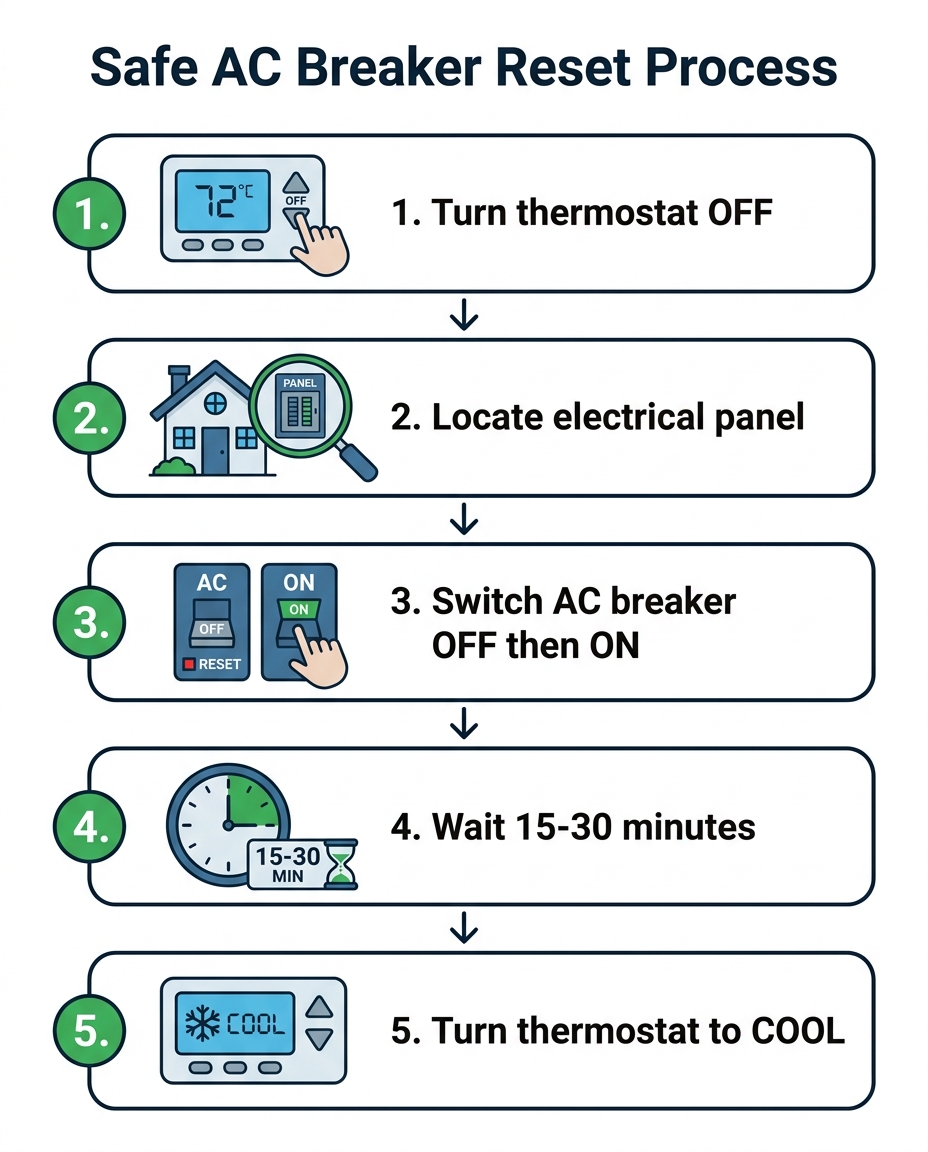
Follow these exact steps to safely reset your system after high-load summer grid flickers disrupt your power:
1. Turn the thermostat to the "OFF" position. Never attempt to reset a breaker while the thermostat is actively calling for cooling. If you flip the breaker while the system is demanding power, it can cause an electrical arc or a sudden voltage spike that damages the outdoor unit's contactor or capacitor. Switch the system entirely off at the wall first.
2. Locate your main electrical panel. Find your home's primary electrical panel, usually located in a garage, basement, or on an exterior wall. Open the metal door and look for the breaker labeled "AC," "Condenser," or "Compressor." This is typically a large, double-pole breaker (it looks like two switches tied together) located near the top or bottom of the panel.
3. Identify the tripped breaker. A tripped breaker will not always be entirely in the "OFF" position. Most of the time, it rests slightly off-center, feeling loose or spongy if you touch it. It might also have a small orange or red indicator window showing that it has tripped.
4. Switch the breaker completely OFF, then firmly ON. To reset a tripped breaker, you cannot just push it toward the "ON" side. You must first push the switch firmly all the way to the "OFF" position until you hear a distinct click. Once it is fully seated in the off position, push it solidly back to the "ON" position.
5. Wait 15 to 30 minutes before testing. This is the most crucial and most frequently skipped step. Once the breaker is back on, leave the thermostat in the "OFF" position for at least 15 to 30 minutes. This allows the internal electrical components to reset, the refrigerant pressures to fully equalize, and any internal thermal overloads inside the compressor to cool down.
6. Turn the thermostat back to "COOL." After the waiting period, switch the thermostat back to the cooling mode and lower the temperature a few degrees. Walk outside and verify that the outdoor fan is spinning and the compressor is humming. Within a few minutes, the air coming from your indoor vents should turn cold.
Warning Signs: When to Stop Resetting the Breaker
While a single tripped breaker after a power outage is a completely normal reaction to a grid surge, a breaker that refuses to stay reset is a massive red flag. A circuit breaker is, first and foremost, a life-safety device. Its entire job is to monitor the flow of electricity and immediately cut the power if the wires begin pulling more current than they can safely handle. If the breaker trips, it is preventing an electrical fire.
If you follow the reset steps above and the breaker immediately snaps back to the tripped position the second you turn the thermostat to "COOL," you must stop troubleshooting immediately. Do not attempt to force the breaker to stay on, and do not tape the switch down. Repeatedly resetting a tripping breaker sends repeated surges of massive electrical current into a compromised system, which can turn a minor repair into a complete system replacement.
Here are the warning signs that indicate you should stop resetting the system and call a professional:
• Instantaneous tripping: If the breaker trips the exact millisecond the outdoor unit tries to turn on, you likely have a "hard short" in the wiring, a burnt contactor, or a completely grounded compressor motor.
• Acrid or burning electrical smells: If you notice a smell resembling burning plastic, melting rubber, or ozone near the electrical panel or the outdoor unit, leave the breaker off immediately.
• Loud buzzing or humming before the trip: If the outdoor unit makes a loud, strained buzzing noise for a few seconds before the breaker pops, the compressor is likely locked up or the dual run capacitor has failed, preventing the motor from starting.
• Hot breaker switches: If the physical plastic switch on the electrical panel feels hot to the touch, the circuit is severely overloaded and requires immediate professional electrical diagnosis.
For Palmdale homeowners dealing with summer heat, it is tempting to keep trying the breaker in hopes that it will eventually hold. However, establishing this strict boundary—knowing when to walk away and leave the power off—is the best way to protect your home and your HVAC equipment from permanent damage.
Avoiding Unnecessary Repair Bills
When the house is quickly heating up and the vents are stubbornly blowing warm air, panic is the natural response. Many homeowners immediately grab their phones and search for the fastest AC repair available, assuming the worst. They brace themselves for a catastrophic compressor failure and a massive repair bill.
Understanding the difference between a true mechanical failure and a simple electrical safety trip caused by high-load summer grid flickers empowers you to make smarter decisions. A power surge that trips a breaker is the system doing exactly what it was designed to do: protect itself. By taking a few minutes to check the electrical panel and wait out the thermostat delay, you can often restore your own comfort without spending a dime.
This is where working with the right diagnostic partner makes all the difference. An honest HVAC company does not want to charge you for a visit just to flip a breaker switch. We believe in empowering homeowners to safely check their own electrical panels first. If a simple reset solves the problem, you have saved yourself an unnecessary service call. If the breaker continues to trip or the system refuses to cool, you can call for help knowing that you have already ruled out the simple fixes, and a professional diagnostic is genuinely required.
Frequently Asked Questions About AC Troubleshooting After a Power Outage
How do I reset my AC after a power outage?
To safely reset your AC after a power outage, you must first turn your thermostat entirely off. Next, locate your main electrical panel and find the double-pole breaker labeled for the AC compressor. If it is tripped, push the switch firmly to the "OFF" position until it clicks, then push it solidly back to "ON." Finally, wait 15 to 30 minutes to allow the system's internal pressures to equalize before turning the thermostat back to the cooling mode.
Why is my AC running but not cooling after a storm?
Your AC is running but not cooling because the indoor air handler and the outdoor condenser operate on two separate electrical circuits. A power surge from a storm can easily trip the high-voltage breaker for the outdoor unit while leaving the lower-voltage indoor fan powered on. As a result, the indoor fan continues to circulate air through your ductwork, but because the outdoor compressor has no power to cool the refrigerant, the air coming from your vents remains warm.
Can a power outage damage an air conditioner?
The sudden loss of power rarely damages an air conditioner, but the massive voltage spike that occurs when the power is restored certainly can. When electricity suddenly floods back into the grid, the surge can easily overwhelm the HVAC system, blowing low-voltage fuses, destroying dual run capacitors, or even shorting out the compressor motor. Installing a whole-home surge protector or a dedicated HVAC surge protector at the outdoor disconnect box is the best way to mitigate this risk.
How long should I wait to turn on my AC after a power outage?
You should wait at least 15 to 30 minutes before turning your AC back on after a power outage. This waiting period serves two critical purposes: it allows the highly pressurized refrigerant inside the compressor lines to equalize, and it ensures that any built-in time delays on the thermostat or control board have fully cleared. Attempting to force the system on too quickly can cause the compressor to start under extreme pressure, leading to overheating and potential motor failure.
Why is my thermostat screen blank after a power surge?
A blank thermostat screen after a power surge usually means the device has lost its low-voltage power supply from the indoor air handler. This can happen if the indoor unit's circuit breaker tripped, if the backup batteries inside the thermostat are completely depleted, or if the surge blew the small 3-amp or 5-amp automotive-style fuse located on the indoor furnace control board. Checking the indoor breaker and replacing the thermostat batteries are the best first steps before calling a professional.
Restore Your Comfort with Confidence
Dealing with an air conditioner that refuses to cool after high-load summer grid flickers can be incredibly frustrating, but knowing how the system reacts to power surges gives you the upper hand. By understanding the mechanical desync between the indoor and outdoor units, waiting out the thermostat's protection delays, and safely checking your electrical panel, you can often restore your home's comfort without the stress of an unnecessary repair bill.
However, safety must always come first. If you have followed the proper reset procedures and your breaker continues to trip, or if the vents are still blowing warm air after resetting the system, it is time to stop troubleshooting. Repeated electrical issues require a trained eye to diagnose safely. When simple resets are not enough to get the cold air flowing again, reach out for a professional inspection to restore your cooling safely and efficiently.