How Antelope Valley's Extreme Temperature Swings Stress Your HVAC's Contactor


When 40-Degree Swings Threaten Your Comfort: How Antelope Valley's Extreme Temperature Swings Stress Your HVAC's Contactor
At Affordable Air and Heating, our technicians see firsthand that nearly 75% of unexpected electrical failures in local outdoor units trace back to a single environmental factor. Understanding exactly how Antelope Valley's extreme temperature swings stress your HVAC's contactor is the key to preventing a mid-winter breakdown. When the high desert sun pushes afternoon temperatures into the upper 80s, only to plummet into the 40s by midnight, your outdoor equipment endures massive physical stress. These 40-degree daily temperature swings force metal components to expand and contract constantly, day after day. The most vulnerable part of this relentless cycle is the electrical contactor—the heavy-duty switch that acts as a drawbridge for the high voltage powering your compressor.
If this vital component fails during a freezing night, your home loses heating capability instantly, leaving you entirely unprotected against the harsh high desert cold. Protecting your HVAC system requires proactive air conditioning repair and service before the deep cold sets in. Addressing the unseen wear and tear on your electrical components during the fall season is the most effective way to guarantee your heating system will ignite perfectly on the first freezing night of the year.
The Harsh Reality of the High Desert Climate
To understand why outdoor equipment fails faster here than in other parts of California, you have to look at the unique meteorology of the Antelope Valley / Lancaster region. In our years of providing heating and cooling solutions across the high desert, our team has noticed a stark contrast in equipment wear compared to coastal areas. Coastal cities benefit from a thick marine layer that acts like a thermal blanket, keeping daytime highs and nighttime lows relatively close together. The high desert lacks this moderating influence entirely. Our elevation and geography create an environment where the sun bakes the earth during the day, and clear night skies allow that heat to radiate back into the atmosphere rapidly after sunset.
This phenomenon is known as Diurnal Temperature Variation (DTV). While a coastal town might see a mild 10 to 15-degree shift over 24 hours, Lancaster regularly experiences extreme daily temperature fluctuations. This lack of moderation takes a severe toll on heavy machinery operating outside.
• Coastal California — Average Fall Afternoon High: 72°F — Average Fall Overnight Low: 60°F — Daily Temperature Swing: 12 Degrees — Impact on Outdoor Metal Components: Minimal thermal expansion; low mechanical stress.
• Antelope Valley / Lancaster — Average Fall Afternoon High: 85°F — Average Fall Overnight Low: 45°F — Daily Temperature Swing: 40+ Degrees — Impact on Outdoor Metal Components: Severe thermal expansion and rapid contraction; high fatigue.
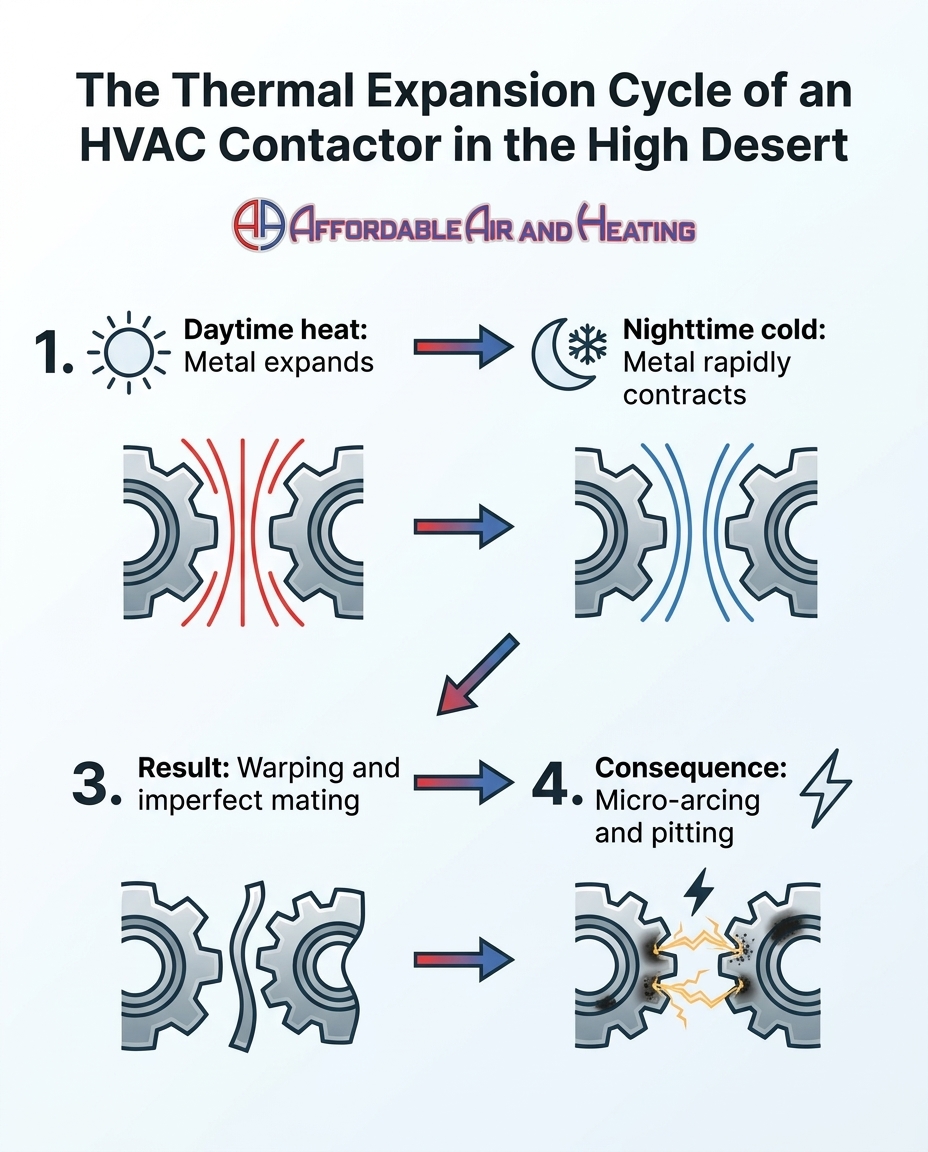
Your outdoor condenser unit sits in direct sunlight, soaking up intense radiant heat. The metal chassis, the internal copper wiring, and the heavy brass electrical fittings all heat up and expand. Then, as the sun drops behind the mountains and the ambient air cools rapidly, those same metals contract. Because different metals (like copper, brass, and silver alloys) cool at different rates, they pull and push against each other. This constant shifting is essentially bending a microscopic paperclip back and forth. Over hundreds of days, the structural integrity of these electrical parts weakens dramatically.
Thermal Expansion: The Silent Killer of Electrical Contactors
Inside your outdoor unit sits a small but mighty component called the contactor. You can think of it as a heavy-duty mechanical drawbridge for high-voltage electricity. When your thermostat calls for heating or cooling, a low-voltage magnetic coil energizes, pulling this metallic bridge closed. This action sends hundreds of volts of electricity to your compressor and fan motor. Because it handles such massive electrical loads, understanding what causes AC contactor failure usually starts with examining the physical condition of its metal plates.
The contact points on this switch are typically made of a silver alloy coated over brass and copper. During the heat of the day, these metals swell. During the freezing nights, they shrink rapidly. This relentless 40-degree daily temperature swing causes profound structural fatigue. Over time, the flat metal plates begin to warp, curl, and deform. When the magnetic coil pulls the bridge closed, the warped plates no longer mate perfectly flat against each other. Instead of a solid, flush connection, microscopic gaps remain between the metal surfaces.
The Mechanics of Micro-Arcing
When electricity encounters a microscopic gap between two warped metal plates, it does not simply stop—it jumps. This jump is called micro-arcing. Essentially, a miniature lightning bolt arcs across the gap every time your system turns on. This electrical arc burns at thousands of degrees, instantly melting the surface of the metal and creating tiny craters, a process known as electrical pitting.
The cascading effect: Once pitting begins, the metal surface becomes rough and uneven, which creates even more gaps. More gaps lead to more arcing, which creates deeper pits. Eventually, the metal is so burned and scarred that electricity cannot flow through it at all, and the system completely fails to start.
Why Standard Contactor Lifespans Fail Here
Most HVAC manufacturers build and test their equipment for average national climates. If you read the technical manual for a standard outdoor unit, it might state that a contactor should last anywhere from five to ten years. However, those estimates assume a gentle, moderate climate with minimal daily temperature shifts. In the extreme environment of the Antelope Valley / Lancaster area, that expected lifespan is often cut in half by severe thermal stress.
This is exactly where deep local expertise matters. When our Affordable Air and Heating technicians respond to service calls, we often find that a generic technician traveling from outside the area might look at a four-year-old system and assume the electrical components are perfectly fine based purely on their age. They frequently overlook the accelerated wear-and-tear caused by high-desert thermal expansion. Working with a local team that actually understands these mechanical wear patterns ensures specific, climate-driven weaknesses are identified before they cause a breakdown.
Our team knows to look for this accelerated degradation because we see the effects of high-desert thermal stress every single day on the job. A localized maintenance schedule doesn't just check the refrigerant levels; it involves a microscopic inspection of the contactor plates to ensure they are surviving the extreme temperature swings.
The Hidden Risks During Mid-Fall Heating Startup
October is the most critical transition period for high-desert homeowners. Every fall, our dispatch board fills up with emergency calls from residents whose systems failed the moment they switched from cooling to heating mode. The hidden danger is that your electrical contactor has just spent the entire summer enduring brutal heat and constant cycling. It is highly likely that the metal is already warped and pitted from months of micro-arcing.
When you initiate your mid-fall heating startup, you are putting a massive electrical load onto a compromised component just as the nighttime temperatures plummet. The cold makes the metal stiff and brittle, increasing the likelihood that the contactor will finally stick or fail completely. This often happens on the very first freezing night of the year, leaving your family without warmth when you need it most.
One homeowner in nearby Santa Clarita learned this the hard way during a severe winter freeze warning. Their heating system suddenly stopped working right in the middle of a dangerously cold week. When a technician arrived that same day to assess the unit, they diagnosed a completely failed electrical relay—a direct casualty of severe temperature stress that had finally given out. Because the damage was extensive and the overall system was aging rapidly, the homeowner opted for a complete system replacement, utilizing flexible financing to install a new Goodman unit that restored reliable heating just in time.
Warning Signs of a Pitted Contactor
While you should never attempt to inspect the high-voltage components yourself, your outdoor unit will often give you audible clues that the contactor is failing. In our experience, catching these symptoms early can mean the difference between a simple part replacement and a total system failure.
• Loud clicking or chattering: If you hear a rapid clicking sound coming from the outdoor unit when the thermostat calls for heat, the magnetic coil is struggling to pull the warped plates together.
• Aggressive buzzing or humming: A loud hum indicates that the low-voltage signal is reaching the contactor, but the high-voltage electricity cannot pass through the pitted metal to start the compressor.
• Delayed system starts: If you hear the thermostat click inside, but the outdoor unit hesitates for several minutes before turning on, the electrical resistance across the contactor is dangerously high.
• The system runs continuously: Sometimes, the micro-arcing actually welds the pitted metal plates together. If this happens, the contactor gets stuck in the "on" position, and the outdoor unit will not shut off even when the thermostat is satisfied.
A critical safety warning: Never attempt to open the outdoor electrical panel or replace a contactor personally. These components handle 240 volts of raw electricity, which poses an extreme, lethal hazard. Always rely on a licensed professional who serves the Antelope Valley service areas to safely test the voltage drops and inspect the contacts using the proper protective equipment.
Protecting Your System Before the First Freeze
Proactive inspection of your electrical components is always cheaper, safer, and significantly less stressful than dealing with an emergency replacement in the dark. A comprehensive high-desert fall inspection goes far beyond just changing the air filter. It involves a deep diagnostic check of the parts that take the most abuse from the climate.
During a localized fall inspection, an Affordable Air and Heating professional will perform several critical checks:
1. Visual surface inspection: Checking the contactor plates for dark carbon scoring, melting, or severe pitting caused by micro-arcing.
2. Voltage drop testing: Using a multimeter to measure exactly how much electrical resistance is occurring across the contact bridge. High resistance means the part is failing.
3. Thermal tightening: Tightening all electrical lugs and connections that have vibrated loose due to the constant expansion and contraction of the metal.
Catching these issues early provides immense peace of mind. A local family experienced the alternative during the fall season when they returned home from a long vacation. Their HVAC unit had finally died after more than 30 years of enduring the high-desert climate stress. Rather than suffering through the cold nights with a dead system, they received a competitive assessment, and a professional team completed a full system replacement in a single day. However, for newer systems, a simple pre-winter inspection can prevent these sudden failures entirely, ensuring your equipment easily handles the winter load.
Frequently Asked Questions About High-Desert HVAC Wear
Why does an HVAC contactor pit?
An HVAC contactor pits because electrical arcing occurs across imperfectly mated metal surfaces. When temperature swings warp the copper and brass plates, they no longer close tightly against each other. The high-voltage electricity jumps this microscopic gap, creating an intense arc of heat that burns, melts, and pits the material over time.
How does cold weather affect HVAC electrical parts?
Cold weather causes metal components to rapidly contract, which can loosen electrical connections and warp contact points. This constant shrinking, especially after expanding during a hot high-desert day, leads to structural fatigue in the wiring and relays. Over time, this thermal stress increases electrical resistance and causes parts to fail prematurely.
Why is my heater clicking but not starting?
If your heater is clicking but not starting, it usually indicates a failing contactor or relay that is receiving the signal from the thermostat but cannot physically close the circuit. The clicking sound is the magnetic coil attempting to pull the damaged contacts together. When severe pitting or warping prevents a solid connection, the high voltage cannot reach the compressor to start the heating cycle.
How long do AC contactors last?
While generic manufacturer estimates suggest AC contactors last 5 to 10 years, high-desert climates often reduce this lifespan significantly. In our daily service routes across the Antelope Valley, we see extreme thermal stress from 40-degree daily temperature swings causing accelerated mechanical wear and tear. These components frequently require replacement much sooner here than in moderate coastal areas.
Can extreme temperature swings void my warranty?
Weather itself does not void an HVAC manufacturer warranty, but failing to perform required seasonal maintenance often does. Manufacturers require regular inspections by licensed professionals to catch weather-related wear, such as pitted contactors, before they cause catastrophic compressor failure. Keeping up with your fall maintenance ensures your warranty remains valid and your system stays protected.
Schedule Your Fall Contactor Inspection Today
As we approach the critical mid-fall heating startup, you face a clear decision point: proactively inspect your electrical components now, or risk a sudden, total failure when the first hard freeze hits the high desert. Don't let a worn-out, pitted part leave your family shivering in the cold because it couldn't handle the thermal stress. Our team at Affordable Air and Heating understands exactly how Antelope Valley's extreme temperature swings stress your HVAC's contactor, and we have the local expertise to fix it before it breaks. Reach out to us today to schedule your pre-winter inspection and secure your home's comfort for the season ahead.