Why Desert Homeowners Need to Rethink Their AC Service Schedule
If you've ever wondered how often should you service your air conditioner in a desert climate, here's the short answer: twice a year — once in spring before peak heat arrives, and once in fall after the heavy cooling season ends. This is significantly more than the once-a-year standard recommended for moderate climates.
Quick Answer: Desert AC Service Frequency
System AgeRecommended Service FrequencyBest TimingUnder 5 yearsOnce per yearSpring (March-April)5-15 yearsTwice per yearSpring + Fall15+ years or heavy use2-3 times per yearSpring, Midsummer, Fall
In a place like California's Antelope Valley, your air conditioner isn't just working hard — it's running nearly year-round. Desert AC systems log roughly 4,000 to 5,000 cooling hours per year, compared to just 800 to 1,500 hours in milder climates. That's not normal wear. That's the kind of workload that turns a small, skippable maintenance issue into a full system breakdown in the middle of a 110°F July.
Add in the relentless dust, intense UV exposure, and dramatic temperature swings that define high desert living, and it becomes clear why the standard national advice simply doesn't apply here. Skipping or delaying service in this environment can quietly drain your energy efficiency by 20 to 30% and shave years off your system's life.
This guide walks you through exactly what your AC needs, when it needs it, and why — so you can stay cool all summer without the stress of an emergency breakdown.
How Often Should You Service Your Air Conditioner in a Desert Climate?
In the Antelope Valley and surrounding high desert regions, we have to look at HVAC care through a different lens. While a homeowner in a coastal city might get away with a "set it and forget it" mentality, our environment requires a proactive AC Maintenance in Desert Climate strategy.
We recommend a bi-annual schedule as the gold standard. Think of it like a marathon runner. You wouldn't expect someone to run 26 miles in the sand without a checkup before the race and a recovery session afterward. Your AC is that runner.
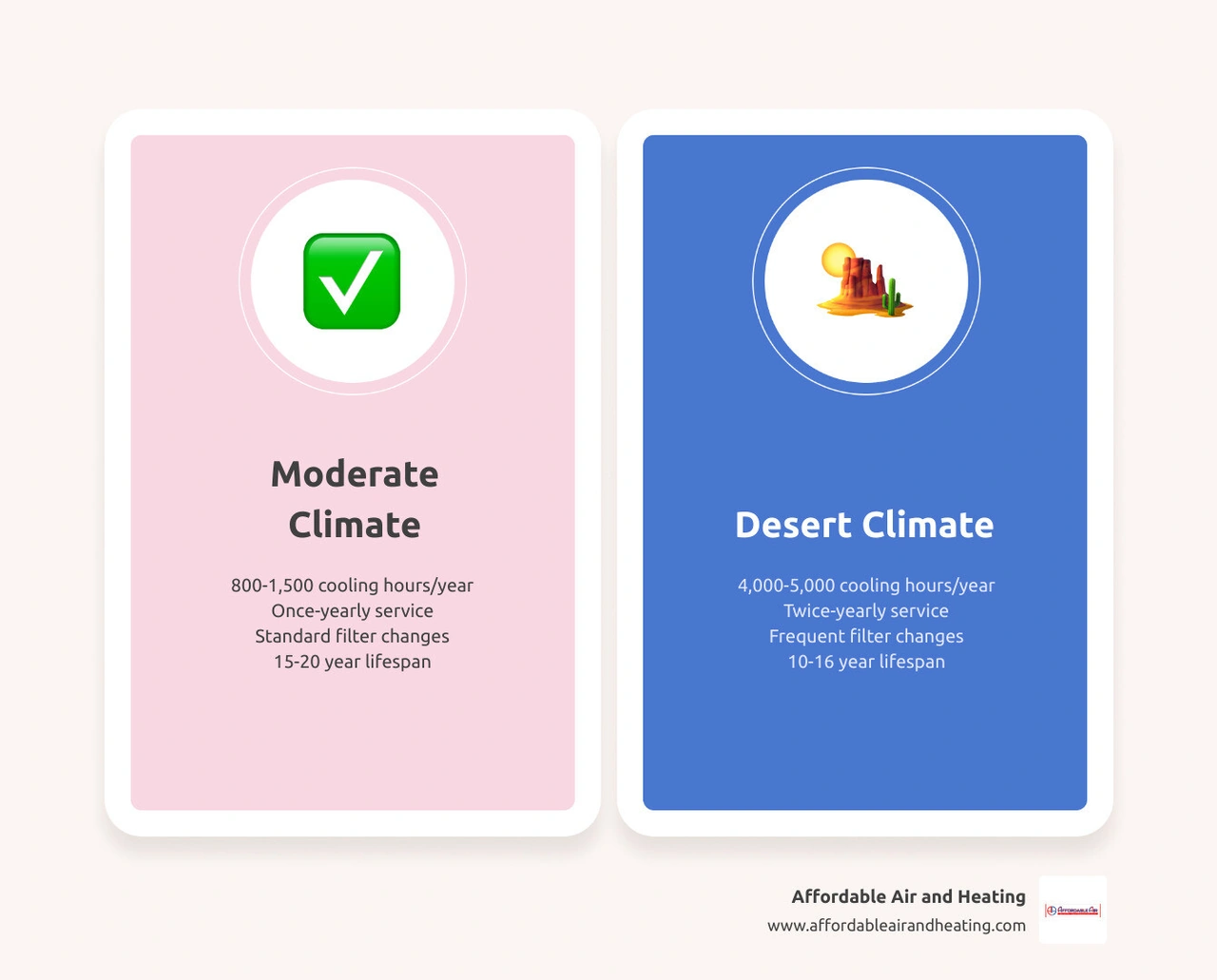
FeatureModerate ClimateDesert Climate (Antelope Valley)Service FrequencyOnce annuallyTwice annually (Spring & Fall)Cooling Hours/Year800 – 1,5004,000 – 5,000Filter ChangesEvery 90 daysEvery 30 daysSystem Lifespan15 – 20 years10 – 16 years (without maintenance)Efficiency LossLow (5-10%)High (20-30% if neglected)
How often should you service your air conditioner in a desert climate to prevent summer breakdowns?
To avoid the dreaded "no-AC" call during a triple-digit heatwave in Palmdale or Lancaster, the Spring Tune-Up is non-negotiable. Ideally, this should happen in March or April.
During this pre-summer visit, we focus on reliability. We check the components most likely to fail under stress, such as capacitors and fan motors. By catching a weakened part in April, we prevent a total system shutdown in July. For those using modern systems, a Spring Heat Pump Tune-Up Palmdale ensures the reversing valve and refrigerant levels are perfect before the cooling demand spikes.
How often should you service your air conditioner in a desert climate when dealing with heavy dust?
The second half of the bi-annual equation is the Fall Recovery Check, typically scheduled for October or November. After a long summer filled with Santa Ana winds and high desert dust storms, your outdoor unit is often caked in a layer of fine silt.
This dust acts as an insulator, trapping heat inside your coils and forcing the compressor to work 30% harder. A post-summer AC Service Santa Clarita allows us to deep-clean the system, clearing out the summer’s debris so it doesn't sit and corrode the components during the winter months.
Why High Desert Conditions Demand More Frequent Maintenance

Living in May 2026, we’ve seen how climate patterns in the Antelope Valley continue to put extreme stress on home machinery. There are three primary "system killers" unique to our desert home:
- The Sandpaper Effect: Desert dust isn't just dirt; it's often comprised of sharp silica particles. As these are sucked into your system, they act like microscopic sandpaper, eroding motor bearings and pitting the sensitive aluminum fins on your coils.
- Thermal Cycling (The Paperclip Effect): In places like Acton or Quartz Hill, we often see diurnal temperature swings of 30 to 40 degrees. This constant expansion and contraction of metal components—much like bending a paperclip back and forth—eventually leads to refrigerant leaks and electrical failures.
- High Altitude Derating: Many of our service areas, like Lake Hughes and Wrightwood, sit at higher elevations. Thinner air is less efficient at carrying heat away from your coils, which means your blower motor has to work harder to achieve the same cooling effect as a unit at sea level.
When you combine these factors with roughly 5,000 cooling hours a year, it’s easy to see why the Benefits of Regular HVAC Maintenance go far beyond just "blowing cold air." It’s about protecting a major investment from a very hostile environment.
What to Expect During a Professional Desert AC Tune-Up
A professional tune-up isn't just a quick "look-over." In the desert, it needs to be a rigorous 20-point inspection. When we perform AC Service Palmdale, we are looking for the specific ways desert heat attacks a system.
- Chemical Coil Cleaning: We don't just spray the coils with a hose. We use specialized cleaners to break down the "muddy sludge" that forms when desert dust meets evening condensation.
- Refrigerant Precision: A system that is just 10% low on refrigerant can lose 20% of its cooling capacity. We check for the tiny leaks caused by thermal cycling.
- Capacitor Testing: Capacitors are the #1 failure point in desert heat. They are rated for high temperatures, but internal attic temps in Santa Clarita can exceed 150°F, causing them to "pop" or lose their charge.
- Drain Line Flushing: Desert monsoons and high dust can lead to algae and silt buildup in your condensate lines. We flush these to prevent water damage to your ceilings.
- Electrical Tightening: Vibrations and heat can loosen electrical connections. Loose wires are responsible for nearly 60% of compressor failures. Our AC Tune-Up Canyon Country includes tightening every terminal to ensure a safe, steady flow of power.
Maximizing Efficiency and Lifespan in Harsh Arid Environments
We all want our AC units to last forever, but the reality of the desert is that a neglected unit might fail in under 10 years. However, with consistent AC Maintenance Lancaster, we regularly see systems reach the 15 to 20-year mark.
The secret is maintaining the "SEER" (Seasonal Energy Efficiency Ratio). In a desert environment, an unmaintained AC can lose 0.5 to 1.0 SEER points every single year. This means by year five, you could be paying 20% more on your Southern California Edison bill for the exact same amount of cooling.
Features of a Desert-Optimized System:
- Variable-Speed Compressors: These allow the system to run at lower speeds for longer periods, which is much easier on the components than constant "on-off" cycling in 110-degree heat.
- High SEER2 Ratings: The more efficient the unit, the less heat it generates internally while trying to cool your home.
- Enhanced Coil Coatings: These help protect against the corrosive effects of desert dust and potential salt air if you're closer to the coast.
Homeowner Tips: Supporting Your System Between Professional Visits
While professional service is essential, there are things you can do to help. In fact, what you do between our visits is just as important as the tune-up itself.
- The 30-Day Filter Rule: Forget the "90-day" labels on the box. In the Antelope Valley, you should check your filter every 30 days. If you live near construction or in a particularly windy area like Rosamond, you may need to change it monthly.
- MERV 8-11 is the Sweet Spot: We recommend filters in the MERV 8 to 11 range. Anything higher can actually restrict airflow in our thin desert air, causing the blower motor to overheat.
- Maintain a "Clear Zone": Keep at least 24 inches of clearance around your outdoor unit. Desert shrubs grow fast after a rain; don't let them choke your AC's air intake.
- Gentle Rinsing: After a major dust storm, you can gently rinse your outdoor coils with a garden hose (never a pressure washer!). This helps the unit "breathe" until your next professional AC Service Santa Clarita.
- Strategic Shading: Providing shade for a west-facing outdoor unit can reduce the thermal load on the system by 10-20°F. Just ensure the shading structure doesn't trap the hot air being exhausted out the top of the unit.
Frequently Asked Questions About Desert AC Care
What are the signs my AC needs immediate service?
Even with regular maintenance, the desert can throw surprises at you. Call for AC Maintenance Palmdale immediately if you notice:
- Weak Airflow: This often indicates a clogged coil or a failing blower motor.
- Strange Noises: Grinding or clicking sounds usually mean a bearing is failing or a capacitor is about to go.
- Energy Bill Spikes: A 20% jump in your bill without a change in weather is a classic sign of a system struggling with mechanical friction or low refrigerant.
- Frequent Cycling: If your AC turns on and off every few minutes, it's likely overheating or has a sensor issue.
Can I perform my own AC maintenance in the desert?
You can—and should—handle filter changes and keeping the area around the unit clear. However, the technical aspects of a tune-up require professional tools. Checking refrigerant pressures, testing electrical draw, and cleaning internal components involves high-voltage electricity and pressurized gases. For your safety and to keep your warranty valid, professional service is a must.
How long do AC units typically last in the Antelope Valley?
Without maintenance, many systems in our area fail between 8 and 12 years. With bi-annual care, we expect a lifespan of 12 to 16 years, and sometimes up to 20. The extreme heat stress simply wears out parts faster than in a city like San Diego or San Francisco.
Conclusion
Understanding how often should you service your air conditioner in a desert climate is the first step toward a more comfortable, affordable home. In the Antelope Valley, the answer is clear: twice a year is the only way to stay ahead of the heat, the dust, and the high energy bills.
At Affordable Air and Heating, we’ve been family-owned and operated since 1996. We understand the unique challenges of high desert living because we live here too. Whether you need a routine AC Maintenance Lancaster visit or a complete system upgrade, our team is dedicated to providing energy-efficient solutions that stand up to the harshest California sun.
Don't wait for the first 100-degree day to find out your system is struggling. Schedule your spring or fall tune-up today and keep your home a cool oasis all year long.