When to Call About an AC Breakdown vs. Waiting for Regular Hours
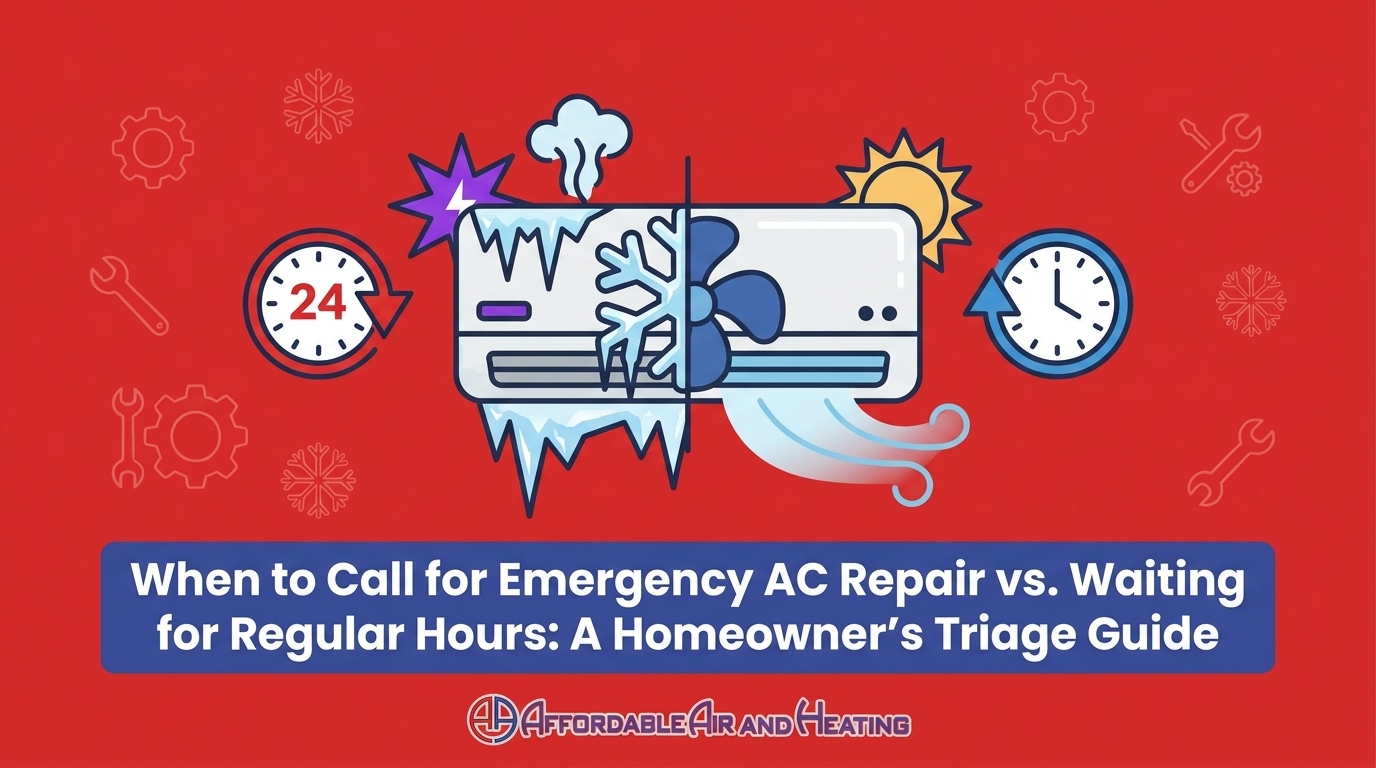


Is Your Broken Air Conditioner an Urgent Problem?
How do you know when an AC problem is urgent and when it can safely wait for regular hours, especially when the temperature inside your house is climbing fast? Is your AC actually broken—or just struggling to keep up with an August late-summer heatwave? When your cooling system shuts down on the hottest day of the year, it is easy to panic. The heat sets in quickly, and you are left wondering if the problem can safely wait until morning.
At Affordable Air and Heating, if you need immediate help with your HVAC services, including urgent air conditioning repair, our team is ready to respond.
In our experience, the secret to handling a sudden breakdown is applying a simple triage process. HVAC triage means separating minor mechanical inconveniences from genuine safety hazards. A system that is blowing warm air is certainly frustrating, but an electrical burning smell is an immediate danger. Knowing the difference between these two scenarios protects your home's safety and prevents you from paying unnecessary after-hours fees for a repair that could easily happen the next day. By evaluating your system's symptoms calmly, you can make the right decision for your home.
Definitive Signs You Need Prompt Professional Attention
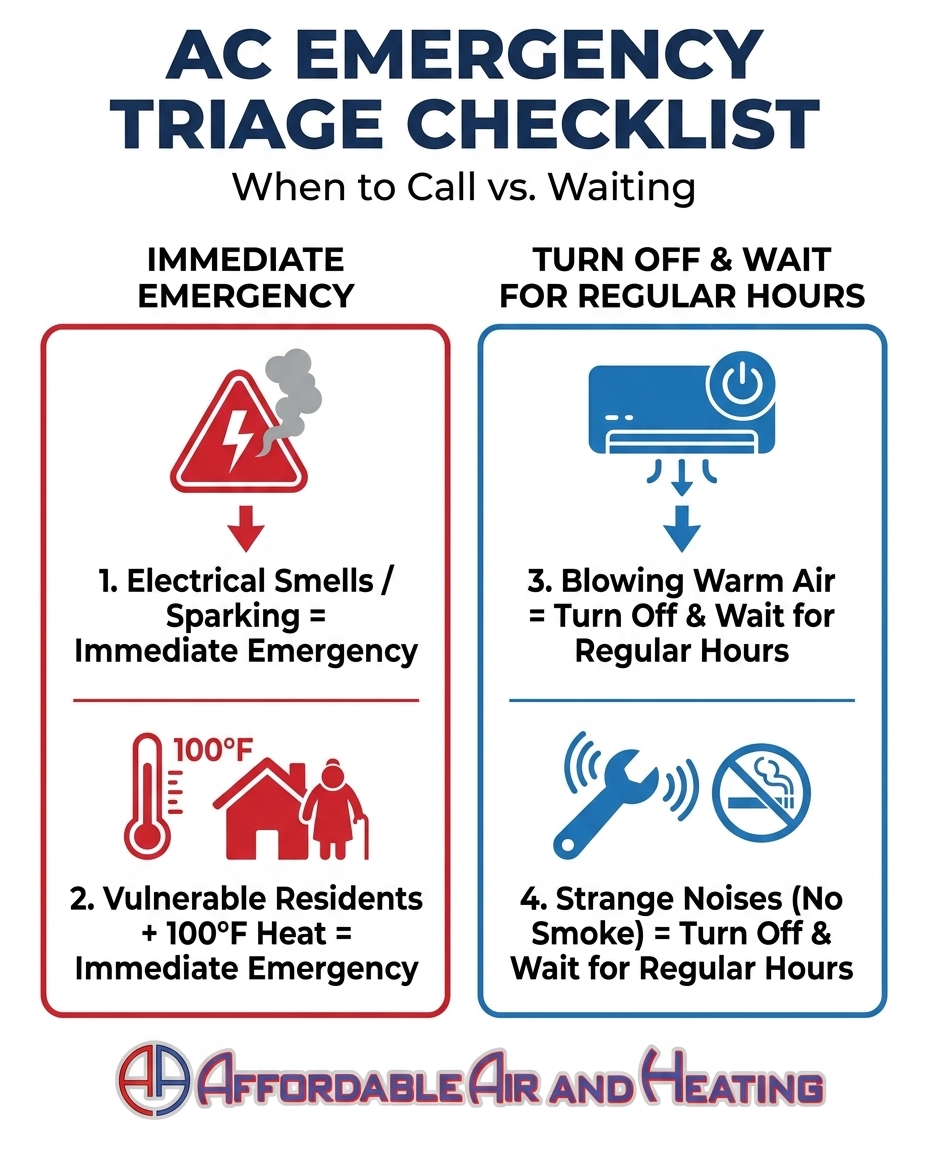
Certain cooling failures require professional attention as soon as possible. We always advise shutting your system down at the thermostat and calling for help right away if you notice any of the following symptoms. If you ever smell gas, leave the home and call your gas utility or 911.
• Burning electrical smells: If you detect an odor resembling fish, melting plastic, or burning rubber coming from your vents or the outdoor unit, you have a severe electrical fault.
• Sparking or visible smoke: Any visible signs of combustion near your equipment mean the system is a high fire risk.
• Repeatedly tripping breakers: If your air conditioner trips the circuit breaker immediately after you reset it, the system is pulling a dangerous amount of electricity.
• Rapid indoor water leaks: A clogged condensate drain line can back up quickly, sending gallons of water through your ceiling or pooling around your indoor air handler.
When 100°F+ outdoor temperatures hit the region, the window of safety inside a home without air conditioning shrinks drastically. The extreme heat transforms what might be a minor inconvenience in milder weather into a time-sensitive situation.
Electrical and Fire Hazards
Never ignore sparking, smoke, or a burning odor at the vents or the outdoor condenser. These symptoms usually point to a failing motor, melted wire casings, or a short circuit. If these occur, shut off the system at the main electrical panel immediately. Running compromised electrical components can lead to a catastrophic equipment failure or an electrical fire. A licensed technician must test the wiring and replace the damaged parts before the system is safe to operate again.
Health Risks for Vulnerable Residents
Indoor temperatures exceeding 90°F significantly increase the risk of heat-related illnesses. Lack of cooling becomes a medical emergency rapidly for sensitive individuals, including infants, the elderly, and those with respiratory or cardiovascular conditions. If your home has vulnerable residents and the indoor temperature is rising dangerously close to 90°F during an extreme late-summer heatwave, you are facing a true emergency. In these cases, restoring the cooling system is about protecting human health, not just restoring comfort.
When It Is Safe to Wait for Regular Business Hours
Not every cooling failure demands a midnight service call. Honest, transparent guidance means telling you exactly when it is safe to wait. Knowing which symptoms are merely uncomfortable rather than dangerous helps you avoid panic. If your system is failing but you do not smell smoke, see sparks, or have vulnerable family members at risk, you can usually wait for the sun to come up.
A straightforward mechanical issue, such as a system that suddenly stops blowing cool air, is not an electrical hazard. In that case, turn the system off safely and schedule a visit during regular hours. Waiting for regular hours is a standard, safe practice for many common HVAC issues.
The System is Blowing Warm Air
An air conditioner blowing warm air is incredibly frustrating, but in our experience, it is rarely an immediate danger. This symptom is often caused by a tripped outdoor breaker, a heavily soiled air filter, a failed capacitor, or a refrigerant leak. None of these issues pose a fire hazard. It is entirely safe to turn the system off at the thermostat and schedule a daytime appointment. Running the system while it blows warm air can damage the compressor, so shutting it down is the best protective measure you can take.
Strange Noises Without Smoke or Burning
If your outdoor condenser starts rattling, squealing, or buzzing, but there are no electrical smells accompanying the noise, our team typically finds a mechanical issue. A squealing sound often points to a worn fan belt or failing motor bearings, while a loud buzzing usually indicates a bad contactor or capacitor. Turn the system off to prevent the mechanical parts from grinding together and causing further damage, then wait for regular business hours to have a professional diagnose the noise.
Frozen Evaporator Coils
If you notice ice building up on the copper refrigerant lines outside or on the indoor evaporator coil, your system has frozen over. A technician cannot properly diagnose or repair a frozen air conditioner until the ice has completely melted. This thawing process takes several hours. Calling for an emergency midnight repair will not speed up the process, as our technicians will simply have to wait for the ice to melt anyway. Turn the thermostat to "off," switch the fan setting to "on" to help circulate air over the ice, and wait until morning.
The Risks of High-Desert Heat Accumulation in Your Home
In our years of providing cooling solutions across Lancaster, we have learned that living in the high desert requires a distinct approach to home cooling. The severe triple-digit late-summer heatwaves typical of the Antelope Valley change how our team measures indoor safety. When the outdoor temperature spikes, a broken air conditioner forces you to rely entirely on your home's thermal envelope to keep you safe.
During a 100°F+ outdoor temperature spike, indoor heat accumulation happens rapidly. Homes absorb heat through the roof, windows, and poorly insulated walls. Once the air conditioner stops running, the thermal mass of your home begins to hold onto that heat. If your cooling system has been running at maximum capacity all season, it is already prone to end-of-season wear. When it finally shuts down, the trapped heat has nowhere to go.
To help you gauge whether your home will stay safe until morning, consider how your property handles heat accumulation. If you live in an older home with single-pane windows and minimal attic insulation, the indoor temperature will rise much faster than in a newer, tightly sealed build. We proudly service service areas in the Antelope Valley, where understanding these regional climate challenges is a daily requirement for our crew.
• Direct Afternoon Sun — Impact on Indoor Temperature: Rapidly heats west-facing rooms; raises overall indoor temp quickly. — Safety Recommendation: Close all heavy drapes and blinds immediately after the AC fails.
• Attic Insulation Quality — Impact on Indoor Temperature: Poor insulation allows radiant roof heat to push down into living spaces. — Safety Recommendation: Move to lower floors if available; heat rises to the highest ceilings.
• Ventilation & Airflow — Impact on Indoor Temperature: Stagnant air makes the ambient temperature feel 5-10 degrees warmer. — Safety Recommendation: Keep ceiling fans running to create a wind-chill effect on the skin.
Safe Steps to Take While Waiting for an AC Technician
If you have determined that your cooling failure is not a critical emergency and you are waiting for regular business hours, there are specific steps we recommend you take to manage the situation safely. Never attempt dangerous DIY electrical troubleshooting. Opening the electrical panel of the AC unit or attempting to replace capacitors without a license exposes you to high-voltage shocks.
Waiting can be the smartest choice when there is no electrical hazard. By safely shutting the system down and scheduling a visit, you give the technician the time to diagnose the problem properly. Here is what we recommend you do while you wait:
1. Turn off the AC at the thermostat: This is the single most important step. If the system is malfunctioning, leaving it running can destroy the compressor. Switch the thermostat from "cool" to "off."
2. Check your air filter: A completely clogged air filter restricts airflow so severely that it can cause the system to shut down or freeze. If the filter is caked in dust, replace it.
3. Verify the thermostat batteries: Sometimes a blank thermostat screen simply means the batteries have died. Swap in fresh batteries to see if communication is restored.
4. Check the circuit breaker once: Look at your main electrical panel. If the breaker labeled for the AC has tripped, you can reset it exactly one time. If it trips again immediately, leave it off and wait for a professional.
5. Manage indoor heat: Close all blinds and curtains to block direct sunlight. Turn on ceiling fans to keep the air moving, and avoid using the oven or stove.
If your system recently lost power due to a grid failure, you might be dealing with a different set of symptoms. Understanding why your vents are blowing warm air after a power outage can help you safely reset the system before assuming the equipment is permanently broken.
Frequently Asked Questions About AC Troubleshooting and Triage
What is considered an AC emergency?
An AC emergency is any situation involving electrical burning smells, sparking, visible smoke, or rapid water leaks inside the home. Furthermore, a complete cooling failure becomes a medical emergency when outdoor temperatures are extreme and vulnerable individuals (like infants or the elderly) are indoors. If you observe these dangerous conditions, you must shut the system down at the breaker and call for professional help immediately to prevent fire hazards or severe heat-related illness.
Is an AC blowing warm air an emergency?
Typically, no, an AC blowing warm air is not an immediate emergency. In our experience, it usually indicates a mechanical issue like a failed capacitor, a clogged air filter, or a slow refrigerant leak. While the lack of cold air is highly uncomfortable, it does not pose a fire or safety hazard to the home itself. It is safe to turn the unit off at the thermostat and wait for regular business hours to schedule a diagnostic visit.
When should I shut off my air conditioner?
You should shut off your air conditioner immediately if you smell burning plastic, hear loud grinding noises, or notice ice building up on the indoor or outdoor coils. Running a system with these symptoms forces damaged components to keep working, which often destroys the expensive compressor. Turning the system off protects your equipment from further damage while you wait for a technician to arrive.
How hot is too hot for a house without AC?
An indoor temperature exceeding 90°F is generally considered too hot for a house without AC, as it significantly increases the risk of heat exhaustion and heatstroke. For vulnerable populations, such as the elderly or those with medical conditions, even temperatures climbing past 80°F can be dangerous if the humidity is high. If your home cannot maintain a safe temperature during a Lancaster heatwave, seek a temporary cooling shelter and call us during office hours.
Is a leaking AC an emergency?
A leaking AC can be an emergency if a large volume of water is actively damaging your ceilings, drywall, or flooring. Most leaks are caused by a clogged condensate drain line causing the drain pan to overflow. If the leak is minor and contained within a utility space, you can turn the system off and wait for morning; however, rapid water intrusion into living spaces requires immediate attention to prevent severe property damage.
Can a frozen AC coil cause permanent damage if left running?
Yes, leaving a frozen AC coil running can cause permanent and expensive damage to your system. The ice block prevents refrigerant from absorbing heat properly, which can cause liquid refrigerant to flow backward into the compressor, destroying it. If you see ice on your coils or copper lines, you must turn the cooling function off immediately and turn the fan to "on" to begin the thawing process safely.
Secure Reliable Air Conditioning Support for Your Home
Whether you are facing a midnight emergency or a morning repair, expert help is necessary to restore your home's cooling system properly. Applying a clear triage checklist provides the confidence you need to make the right call without second-guessing yourself. You now know how to identify dangerous electrical faults, protect vulnerable family members, and safely shut down a struggling system.
Our family-owned team at Affordable Air and Heating has served Lancaster and Santa Clarita since 1996 and understands the unique challenges of keeping homes cool in the Lancaster and Antelope Valley climate. Do not let a malfunctioning system compromise your home's safety. Reach out and contact us during office hours (Mon–Sat 8 AM–8 PM, Sun 9 AM–6 PM) so we can restore your cooling system correctly.