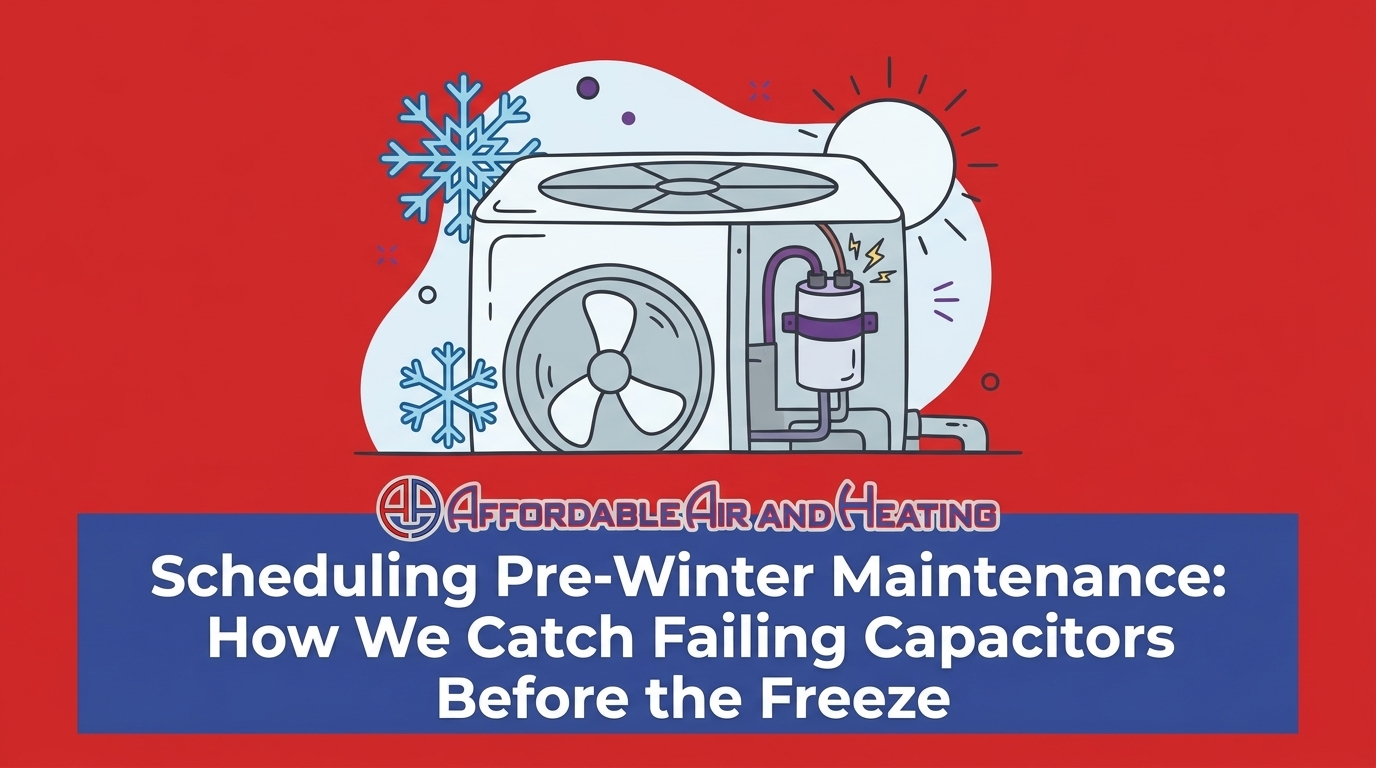
Scheduling Pre-Winter Maintenance: How We Catch Failing Capacitors Before the Freeze


The Hidden Electrical Threat Lurking in Your System This Fall
Mid-fall in the High Desert means one thing: the brutal summer heat is fading, and sudden overnight freezes are just around the corner. Here at Affordable Air and Heating, our technicians see firsthand how extreme Antelope Valley summers take a toll on local HVAC units. If you want to avoid a sudden breakdown, Scheduling Pre-Winter Maintenance: How We Catch Failing Capacitors Before the Freeze should be at the top of your October to-do list. After months of running non-stop to combat extreme temperatures, the internal electrical components inside your equipment are exhausted. A pattern we see often across Lancaster is that a dual-run capacitor stressed to the limit by summer heat is a concrete problem that often goes unnoticed until the system suddenly stops working.
Many homeowners assume that a fall tune-up is simply about changing the air filter and wiping down the cabinet. The reality is much more technical. True preventative care requires deep electrical diagnostics to test components that have been silently degraded by the harsh Lancaster / Antelope Valley climate. Deciding to schedule a proactive fall tune-up now allows a professional to test these parts before they fail, rather than waiting for your heater to give out on the first freezing night of the year.
Securing the health of your HVAC system requires a comprehensive approach to heating maintenance that goes beyond the surface.
• Changing the air filter and wiping the cabinet exterior. — Deep Electrical Diagnostic (What You Need): Measuring electrical draw and component capacitance.
• Glancing at wires for obvious burn marks. — Deep Electrical Diagnostic (What You Need): Testing relays and contactors for voltage drops.
• Listening to the system run for a few minutes. — Deep Electrical Diagnostic (What You Need): Verifying the exact microfarad output of capacitors.
• Assuming parts are fine because the air feels warm. — Deep Electrical Diagnostic (What You Need): Replacing components that test outside safe factory tolerances.
How Brutal Summer Heat Invisibly Degrades Dual-Run Capacitors
The Problem: Your heating and cooling equipment relies on a small, cylindrical component called a dual-run capacitor. This device acts like a powerful, short-term battery. It stores a massive jolt of electricity to kickstart the heavy motors inside your system, specifically the compressor and the blower fan. Without this initial burst of energy, the motors cannot overcome their own resting inertia.
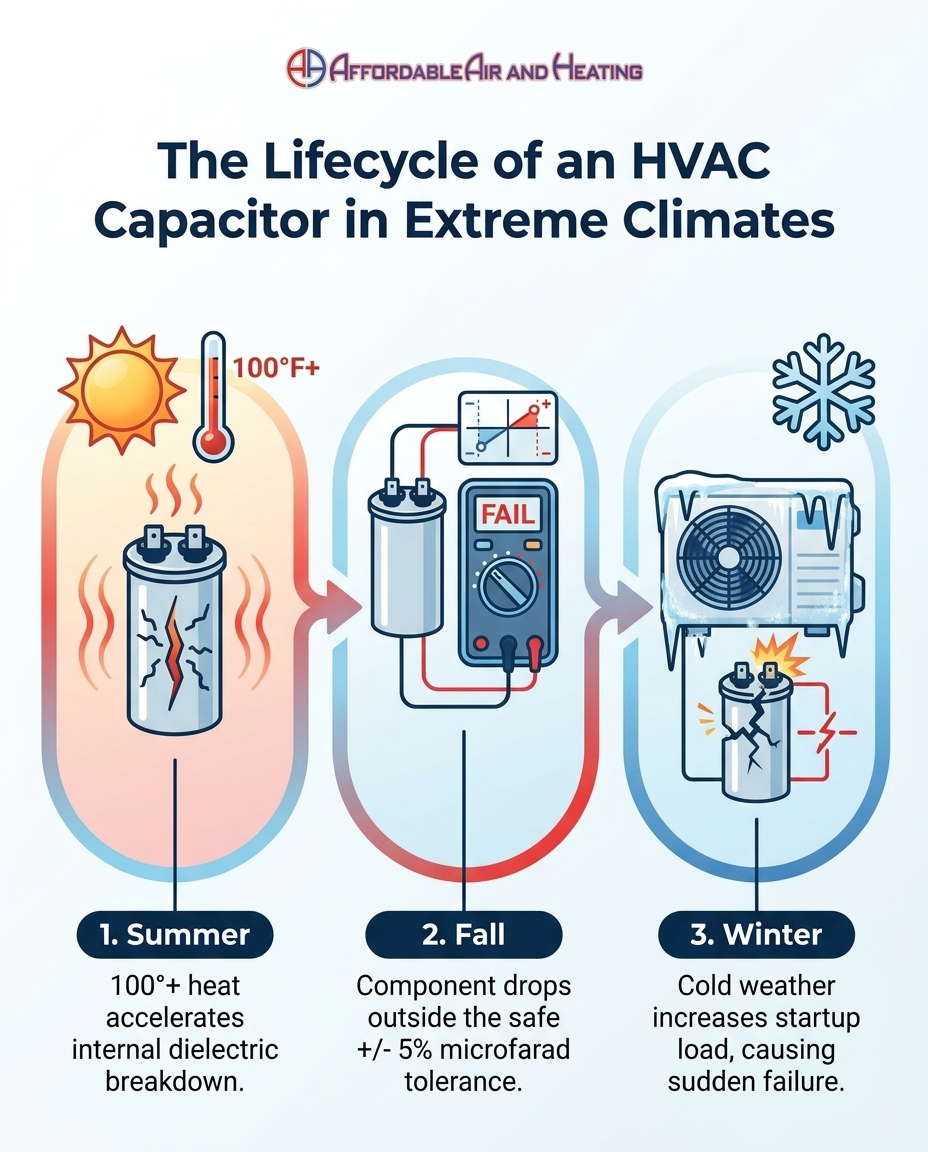
The Cause: The sustained, extreme summer temperatures in the Lancaster / Antelope Valley region act as an incubator for electrical degradation. Capacitors are filled with a specialized dielectric fluid that insulates the internal foil layers. When outside temperatures regularly exceed 100 degrees, the heat inside the metal equipment cabinet spikes even higher. Over months of continuous cycling, this intense thermal stress bakes the capacitor. The dielectric fluid begins to break down, lose its insulating properties, and sometimes even boil, causing the top of the cylinder to bulge.
The Role of Dielectric Materials
The internal insulation of a capacitor is what allows it to store high-voltage energy safely. Think of the dielectric material as a protective barrier between positive and negative charges. When extreme ambient heat compromises this insulation, the component loses its ability to hold a full charge. It might still hold enough energy to start the motor, but it has to work much harder to do so, generating even more internal heat in a destructive loop.
Cumulative Thermal Stress
The Solution: Understanding that this damage is cumulative is the first step in preventing a breakdown. A capacitor does not usually fail instantly. Instead, months of continuous cycling in high heat weaken the component gradually. The damage is often completely invisible from the outside. A capacitor can lose a significant amount of its storage capacity while the system still seemingly functions during late summer. Because the system is still blowing air, homeowners are lulled into a false sense of security, unaware that the component is hanging on by a thread.
Why Electrical Failures Strike on the First Freezing Night
When the weather shifts in Mid-fall (October), your equipment undergoes a significant mechanical change. Switching from cooling mode to heating mode introduces entirely new stresses to the system. While the summer heat caused the initial invisible damage, the sudden overnight temperature drops typical of the High Desert in late fall are what finally push a weakened component over the edge.
The Increased Load of Heating Startup
Cold weather dramatically increases the starting torque required for electrical motors to spin. When temperatures drop toward freezing, the lubricating oils inside the blower motor and compressor become thick and sluggish. The metal components contract slightly, creating more mechanical resistance. Because the parts are stiff and cold, the motor must draw significantly more amperage to get moving.
This is where the summer heat damage reveals itself. The motor demands a massive jolt of electricity to overcome the cold, stiff mechanical parts. It asks the dual-run capacitor for maximum power. However, because the capacitor's internal insulation was baked and degraded during the summer, it simply cannot deliver the required energy. The weakened capacitor fails completely under the sudden strain of a freezing night, leaving the motor stalled and your home without heat exactly when you need it most.
The Diagnostic Difference: Catching Microfarad Tolerance Drops
A thorough, technical diagnostic process is what separates a quick visual inspection from true preventative maintenance. At Affordable Air and Heating, our team doesn't just look at a capacitor to see if it appears damaged; we actively measure its electrical output to catch invisible degradation before it causes an emergency winter breakdown.
What Is a Microfarad (µF) Rating?
1. Defining the measurement: Electrical capacitance is measured in a unit called a microfarad (µF). Every dual-run capacitor has a specific factory rating printed on its label, such as 45/5 µF or 35/3 µF.
2. Understanding factory specifications: These numbers represent the exact amount of energy the component is designed to store for the compressor and the fan motor.
3. Evaluating real-world output: Over time, heat degradation causes the actual output to drop below the factory specification. A capacitor might be rated for 45 µF, but due to summer heat stress, it may only be producing 38 µF.
Precision Multimeter Testing
1. Establishing the tolerance range: Manufacturers build capacitors with a strict +/- 5% to 6% tolerance range. If a component's output falls outside this narrow window, it is considered compromised and at high risk of sudden failure.
2. Applying specialized tools: Technicians use specialized digital multimeters that are specifically designed to measure capacitance. They isolate the component, safely discharge any stored energy, and take a precise reading.
3. Catching the Microfarad (µF) tolerance drop: By comparing the actual multimeter reading to the factory rating, the technician can calculate the exact Microfarad (µF) tolerance drop. Catching a component that has slipped outside its safe operating range allows for a simple replacement today, rather than an emergency breakdown during a freezing night later.
Protecting the Entire Heating Circuit from Cascading Failures
A failing capacitor does not just stop your heater from turning on; it actively threatens the rest of your expensive equipment. When a capacitor cannot provide the necessary starting jolt, the blower motor or compressor struggles to start. To compensate for the lack of stored energy, the motor is forced to pull more raw amperage directly from your home's electrical panel.
Preventing Motor Burnout
The danger of excess heat: Pulling excess amperage generates a massive amount of heat inside the motor windings. If a motor is forced to run on a weak capacitor for weeks or months, this heat will eventually melt the insulation surrounding the copper wires inside the motor. Once those wires touch, the motor shorts out completely. What should have been a quick electrical component swap suddenly becomes an extensive motor replacement.
Protecting the relays: This excess electrical draw also damages the wiring and other electrical relays in the circuit. The increased heat and electrical arcing can weld contacts together, leading to contactor failure symptoms where the system refuses to shut off or fails to turn on at all. By actively measuring the Microfarad (µF) tolerance drop and replacing weak parts early, you protect the entire heating circuit from these cascading, expensive failures.
• Struggling motors: Motors pull higher amps and run hotter than designed.
• Burnt wiring: Excess current can melt wire insulation and cause shorts.
• Damaged contactors: Electrical arcing pits and destroys relay switches.
• Total system failure: A minor component replacement cascades into a major motor overhaul.
The Danger of DIY: Why Electrical Diagnostics Require Professional Tools
Safety first: It is critical to understand that dual-run capacitors store lethal amounts of high-voltage energy. They are designed to hold this charge even when the power to the equipment is completely disconnected at the breaker panel. Touching the wrong terminals on a fully charged capacitor can result in a severe, potentially fatal electrical shock.
Professional expertise required: Discharging, testing, and replacing a capacitor is strictly for licensed professionals. Standard household tools, like a basic voltage sniffer or a cheap hardware store multimeter, are entirely insufficient for safely handling high-voltage components or providing accurate microfarad readings. A standard multimeter often lacks the specific capacitance setting required to measure a Microfarad (µF) tolerance drop accurately.
Attempting to diagnose these electrical issues yourself is not worth the extreme physical risk or the danger of wiring a new component incorrectly and destroying your system's compressor. The safest and most effective way to protect your home in Mid-fall (October) is to rely on comprehensive preventative maintenance services performed by a trained technician with the proper safety gear and diagnostic equipment.
Common Questions About Pre-Winter Electrical Diagnostics
Can a bad capacitor cause a heater not to work?
Yes, a bad capacitor can absolutely prevent your heater from working. If you have a heat pump or if your gas furnace relies on an electric blower motor to distribute warm air, those motors require a capacitor to start. If the component fails, the motor will simply hum or click, and no warm air will circulate through your Lancaster / Antelope Valley home.
How does summer heat affect HVAC capacitors?
Extreme summer heat bakes the internal components of the capacitor. The high ambient temperatures cause the internal dielectric fluid to break down, lose its insulating properties, and sometimes expand. This cumulative thermal stress permanently reduces the component's ability to store and release the electrical energy needed to start your system's motors.
What electrical components are tested during a fall tune-up?
A thorough fall tune-up involves testing all critical electrical components, including the dual-run capacitor, the contactor, the blower motor, and the control board relays. Technicians measure voltage, amperage draw, and microfarad output to ensure every part is operating within safe factory tolerances before the heavy winter usage begins.
Why do AC capacitors fail in cold weather?
While the actual damage to the capacitor occurs during the extreme heat of summer, the failure often happens in cold weather because of the increased mechanical load. Cold temperatures cause lubricating oils to thicken and metal parts to contract, meaning the motor requires a much larger jolt of electricity to start. A summer-weakened capacitor simply cannot handle this sudden winter demand and fails.
How long does a dual-run capacitor typically last in the High Desert?
In extreme climates like the High Desert, a dual-run capacitor typically lasts between 3 to 5 years, though this can vary based on system usage and placement. The relentless summer heat and wide temperature swings put immense stress on these electrical parts, making annual testing a necessity to catch degradation before it leads to a total failure.
Secure Reliable Heat Before the High Desert Freeze
Act before the weather turns: Knowing that your electrical components have been professionally tested and verified provides immense comfort as the seasons change. You do not have to cross your fingers and hope your equipment survives the first freezing night. By taking action in Mid-fall (October), you stay ahead of the weather and ahead of the emergency repair queues.
Schedule your diagnostic today: Do not let invisible summer heat damage leave you freezing in the dark. The sudden Antelope Valley winter freeze is approaching fast. Schedule a comprehensive electrical diagnostic and tune-up today to ensure your heating system is safe, reliable, and ready to perform perfectly all winter long.