Why Santa Clarita Homes Need Different HVAC Load Calculations Than Lancaster


Reviewing a Pre-Winter HVAC Quote? Why Generic Sizing Fails
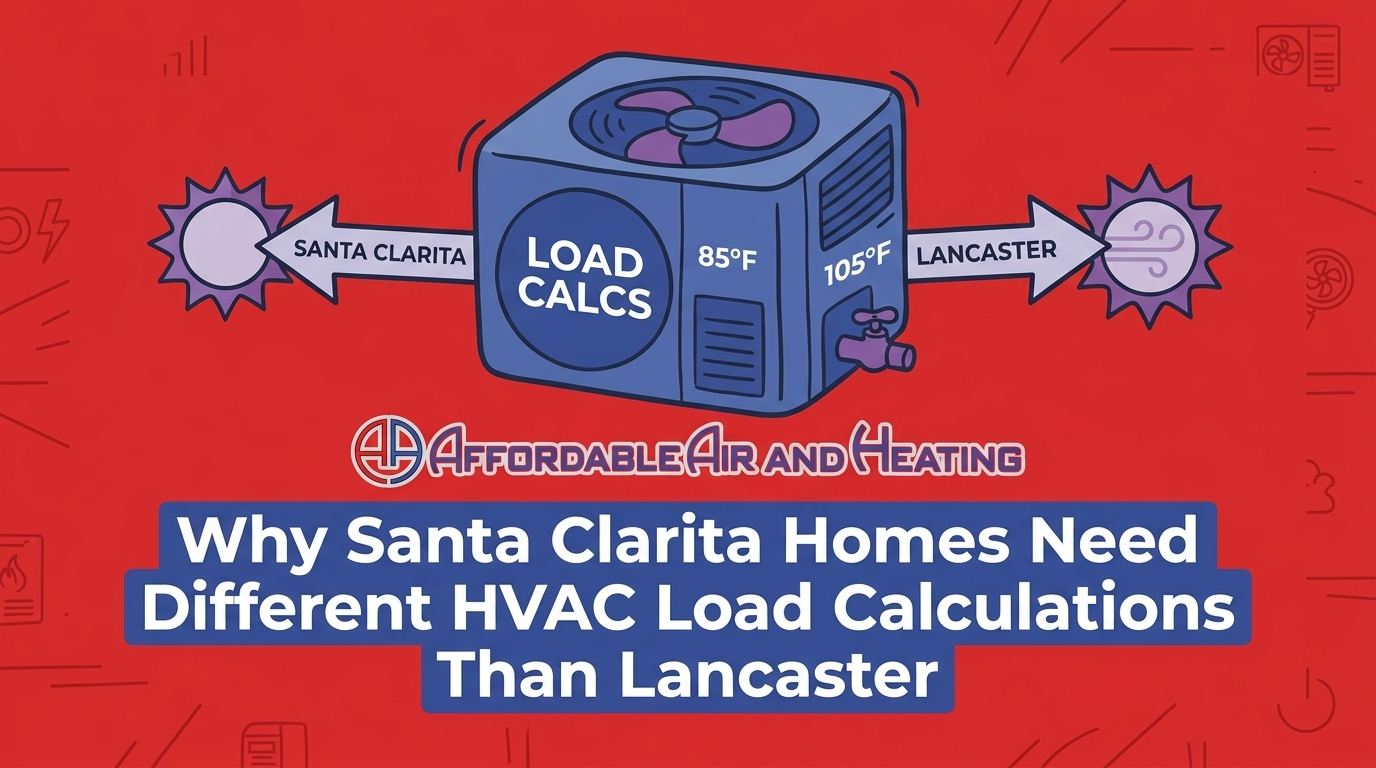
Your furnace is rattling loudly, the house feels colder than it should, and as you review replacement quotes for an October pre-winter heating startup, you might be wondering why Santa Clarita homes need different HVAC load calculations than Lancaster. At Affordable Air and Heating, our technicians see the consequences of poor planning every fall. The short answer is that applying generic, one-size-fits-all math to Southern California's diverse microclimates is a recipe for system failure. When contractors treat the entire region as a single climate zone, they ignore the drastic environmental differences that dictate exactly how much heating and cooling power your home actually requires.
To ensure your home stays comfortable without wasting energy, you need professional HVAC services that rely on precise mathematics rather than guesswork. In our experience, a proper installation always begins with an ACCA Manual J load calculation, which is the industry's gold standard for determining equipment size. Unfortunately, we often see out-of-town contractors skip this crucial step, especially when rushing to close deals as temperatures begin to drop.
The quick fix is never the right fix: Relying on a basic square-footage estimate might seem faster, but it completely ignores the unique elevation, humidity, and temperature swings of your specific neighborhood. If a contractor hands you a quote based solely on the size of your floor plan, they are setting your new system up to struggle before the first winter freeze even arrives. Neighboring regions require drastically different mathematical models to ensure proper equipment sizing, and understanding these differences is the key to a long-lasting, efficient HVAC system.
The Flaw of 'Rule of Thumb' Sizing in Southern California
For decades, the HVAC industry relied on a simple but flawed "rule of thumb" to size heating and cooling equipment: assigning a certain amount of tonnage or BTU capacity based strictly on a home's square footage. While this outdated method might occasionally get lucky in perfectly temperate coastal cities, it completely falls apart when applied to the Lancaster high desert vs. Santa Clarita valley microclimates. Out-of-town contractors still use this shortcut because it saves them time on the initial estimate, but our team frequently has to fix the resulting comfort and equipment lifespan issues for local homeowners.
When you are investing in a new air conditioning installation or heating replacement, precision is non-negotiable. Applying coastal or generic valley sizing to a high desert home means the equipment will either lack the power to combat extreme weather or be so oversized that it damages itself through rapid cycling. A true Manual J calculation eliminates this risk by measuring the exact thermal properties of your specific house.
What is an ACCA Manual J?
The ACCA (Air Conditioning Contractors of America) Manual J is the mathematical blueprint for proper HVAC sizing. It does not just look at floor space; it accounts for sensible heat capacity (temperature changes) and latent heat capacity (moisture removal). It requires precise localized environmental data to calculate exactly how much heat your home gains in the summer and loses in the winter.
To understand why the rule of thumb fails, look at the specific variables a Manual J measures:
• Window quality and orientation: South-facing single-pane windows let in massively different heat loads than north-facing double-pane glass.
• Insulation values: The R-value of your attic, walls, and floors dictates how quickly your home loses conditioned air.
• Local climate data: Historical weather patterns, extreme temperature highs and lows, and regional humidity averages are factored into the equation.
• Occupancy and heat-generating appliances: The number of people living in the home and the heat produced by kitchens and electronics alter the baseline cooling requirements.
How Elevation Impacts Air Density and HVAC Capacity
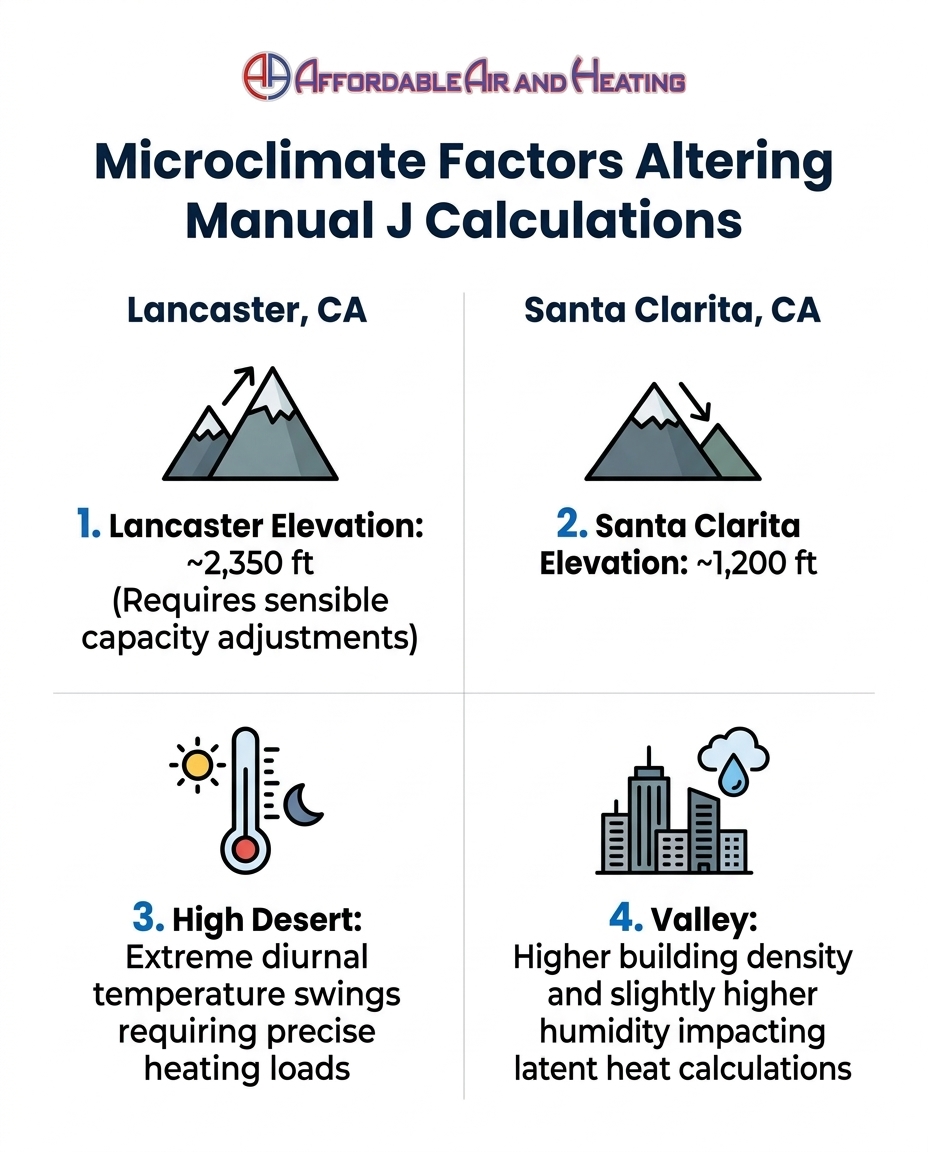
One of the most critical, yet frequently overlooked, factors our installers account for in local load calculations is the physical elevation of the property. Having worked extensively across these communities, we know the elevation gap between the Lancaster high desert vs. Santa Clarita valley completely changes how air behaves inside your ductwork. Lancaster sits at approximately 2,350 feet above sea level, while Santa Clarita rests much lower at roughly 1,200 feet. This 1,150-foot difference is not just a geographic trivia fact; it is a fundamental variable in thermodynamics.
When an HVAC system conditions your home, it relies on the mass of the air passing over the heat exchanger or evaporator coil to transfer thermal energy. Because Lancaster is at a higher elevation, the air density is notably lower. Thinner air holds less heat and carries less thermal mass, meaning the equipment must work significantly harder to move the same amount of conditioned air into your living spaces. This is why sizing AC installations for Lancaster's unique climate requires specialized knowledge of high-altitude physics.
The Physics of High-Altitude Heat Transfer
ACCA Manual J guidelines strictly require specific sensible capacity adjustments for high-altitude installations. When a contractor ignores this elevation gap, they are reading the manufacturer's equipment specifications as if the unit were being installed at sea level. In reality, a furnace rated for a specific BTU output at sea level will deliver noticeably fewer BTUs in the high desert.
• Air Density — Lancaster (~2,350 ft): Lower (Thinner air) — Santa Clarita (~1,200 ft): Higher (Denser air)
• Heat Transfer Capability — Lancaster (~2,350 ft): Reduced; requires capacity derating — Santa Clarita (~1,200 ft): Standard; closer to sea-level baselines
• Equipment Strain — Lancaster (~2,350 ft): Higher if not properly adjusted — Santa Clarita (~1,200 ft): Moderate, assuming correct sizing
Derating factors must be applied to the manufacturer specifications based on the exact elevation of the installation. If a contractor uses a Santa Clarita load calculation for a Lancaster home, the resulting equipment will be undersized. During extreme weather events, this undersized system will run continuously, struggling to push enough thin, conditioned air through the home to satisfy the thermostat, ultimately leading to premature component failure.
Extreme Diurnal Temperature Swings and Heating Loads
Beyond elevation, the rapid shift in daily temperatures makes accurate load calculations vital for an October pre-winter heating startup. Diurnal temperature variation refers to the difference between the daytime high and the nighttime low. In the high desert, this swing is notoriously extreme. A day that feels perfectly mild in the afternoon can plummet into a severe, bone-chilling freeze shortly after sunset. By contrast, the valley experiences much more moderate, gradual evening transitions.
These rapid, steep evening temperature drops in the high desert require completely different heating systems and load parameters to prevent the equipment from falling behind. When the outdoor temperature crashes by 30 or 40 degrees in a matter of hours, a home loses its retained heat rapidly. If a furnace was sized for the milder evening transitions of a valley neighborhood, it simply will not possess the recovery capacity needed to keep the indoor environment stable.
Preparing for Rapid Evening Temperature Drops
Heating systems must have the precise capacity to recover temperature quickly without being so oversized that they short-cycle during milder daytime use. The strain on heating elements is immense when a system is sized for a milder microclimate but forced to operate in extreme cold.
When systems lack the proper capacity for these diurnal swings, the results can be catastrophic for home comfort. For example, our team recently helped a local Lancaster homeowner who reached out when their heat stopped working entirely during a severe winter freeze warning. Our technicians assessed the unit the same day, handled the necessary financing paperwork, and installed a brand new Goodman unit specifically sized by us with the proper heating capacity to handle those freezing high desert nights. Without accurate heating loads, homes are left vulnerable to freezing during sudden cold snaps.
Humidity and Building Density: The Santa Clarita Contrast
While sensible heat (temperature change) is heavily impacted by elevation and diurnal swings, latent heat (moisture removal) is governed by humidity. Comparing the Lancaster high desert vs. Santa Clarita valley reveals a distinct contrast in atmospheric moisture. The high desert is characterized by extreme dry air, especially during the winter months, whereas the valley retains slightly higher humidity levels due to its geography and denser vegetation.
Latent heat calculations change significantly based on these moisture differences. An air conditioner does not just cool the air; it also acts as a dehumidifier, pulling moisture out of the indoor environment before circulating the conditioned air back through the vents. In a bone-dry desert climate, the system requires very little latent cooling capacity because there is minimal moisture to remove. However, in the valley, the system must be calibrated to handle a higher latent load to prevent the home from feeling clammy and uncomfortable.
Furthermore, building density plays a massive role in cooling loads. Santa Clarita features denser neighborhoods and more concentrated commercial zones, which contribute to the "urban heat island" effect. Concrete, asphalt, and closely packed roofs absorb and radiate heat long after the sun goes down. This means a home in a dense valley neighborhood might require a higher sensible cooling load in the late evening compared to an isolated property in the high desert. The combination of slightly elevated humidity and greater structural density demands a distinct mathematical approach for valley homes, proving once again that a localized Manual J is essential.
The Dangers of Installing an Incorrectly Sized System
Skipping a microclimate-specific load calculation before an October pre-winter heating startup almost always leads to improper equipment sizing. The most common consequence of a bad estimate is oversizing, under the mistaken belief that a larger unit will heat or cool the home better. In reality, an oversized system suffers from short-cycling—a damaging process where the unit turns on, blasts the home with conditioned air, satisfies the thermostat rapidly, and abruptly shuts off.
This rapid on-and-off cycling is terrible for the equipment. HVAC systems draw the most electrical current and endure the most mechanical stress during startup. When a system short-cycles, it multiplies that stress, leading to excessive wear and tear on blower motors, capacitors, and compressors. When systems are stressed by improper sizing, they often fail when you need them most. For instance, our emergency dispatch recently responded to a local homeowner who experienced an unexpected air conditioning outage on a hot summer weekend due to system strain. Our technician arrived on Sunday morning, retrieved the necessary part, and had the system fully repaired. However, as we always tell our customers, avoiding these sudden breakdowns in the first place starts with accurate sizing.
Why Bigger Isn't Always Better
The impact of short-cycling goes beyond mechanical failure; it severely degrades your indoor comfort and air quality. Here is what happens when a system is incorrectly sized:
• Uneven temperatures: Oversized heating systems blast heat and shut off before the air can properly circulate, leaving cold spots in distant bedrooms.
• Poor humidity control: Oversized AC units cool the house too fast and shut down before they have time to remove humidity, leading to a damp, uncomfortable indoor environment.
• Reduced lifespan: Continuous short-cycling drastically reduces the overall lifespan of the equipment, turning a 15-year investment into a 7-year headache.
• Spiking utility bills: The constant starting and stopping consumes significantly more energy than a properly sized unit running in long, efficient cycles.
A system sized correctly for the local climate will run in smooth, steady cycles, maintaining a consistent temperature, quietly filtering the air, and operating efficiently for years.
Why Your Next Quote Must Include a Localized Manual J
As you prepare for the changing seasons, it is crucial to protect your investment by asking the right questions. Generic estimates are a glaring red flag for future system performance issues. If a contractor walks through your home, looks at the square footage, and immediately hands you a quote without taking detailed measurements or asking about your insulation, they are guessing with your money.
To ensure your home gets the exact heating and cooling capacity it needs, demand precision. Working with our veteran team at Affordable Air and Heating means benefiting from our deep regional expertise across Southern California's distinct microclimates. We understand the exact environmental data required for both the high desert and the valley, ensuring custom equipment sizing rather than relying on generic estimates for our local service areas.
Questions to ask your HVAC contractor before committing:
• Will you be performing a full ACCA Manual J load calculation?
• How are you adjusting the sensible capacity for our specific elevation?
• Does this quote account for the extreme diurnal temperature swings in our neighborhood?
• Are you measuring my windows, insulation levels, and ductwork condition?
Understanding why Santa Clarita homes need different HVAC load calculations than Lancaster is the first step toward true indoor comfort. By insisting on a localized Manual J, you guarantee that your new system is engineered specifically for your home, giving you the confidence that it will perform flawlessly through every freezing winter night and scorching summer afternoon.
Frequently Asked Questions
What factors go into an HVAC Manual J load calculation?
A Manual J load calculation measures the exact thermal properties of your home to determine precise heating and cooling needs. It factors in your home's square footage, window quality and orientation, insulation R-values, ceiling heights, and local historical climate data. It also accounts for the number of occupants and heat-generating appliances inside the house.
Why does elevation affect HVAC load calculations?
Elevation directly impacts air density, which alters how effectively an HVAC system can transfer heat. At higher altitudes, the air is thinner and holds less thermal mass, meaning the equipment must work harder to move conditioned air. Contractors must apply specific derating formulas to ensure the system has enough capacity to compensate for this thinner air.
How do microclimates impact HVAC sizing in Southern California?
Southern California features incredibly diverse microclimates, ranging from humid coastal zones to dry, high-altitude deserts. These differences mean that homes separated by just a few dozen miles experience completely different humidity levels, temperature swings, and air densities. A system sized for a mild valley will struggle and fail if installed in a high desert environment without mathematical adjustments.
What happens if my heating system is oversized for my climate?
An oversized heating system will heat your home too quickly and abruptly shut off, a process known as short-cycling. This prevents the warm air from circulating evenly, leaving cold spots in distant rooms while overheating the main areas. Furthermore, the constant starting and stopping causes severe mechanical wear and tear, leading to frequent breakdowns and a shortened equipment lifespan.
Can a contractor size an HVAC system just using the square footage of my home?
No, using square footage alone is an outdated and inaccurate "rule of thumb" method. It completely ignores critical variables like insulation quality, window placement, ceiling height, and local weather extremes. Relying solely on square footage almost guarantees that your new system will be improperly sized for your actual comfort needs.
How do extreme temperature swings in the high desert affect heating loads?
High desert environments often experience massive diurnal temperature variations, where mild afternoons rapidly turn into freezing nights. Because the home loses its retained heat so quickly after sunset, the heating system must be sized with the precise recovery capacity to keep up with the sudden drop. Without an accurate heating load calculation, the furnace will fall behind, leaving the home uncomfortably cold during winter nights.