How We Size AC Installations for Lancaster's Unique Climate


The High-Desert Cooling Challenge: Why Generic Sizing Fails in Lancaster
Your air conditioner is running nonstop, but the house still feels uncomfortably warm. When determining how we size AC installations for Lancaster's unique climate, the first thing our team at Affordable Air and Heating looks at is whether the system was actually engineered for the environment it operates in. Standard sizing calculators often fail homeowners during the peak July summer heat in the Antelope Valley because they rely on national averages that simply do not apply to our specific geography.
Lancaster sits squarely in California Building Climate Zone 14. This means our homes face extreme summer temperatures that easily exceed 100 degrees, accompanied by intense sun exposure and massive temperature swings between day and night. When a generic calculator suggests a unit size based solely on the square footage of your floor plan, it drastically underestimates the cooling power required to overcome these severe environmental stressors. If you are exploring comprehensive HVAC services to replace an aging unit, the critical decision point is whether to trust a basic square-footage chart or demand a true, custom load calculation for your specific property.
An undersized system will run continuously without ever reaching your thermostat set point, driving up utility bills and wearing out mechanical components prematurely. Conversely, an oversized system introduces an entirely different set of mechanical failures. Getting the size exactly right requires treating your home as a unique thermal environment, measuring exactly how much heat enters the structure and how much cooling power is needed to remove it.
The Flaws of the 'Rule of Thumb' Square-Footage Method
For decades, the HVAC industry relied heavily on a generic "rule of thumb" to determine equipment size. This method usually assigns a set number of British Thermal Units (BTUs)—typically around 20 to 25 BTUs—for every square foot of living space. While this overly simplified math might produce an acceptable baseline for a mild coastal property with heavy tree coverage, it completely falls apart in the extreme conditions of the Antelope Valley.
A true professional air conditioning installation requires a Manual J load calculation. This is the industry-standard protocol developed by the Air Conditioning Contractors of America (ACCA). Instead of just measuring the floor, a Manual J calculation evaluates the entire thermal envelope of the home. Because this process involves complex mathematics and specialized diagnostic tools, we always advise homeowners never to attempt DIY load calculations when planning an equipment upgrade.
• Square-Footage Rule of Thumb — Primary Variables Measured: Floor space only (Length x Width) — Accuracy for High-Desert Climates: Highly inaccurate; ignores extreme local heat and sun exposure.
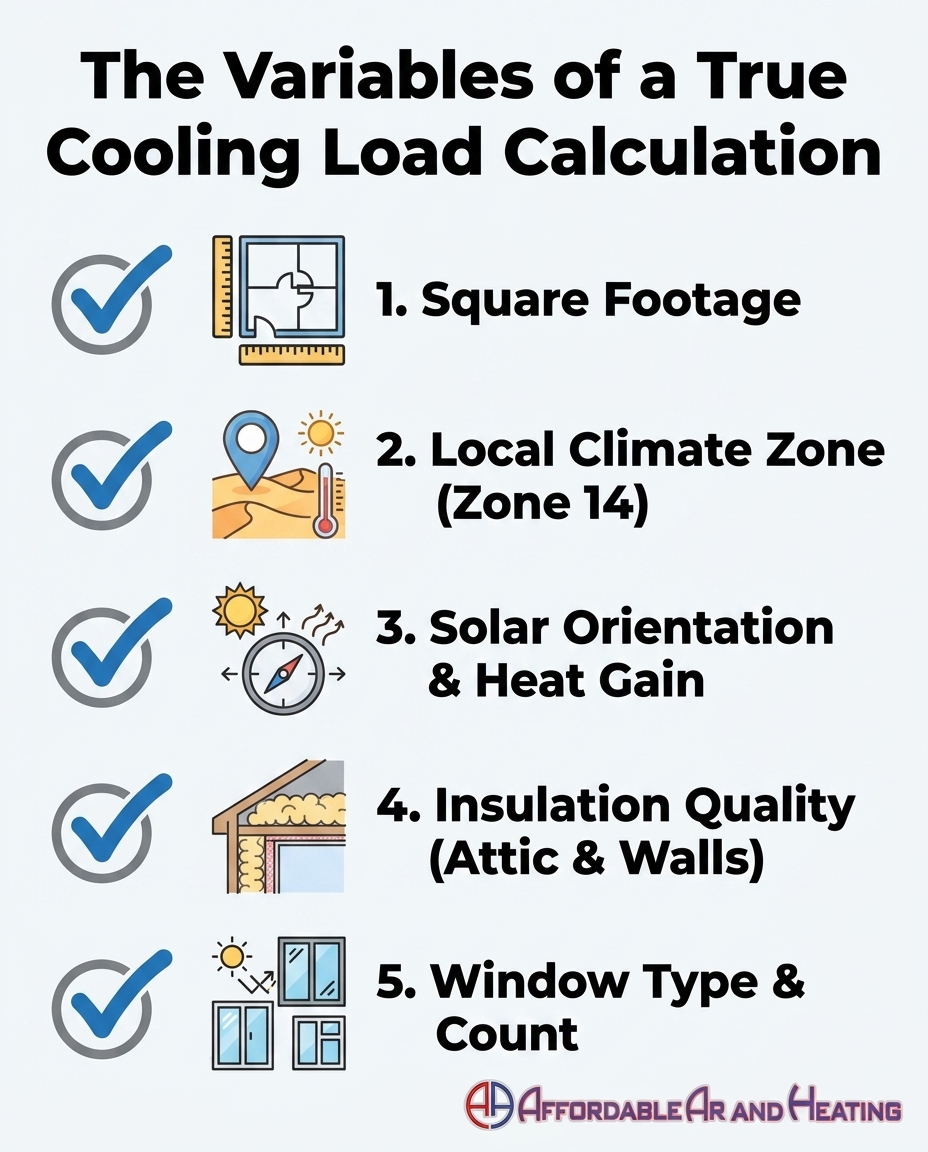
• Manual J Load Calculation — Primary Variables Measured: Insulation, window quality, solar orientation, ceiling height, local climate zone — Accuracy for High-Desert Climates: Highly accurate; engineered specifically for California Climate Zone 14.
What National Calculators Miss About the High Desert
National calculators fail to account for the extreme diurnal temperature swings characteristic of the high desert. Lancaster can see daytime highs near 105 degrees and nighttime lows dropping into the 60s. This massive swing affects how the physical structure of your home stores and releases thermal energy. A generic calculator assumes a steady, moderate climate.
Furthermore, these basic charts fail to adjust for local humidity levels. Air conditioning systems perform two functions: sensible cooling (lowering the temperature) and latent cooling (removing moisture). In our dry desert climate, the latent cooling demand is very low, but the sensible cooling demand is exceptionally high. If a generic calculator assumes a humid climate, it will recommend a system calibrated to remove moisture rather than one optimized to aggressively drop the air temperature.
Calculating the Impact of Antelope Valley Sun Exposure
The relentless high-desert sun plays a massive role in how warm your house gets during the day. Solar radiation penetrates windows and heats roofing materials, transferring thermal energy directly into your living spaces. This specific measurement is known as the solar heat gain load, and it is a critical variable that generic sizing methods completely ignore.
The orientation of your house drastically changes the cooling requirements for specific rooms. For example, a living room with a large bank of west-facing windows will absorb a tremendous amount of radiant heat during the late afternoon—precisely when the outside temperature is at its highest. If your AC system is sized without accounting for this intense localized heat gain, that specific room will never stay cool, regardless of what the thermostat reads in the hallway. Our professional technicians measure these variables during an in-home assessment to understand exactly how ceiling height and sun exposure affect what size AC you need.
Window Quality and Radiant Heat Transfer
Not all windows are created equal, and the type of glass in your home significantly alters the final load calculation.
• Single-pane vs. double-pane: Older homes with single-pane aluminum windows allow heat to transfer almost unimpeded, requiring a higher cooling capacity to compensate. Modern double-pane windows with low-E coatings block a significant portion of this radiant heat.
• Shading and overhangs: Deep roof overhangs, mature shade trees, and exterior solar blinds physically block the sun from hitting the glass, which actively reduces the required BTUs for that specific zone.
• Neighborhood canopy: In many newer Lancaster developments, the lack of mature tree canopy exacerbates radiant heat, leaving the home fully exposed to the sun from dawn until dusk.
Addressing the Insulation Deficits in Local Neighborhoods
To accurately size an air conditioner, we have to look closely at the architectural and construction realities of the target service area. During the building boom of the 1980s and 1990s, thousands of homes were constructed across the Antelope Valley. While these homes were built to the codes of that era, our technicians at Affordable Air and Heating routinely uncover significant weaknesses in their thermal design when assessing peak-summer cooling demands.
Many older Lancaster tract homes suffer from degraded attic insulation and leaky ductwork. Over decades, blown-in insulation settles and compresses, losing its R-value (its ability to resist heat flow). When the July sun bakes your roof, temperatures inside the attic can easily surpass 140 degrees. If the insulation barrier between the attic and your ceiling is compromised, that heat radiates directly downward into your living space, drastically increasing the overall cooling demand.
Thermal Envelope Leakage
Your home's thermal envelope consists of the roof, walls, windows, and foundation—everything that separates the conditioned indoor air from the unconditioned outdoor air. When this envelope is leaky, cold air escapes and hot air infiltrates.
The leakage factor: Conditioned air readily escapes through poorly sealed doors, uncaulked windows, and unsealed recessed lighting fixtures. A proper load calculation measures this specific rate of loss. An AC unit must be precisely sized to compensate for the air that is actively leaking out of the building. If you simply measure the floor space and ignore a highly compromised thermal envelope, the resulting system will struggle to keep up on a hot afternoon.
The Mechanical Dangers of Incorrect AC Sizing
Ignoring local variables and relying on generic sizing charts leads directly to mechanical failure. When an air conditioning system is incorrectly sized, it places immense strain on the internal components, leading to frequent breakdowns and compromised comfort.
The symptoms of an undersized unit: An undersized unit lacks the raw cooling capacity to overcome the heat entering the home. During a heatwave, this system will run constantly, driving up utility bills while failing to reach the thermostat set point. The compressor is forced to operate continuously at maximum capacity, which drastically reduces its overall lifespan and increases the likelihood of a catastrophic failure during the hottest weeks of the year.
The symptoms of an oversized unit: Many homeowners mistakenly believe that buying the biggest unit possible will solve their cooling problems. An oversized unit cools the air too rapidly, satisfying the thermostat in a matter of minutes before shutting off. This rapid cycling prevents the system from properly circulating and filtering the air, leaving the home feeling cold but uncomfortably clammy.
Why Bigger Isn't Always Better in HVAC
The physics of the cooling cycle dictate that a system needs time to operate efficiently. When an oversized unit blasts cold air and shuts down quickly, it experiences a phenomenon known as "short-cycling."
• Mechanical wear: The most stressful part of an air conditioner's operation is the startup phase. Short-cycling forces the compressor and electrical contactors to start and stop dozens of times an hour, leading to premature mechanical wear and tear.
• Incomplete filtration: Because the system isn't running long enough to pull the entire volume of the home's air through the return filter, dust, dander, and allergens remain suspended in the indoor air.
Targeted Cooling Solutions for Hard-to-Reach Rooms
Sometimes, a comprehensive load calculation reveals that upgrading the central AC size isn't the right answer for the entire house. Homes with unique architectural features—such as room additions, vaulted ceilings, or converted garages—often have specific zones that throw off the whole-house sizing math.
If you size the main central unit to perfectly cool a poorly insulated west-facing addition, you will likely oversize the system for the rest of the house, leading to short-cycling in the main living areas. The solution is a careful assessment by a professional installation team, ensuring the equipment runs optimally and keeps the entire house cool without overworking the central unit.
In these scenarios, targeted zoning or supplemental cooling options are often the best approach. By installing ductless mini split systems in hard-to-reach rooms, you can handle localized heat gain independently. These systems operate on their own thermostats, delivering precise cooling exactly where it's needed without forcing the main central air system to compensate for one problematic room.
Our Hyper-Local Approach to Cooling Load Calculations
As local high-desert specialists at Affordable Air and Heating, we refuse to cut corners on the sizing process. We know that generic national sizing charts cause frequent short-cycling and breakdowns in the Antelope Valley, which is why we rely on our deep local expertise to engineer custom AC sizing for the area's specific homes.
During a professional in-home estimate, our technicians assess a wide range of variables to ensure the final system is perfectly matched to your property's thermal footprint. Here is what that hyper-local approach entails:
1. Evaluating solar orientation: Mapping out exactly how the sun hits the home throughout the day and measuring the impact of west-facing and south-facing walls.
2. Assessing insulation values: Inspecting the attic to determine the current R-value of the insulation and identifying areas where thermal degradation has occurred.
3. Inspecting ductwork condition: Checking for leaks, disconnects, or poorly insulated runs in the attic that would bleed cooling power before it reaches the vents.
4. Cataloging window types: Noting the square footage, glazing type, and shading of all windows to calculate accurate radiant heat transfer.
Taking the time to measure these variables prevents future breakdowns and guarantees that your new system will operate at peak efficiency. The ultimate goal is the peace of mind that comes from knowing your equipment was engineered specifically for your home.
Frequently Asked Questions About Local AC Sizing
Why does climate matter for AC sizing?
Climate determines the exact environmental stress your home faces, dictating the required cooling capacity. In the high desert, extreme summer temperatures and intense solar radiation create a massive sensible cooling demand. A system sized for a mild, humid coastal climate will completely fail to keep up with the severe heat of the Antelope Valley.
What happens if an AC unit is oversized for my home?
An oversized AC unit cools the space too quickly and shuts off, a process known as short-cycling. This rapid on-and-off operation prevents the system from completing a full air-filtration pass and causes severe wear and tear on the compressor. Ultimately, it leads to a shorter equipment lifespan and a home that feels cold but clammy.
How is a cooling load calculated for a desert climate?
A true cooling load calculation uses the Manual J protocol to assess the home's entire thermal envelope. Professionals measure variables like insulation quality, window types, solar orientation, and local climate zone data. In a desert climate, specific emphasis is placed on calculating the solar heat gain load and overcoming extreme daytime temperature peaks.
How many BTUs do I need for a house in Southern California?
There is no single BTU number that applies to all houses in Southern California, as the requirement depends heavily on the specific microclimate and the home's construction. A house in Lancaster requires significantly more BTUs than a similarly sized house in Santa Monica due to extreme high-desert temperatures. A professional load calculation is the only way to determine the exact BTU requirement.
Can I use an online calculator to size my new air conditioner?
Online calculators are notoriously inaccurate because they rely on basic square-footage averages and generic climate assumptions. They cannot account for your home's specific insulation degradation, window quality, or solar orientation. Relying on an online calculator often results in purchasing incorrectly sized equipment that will struggle during peak heatwaves.
Why does my current AC run constantly during summer heatwaves?
If your AC runs constantly without reaching the set temperature, it is likely undersized, suffering from severe airflow restrictions, or dealing with a compromised thermal envelope. In our experience with older tract homes in Lancaster, degraded attic insulation and leaky ductwork can allow so much heat into the house that even a properly functioning unit cannot keep up with the demand.
Get the Right Fit for Your Lancaster Home
A comfortable, efficient home requires a scientifically sized cooling system that respects the realities of the high desert. Relying on generic square-footage rules of thumb simply leaves you vulnerable to high utility bills and premature mechanical failures when the extreme summer heat arrives. Proper sizing leads directly to better energy efficiency, enhanced indoor comfort, and a much longer lifespan for your equipment. If you are ready for a clear explanation of exactly what your home needs, schedule a professional evaluation with Affordable Air and Heating today so we can measure your specific local factors and engineer the perfect fit for your property.