Is a Maintenance Plan Worth It If Your System Is Only Three Years Old?


Why a Three-Year-Old HVAC System Can Lull You Into a False Sense of Security
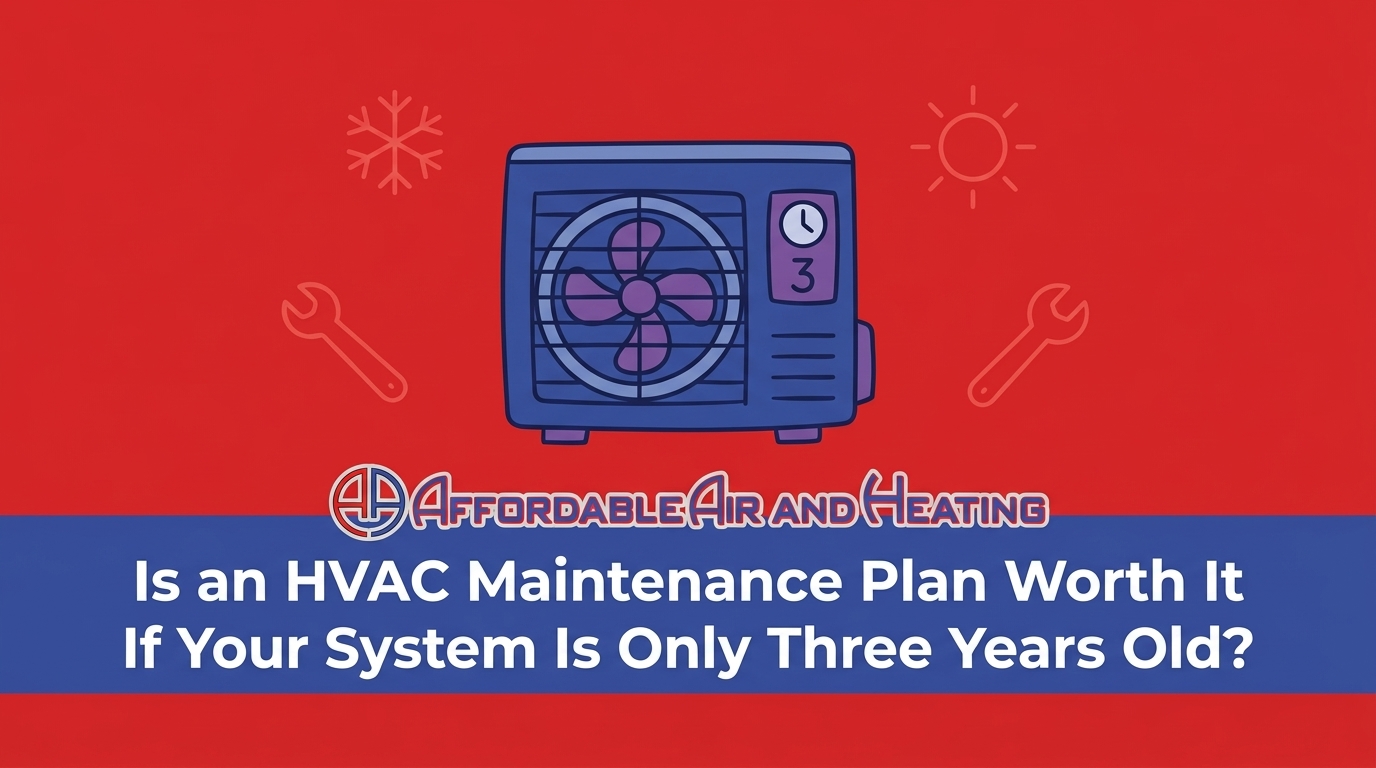
At Affordable Air and Heating, our technicians frequently hear homeowners ask, "Is a maintenance plan worth it if your system is only three years old?" The short answer is an absolute yes, though the reasons go far beyond simply preventing an immediate breakdown. When a central heating and cooling unit is installed, it typically runs flawlessly for the first 36 months. The air is cold in the summer, the heat is reliable in the winter, and the thermostat responds instantly. This honeymoon phase creates a dangerous false sense of security, leading many homeowners to skip their annual inspections under the assumption that new equipment simply doesn't need attention yet.
In our experience, the reality of modern climate control equipment is much more complex. While a catastrophic failure is rare at this stage, a three-year-old system is entering a critical period where minor wear and tear begins to compound. More importantly, this is the exact moment when skipping professional maintenance can unknowingly void the manufacturer's parts warranty. Treating preventative care as essential compliance documentation, rather than just a tool to prevent breakdowns, changes the entire equation. For comprehensive support, professional HVAC services provide the necessary paper trail to keep your investment protected.
The true cost of skipping service:
• Lost warranty coverage: Manufacturers require proof of maintenance to honor parts claims.
• Silent efficiency drops: Minor dust buildup forces the blower motor to work harder, increasing utility usage.
• Undetected electrical stress: Components like capacitors degrade over time, regardless of the system's age.
• Premature aging: A system neglected in its early years will rarely reach its full 15-to-20-year expected lifespan.
By the time a system reaches the three-year mark, the initial installation labor warranty has almost certainly expired, leaving you entirely reliant on the manufacturer's parts warranty. Promptly establishing a maintenance routine ensures that you aren't risking major out-of-pocket component costs simply to save on a seasonal tune-up.
The Hidden Clause: How Skipping Maintenance Voids Your Parts Warranty
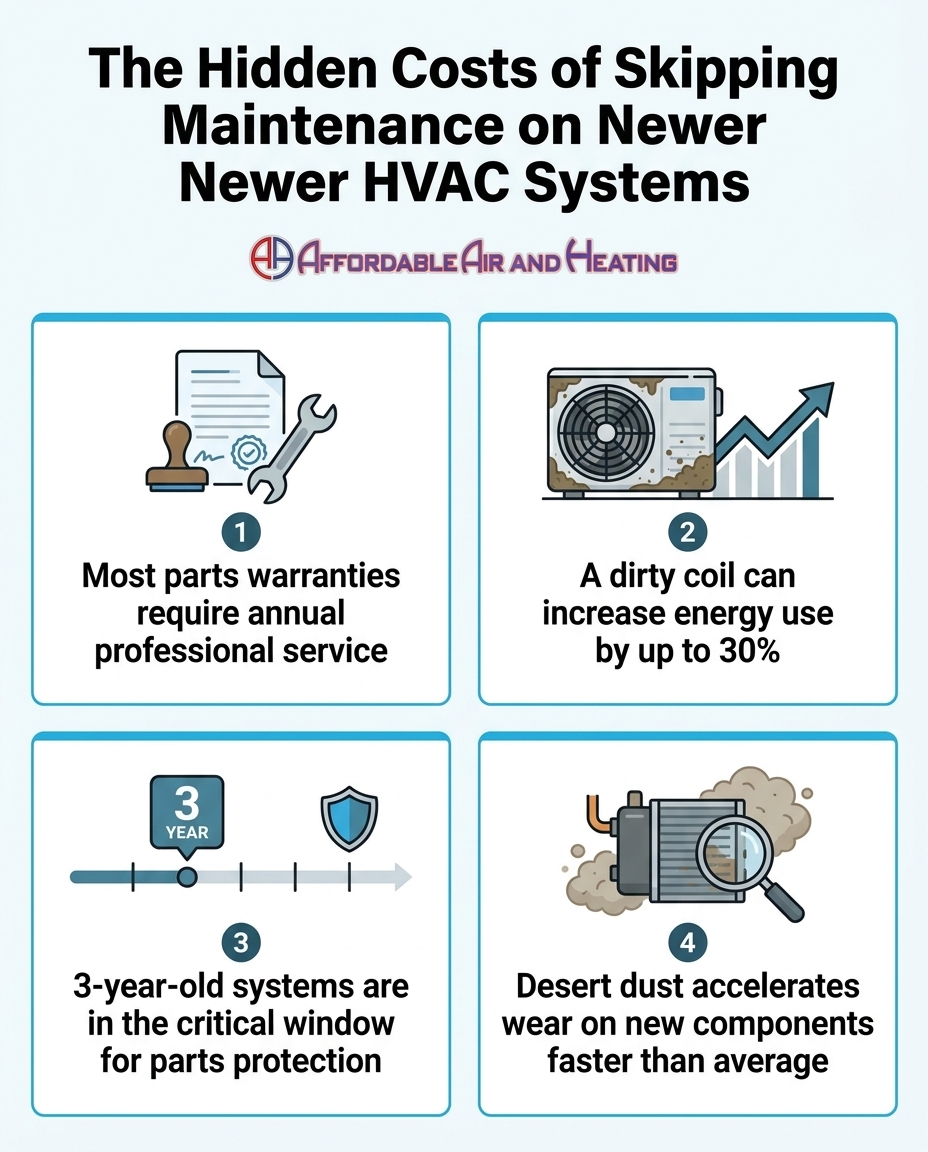
Most major HVAC manufacturers offer generous five-to-ten-year warranties on critical parts like compressors, heat exchangers, and blower motors. However, these agreements come with strict, legally binding conditions buried in the fine print. The most important—and most frequently overlooked—stipulation is the requirement for annual professional maintenance. Manufacturers mandate this because they know that a neglected system will fail prematurely, and they will not cover the cost of a replacement part if the failure was caused by a lack of basic care.
Without a documented history of service from a licensed professional, a failed compressor claim will likely be denied outright. In our years of handling warranty claims, we have seen this exact scenario catch homeowners off guard. When you are sitting squarely in the 3-year-old system parts warranty window, this documentation is your only shield against significant repair bills. If a blower motor burns out because a clogged filter restricted airflow for two years, the manufacturer will deem that a maintenance failure, not a factory defect.
An HVAC maintenance plan acts as an insurance policy for this warranty. It automatically generates the necessary compliance trail, ensuring that if a component does fail due to a manufacturing defect, you have the exact paperwork required to get the part replaced at no cost.
Understanding the Burden of Proof
When a warranty claim is filed, the burden of proof falls on the homeowner, not the manufacturer. You must be able to prove that the system was maintained according to factory specifications.
• Compressor Failure (Year 4) — With a Documented Maintenance Plan: Claim approved. Manufacturer provides a replacement compressor at no cost; homeowner pays only for labor/refrigerant. — Without Documented Maintenance: Claim denied due to lack of service records. Homeowner pays full out-of-pocket costs for both the part and the labor.
• Heat Exchanger Crack (Year 5) — With a Documented Maintenance Plan: Claim approved. Replacement part provided based on consistent annual heating inspections. — Without Documented Maintenance: Claim denied. Manufacturer cites lack of airflow verification and dirty burners as the cause of the failure.
• Blower Motor Burnout (Year 3) — With a Documented Maintenance Plan: Claim approved. Service records prove filters were changed and static pressure was within normal limits. — Without Documented Maintenance: Claim denied. Manufacturer assumes restricted airflow caused the motor to overheat and fail prematurely.
By investing in a membership, you remove the guesswork. Our service team tracks your visits, records the technical data (like refrigerant pressures and electrical draws), and maintains the exact records the manufacturer will ask for if a problem arises.
Accelerated Wear and Tear: The Desert Climate Factor
Even relatively new, high-efficiency systems are highly vulnerable to environmental stress. Having serviced Lancaster and the Antelope Valley for years, our team sees firsthand how extreme temperature swings and heavy desert dust accelerate wear and tear on equipment much faster than in mild, temperate zones. A system operating in our harsh desert environment works significantly harder, processing massive amounts of airborne particulate matter every single day.
High particulate matter, sand, and fine dust coat condenser coils and clog filters at an alarming rate. When a system is installed, the outdoor condenser coil is pristine, allowing heat to transfer efficiently. However, within just a few seasons, the Antelope Valley winds can drive enough fine dirt into the aluminum fins to create a suffocating blanket. When morning condensation mixes with this dust, it forms a stubborn, cement-like paste that drastically reduces the unit's ability to release heat.
The cascading effects of desert dust on newer systems:
• Increased energy consumption: A dirty condenser coil can increase energy consumption by up to 30 percent, forcing a three-year-old system to consume electricity like an older, failing unit.
• Elevated operating temperatures: Restricted airflow causes the compressor to run hotter, degrading the internal lubricating oils and shortening its lifespan.
• Micro-abrasions on moving parts: Fine sand that bypasses filtration can cause physical wear on fan blade edges and motor bearings.
• Clogged condensate drains: Dust buildup in the indoor evaporator coil washes down into the drain pan, creating sludge that can cause water backups and system shutdowns.
Regular professional cleaning removes this abrasive buildup before it permanently damages moving parts. Understanding the average lifespan of a central air conditioner in a desert environment requires acknowledging that maintenance schedules must be strictly adhered to. What might be considered "optional" maintenance in a mild coastal city is absolutely critical for survival in the high desert.
The Critical Role of the Pre-Winter Heating Startup
Transitioning a system from a grueling summer cooling season directly into winter heating requires careful mechanical preparation. A furnace or heat pump has likely sat dormant for six to eight months. Expecting it to fire up flawlessly on the first freezing night of the year without a thorough inspection is a gamble, even if the equipment is only 36 months old.
The October pre-winter heating startup is a critical phase of the maintenance calendar. A pattern we see often during our fall inspections is early-stage ignition, sensor, or venting issues going completely unnoticed until the system is forced to run continuously during a cold snap. For example, a flame sensor—a vital safety device that detects whether the gas burners have actually ignited—can easily become coated in a thin layer of dust or light oxidation over the summer. If this sensor cannot detect the flame, it will shut the furnace down within seconds to prevent gas buildup. This results in a system that constantly short-cycles, providing no heat and causing extreme wear on the ignition components.
Proactive fall inspections on your heating equipment catch these minor faults before they escalate into complete heating failures during extreme cold. One of our licensed technicians will clean the burners, test the safety limit switches, and verify that the venting system is completely clear of debris or pest nests that may have accumulated over the summer.
Testing the Heating Sequence for Safety and Efficiency
Safety is the primary driver for fall maintenance. Even newer gas furnaces produce carbon monoxide during the combustion process. The heat exchanger safely contains these gases and directs them out the flue. While a three-year-old heat exchanger is highly unlikely to have major cracks, our team insists on verifying proper draft and testing for safe operation because it is simply non-negotiable.
Testing the complete heating sequence ensures optimal energy efficiency throughout the winter. A technician will calibrate the thermostat, ensure the blower motor is moving the correct volume of air, and verify that the system is not consuming more fuel than necessary to reach your desired indoor temperature. Catching a minor calibration issue in October prevents months of inflated utility bills from November through March.
Addressing the Summer Toll on Air Conditioning Components
One common misconception we encounter is that fall maintenance only focuses on the furnace. In reality, a comprehensive pre-winter inspection must address the cooling side of the system as well. A harsh summer cooling season leaves behind worn contactors, stressed capacitors, and degraded fan motors. If these issues are ignored until the following spring, they can compound and cause unexpected failures.
Addressing these electrical and mechanical stresses in the fall prevents them from worsening while the system sits idle—or while it runs in heat pump mode, which utilizes the exact same outdoor components to heat your home. The contactor, for instance, is a heavy-duty electrical switch that engages every time the thermostat calls for cooling. After thousands of cycles over a long desert summer, our technicians routinely find metal contacts that have become pitted and scorched. A pitted contactor might still work intermittently, but it is highly prone to sticking. If a contactor sticks closed during the winter, the air conditioning systems compressor could potentially run simultaneously with the furnace, causing massive electrical spikes and severe equipment damage.
Why We Don't Ignore the AC in Winter
Clearing condensation drains and checking refrigerant levels in the fall ensures the system is perfectly balanced and ready for the next cycle. During the summer, the indoor evaporator coil produces gallons of condensation. This moisture drips into a drain pan and exits through a PVC pipe. If algae or dust has partially clogged this line, leaving it stagnant over the winter can lead to hard blockages or unpleasant odors circulating through your ductwork.
Comprehensive care extends the life of the entire HVAC ecosystem, not just the heating elements. By ensuring the outdoor unit is clean, the electrical connections are tight, and the refrigerant charge is exact, we protect the heart of your system. This holistic approach guarantees that when you finally switch the thermostat back to cooling next spring, the system responds immediately and efficiently.
What to Look for in a Legitimate HVAC Maintenance Membership
Not all maintenance plans are created equal. Some are simply vehicles for aggressive upselling, offering a superficial "check" that takes fifteen minutes and results in a long list of unnecessary upgrade recommendations. When your system is only three years old, you do not need aggressive sales tactics; you need thorough, preventative care that protects your investment.
A legitimate plan focuses on comprehensive cleaning, detailed system diagnostics, and transparent reporting. The technician should spend significant time actually cleaning the equipment, taking electrical multimeter readings, and verifying system performance against the manufacturer's original specifications.
Key features of a high-quality maintenance agreement:
• Comprehensive cleaning: The plan should explicitly include cleaning the outdoor condenser coils, clearing the condensate drain, and wiping down the cabinet interior.
• Warranty-compliant documentation: Look for agreements that provide clear, digitized documentation specifically designed to satisfy manufacturer warranty requirements, proving the 3-year-old system parts warranty window remains protected.
• Priority scheduling: If your system does experience an issue during a peak weather event, members should jump to the front of the service queue.
• Transparent pricing: The best plans offer clear terms without burying hidden fees or trip charges in the fine print.
At Affordable Air and Heating, our team offers transparent, legitimate tune-ups and membership plans that protect manufacturer warranties without hidden fees. Working with our dedicated local professionals means you receive honest assessments based on actual system data, ensuring your three-year-old equipment remains in peak condition without unnecessary pressure.
Frequently Asked Questions About Newer HVAC System Maintenance
Does skipping HVAC maintenance actually void the warranty?
Yes, most major manufacturers stipulate that parts warranties become void if the system is not maintained annually by a licensed professional. When you are within the 3-year-old system parts warranty window, this documentation is critical. Homeowners must be able to produce service records if a major component, like a compressor or blower motor, fails. Without proof of regular care, the manufacturer will likely deny the claim, leaving you responsible for the full cost of the repair.
What maintenance does a 3-year-old HVAC system need?
It requires comprehensive cleaning of coils, filter replacement, electrical connection testing, and moving part lubrication. Even though the system is relatively new, components like capacitors and contactors experience significant stress and need to be evaluated. Safety checks on ignition systems, flame sensors, and heat exchangers are also mandatory before the October pre-winter heating startup to ensure safe operation.
Is an HVAC maintenance contract worth it for a new system?
Yes, because it automates compliance with warranty requirements and prevents early-stage wear from reducing the system's energy efficiency. A maintenance contract acts as a safeguard against expensive out-of-pocket repairs during the first 5 to 10 years of the system's life. It also ensures that a professional is regularly monitoring the equipment, catching minor calibration issues before they escalate into major breakdowns.
How long does a new HVAC system last without maintenance?
While a system might run for several years without service, its efficiency drops significantly each year due to dust buildup and mechanical friction. Unmaintained systems often suffer catastrophic failures years before their expected 15-to-20-year lifespan. In our harsh desert climate, an ignored system may begin experiencing major component failures in as little as five to seven years due to extreme environmental stress.
Can I perform my own fall HVAC maintenance?
Homeowners should regularly change filters and keep the area around the outdoor unit clear of debris, weeds, and leaves. However, internal cleaning, electrical testing, and refrigerant checks must be performed by a licensed professional to satisfy warranty terms. Attempting to clean sensitive internal components or test electrical draws without proper training can result in system damage or personal injury, and will not provide the documentation required by manufacturers.
Secure Your Warranty and Winter Comfort Today
A three-year-old HVAC system is in its absolute prime, but it will only stay that way if its warranty remains valid through documented, professional care. Skipping the October pre-winter heating startup might seem like an easy way to save time, but it leaves your equipment vulnerable to early-stage wear and strips away the manufacturer protection you rely on. By prioritizing preventative care, you ensure that minor electrical stresses and accumulated desert dust are handled long before they cause a breakdown.
Don't wait for the first freezing night to discover a hidden ignition issue. Take control of your system's health and secure your warranty by scheduling a professional inspection before the extreme winter temperatures arrive. Reach out to our experts at Affordable Air and Heating today to establish a protective maintenance routine that keeps your home comfortable and your investment safe.