How Long Does a Central AC Unit Last in a Hot Desert Climate?
The average lifespan of a central air conditioner in a hot desert climate is significantly shorter than what most national guides will tell you — and if you live in the Antelope Valley, that gap matters a lot.
Quick Answer: Average Central AC Lifespan by Climate
| Climate Type | Average Lifespan |
|---|---|
| National average (moderate climate) | 15-20 years |
| Hot desert (Arizona, Las Vegas) | 10-15 years |
| High desert (Antelope Valley, New Mexico) | 10-16 years |
| Extreme desert (West Texas, low Nevada) | 8-12 years |
| Well-maintained desert unit | Up to 15-16 years |
| Poorly maintained desert unit | As few as 7-8 years |
Here in the Antelope Valley, your central AC isn't just cooling a house — it's fighting triple-digit temperatures for months on end. While a system in a mild Midwest city might run 800 to 1,500 hours a year, a desert unit can log 3,000 to 5,000 hours in that same period. That kind of workload accelerates wear on every major component, from the compressor to the capacitors to the coil fins.
The result? What feels like a middle-aged system elsewhere is already a senior citizen in the high desert. By year 10, many Antelope Valley units are showing signs of strain that homeowners in cooler climates wouldn't see until year 15 or later.
Understanding why desert heat shortens AC life — and what you can do about it — is the first step toward protecting one of the most important systems in your home.
Understanding the Average Lifespan of a Central Air Conditioner in a Hot Desert Climate

When we talk about the average lifespan of a central air conditioner in a hot desert climate, we have to look at the numbers through a different lens. While the Department of Energy often cites 15 to 20 years for a central air conditioner, that assumes a moderate environment. In the high desert regions like Palmdale or Lancaster, the reality is closer to 10 to 15 years for a well-maintained system.
Why the discrepancy? It comes down to operational hours. In many parts of the country, the air conditioner is a seasonal luxury. In our neck of the woods, it’s a survival necessity that runs nearly year-round. By the time an AC unit in Santa Clarita hits its tenth birthday, it has likely logged as many running hours as a system in Oregon would log in twenty-five years.
If you’re wondering, How Long Will My HVAC System Last, the answer depends heavily on how much stress it’s under. A unit that is forced to run 12 to 14 hours a day during a July heatwave is going to experience mechanical fatigue much faster than one that only runs for four hours in the afternoon.
Why the average lifespan of a central air conditioner in a hot desert climate is shorter
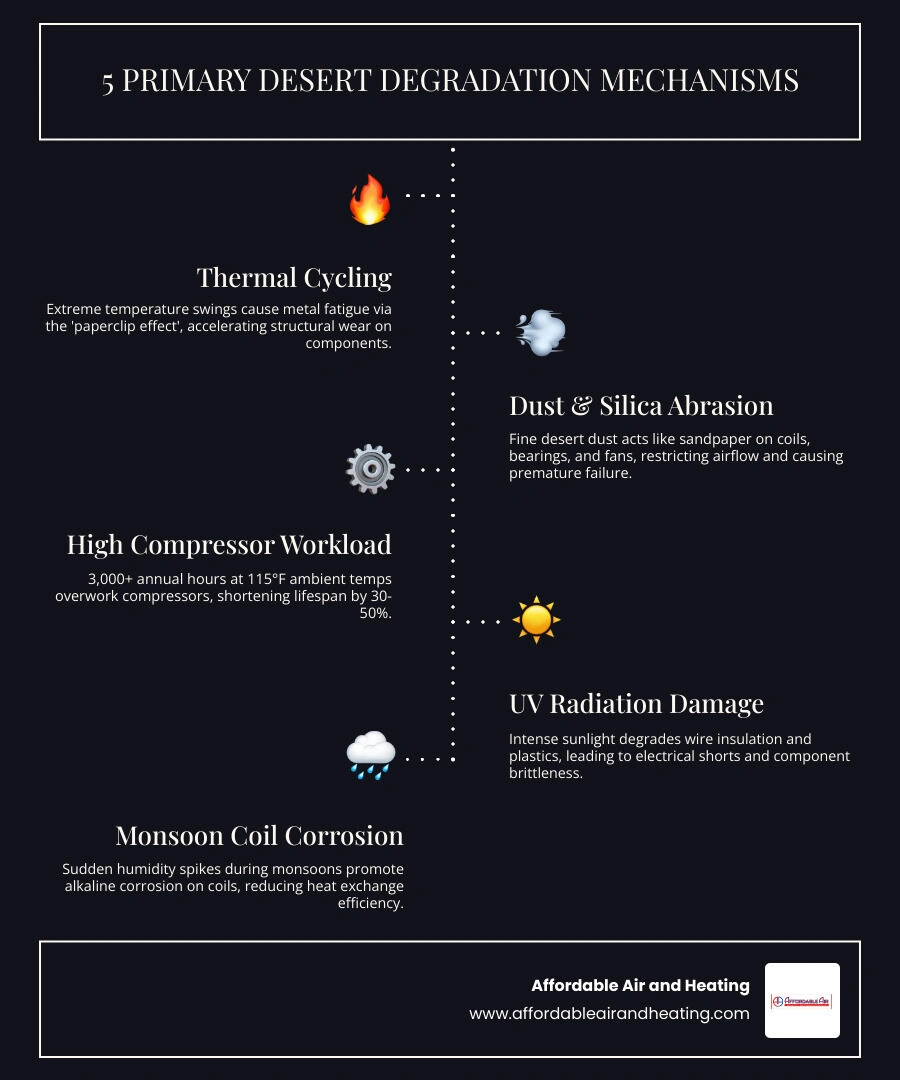
The primary culprit is thermal cycling. Think of your AC components like a paperclip. If you bend a paperclip back and forth enough times, it eventually snaps. This is the "paperclip effect" in action. In the desert, your system experiences extreme temperature swings. During the day, the metal components in your outdoor condenser can reach temperatures well over 140°F due to direct sun and 110°F+ ambient heat. At night, those temperatures drop significantly. This constant expansion and contraction put immense physical stress on the copper lines and electrical connections.
Furthermore, the compressor—the "heart" of your system—is designed to operate optimally at ambient temperatures up to 95°F. When we hit those 115°F peaks in the Antelope Valley, the head pressure inside the compressor skyrockets. This forces the motor to work harder, generating internal heat that can exceed 225°F. At these temperatures, the lubricating oil can start to break down and turn acidic, leading to a premature death for the most expensive part of your unit. For more on this, check out our guide on When Your AC Needs Replacement.
Regional variations in desert system longevity
Not all deserts are created equal. The "High Desert" (like Lancaster and Palmdale) presents a different set of challenges than the "Low Desert" (like Palm Springs or Phoenix). In the high desert, we deal with more significant diurnal temperature swings—the difference between the daytime high and the nighttime low. These 40-to-50-degree swings accelerate the thermal cycling mentioned above.
Additionally, our altitude affects air density. Thinner air means your blower motor has to work slightly harder to move the same amount of air through your ducts. While it might seem minor, over 3,500 annual operating hours, that extra effort adds up. Knowing When Should You Get a New AC System Installed often depends on these local environmental factors that push your system to its limit.
Environmental Factors That Accelerate Wear in Arid Regions
If heat is the "silent killer" of AC units, then desert dust is the "abrasive assassin." In the Antelope Valley, we aren't just dealing with heat; we're dealing with wind and silica-rich dust that can wreak havoc on mechanical systems.
Impact of dust and heat on the average lifespan of a central air conditioner in a hot desert climate
Dust in the desert isn't just "dirt"—it's often composed of fine silica particles that act like sandpaper. When this dust gets sucked into your outdoor condenser, it coats the fins and gets into the bearings of the fan motor. This creates a "sandpaper effect" that grinds down moving parts.
Even worse, dust acts as an insulator. When your condenser coils are coated in a layer of desert grime, they can't release heat effectively. This causes the internal temperatures of the system to spike even higher, often leading to the sudden failure of capacitors. These small electrical components are often rated to handle up to 131°F, but in a dust-clogged unit sitting in the sun, internal temperatures can easily hit 150°F. Following AC Maintenance Best Practices is essential to keep this dust from shortening your system's life.
Then there’s the UV radiation. With over 300 days of sunshine a year, the intense UV rays in our region literally bake the plastic components and wire insulation of your outdoor unit. Over time, these materials become brittle and crack, leading to electrical shorts or mechanical failures that wouldn't happen in a cloudier climate.
The role of proper sizing and installation
We often see systems fail early not because of the weather, but because they weren't installed correctly for the desert. A common mistake is installing an oversized unit. You might think "bigger is better" for a 110°F day, but an oversized AC will "short-cycle," turning on and off rapidly. Since the most wear and tear occurs during the startup phase, short-cycling can shave years off the average lifespan of a central air conditioner in a hot desert climate.
Professional installation must include a Manual J load calculation to ensure the system is perfectly sized for your home’s square footage, insulation levels, and window orientation. Improperly sized systems also struggle with static pressure, forcing the blower motor to work against restricted airflow, which eventually leads to a burnt-out motor.
Maintenance Strategies to Maximize Longevity in the High Desert
The good news is that you aren't powerless against the desert elements. While the climate is harsh, proactive care can add 3 to 5 years to your system's life.
First and foremost: change your filters. In a dusty climate, a standard 90-day filter might only last 30 days during a particularly windy month or harvest season. We recommend using filters with a MERV 8 to 11 rating. These provide a great balance between catching fine desert dust and allowing enough airflow so your system doesn't "suffocate."
Another pro-tip is shading your outdoor unit. If your condenser is on the west side of your house, it’s taking a beating from the afternoon sun. Installing a trellis or a shade structure can lower the ambient temperature around the unit by 10 to 15 degrees. Just make sure you maintain at least 24 inches of clearance on all sides for proper airflow—otherwise, you'll trap the heat instead of blocking it!
If you're in Canyon Country or Palmdale, you know the value of local expertise. Scheduling an AC Tune-Up Maintenance in Canyon Country CA or a Spring Heat Pump Tune-Up Palmdale ensures that a professional can catch the small issues—like a bulging capacitor or a slightly low refrigerant charge—before they turn into a mid-summer catastrophe.
Professional tune-ups and the average lifespan of a central air conditioner in a hot desert climate
A professional tune-up is like an oil change for your car. In the desert, we recommend these twice a year: once in the spring before the heat hits, and once in the fall after the monsoon dust has settled.
During these visits, we focus on:
- Chemical Coil Cleaning: Removing the "bio-slime" and alkaline dust that garden hoses can't reach.
- Electrical Tightening: Ensuring that thermal cycling hasn't loosened connections, which can cause "pitting" on contactors.
- Refrigerant Calibration: Even a 10% undercharge can cause the compressor to overheat and fail in desert temperatures.
The Benefits of Regular HVAC Maintenance are amplified in our climate. Research shows that well-maintained units in desert regions last up to 35% longer than neglected ones.
Smart technology and efficiency upgrades
Modern technology has come a long way in handling extreme heat. If your unit is approaching the 10-year mark, it might be Time for an AC Replacement to take advantage of newer SEER2 standards.
Variable-speed compressors and inverter technology are game-changers for desert homes. Unlike older "on/off" systems, variable-speed units can ramp up or down to match the cooling load. This reduces the number of "hard starts" the compressor has to endure, significantly extending its life. Plus, smart thermostats can help optimize run times, ensuring your system isn't working harder than it needs to when you aren't home.
Identifying the Signs of a Failing Desert AC System
How do you know when your system is nearing the end of its average lifespan of a central air conditioner in a hot desert climate? The signs are often subtle before they become undeniable.
- The 50% Rule: If your system is over 10 years old and a single repair costs more than 50% of the value of a new system, it’s usually time to replace. In the desert, we sometimes even suggest a 30-40% threshold for units over 12 years old because once one major component fails, others often follow quickly due to the collective heat stress.
- Rising Energy Bills: If your electricity bills are 20% higher than they were last summer but your usage hasn't changed, your system is losing efficiency. This is often due to internal compressor wear or fouled coils.
- Weak or Warm Airflow: If the air coming out of your vents feels "lazy" or isn't as cold as it used to be, your system is struggling to keep up with the desert heat.
- Strange Noises: Grinding or squealing noises often indicate that the fan motor bearings have been compromised by desert dust.
- Frequent Capacitor Failures: If you’re replacing your start or run capacitor every single summer, it’s a sign that the system is drawing too much heat and amperage, and the compressor might be on its last legs.
Frequently Asked Questions about Desert AC Longevity
Is it normal for my AC to run all day during a desert summer?
In the Antelope Valley, yes! When temperatures exceed 105°F, it is perfectly normal for a properly sized AC unit to run almost continuously to maintain a 78°F indoor temperature. AC units are designed to move heat, and when the heat gain from the outside is constant, the "move" must be constant too. However, if it’s running all day when it’s only 85°F outside, you likely have an efficiency issue or a refrigerant leak.
Can an air conditioner last 20 years in the high desert?
While it is mathematically possible, it is extremely rare. A unit would need a perfect maintenance record, a shaded location, and perhaps a bit of luck with the electrical grid. Most systems in our region become "senior citizens" at age 12. By year 20, even if the unit is still running, it is likely so inefficient that you are paying for a new unit every few years just in excess electricity costs.
How often should I change my filters in a dusty climate?
During the windy season or if you live near open desert land in places like Antelope Acres or Rosamond, we recommend checking your filters every 30 days. If you have pets or allergies, you might even need to change them every 3 weeks during the peak of summer. A clean filter is the easiest way to ensure your AC doesn't have to "breathe through a straw."
Conclusion
Navigating the average lifespan of a central air conditioner in a hot desert climate doesn't have to be a guessing game. While our environment is tough, being proactive is the key to staying cool. At Affordable Air and Heating, we’ve been the Antelope Valley’s trusted experts since 1996. As a family-owned business, we understand exactly what the heat in Palmdale, Lancaster, and Santa Clarita does to your equipment.
Whether you need a quick repair to get through a heatwave or you're looking for energy-efficient solutions to replace an aging system, we're here to help. We specialize in residential HVAC services that are tailored to the unique stressors of the high desert. Don't wait for your system to fail on a 110-degree afternoon. Schedule your professional AC evaluation in Antelope Acres today and let us help you maximize the life of your air conditioner.