The Chilly Reality of Autumn Nights in the High Desert
Your heater is running nonstop, but you are still reaching for a blanket, leaving you wondering how drafty windows defeat your central heating. As September pre-heating preparation begins, our team frequently hears from homeowners who notice a frustrating pattern: the thermostat says the house is warm, yet the living room feels freezing. You might assume your equipment is failing, but the real culprit is often invisible to the naked eye. When cold air seeps through worn window seals, it creates an endless, invisible battle between your furnace and the outside elements. You end up paying to heat the neighborhood while your family shivers inside.
Before you assume you need major HVAC services, it is time to look closely at your home's thermal envelope. Understanding how this invisible barrier works is the absolute best way to ensure your heating system operates efficiently. A high-efficiency furnace is only as good as the house it sits in. If your home cannot hold onto the warmth your system produces, no amount of mechanical power will keep you comfortable during those brisk autumn evenings.
Understanding Your Home's Thermal Envelope
To truly grasp why your living room stays cold while the vents blow hot air, you have to look at the physics of your house. Your heating equipment does not operate in a vacuum. It relies entirely on the structural integrity of the building around it.
The Physical Barrier
The problem: Every house relies on a thermal envelope. This is the physical separator between the conditioned indoor air and the unconditioned outdoor environment. It includes your roof, walls, insulation, doors, and most importantly, your windows. When this envelope is compromised, the heat you pay for escapes rapidly into the cold night air.
The High Desert Climate Challenge
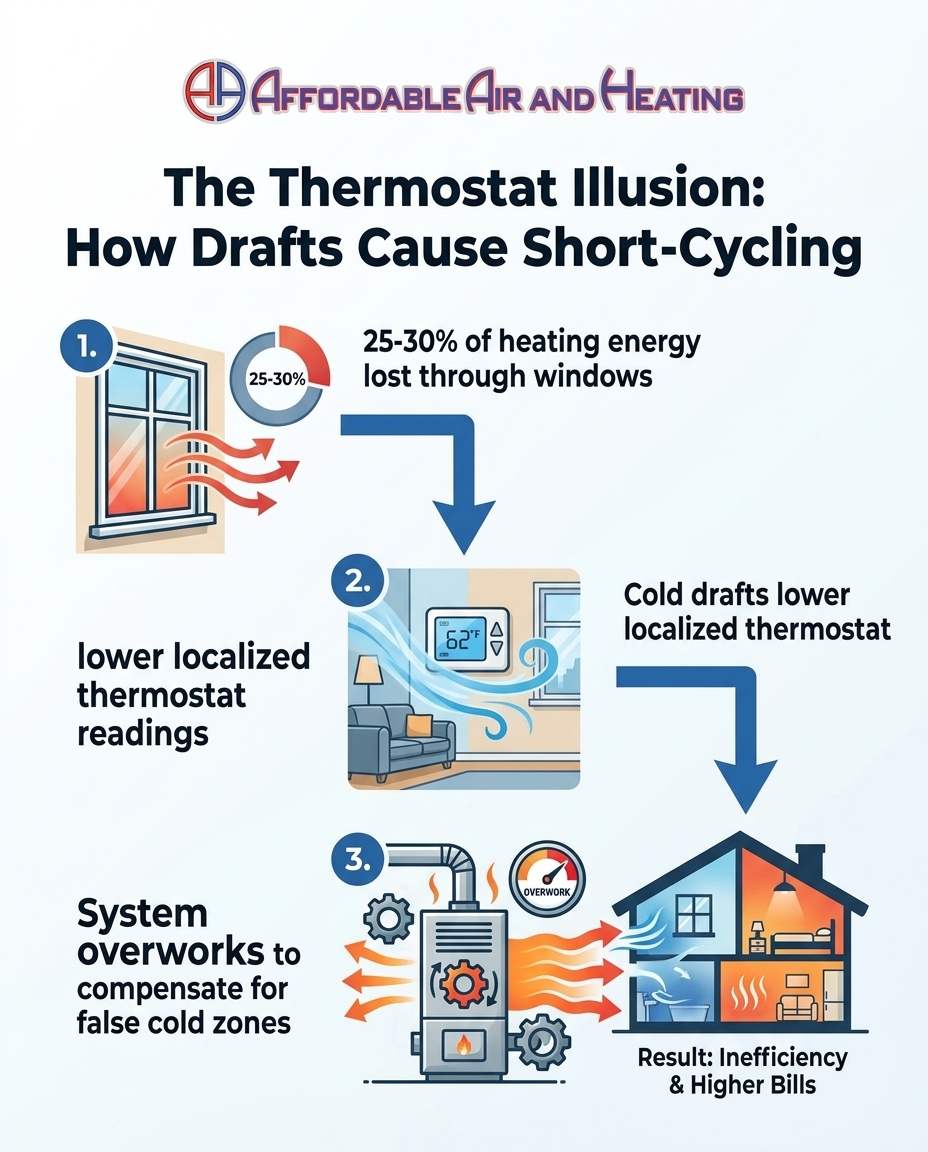
The cause: In our years of servicing homes across the Antelope Valley, our team at Affordable Air and Heating consistently sees the toll our local climate takes on a home. The Lancaster high desert experiences rapid day-to-night temperature swings. You might enjoy a mild 75-degree afternoon, only to see temperatures plummet by thirty degrees as soon as the sun goes down. This rapid shift creates intense pressure against your home's exterior. According to Department of Energy data, heat gain and loss through windows are responsible for 25 to 30 percent of residential heating energy use. When cold desert air pushes against poorly sealed glass and aging window frames, rapid heat transfer occurs. The heat inside your home is literally drawn outside.
Sealing the Leaks
The solution: Stopping this rapid heat loss requires reinforcing your thermal envelope. Upgrading insulation, replacing worn weatherstripping, and sealing gaps around window frames traps the heat indoors. A tightly sealed envelope means your heating system only has to replace the small amount of heat lost naturally, rather than fighting a constant influx of freezing desert air.
The Thermostat Illusion: How Drafts Trick Your Heating System
Your thermostat acts as the brain of your entire HVAC setup, but it can only measure the air immediately surrounding it. When drafts enter your home, they do not just make you feel cold; they actively deceive your equipment.
Micro-climates in your home: Drafty windows create localized cold zones, or "micro-climates," within a room. If cold air continuously pours through a cracked window seal and sinks to the floor, the ambient temperature in that specific corner drops drastically compared to the rest of the house.
The mechanism of false readings: If a draft hits the thermostat directly, the sensor reads the room as much colder than it actually is. For example, your hallway might be a comfortable 72 degrees, but the cold air spilling from a nearby window tricks the thermostat into registering 65 degrees. It will constantly signal your central heating systems to keep firing, desperately trying to warm up a sensor that is being chilled by an outside breeze.
The short-cycling effect: This deception leads to uneven temperatures across your home. One room turns into a sauna while the room with the draft remains freezing. Worse, the system may turn on and off rapidly in a process called short-cycling, which prevents the equipment from ever reaching a steady, efficient operating rhythm.
The Mechanical Toll of an Overworked Heater
Ignoring a compromised thermal envelope does more than just leave you shivering in your living room. It places severe, cumulative mechanical strain on your heating equipment. When your system runs constantly to compensate for drafty windows, every internal component works overtime.
Blower motor strain: The blower motor is responsible for pushing warm air through your ductwork. When false thermostat readings force the system to run non-stop, this motor overheats. The continuous friction and lack of downtime break down the internal lubricants, leading to grinding bearings and eventual motor failure.
Electrical component wear: An overworked system experiences accelerated wear and tear on its relays, capacitors, and contactors. Every time the system fires up to fight a draft, a surge of electricity passes through these components. Short-cycling multiplies this electrical load drastically.
Our technicians recently responded to a call from a Santa Clarita homeowner during a particularly brutal winter freeze warning when their heating stopped working entirely. The system had been running constantly to fight the cold week. Our team assessed the unit and identified a bad relay caused by the severe strain, ultimately recommending a new HVAC unit due to the old system's age and extreme inefficiency. A new unit resolved the issue and improved their home's energy efficiency, but a pattern we see often is exactly what happened here: ignoring envelope issues pushes a system past its limits, leading to premature system failure right when the weather is coldest.
Why Weatherstripping is Your First and Most Affordable Defense
In our experience serving local neighborhoods, the team at Affordable Air and Heating has found that the best solutions are often the simplest. Trying inexpensive weatherstripping to fix cold spots is the smartest, most cost-effective step before paying for an HVAC diagnostic visit. Trapping existing heat is mechanically easier and far cheaper than forcing a system to generate more heat.
Here is how to fortify your windows against the autumn chill:
1. Apply adhesive foam tape: This is the easiest weatherstripping method. Clean the window frame thoroughly, measure the gaps where the window sash meets the frame, and press the adhesive-backed foam firmly into place. This compresses when the window closes, creating an airtight seal.
2. Install V-strip (tension seal): For double-hung or sliding windows, V-strip weatherstripping provides a durable barrier. Fold the strip into a "V" shape and slide it into the tracks. The tension presses against the moving parts, blocking cold air while still allowing the window to open.
3. Renew exterior caulking: Inspect the perimeter of your windows from the outside. If the old caulk is cracked, peeling, or missing, scrape it away. Apply a continuous bead of exterior-grade silicone caulk to seal the joint between the window frame and the siding.
4. Hang thermal curtains: As an additional layer of defense against nighttime heat loss, install heavy thermal curtains. Keep them open during the day to let sunlight warm the room, and pull them tightly closed as soon as the sun sets to trap the warmth inside.
By taking these simple steps, you block out the cold drafts, directly boosting your energy efficiency with insulation and giving your heating equipment a much-needed break.
Identifying Drafts and Poor Air Seals Before Winter
You cannot fix a leak you cannot find. Before the heavy winter weather arrives, take an afternoon to thoroughly inspect your home's thermal envelope. Finding these invisible leaks is easier than you might think.
• Perform a visual inspection: Start by looking closely at the edges of every window and exterior door. Look for daylight shining through the cracks. Check for cracked caulking, peeling paint around the frames, and worn or flattened weatherstripping.
• Conduct the hand-feel test: Wait for a breezy afternoon. Run your bare hand slowly around the perimeter of your window frames and doors. If you feel a distinct temperature drop or a slight breeze against your skin, you have found an air leak.
• Use the incense test: For a more precise diagnostic, close all windows, doors, and vents. Turn off your HVAC system so the air is still. Light a stick of incense and hold it near the edges of your windows. If the smoke pulls outward or blows sharply into the room, you have located a draft.
• Check for dust accumulation: High desert winds often push fine dust through the exact same unsealed gaps that drain your home's heat. If you constantly wipe dirt off a specific windowsill, that window is leaking air, which is also taking a toll on your indoor air quality.
Envelope vs. Equipment: When to Call a Professional
Basic weatherstripping works wonders, but it cannot fix a failing furnace. You need to know when the issue transitions from a structural envelope problem to a mechanical failure. If you have sealed your windows, hung thermal curtains, and locked the doors, but the house is still freezing, your equipment requires professional attention.
Signs of mechanical failure: Listen to your system when it turns on. Strange noises like grinding, squealing, or loud banging indicate failing internal components. If the airflow coming from your vents feels weak or lukewarm, your blower motor or heat exchanger may be struggling. An unresponsive thermostat that clicks but fails to ignite the furnace is another clear indicator of mechanical trouble.
A professional diagnostic is incredibly valuable when the thermal envelope has been ruled out. A technician can test your electrical relays, measure airflow, and determine if upgrading to a modern heat pump (ask us which utility rebate programs are currently open) or replacing a worn-out component is the right move.
• Temperature Distribution — Likely Envelope Issue (Drafts): One room is freezing while others are warm. — Likely Mechanical Issue (HVAC): The entire house struggles to reach the set temperature.
• Airflow Strength — Likely Envelope Issue (Drafts): Air blows strongly from vents, but the room feels cold. — Likely Mechanical Issue (HVAC): Airflow from vents is weak, barely noticeable, or lukewarm.
• System Cycling — Likely Envelope Issue (Drafts): System short-cycles rapidly due to nearby cold drafts. — Likely Mechanical Issue (HVAC): System runs constantly without ever blowing hot air, or refuses to turn on.
• Dust Levels — Likely Envelope Issue (Drafts): Heavy dust buildup localized around window sills and doors. — Likely Mechanical Issue (HVAC): Dust blowing directly out of the supply vents into the room.
Maximize Your Heating Efficiency This Season
Understanding your home's thermal envelope and applying basic weatherstripping is the crucial first step to ensuring your winter comfort. By sealing up those drafts, you stop the invisible drain on your energy and protect your heater from unnecessary mechanical strain. We highly encourage homeowners to complete their draft checks now, during the September pre-heating season, before the bitter cold arrives.
If you have sealed your windows and eliminated the drafts, but your system is still struggling to keep you warm, it might be time for an expert set of eyes. Addressing mechanical wear early prevents midnight breakdowns and keeps your home comfortable all season long. Remember, understanding how drafty windows defeat your central heating is your best defense against the autumn chill.
Frequently Asked Questions
Why is my heater running constantly but the house is cold?
Your heater is likely fighting a compromised thermal envelope. When warm air escapes through unsealed windows and cold air pours in, your system runs continuously to replace the lost heat. Checking for drafts and adding weatherstripping usually resolves this constant running.
How do drafts affect my thermostat?
Drafts create isolated cold zones that trick the thermostat sensor. If cold air from a nearby window hits the thermostat, it registers a lower temperature than the actual room average. This false reading forces your heating system to work overtime, leading to uneven temperatures and short-cycling.
Can drafty windows make a room cold?
Yes, drafty windows are a primary cause of cold rooms. They allow rapid heat transfer, where the warmth generated by your furnace is pulled outside while freezing air is pushed inside. Even a small gap in the window frame can drastically lower the ambient temperature of a room.
How do you fix drafty windows in the winter?
You can fix drafty windows quickly by applying adhesive foam tape or V-strip weatherstripping along the sashes. Renewing the exterior caulking around the window frame also blocks air leaks. For an added layer of insulation at night, hanging heavy thermal curtains helps trap the heat indoors.
How much heating energy is lost through drafty windows?
According to the Department of Energy, heat loss through windows accounts for 25 to 30 percent of residential heating energy use. This massive loss means you are paying a premium to generate heat that simply slips through the cracks. Sealing your windows is the most effective way to reclaim that lost energy.