How Often Do You Really Need Air Duct Cleaning in the Antelope Valley's Desert Climate?



Are Generic Air Duct Cleaning Timelines Failing Your Antelope Valley Home?
Are you constantly wiping down your countertops and living room furniture, only to find a fresh layer of fine dirt settling just days later? Figuring out exactly how often you really need air duct cleaning in the Antelope Valley can feel like a guessing game when you rely on generic internet advice. The standard recommendation you will find online usually suggests having your home's ductwork cleaned every three to five years. However, if you live in the western Mojave Desert, you are likely already realizing that national timelines do not account for our extreme local environment.
The core problem for local homeowners is deciding whether to stick to those generic national guidelines or adopt a maintenance schedule tailored to a climate known for intense heat and heavy dust. In our years of providing local HVAC solutions, we have seen firsthand that when your home is constantly bombarded by elevated particulate matter, standard residential HVAC defenses are put to the ultimate test. To get ahead of the constant dust buildup, exploring professional indoor air quality services that are specifically calibrated for desert living is the first step toward breathing easier.
Local environmental factors play a massive role in indoor air quality. The air outside your house eventually becomes the air inside your house, and in the Antelope Valley, that outside air carries unique challenges. If you wait five years between cleanings in this region, you might be circulating years of accumulated desert silt through your living spaces every time the thermostat clicks on.
Why the Standard 3-to-5-Year Rule Doesn't Apply in the Mojave Desert
When you research HVAC maintenance, you will often encounter guidelines from two major organizations: the Environmental Protection Agency (EPA) and the National Air Duct Cleaners Association (NADCA). The EPA generally recommends cleaning air ducts "as needed," focusing on visible mold, pest infestations, or excessive debris. Meanwhile, NADCA suggests a baseline of every three to five years for a typical residential home. The catch? These baselines are formulated for average, temperate climates—often coastal or Midwestern zones with high humidity and significantly lower particulate matter in the outdoor air.
As local experts who understand the specific topography of this region, our team knows firsthand that national HVAC advice often fails in our specific desert environment. When our technicians are out on service calls across the western Mojave Desert, we see a completely different set of variables. The primary difference is the constant presence of elevated PM10 levels. PM10 refers to particulate matter that is 10 micrometers or less in diameter—small enough to easily become airborne and bypass standard physical barriers. During frequent high wind events, this micro-particulate is whipped into the air in massive volumes.
Because of these heavy dust loads, the lifespan of a clean ductwork system is drastically shortened compared to standard environments. A system in a coastal city might only accumulate light household dust over five years. In contrast, a system exposed to high wind events in our region can accumulate a thick, restrictive layer of silt in just a fraction of that time.
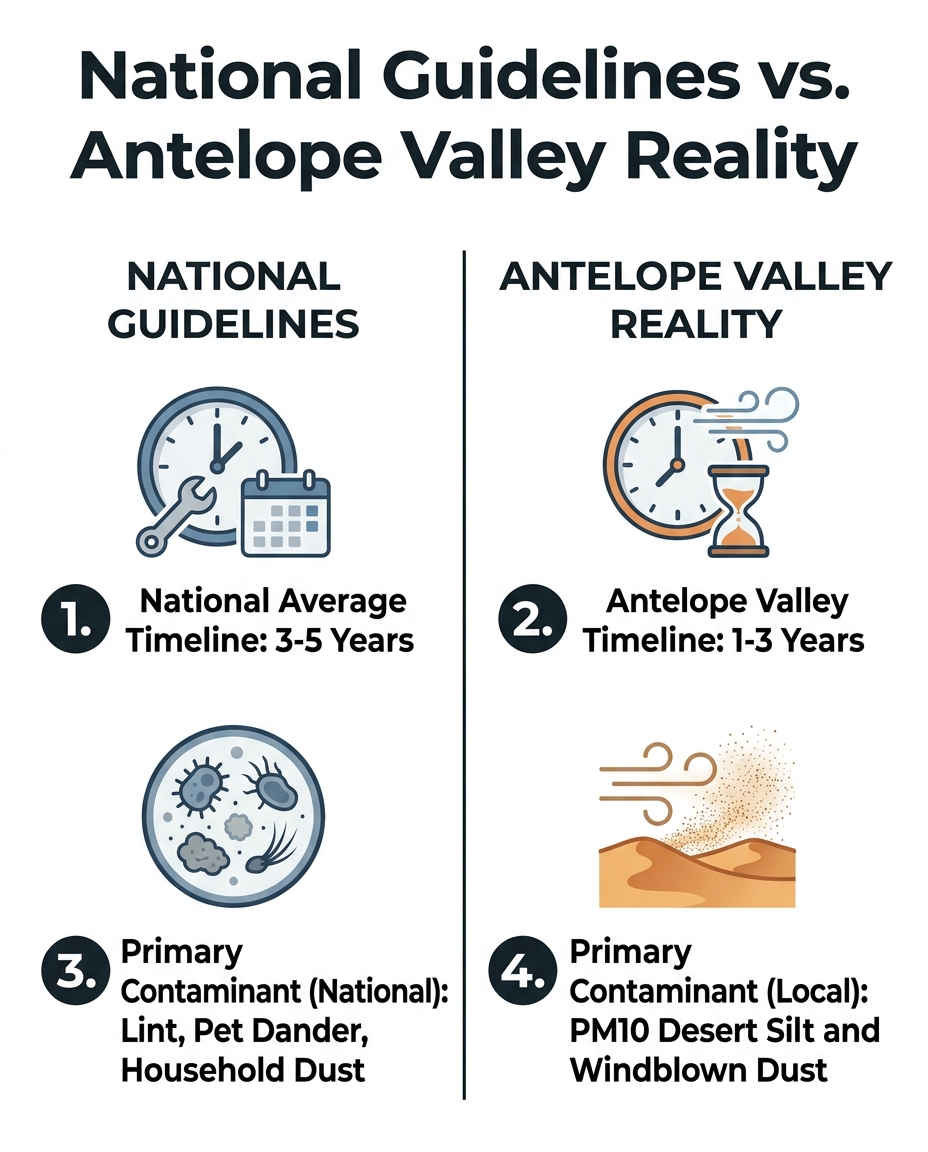
• Primary Contaminants — National Average (Temperate Climates): Pet dander, fabric lint, standard household dust — Mojave Desert Reality: Ultra-fine PM10 desert silt, windblown sand
• Weather Impact — National Average (Temperate Climates): Seasonal pollen spikes, moderate wind — Mojave Desert Reality: Frequent, severe high wind events pushing dust indoors
• Filter Lifespan — National Average (Temperate Climates): Typically 90 days for standard 1-inch filters — Mojave Desert Reality: Often reduced to 30 days or less during windy seasons
• Duct Cleaning Timeline — National Average (Temperate Climates): 3 to 5 years — Mojave Desert Reality: 1 to 3 years, depending on home sealing
Relying on a five-year schedule in a heavily dusty environment means your HVAC system will spend years operating under severe stress, pushing contaminated air into your home while working harder to maintain your set temperature.
How Fine Desert Silt Bypasses Standard HVAC Defenses
To understand why ductwork gets dirtier faster in the Antelope Valley, it helps to look at the mechanics of dust infiltration. Standard household dust is primarily composed of dead skin cells, fabric lint, and pet dander. These particles are relatively large and light. Desert silt, on the other hand, is ultra-fine, abrasive, and dense. When it enters your HVAC system, it behaves differently than standard dust.
Based on the hundreds of duct systems our team inspects each year, the process of desert dust overwhelming a standard HVAC system usually follows a specific pattern:
1. Infiltration during pressure changes: When gusty winds hit the exterior of your house, they create zones of high pressure on the windward side and low pressure on the leeward side. This forces fine silt through tiny cracks in the building envelope.
2. Bypassing basic filtration: Most homes are equipped with standard 1-inch fiberglass filters. These filters are designed to catch large debris like pet hair to protect the blower motor, but they are highly ineffective at capturing micro-particulate desert silt.
3. Coating the internal components: The ultra-fine silt passes right through the filter media and enters the air handler, coating the blower motor blades and the evaporator coil.
4. The compounding effect: Once a thin layer of abrasive silt forms on the walls of your ductwork, it creates a textured surface. This rough surface catches even more debris, accelerating the buildup exponentially over time.
Because the particles are so fine, they don't just sit in the ducts; they are constantly resuspended in the air every time the blower fan turns on, ensuring a continuous loop of poor indoor air quality.
The Role of Home Envelope Leaks
Your HVAC system does not operate in a vacuum; it is deeply affected by the integrity of your home's envelope. Unsealed windows, worn weatherstripping around doors, and poorly insulated attic bypasses allow silt to enter the return air stream directly. Local topography plays a role here as well. Wide-open desert spaces allow wind to tunnel against residential structures with significant force. If your home has even minor envelope leaks, the negative pressure inside your house will literally vacuum the dust out of the air outside and pull it indoors. Once inside, the return vents suck that dust directly into your ductwork.
Clear Signs Your Ductwork is Overwhelmed by Desert Dust
You do not have to guess when your ducts are full; the system will usually give you clear, actionable indicators. We always advise our local customers that if you know what to look for, you can catch heavy dust buildup before it severely impacts your HVAC equipment or your family's comfort. Pay close attention to these visible signs that our technicians frequently encounter, especially in the direct aftermath of seasonal high wind events:
• Dark dust trails on ceilings or walls: Look closely at the supply registers (the vents blowing air into your rooms). If you see dark, radiating streaks of dust spreading across the ceiling or wall outward from the vent, your ducts are pushing heavy particulate into the room.
• Filters clogging in weeks, not months: If you install a fresh pleated filter and it turns dark gray or brown in just three to four weeks, the volume of dust moving through your system is abnormally high.
• Sudden allergy spikes or respiratory irritation: If your family experiences an increase in sneezing, coughing, or itchy eyes while indoors—particularly when the AC or heater kicks on—your ducts may be circulating concentrated allergens and silt.
• A lingering, earthy odor: When your system kicks on for the first time after sitting idle, a dusty, earthy smell indicates a heavy layer of dirt resting inside the ductwork or on the evaporator coil.
• Excessive dust on return vent grilles: The large grilles that pull air back into the system should remain relatively clean. If they are constantly coated in a thick layer of fuzz and grit, the system is pulling in more debris than it can handle.
Noticing one of these signs is a good reason to check your system; noticing two or more usually means it is time for a professional cleaning.
Establishing a Climate-Adjusted Duct Cleaning Schedule
If the standard advice does not work, what is the correct timeline? Based on our extensive experience serving homes in the Antelope Valley, establishing a climate-adjusted schedule usually means having your air ducts professionally cleaned every 1 to 3 years, depending on your home's specific exposure to wind and dust.
Several factors will dictate whether your home falls closer to the one-year mark or the three-year mark. You will likely need a cleaning every year if you live in an older home with original, leaky ductwork, or if your property sits adjacent to open desert lots where windblown sand is unobstructed. Additionally, homes with multiple shedding pets will see their ducts clog much faster, as the pet dander mixes with the desert silt to create a heavy, restrictive matting inside the vents.
Conversely, our team often sees homeowners stretch the timeline to three years if they live in a newer build that is tightly sealed against the elements. Homes equipped with high-efficiency filtration systems, sealed ductwork, and strict maintenance routines can resist dust infiltration much longer than average properties.
Ultimately, visual inspections should dictate the exact timing rather than just the calendar. If it has been two years and your vents look perfectly clean and your filters are lasting their full lifespan, you can likely wait. But if it has only been 14 months and you are seeing dark streaks around your registers, the local climate has accelerated your timeline.
Protecting Your HVAC System Between Professional Cleanings
While professional cleaning resets your system to a clean baseline, what you do between those cleanings determines how long that baseline lasts. Our team highly recommends taking proactive steps to help you extend the time between necessary services, even during the worst high wind events.
• Upgrade to MERV 8-11 filters: Standard fiberglass filters do very little to stop fine silt. Upgrading to a pleated filter with a MERV rating between 8 and 11 provides an excellent balance. These filters are dense enough to capture micro-particulate, but not so restrictive that they suffocate your blower motor. Avoid going higher than MERV 11 unless your system is specifically designed for hospital-grade filtration.
• Adopt a strict replacement schedule: In a desert climate, checking your filters monthly is a necessity. During gusty seasons, you may need to replace a 90-day filter every 30 days. Never let a filter become fully impacted, as this forces the system to pull dirty air through microscopic leaks in the duct joints instead.
• Seal ductwork and envelope leaks: Have a professional inspect your accessible ductwork in the attic or crawlspace for unsealed joints or disconnected lines. Sealing these gaps with mastic sealant prevents the system from pulling attic dust directly into the air stream.
• Schedule routine seasonal maintenance: Having your HVAC system tuned up before the summer heat and winter cold ensures that your blower wheel and evaporator coils stay clean. A clean coil allows proper airflow and prevents dust from mixing with condensation to form a sludge that blocks airflow entirely.
Frequently Asked Questions About Air Quality and Duct Cleaning
How often should air ducts be cleaned in a dusty environment?
Typically, air ducts should be cleaned every 1 to 3 years in heavily dusty areas, rather than the standard 3 to 5 years recommended for temperate climates. The constant infiltration of fine silt in the Antelope Valley accelerates buildup significantly. Regular visual checks of your registers and filters will help you pinpoint the exact right time for your specific home.
What are the signs of heavy dust in ductwork?
Rapid filter clogging, visible dust trails radiating from supply vents, and increased indoor allergy symptoms are the most common signs. You might also notice an earthy, dusty smell when the system first turns on. If you are dusting your furniture twice a week and still falling behind, your ductwork is likely overwhelmed.
Is air duct cleaning really necessary in the Antelope Valley?
Yes, because fine desert silt easily bypasses standard residential air filters and accumulates deep within the system. Over time, this buildup reduces your HVAC system's efficiency by restricting airflow and significantly lowers your indoor air quality. Removing this debris is the only way to reset the system's performance.
Can dirty air ducts make you sick?
While dirty ducts do not directly cause viral or bacterial illnesses, the circulation of accumulated dust, dander, and allergens can severely exacerbate respiratory issues. Homeowners with asthma or severe seasonal allergies often experience heightened symptoms when their ductwork is pushing concentrated particulate matter into their living spaces.
How does desert wind affect my HVAC filter lifespan?
High winds force microscopic particulates through tiny cracks in your home's envelope, drastically increasing the volume of dust your system has to process. This often cuts a standard pleated filter's lifespan from 90 days down to 30 days or less. Checking your filters monthly during the windy season is highly recommended.
Does cleaning my ducts improve my AC efficiency during summer?
Yes, removing heavy dust buildup improves overall airflow and prevents the evaporator coil from suffocating under a blanket of dirt. When air flows freely through clean ducts, your air conditioner does not have to run as long to cool the house, which helps the system run efficiently and reduces strain on the blower motor.
Get a Clear Timeline for Your Home's Air Quality Needs
Relying on generic national advice simply does not work when you are battling the unique environmental challenges of the western Mojave Desert. A climate-adjusted timeline is the only reliable way to maintain true indoor air quality in this region. The good news is that you never have to guess if it is time for a cleaning; visual inspections and filter checks provide the exact answers you need, especially after severe high wind events.
If you are noticing rapid dust buildup, dark streaks around your vents, or a sudden spike in indoor allergies, it is time to stop circulating that desert silt through your home. Reach out for a professional assessment of your ductwork today, and get a clear, customized timeline that actually addresses your home's specific air quality challenges.