How Solar Panels Change the Math on AC Usage


Are Your Solar Panels Keeping Up With Late-Summer Cooling Demands?
Is your cooling equipment pulling heavily from the grid right when utility rates hit their absolute highest? When evaluating how solar panels change the math on AC usage, the biggest hurdle often arrives during the late afternoon. As August late-summer peak heat sets in across the region, a predictable pattern emerges: solar production begins dropping rapidly just as outdoor temperatures and indoor cooling demands remain stubbornly high.
This intersection creates a critical decision point for homeowners who want to maximize their solar investment. Do you attempt to pre-cool the house using mid-day solar energy, or do you maintain a steady temperature into the evening and rely on grid power? The standard advice—keeping your thermostat at a constant, moderate temperature all day—often fails when balancing solar generation curves against peak utility rates. Instead of saving energy, the traditional "set it and forget it" method can inadvertently force your HVAC system to work its hardest exactly when electricity is most expensive.
Most homeowners don't realize that standard thermostat programming was designed for a grid without solar power. When you generate your own electricity, the rules of efficiency change entirely. Managing indoor comfort effectively requires a shift in perspective, moving away from simply reacting to warm air and moving toward proactively managing the energy your home absorbs throughout the day. By rethinking when and how your equipment runs, you can bridge the gap between peak solar production and peak evening temperatures.
The Physics of Thermal Mass: Using Your Home as a Battery
To understand advanced cooling strategies, you first have to look at the physical structure of your home. Your house is not just a container of air; it is composed of tons of physical materials. Drywall, hardwood flooring, tile, cabinetry, and heavy furniture all possess what engineers call "thermal mass." Thermal mass is the ability of a material to absorb, store, and slowly release heat or cold over time.
When you turn on your air conditioner, you are not just cooling the air circulating through the vents. You are slowly cooling the physical mass of the house itself. If the drywall and flooring are warm, they will continuously radiate heat back into the rooms, forcing the equipment to cycle back on. Conversely, if those heavy materials are deeply chilled, they will act like ice cubes in a cooler, absorbing ambient heat and keeping the surrounding air comfortable for hours after the equipment shuts off.
This physical property is especially crucial in the Lancaster High Desert climate. In this region, rapid temperature drops after sunset make bridging the late afternoon heat gap the primary hurdle for solar homeowners. If you can keep the home comfortable until the sun goes down, the natural climate takes over. By deeply chilling the home's thermal mass during the day, you effectively bypass the need for expensive physical solar batteries, using your home's structure to store the energy your panels produce.
Absorbing Free Mid-Day Energy
The charging phase: Think of pre-cooling as "charging" your house with cold air while your solar panels are over-producing. By running your system harder at noon, when sunlight is abundant and free, you push excess solar energy directly into the thermal mass of your home. The equipment runs continuously, driving the temperature of the walls, floors, and furniture down by several degrees.
The release phase: Later in the day, as solar production drops off and outdoor temperatures peak, the chilled building materials slowly release that stored cooling energy. The indoor air remains comfortable, and the thermostat does not trigger the equipment to turn back on. This allows you to coast through the hottest, most expensive part of the day with minimal grid reliance. If you are considering upgrading your system to better handle these intense cycles, exploring professional air conditioning services can ensure your equipment is sized and configured correctly for thermal mass cooling.
Time-of-Use (TOU) Rates vs. Solar Production Curves
The financial argument for pre-cooling comes down to a stark mismatch between when solar panels generate power and when utility companies charge the most for electricity. Understanding these two overlapping curves is the key to unlocking true energy savings with a residential solar array.
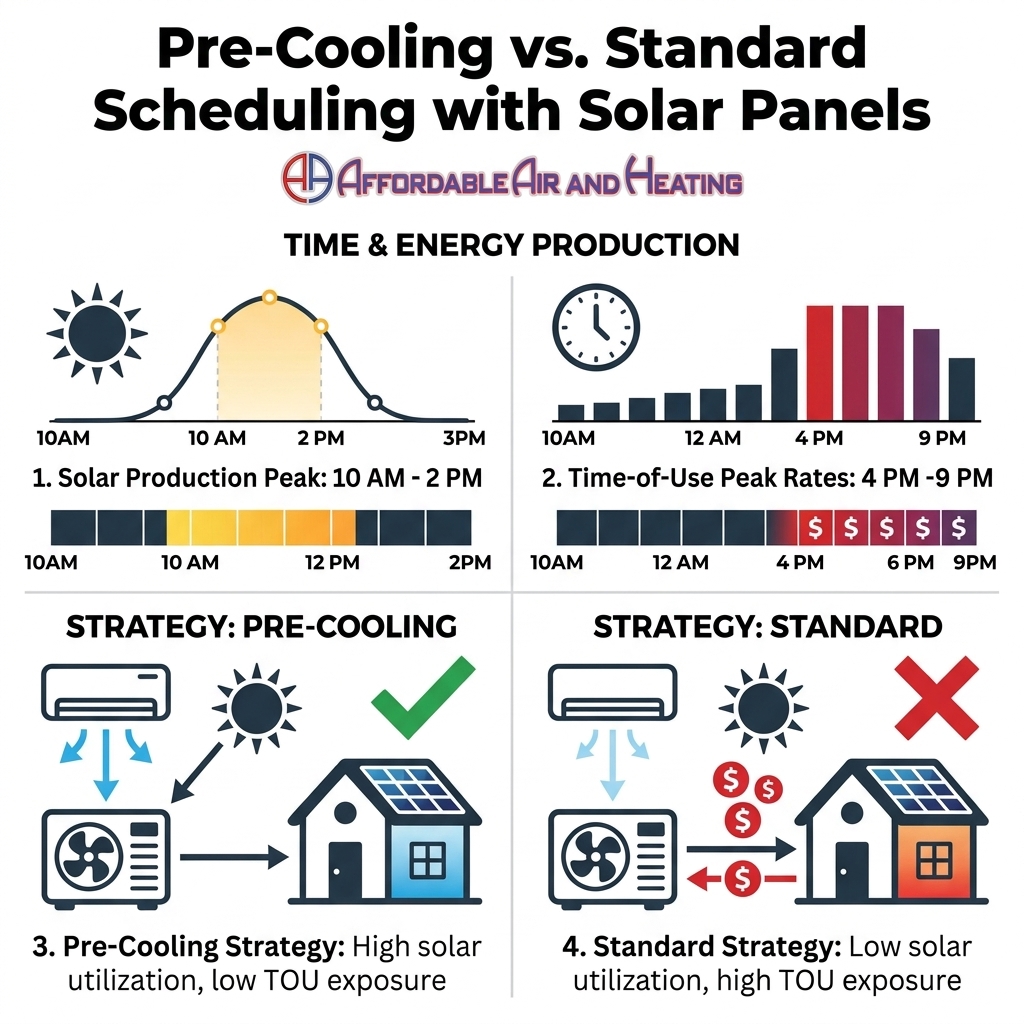
The solar production curve: Standard residential solar panels follow a bell curve of production. They begin generating light power in the early morning, ramp up significantly, and hit their absolute peak between 10 AM and 2 PM. During this four-hour window, most systems produce far more electricity than a typical home can consume. By 4 PM, however, the sun's angle drops, and production falls off a cliff.
The utility rate curve: Utility companies structure their pricing based on total grid demand. Because millions of people return home from work, turn on appliances, and blast their air conditioning in the late afternoon, utility providers implement Time-of-Use (TOU) pricing. The 4 PM to 9 PM peak Time-of-Use window represents the most expensive electricity of the day. Rates during this period can be significantly higher than morning or overnight rates.
The financial trap: If you use standard thermostat scheduling, your system will likely sit idle during the morning when you have abundant, free solar power. Then, as the house naturally warms up by 4 PM, the thermostat triggers the equipment to turn on. At this exact moment, your solar panels are powering down, and the utility company is charging peak TOU rates. You end up buying the most expensive power of the day to cool your home, completely missing out on the financial benefits of your mid-day solar surplus.
Head-to-Head: Pre-Cooling Strategy vs. Standard Thermostat Scheduling
To help you make an informed decision on how to program your system, it helps to see a clear, side-by-side comparison of the two approaches. The table below outlines how pre-cooling stacks up against standard, constant-temperature scheduling during the demanding summer months.
• Primary Energy Source — Pre-Cooling Strategy: Mid-day surplus solar production — Standard Thermostat Scheduling: Late afternoon utility grid power
• TOU Rate Exposure — Pre-Cooling Strategy: Low (system coasts during peak hours) — Standard Thermostat Scheduling: High (system runs heavily from 4 PM to 9 PM)
• Thermal Mass Utilization — Pre-Cooling Strategy: High (deeply chills walls and flooring) — Standard Thermostat Scheduling: Low (only cools ambient air as needed)
• Equipment Stress — Pre-Cooling Strategy: Moderate (runs during milder mid-day heat) — Standard Thermostat Scheduling: Severe (runs during maximum outdoor temperatures)
• Grid Independence — Pre-Cooling Strategy: Maximizes self-consumption of solar — Standard Thermostat Scheduling: Relies heavily on utility grid imports
The data clearly shows that shifting the cooling load to earlier in the day aligns perfectly with the goal of maximizing a solar investment. By treating the physical structure of the house as a thermal battery, you fundamentally alter the economics of keeping your home comfortable.
Reducing Equipment Strain During Peak Heat
Beyond the financial benefits of dodging peak utility rates, pre-cooling offers substantial mechanical advantages for your equipment. Air conditioners and heat pumps work by transferring heat from the inside of your home to the outside air. The hotter it is outside, the harder the compressor has to work to reject that heat. When you run your equipment heavily at 4 PM or 5 PM during August late-summer peak heat, you are forcing the compressor to operate under maximum environmental stress.
By shifting the bulk of the cooling load to the late morning and early afternoon, the equipment operates when outdoor temperatures are generally milder. The compressor doesn't have to fight against peak ambient heat, which allows it to run more efficiently and pull less amperage. Once the worst of the afternoon heat arrives, a pre-cooled home allows the system to coast or remain completely off during the most punishing environmental conditions.
Reducing this kind of mechanical stress can significantly improve the longevity of the equipment. We frequently see the results of long-term mechanical strain on aging systems. In one instance, a homeowner returned from a vacation to find their 30-year-old HVAC unit had finally died after decades of battling peak afternoon temperatures. Our team was able to provide a quote and replace the old unit with a new one in a single day. Upgrading to modern equipment, such as a high-efficiency heat pump installation, combined with smart scheduling, ensures your system won't suffer premature failure from extreme afternoon heat loads.
How to Implement a Smart Pre-Cooling Schedule
Putting this physics-based strategy into action requires a programmable or smart thermostat. The goal is to align your thermostat's schedule with the sun's trajectory and your utility company's rate structure. Here is how to implement a highly effective pre-cooling schedule:
1. The Morning Baseline (7 AM - 10 AM): Set your thermostat to your normal, comfortable temperature (e.g., 74°F). During this time, the house is naturally cooler from the night before, and solar production is just beginning to ramp up.
2. The Solar Charge (10 AM - 3 PM): Drop the thermostat setting by 3 to 4 degrees (e.g., down to 70°F or 71°F). This forces the equipment to run continuously during peak solar production. You are actively "charging" the thermal mass of the drywall, floors, and furniture with cold air using free energy.
3. The TOU Coasting Phase (4 PM - 9 PM): Program the thermostat to allow the indoor temperature to drift up slightly right as the 4 PM to 9 PM peak Time-of-Use window begins. Set the thermostat to 76°F or 78°F. Because the home's thermal mass is deeply chilled, the ambient air will stay comfortable for hours, and the equipment will rarely, if ever, cycle on during peak grid rates.
4. The Evening Reset (9 PM onwards): Once peak TOU rates end, you can return the thermostat to your preferred sleeping temperature. In some climates, you may even choose to turn the system off entirely. Many homeowners ask if they can save money by opening windows at night, which is an excellent way to flush out stagnant air and naturally reset the home's thermal mass for the next day.
A note on smart thermostats: Many generic utility incentive programs offer structural advantages for homeowners optimizing smart thermostat usage. These programs often provide rebates for installing Wi-Fi-enabled thermostats that can automatically adjust during high-demand events. Always check with your local utility provider to see if your new schedule qualifies for additional energy credits.
Frequently Asked Questions About Solar Cooling Strategies
Should I run my AC during the day if I have solar panels?
Yes, running your equipment during the day is the most efficient way to utilize your solar array. By cooling the house when the sun is shining, you use energy that your panels are actively producing rather than pulling from the grid. This strategy prevents the home from overheating and reduces the need to run the equipment during expensive evening hours.
Does solar power cover air conditioning?
Solar power can absolutely cover the energy required for air conditioning, provided your solar array is sized correctly for your home's total electrical load. The key is timing your usage to match production. If you run the system heavily while the sun is up, your panels will offset the consumption directly, drastically lowering your overall utility costs.
What is the best thermostat setting for solar panels?
The best setting involves a tiered approach rather than a single static number. Drop the temperature to 70°F or 71°F between 10 AM and 3 PM to absorb excess solar power, then raise the setpoint to 76°F or 78°F during the 4 PM to 9 PM window. This allows your home to stay comfortable while avoiding peak grid rates.
How do you pre-cool a house with solar?
You pre-cool a house by lowering the thermostat several degrees below your normal comfort level during peak mid-day solar production. This extended cooling cycle chills the physical materials inside the home—like the flooring and drywall. Those deeply chilled materials will then slowly absorb ambient heat later in the day, keeping the house cool even when the equipment shuts off.
Will pre-cooling work effectively in a high-desert environment?
Yes, pre-cooling is highly effective in the Lancaster High Desert climate. Because high-desert environments experience rapid temperature drops after sunset, the main challenge is simply keeping the house cool between 4 PM and 8 PM. Pre-cooling bridges this exact gap, allowing you to comfortably reach the cooler evening hours without relying on the utility grid.
Maximize Your Solar Investment with Expert Cooling Strategies
Understanding how solar panels change the math on AC usage empowers you to take control of your home's comfort and your energy bills. By treating your home's physical structure as a thermal battery, you can successfully bridge the difficult gap between late afternoon solar drop-off and peak TOU rates. Surviving August late-summer peak heat doesn't have to mean compromising on comfort or paying exorbitant grid premiums.
At Affordable Air and Heating, we are dedicated to helping local homeowners find the most cost-effective ways to cool their homes. Leveraging our "Affordable" brand identity means we focus on smart, physics-based strategies that maximize your existing investments. If you want to ensure your current equipment is optimized for advanced scheduling, or if you are considering upgrading to a system that handles thermal mass cooling more efficiently, reach out to our team of experts today. We can help you implement a strategy that keeps your home comfortable and your utility costs firmly in check.