The Myth That Thicker Filters Are Always Better for Your Home
If you are standing in the hardware store aisle wondering, how thick should your AC filter actually be?, you are certainly not alone. A common misconception among homeowners is that buying the thickest, highest-rated air filter on the shelf is the ultimate defense against household dust. It seems logical: a denser, thicker filter should trap more particles and leave your home feeling fresher. However, bigger and thicker is not always better for your cooling equipment. Before you upgrade your filtration, our team at Affordable Air and Heating wants you to understand how these choices impact your overall indoor air quality and system health.
Many homeowners assume that maximizing filter thickness is a universal fix for airborne dust problems. In reality, forcing an ultra-thick, high-MERV (Minimum Efficiency Reporting Value) filter into a standard return grille can severely choke your system's airflow. This creates a critical decision point for anyone trying to manage dust: you have to weigh the perceived air quality gains against the very real risk of stressing your blower motor to the point of failure.
The late summer strain: At Affordable Air and Heating, we notice this mechanical strain becomes especially apparent during August late-summer cooling. By the time kids are heading back to school, your cooling equipment has been running heavily for months. The system is already working overtime to combat the intense heat. When you introduce a dense, restrictive filter into the mix, you are effectively asking a marathon runner to finish the race while breathing through a coffee straw. The resulting airflow restriction forces the equipment to run longer cycles, consume more electricity, and endure unnecessary wear and tear right when you need reliable cooling the most.
Understanding Static Pressure: Why Your HVAC System Needs to Breathe
To understand why thick filters can cause so much trouble, we have to look at the mechanical reality of your HVAC system. Residential cooling systems are precisely calibrated for a specific maximum total external static pressure. In plain terms, static pressure is the resistance your system faces as it pushes and pulls air throughout your home. Typically, residential equipment is designed to operate at a maximum of 0.5 inches of water column. Every single component in your ductwork—including your air filter—adds to this resistance.
The Problem: Every filter creates some level of resistance. However, a high MERV rating vs. airflow restriction is a direct tradeoff. Thicker, denser filters create significantly more resistance than standard 1-inch fiberglass or basic pleated variants. When the filter material is too tight, it physically blocks the air from returning to the air handler.
The Cause: When the filter restricts too much air, the system simply cannot pull enough warm indoor air across the cold evaporator coil. The blower motor spins, but a vacuum effect occurs in the return duct because the thick filter is acting more like a solid wall than a breathable membrane.
The Solution: Starving the system of air leads to a chain reaction of mechanical failures, starting with frozen evaporator coils, leading to poor cooling performance, and ending with premature part failure. The solution is matching the filter's resistance to the system's engineered capacity, ensuring the equipment can breathe freely while still capturing debris.
The Danger of Forcing a 4-Inch Filter into a 1-Inch Grille
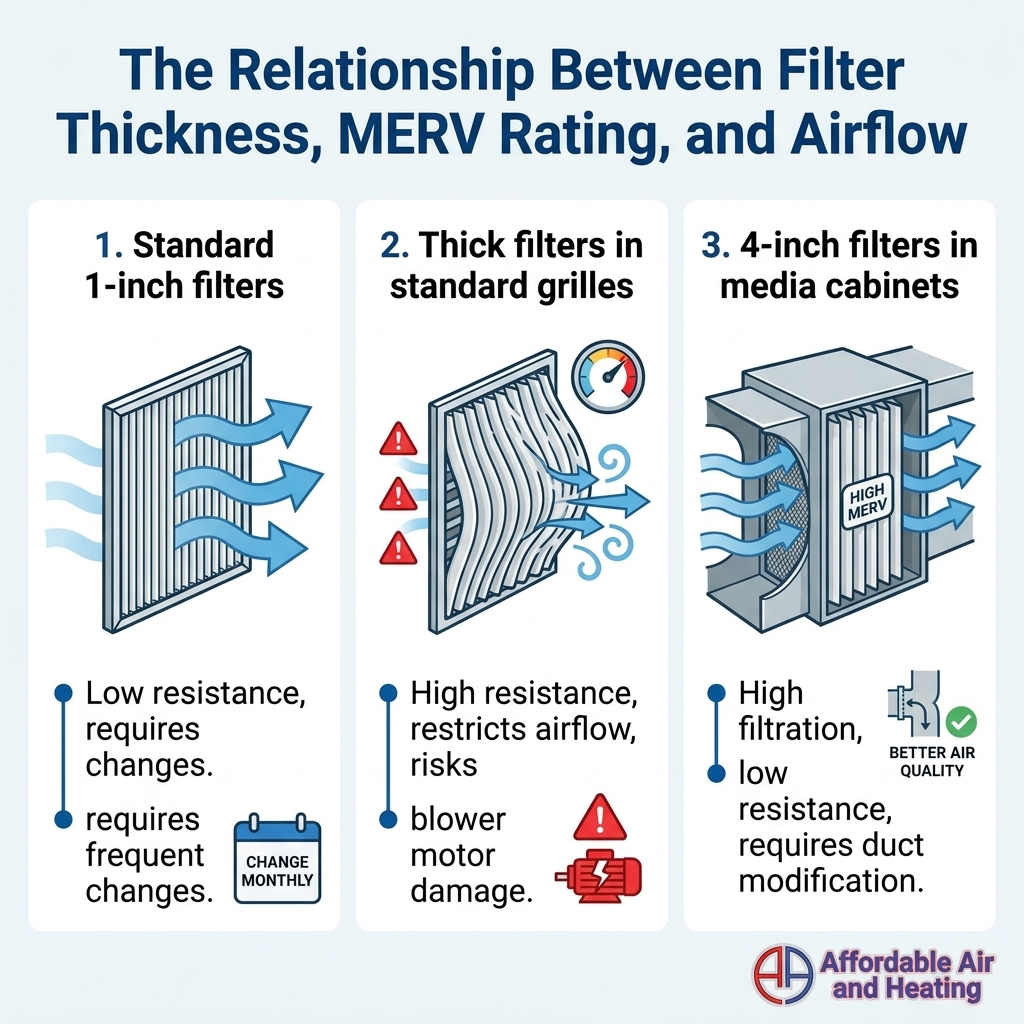
Standard return grilles—the metal vents usually located in your hallway or ceiling—are engineered specifically for standard 1-inch filters. Attempting to jam, bend, or modify a thicker 4-inch filter into a space not designed for it bypasses proper airflow dynamics entirely.
When you force a thick filter into a narrow slot, the edges often crush, allowing dirty air to bypass the filter completely and coat your sensitive internal components with grime. Worse, the dense material forces the blower motor to work exponentially harder to pull air through the restricted surface area. A 4-inch filter is an excellent tool for air purification, but only when it is installed in a housing specifically built to handle its dimensions and maintain proper airflow.
Why High-MERV Filters Struggle in Dusty Desert Environments
The debate over filter thickness takes on a completely different dimension when you factor in local climate conditions. High-MERV filters are brilliantly designed to trap microscopic particles, allergens, and fine pollutants. However, because they are so efficient, they also trap larger particulate matter incredibly fast.
Through our years of servicing HVAC systems in Lancaster and the High Desert region, the Affordable Air and Heating team has seen how extreme summer heat is accompanied by high winds and heavy blowing dirt, sand, and agricultural dust. This heavy environmental load means that dense, thick filters clog exponentially faster here than they would in milder, less dusty climates. A filter that might last 90 days in a coastal city can easily become completely saturated within just a few weeks in the High Desert.
Beware of generic advice: It is common to hear generic big-box store advice pushing expensive, high-MERV filters as a cure-all for a dusty home. Unfortunately, this one-size-fits-all advice fails to assess the local climate's extreme dust load or your specific home's system compatibility. A partially clogged high-MERV filter in our region quickly turns into a solid, impenetrable wall, suffocating the cooling system entirely.
For most homes in our service area with standard ductwork, frequently changing a less restrictive, standard 1-inch filter is often much safer for the equipment. Swapping out a basic filter every few weeks during the peak of summer protects the internal components from heavy dust without creating the dangerous airflow blockages associated with neglected high-MERV products.
The Toll on Your Blower Motor When Airflow is Choked
The blower motor is the beating heart of your air handler. Its sole job is to circulate conditioned air throughout your living spaces. When airflow is choked by an overly thick or dense filter, the mechanical toll on this vital component is severe. Proper airflow is just as critical to your overall air conditioning performance as the refrigerant charge.
Here is the step-by-step breakdown of what our technicians see happen when a restrictive filter suffocates your system:
1. Increased Amperage Draw: As the motor struggles against the high static pressure, it has to work harder to move the same volume of air. This causes the motor to pull more electrical current (amperage), driving up your utility bills.
2. Excessive Heat Buildup: The air moving across the blower motor actually helps keep the motor itself cool. When airflow drops, the motor loses its natural cooling method and begins to run dangerously hot.
3. Component Degradation: Continuous strain and overheating during peak August late-summer cooling seasons gradually bake the internal wiring and bearings of the motor.
4. Complete Motor Failure: Eventually, the thermal overload switch trips, or the motor simply burns out entirely, resulting in a sudden and complete loss of cooling.
Our team sees the results of this strain. Prolonged strain on the system can push a unit beyond a simple repair, sometimes ending in a burnt-out fan motor or a prematurely failed system. That is a significant repair that can often be avoided simply by using the correct filter thickness and changing it regularly.
Signs Your Filter is Restricting Too Much Air
• Constant running with no relief: The system runs constantly, but the house simply isn't cooling down to the temperature set on the thermostat.
• Strange whistling noises: You hear a high-pitched whistling or whining sound coming from the return grille, caused by air squeezing through tiny gaps around a clogged filter.
• Frozen components: Ice begins forming on the copper refrigerant lines outside or directly on the indoor evaporator coil, indicating that warm air isn't moving over the coils to prevent freezing.
• Weak vent airflow: The air coming out of your supply registers feels weak, barely pushing past the vent grates.
Comparing 1-Inch Standard Filters vs. 4-Inch Media Cabinets
To make the best decision for your home, it helps to understand the physical differences between standard filtration and professionally installed thick media filters. The high MERV rating vs. airflow restriction tradeoff changes entirely when you alter the ductwork to accommodate a larger filter properly.
Standard 1-inch filters are primarily designed to protect the HVAC equipment itself from large debris like hair, lint, and heavy dust—they are not necessarily designed to purify the air you breathe. True 4-inch or 5-inch thick filters, on the other hand, require a dedicated media cabinet installed directly into the ductwork next to the air handler.
A dedicated media cabinet has a much larger surface area. Because the filter material is pleated deeply, it can provide high-MERV filtration without increasing static pressure. The air spreads out over a massive surface, passing through slowly and easily, while the microscopic particles are trapped. Homeowners seeking superior dust control should look into upgrading their ductwork rather than compromising their existing standard grilles. Understanding the difference between air purifiers and media air cleaners is a great next step for improving your home's air.
• Primary Purpose — Standard 1-Inch Filter (in grille): Protect HVAC equipment from large debris — 4-Inch Media Filter (in cabinet): Improve indoor air quality and trap fine particles
• Airflow Resistance — Standard 1-Inch Filter (in grille): Low (if MERV 8 or below) — 4-Inch Media Filter (in cabinet): Low (due to massive surface area)
• Installation Method — Standard 1-Inch Filter (in grille): Slides into standard return grilles — 4-Inch Media Filter (in cabinet): Requires professional ductwork modification
• Replacement Frequency — Standard 1-Inch Filter (in grille): Every 30 to 60 days in dusty climates — 4-Inch Media Filter (in cabinet): Every 6 to 12 months
• Filtration Quality — Standard 1-Inch Filter (in grille): Basic dust, lint, and hair — 4-Inch Media Filter (in cabinet): Pollen, pet dander, fine dust, and allergens
Finding the Right Balance for Your Home's Air Quality
Achieving clean air without destroying your cooling equipment requires a balanced approach, especially in the Lancaster and High Desert region. If you have standard 1-inch return grilles, the safest route is to stick to a filter with a MERV 8 rating or lower. More importantly, commit to changing it frequently—sometimes as often as every two to three weeks during the peak of summer when the wind is kicking up heavy dust.
If severe allergies, asthma, or heavy environmental dust require better filtration, do not try to force a thick filter into a small slot. Instead, consider adding a standalone room purifier or investing in professional duct modifications to house a proper media cabinet. Restricted airflow is a common reason an AC unit stops cooling due to a bad fan motor, and issues like these often stem from the system struggling to breathe over long periods.
Never sacrifice essential airflow for a slight increase in filtration efficiency. The health of your blower motor and evaporator coil depends on a steady, unrestricted volume of air. Consulting with a local professional ensures your system's static pressure is measured accurately before making any significant changes to your air purification systems.
Frequently Asked Questions
Does a thicker air filter restrict airflow?
Yes, a thicker air filter will restrict airflow if your HVAC system and ductwork were not designed to accommodate it. When you place a dense 4-inch filter into a standard 1-inch slot, the system has to work much harder to pull air through the thick material. Over time, this restriction can lead to increased energy consumption, poor cooling performance, and severe strain on your blower motor.
What happens if my AC filter is too thick?
If your AC filter is too thick for your specific system, it starves the equipment of necessary return air. This lack of airflow prevents warm indoor air from passing over the cold evaporator coil, which often causes the coil to freeze solid. Additionally, the blower motor will overheat as it struggles against the high static pressure, potentially leading to a complete mechanical breakdown.
Is a thicker AC filter better for my home?
A thicker AC filter is only better if you have a dedicated media cabinet professionally installed in your ductwork. In a proper housing, a thick filter provides massive surface area, allowing it to trap microscopic allergens without restricting airflow. However, if you are just trying to squeeze a thick filter into a standard wall or ceiling grille, it will do more harm to your system than good for your air quality.
Can I use a 2-inch filter instead of a 1-inch filter?
You should only use a 2-inch filter if your return grille or air handler slot is specifically manufactured to hold a 2-inch depth. Forcing a larger filter into a smaller slot can crush the filter frame, creating gaps where dirty air bypasses the filter entirely. Always use the exact thickness recommended by your grille size or HVAC manufacturer to maintain proper static pressure.
How often should I change my AC filter in a dusty desert climate?
In a dusty desert environment, standard 1-inch filters should typically be checked and replaced every 30 days, or even more frequently during peak summer winds. High winds and blowing sand cause filters to clog much faster than the manufacturer's generic 90-day recommendation. Checking the filter every two weeks ensures your system always has the airflow it needs to operate efficiently.
Balancing indoor air quality with the mechanical health of your cooling system doesn't have to be a guessing game. By choosing the right filter thickness for your specific ductwork and changing it regularly, you protect both your family's comfort and your equipment's lifespan. A clear, regionally-aware approach to filtration ensures your home stays cool, clean, and comfortable—even during the dustiest days of late summer.