The Mid-July AC Breakdown: A Decision Framework for Repairing vs. Replacing


Facing a High AC Repair Quote in Peak Summer?
Are you staring at a massive estimate, trying to weigh the pros and cons of repairing vs. replacing your AC when it fails in mid-July? You are not alone. In our years of providing heating and cooling solutions across the local area, our team typically sees homeowners face this exact dilemma. Losing your air conditioning during the hottest part of the year is incredibly stressful, and the urgency to restore comfort often leads to rushed financial decisions. When the house is heating up by the hour, the immediate reaction is usually to authorize whatever repair will get cold air flowing again. However, pouring significant funds into an aging system is often a short-term bandage on a long-term problem.
To navigate this situation, you need comprehensive heating and air conditioning services that focus on diagnosing the root cause rather than just treating the symptom. The primary dilemma every homeowner faces in this scenario is deciding whether to invest in a major, costly repair or to put those funds toward a full system replacement. Making the right choice requires stepping back from the immediate heat and applying an objective decision matrix.
Removing Emotion from the Equation
During a mid-July peak summer heatwave, emotion and physical discomfort drive the narrative. To make a sound financial choice, you must remove that emotion. This is done by relying on established industry benchmarks, specifically the 50 percent rule and the reality of modern refrigerant regulations. By looking at the hard data—the age of your equipment, the cost of the repair, and the availability of parts—you can determine exactly when an air conditioner has crossed the line from a reliable appliance to a financial liability.
The core factors to evaluate include:
• System age: Is the unit approaching or past the 10 to 15-year mark?
• Repair frequency: Have you had to call a technician multiple times in the last three years?
• Refrigerant type: Does the system rely on obsolete chemicals that are no longer legally manufactured?
• Energy consumption: Have your summer utility bills spiked inexplicably?
By assessing these variables, you build a clear, factual framework that points directly to the most cost-effective path forward.
The Impact of the R-22 Phaseout on Aging Systems
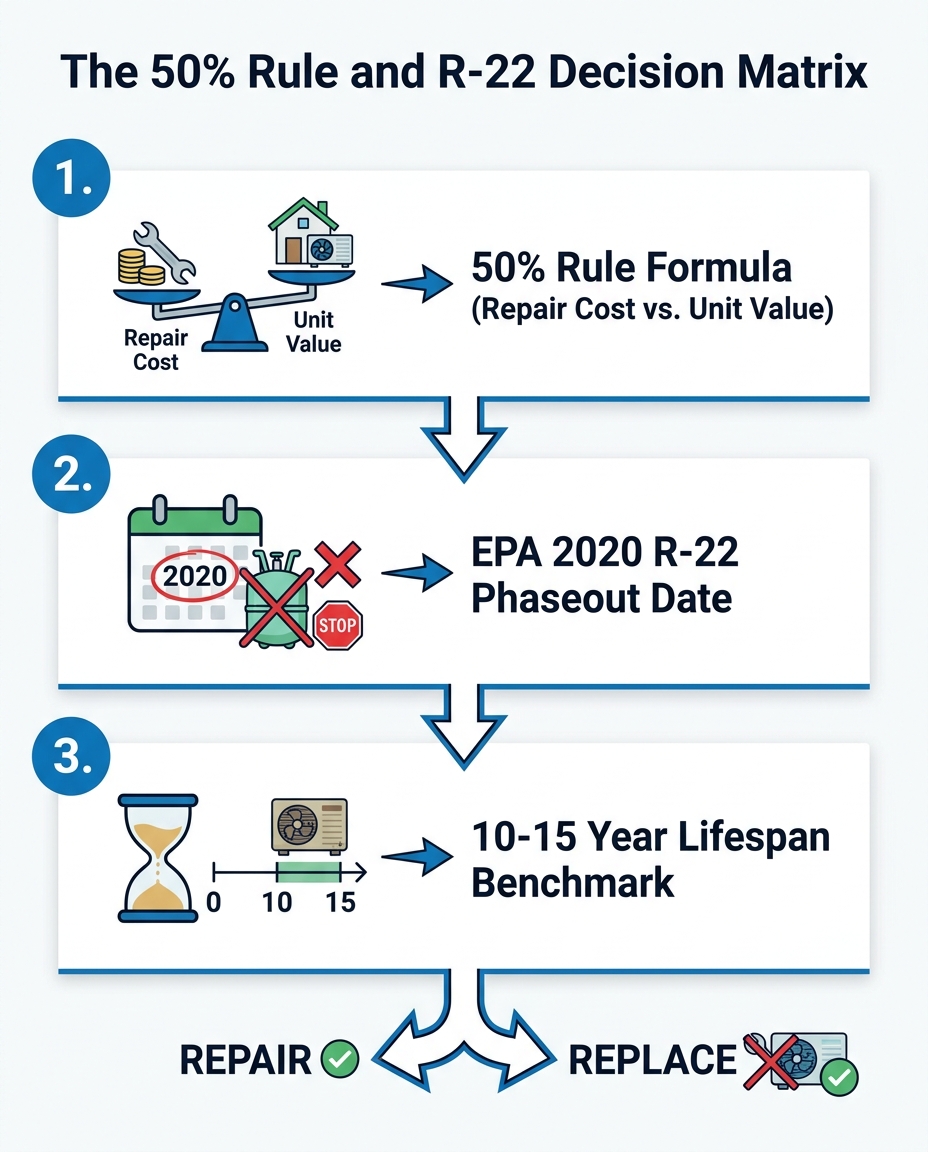
One of the most critical factors in evaluating a repair quote is knowing exactly what type of refrigerant your system uses. For decades, the industry standard was R-22 (commonly known as Freon). However, due to its ozone-depleting properties, the Environmental Protection Agency (EPA) initiated a strict phaseout program. As of 2020, the EPA finalized this phaseout, making it completely illegal to produce or import R-22 in the United States. This regulatory shift drastically alters the repair vs. replace equation for older units.
Why "Topping Off" is a Flawed Strategy
A common pattern our technicians see across the local area with older AC units using R-22 refrigerant is a slow, persistent leak. In the past, a technician might have simply "topped off" the system to get you through the rest of the summer. Today, that strategy is neither viable nor financially sound. Because new R-22 cannot be manufactured, the only available supply comes from stockpiles or reclaimed refrigerant recovered from decommissioned systems. The law of supply and demand has driven the cost of R-22 to astronomical levels.
Furthermore, air conditioning systems are closed loops. They do not consume refrigerant like a car consumes gas. If your system is low on R-22, there is a physical leak in the coils or the lines. Paying exorbitant prices to inject rare refrigerant into a leaking system is a guaranteed way to waste money, as that expensive chemical will eventually vent right back into the atmosphere.
The Shift to Modern Alternatives
Modern air conditioners utilize safer, more efficient refrigerants like R-410A (and newer alternatives entering the market). These systems operate at different pressures and require entirely different compressors and coils. You cannot simply put a modern refrigerant into an older R-22 system; the chemical incompatibility will destroy the compressor immediately. If you are unsure what type of refrigerant your system uses, contact us for an honest system evaluation. Understanding your system's chemical baseline is the first major step in deciding whether a repair is a wise investment or a dead end.
Applying the 50 Percent Rule to Your Repair Quote
When you are holding a high repair estimate in the middle of a mid-July peak summer heatwave, you need a mathematical formula to guide your choice. The industry standard for this evaluation is known as the 50 percent rule. This objective financial metric removes the guesswork from your decision-making process.
The rule is straightforward: if the cost of the proposed repair exceeds 50 percent of the value of your current system (or 50 percent of the cost of a new system), replacement is generally the better financial choice. Here is how to apply this rule step-by-step to your specific situation.
1. Determine the age and remaining lifespan of the unit: The average lifespan of a central air conditioning system is 10 to 15 years. If your system is 12 years old, it has already consumed roughly 80 to 90 percent of its useful life. Its current financial value is quite low, meaning almost any major repair (like a compressor or evaporator coil replacement) will quickly exceed the 50 percent threshold.
2. Calculate the true cost of the repair: Look beyond the immediate invoice. If you authorize a major repair today, what else is likely to fail tomorrow? Replacing a compressor on a 14-year-old system leaves you with a brand-new compressor attached to a 14-year-old fan motor, 14-year-old electrical contactors, and a 14-year-old condenser coil.
3. Factor in the multiplying effect method: Another common way to calculate this is to multiply the age of the equipment by the estimated repair cost. If the resulting number exceeds a certain threshold (often measured against the cost of a new unit), the math leans heavily toward replacement. For instance, a high-cost repair on a 15-year-old unit yields a much higher risk score than the same repair on a 4-year-old unit.
4. Evaluate the warranty status: A system past the 10-year mark is almost certainly out of its manufacturer warranty. This means 100 percent of the parts and labor costs fall directly on your shoulders. Conversely, a new installation resets the clock, providing a decade of parts protection and insulating you from future repair shocks.
By strictly applying the 50 percent rule, you protect yourself from the sunk-cost fallacy—the mistaken belief that because you have already spent money repairing a system, you must continue to do so.
Supply Chain Realities: Waiting for Parts in Extreme Heat
The financial math is only one part of the equation; the timeline of the repair is equally critical. July historically represents the absolute peak volume for HVAC service calls nationwide. When systems are running continuously to combat the heat, components fail at a much higher rate. This massive spike in demand puts incredible strain on HVAC parts supply chains.
The Danger of High Desert Temperatures
In the local area, summer temperatures frequently exceed 100 degrees, and a broken air conditioner is not just an inconvenience—it is a safety hazard. The internal temperature of a home can reach dangerous levels within hours of a system failure. In these extreme climates, waiting days for a specialized repair part is often unsafe, which forces a replacement decision much faster than it would in milder, more forgiving climates.
Comparing Timelines: Repair vs. Replacement
When dealing with older AC units using R-22 refrigerant, sourcing major components like a compatible compressor or a specific metering device can be a logistical nightmare. Manufacturers halt production on parts for obsolete systems, meaning distributors must search regional warehouses to find a match. This process can take days or even weeks.
• The Repair Timeline (Older Units): Requires diagnosing the failure, searching obsolete inventory databases, ordering the part, waiting for freight shipping during peak season, and finally scheduling a complex installation that involves recovering old refrigerant and brazing new connections. Average wait: Several days to over a week.
• The Replacement Timeline (New Units): Modern, high-efficiency systems are generally easier to source than specialty repair parts for older equipment, so a full system changeout can often move faster than waiting on a hard-to-find part. Actual timing depends on equipment availability and scheduling.
When the temperature inside your home is climbing past 85 degrees, the ability to restore reliable cooling in 24 hours via a replacement often outweighs the prospect of waiting eight days for a repair part that may or may not extend the life of a dying system.
Long-Term Efficiency Gains and SEER Upgrades
If you are leaning toward replacing your system, it is vital to factor in the operational savings a new unit will provide. Older AC units using R-22 refrigerant were manufactured under outdated energy standards. Keeping one of these units running means accepting significantly higher monthly utility bills.
Understanding SEER Ratings
Air conditioning efficiency is measured by the Seasonal Energy Efficiency Ratio (SEER). The higher the SEER rating, the less electricity the system requires to produce a specific amount of cooling. Systems installed 15 years ago often had SEER ratings of 8 to 10. Today, the Department of Energy mandates a minimum SEER2 rating of 13.4 to 14.3 (depending on your region), with high-efficiency models reaching well into the 20s.
The intense thermal load of peak summer heat accelerates wear on aging compressors. As an old compressor struggles to compress refrigerant, it draws more electrical amperage, reducing its efficiency even further. Replacing an inefficient system significantly reduces cooling energy usage, essentially allowing the new system to partially pay for itself over time through lowered utility bills.
Comparing Old vs. New Systems
• Refrigerant Type — 15-Year-Old R-22 System: Obsolete, expensive R-22 — Modern High-Efficiency System: Modern, available R-410A or newer
• Average SEER Rating — 15-Year-Old R-22 System: 8 to 10 SEER — Modern High-Efficiency System: 14 to 20+ SEER2
• Warranty Status — 15-Year-Old R-22 System: Fully expired (100% out of pocket) — Modern High-Efficiency System: 10-year parts protection standard
• Peak Heat Reliability — 15-Year-Old R-22 System: High risk of consecutive failures — Modern High-Efficiency System: Designed for extreme thermal loads
• Energy Consumption — 15-Year-Old R-22 System: High amperage draw, runs constantly — Modern High-Efficiency System: Variable staging, low power draw
The data clearly shows that while a repair might seem cheaper today, the cumulative cost of running an inefficient system—combined with future repair risks—makes upgrading a much smarter long-term financial strategy.
How to Evaluate Quotes Without the Sales Pressure
The psychological panic of a mid-summer breakdown is real. When your home is incredibly hot and a technician hands you a massive repair bill, it is easy to feel backed into a corner. Unfortunately, some service providers use this mid-July peak summer vulnerability to apply high-pressure sales tactics, urging you to sign a contract immediately "before prices go up" or "before inventory runs out."
You have the right to step back, take a breath, and evaluate your options objectively. At our business, we've spent years helping homeowners in the local area navigate these stressful breakdowns. We believe in a commitment to affordable, transparent pricing and providing honest assessments so customers can make cost-effective decisions without ever feeling pressured. A professional evaluation should empower you with facts, not fear.
Checklist for Objectively Evaluating an HVAC Quote
Use this checklist to self-audit any repair or replacement quote you receive during a breakdown:
• Itemized breakdowns: Does the quote separate the cost of parts, labor, and refrigerant? If it is just a single massive number with no explanation, ask for a detailed breakdown.
• The 50 percent rule application: Did the technician explain the overall health and remaining value of your system, or did they only focus on the broken part?
• Refrigerant transparency: Did they clearly state whether your system uses R-22, and did they explain the long-term financial implications of recharging an obsolete unit?
• Options provided: A trustworthy technician will present multiple options—such as a bare-minimum repair, a comprehensive repair, and a replacement estimate—allowing you to choose what fits your budget.
• No artificial urgency: Beware of "today only" discounts that vanish if you want to take 24 hours to think about a major home investment.
By demanding a transparent, technical breakdown from your service provider, you take control of the conversation and ensure your money is being spent wisely.
Frequently Asked Questions About AC Replacements and Repairs
What is the 50% rule for AC repair?
The 50% rule is a financial guideline stating that if a repair estimate exceeds half the remaining value of your air conditioning unit, you should replace the system instead of fixing it. This rule helps homeowners avoid pouring excessive money into failing equipment. It is especially useful when evaluating systems that are approaching the 10 to 15-year age mark, where the remaining value is already significantly depreciated.
Can you still get R-22 refrigerant for an old AC?
Yes, but it is highly restricted and exceedingly expensive. The EPA finalized the phaseout of R-22 in 2020, making it illegal to manufacture or import new supplies. Any R-22 available today comes from limited stockpiles or has been reclaimed from older units, which drives the price up exponentially. For older AC units using R-22 refrigerant, repairing a leak and recharging the system is rarely a cost-effective long-term solution.
Is it worth repairing a 15-year-old air conditioner?
In the vast majority of cases our team evaluates, repairing a 15-year-old air conditioner is not a wise financial decision. Systems of this age have typically surpassed their engineered lifespan and operate at much lower efficiency levels than modern units. Furthermore, fixing one major component on a 15-year-old unit leaves you vulnerable to other aging parts failing shortly after, leading to a cycle of continuous repair bills.
When should you replace your AC instead of repairing it?
You should replace your AC when the equipment is over 10 years old, requires frequent service calls, uses obsolete R-22 refrigerant, or when the cost of a current repair fails the 50 percent rule. Additionally, if your energy bills have steadily climbed despite regular maintenance, a replacement will offer significant efficiency gains that offset the cost of the new installation.
How does extreme summer heat impact an aging AC compressor?
Extreme summer heat drastically increases the thermal load on your home, forcing the AC compressor to run longer and work harder to maintain the set temperature. For an aging compressor, this continuous operation increases internal friction, causes electrical components to overheat, and draws excessive amperage. This severe strain is why older systems frequently suffer catastrophic compressor failures during peak summer heatwaves.
What should I do if I feel pressured by an emergency HVAC repair quote?
If you feel pressured by high-stress sales tactics, calmly tell the technician you need time to review the numbers. A reputable company will always allow you to evaluate a quote without forcing a same-day decision. Use that time to apply the 50 percent rule, verify your system's age and refrigerant type, and seek a second opinion from a transparent service provider if the initial assessment feels rushed or incomplete.
Make a Confident Decision for Your Home's Comfort
Experiencing an air conditioning failure during a mid-July peak summer heatwave is undoubtedly frustrating, but the decision of how to handle it does not have to be overwhelming. By utilizing the 50 percent rule and confirming the type of refrigerant your system requires, you put yourself firmly in control of the decision-making process. You replace panic with a clear, mathematical framework.
An objective choice is entirely possible, even in the middle of a high-heat emergency. You do not have to settle for endless repair cycles on obsolete equipment, nor do you have to succumb to high-pressure sales tactics. Take the time to evaluate the age of your equipment, the true cost of the repair, and the timeline for parts availability. If you are ready to get the facts you need to make a final, confident decision, schedule an honest evaluation today to restore your home's comfort efficiently and reliably.