Swamp Cooler vs. Central AC: Which Makes Sense in the High Desert?


The Late-Summer Cooling Dilemma in the High Desert
Are you currently weighing a swamp cooler vs. central AC: which makes sense in the High Desert when your current system is struggling to keep up with the intense August late-summer heat? You are certainly not alone in asking this question. Every year, as the temperatures climb into the triple digits, homeowners across the region find themselves staring at their thermostats, wondering if their cooling setup is truly the best fit for their home. The decision usually comes down to a classic debate: the traditional energy efficiency of an evaporative cooler versus the reliable, moisture-removing power of modern air conditioning.
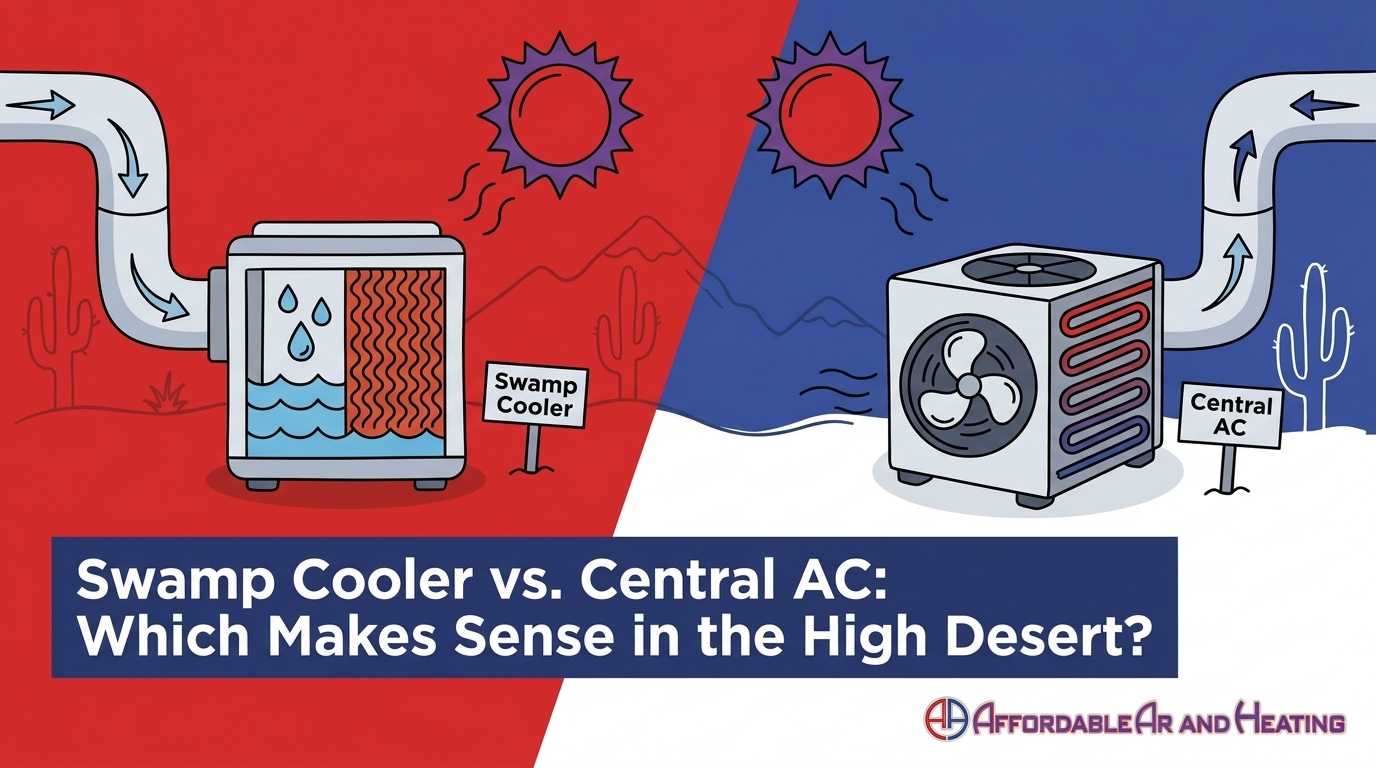
For decades, swamp coolers have been a staple in desert homes. They operate on a very simple mechanical principle, pulling hot outside air through water-saturated pads. As the water evaporates, it absorbs heat, blowing cooler air into your living space. It is a straightforward, natural cooling process. On the other hand, central air conditioning uses a closed loop of chemical refrigerant to actively absorb heat from inside your home and pump it outside, while simultaneously drawing moisture out of the indoor air.
Understanding the fundamental difference between these two technologies is the first step in making the right choice for your family's comfort. What works perfectly in June might leave you sweating in August. To make an informed decision, you need to look beyond basic mechanics and consider how these systems interact with our specific regional weather patterns. If you are considering upgrading your home comfort, learning more about modern HVAC systems is the best place to start.
How the Palmdale and Lancaster Microclimate Impacts Cooling
To truly understand cooling performance, you have to look at the sky outside your window. The Palmdale and Lancaster High Desert region features a highly specific microclimate that changes dramatically as the summer progresses. Early summer typically brings intense, dry heat. During these months, the air is arid, and the sky is clear. However, as late summer arrives, the weather pattern shifts significantly.
The seasonal shift in the High Desert:
• Early Summer (June to July): Extremely dry air with relative humidity often sitting well below 20%. Temperatures climb, but the lack of moisture makes the heat feel less oppressive.
• Late Summer (August to September): Monsoonal moisture patterns push into the Antelope Valley from the south and east. While temperatures remain high, humidity levels can double or triple, creating a heavy, sticky atmosphere.
The relative humidity of the outside air is the single biggest factor in determining how well evaporative cooling works. When the air is bone-dry, a swamp cooler is in its element. It easily evaporates water, dropping the incoming air temperature significantly. But when those isolated humidity spikes hit during late-summer monsoons, the equation changes completely. The outside air is already holding too much moisture to absorb more water from the cooler pads.
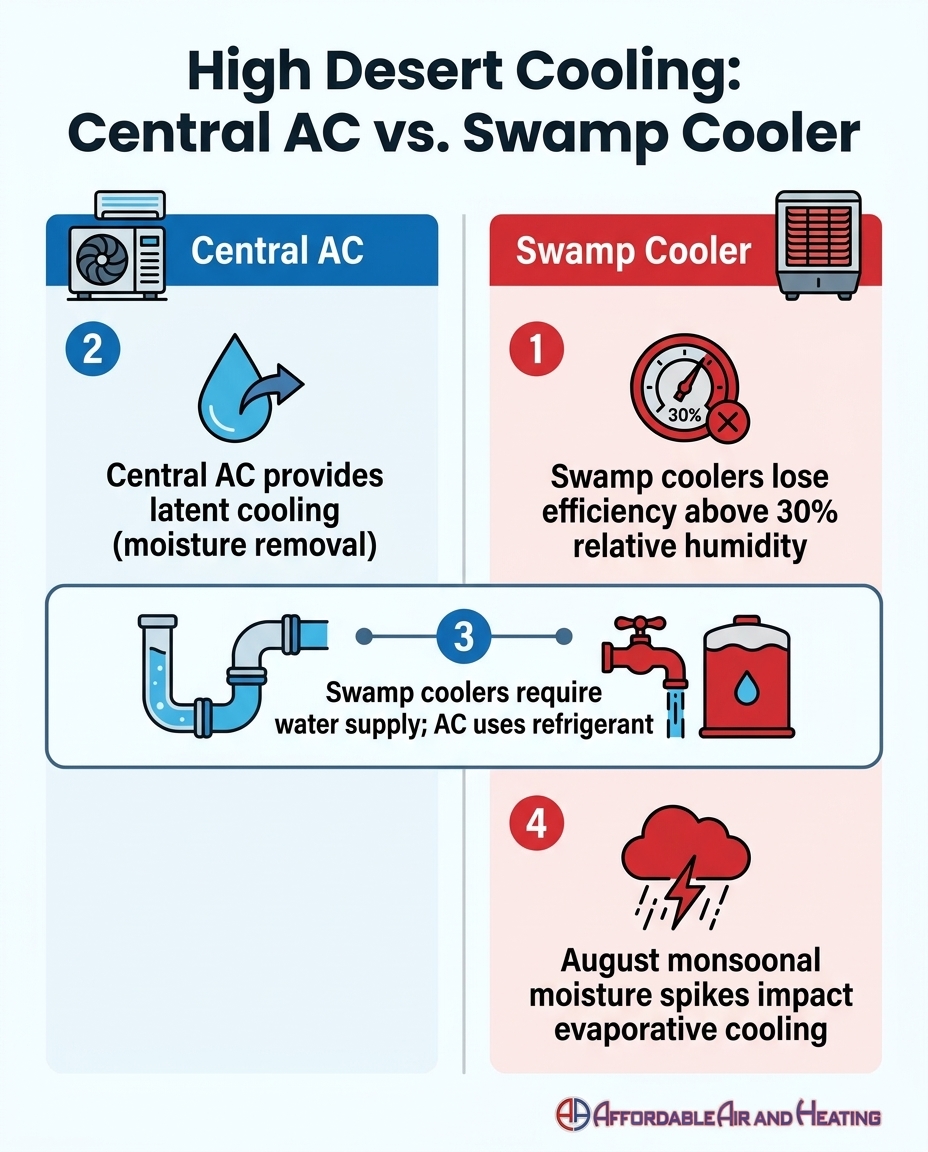
This is where latent cooling comes into play. Latent cooling is the process of actively removing moisture from the indoor air—a feature that only traditional refrigerant-based air conditioning provides. By pulling humidity out of the air, an AC unit makes your home feel cooler and more comfortable, even if the actual temperature on the thermostat hasn't dropped drastically. As local HVAC experts, we understand this specific microclimate transition, unlike national guides that assume the desert is uniformly dry year-round. Knowing how the local weather behaves is critical to choosing the right equipment.
Evaporative Coolers: Performance Limits in Extreme Heat
Every mechanical system has a breaking point, and evaporative coolers are no exception. While they are highly efficient under the right conditions, they face severe performance limits when the weather turns extreme. The core problem usually reveals itself during the peak of the August late-summer heat, when homeowners notice their system is running constantly but the house still feels incredibly warm.
The cause of this problem is deeply tied to the physics of evaporation. An evaporative cooler relies on the air's capacity to absorb water. When the outside air is already saturated from monsoonal weather, the water on the cooler pads simply cannot evaporate quickly enough to create a cooling effect. Instead of chilled air, the system ends up blowing warm, moist air directly into your living room.
The resulting comfort issues include:
• The "Muggy" Effect: Pumping additional moisture into a home that is already experiencing elevated humidity makes the indoor air feel heavy, sticky, and uncomfortable.
• Reduced Temperature Drop: On a dry 100-degree day, a swamp cooler might drop the air temperature by 20 degrees. On a humid 100-degree day, that drop might shrink to just 5 or 10 degrees.
• Trapped Heat: Because swamp coolers require you to crack windows to allow airflow, you are constantly letting hot outside air into your home, which becomes problematic when the system loses its cooling power.
The Humidity Threshold
The data on evaporative cooling is very clear: these systems begin to lose significant cooling capacity once the relative humidity exceeds 30%. At 40% humidity, their effectiveness drops drastically, and at 50%, they are practically just expensive fans blowing wet air. Adding moisture to already humid air actually decreases your physical comfort, because it prevents your body's natural cooling mechanism—sweat evaporation—from working properly.
The ideal use case for a swamp cooler is a climate that remains exceptionally dry all year long. However, when you factor in the specific late-summer weather patterns of our region, relying solely on evaporative cooling often means sacrificing comfort during the most brutal weeks of the year.
Central Air Conditioning: Consistent Comfort Regardless of Weather
When the weather turns unpredictable, consistency becomes the most valuable feature of any home appliance. Central air conditioning provides exactly that. Because refrigerant-based systems do not rely on the outside air's ability to absorb water, they provide consistent, reliable temperature drops regardless of outside humidity or extreme triple-digit heat. You simply set your thermostat, and the system does the rest.
The importance of latent cooling during monsoonal weather patterns cannot be overstated. When a central AC unit runs, the warm indoor air is blown across a freezing cold evaporator coil. As the air cools, the moisture inside it condenses into water droplets on the coil—much like water beading up on the outside of a cold glass of iced tea. This water safely drains away outside, leaving your indoor air crisp, dry, and incredibly comfortable. This process eliminates the sticky, muggy feeling that plagues homes relying on evaporative cooling in late summer.
Upgrading to a modern system truly transforms indoor comfort during the hottest days of the year in the Palmdale and Lancaster High Desert. Modern systems are built to handle intense workloads while remaining highly efficient, challenging the old myth that AC is universally unaffordable to run. Today's variable-speed compressors can adjust their cooling output in tiny increments, drawing only the exact amount of power needed to maintain your desired temperature, rather than constantly blasting at full capacity.
Reliability is another major factor. A faulty fan motor on a central AC unit is a routine repair for a trained technician, which shows that modern AC can be both reliable and easily serviced when you need it. If you are tired of battling the indoor climate, exploring central air conditioning installation is a smart step toward taking back control of your home's comfort.
Resource Usage: Water Conservation vs. Electricity
Beyond daily comfort, it is important to compare the operational resource requirements of both systems. Every cooling method requires resources, but the type of resources they consume differs greatly. When evaluating your options in the Palmdale and Lancaster High Desert, you have to look at the bigger picture of environmental impact and utility usage.
Evaporative coolers require a constant, steady supply of fresh water to keep their pads saturated. In a region prone to severe California drought conditions and strict regional water conservation efforts, pumping hundreds of gallons of water a month onto a roof to evaporate into the air is a significant consideration. Additionally, the hard water common in our region leads to rapid mineral scale buildup on the cooler pads, requiring frequent maintenance and replacement to keep the air flowing properly.
Central air conditioning, conversely, does not consume water to cool your home. It relies entirely on electricity to power the compressor and fans. While older air conditioners were notorious energy hogs, technological advancements have completely changed the landscape.
• Water Usage — Swamp Cooler: High (requires constant water supply) — Central Air Conditioning: None (uses a closed refrigerant loop)
• Electricity Usage — Swamp Cooler: Low (only powers a fan and small pump) — Central Air Conditioning: Moderate to High (powers compressor and blower)
• Humidity Control — Swamp Cooler: Adds moisture to the indoor air — Central Air Conditioning: Removes moisture from the indoor air
• Peak Heat Performance — Swamp Cooler: Drops significantly above 30% humidity — Central Air Conditioning: Consistent regardless of outside weather
• Maintenance Needs — Swamp Cooler: Frequent pad changes, scaling removal, winterizing — Central Air Conditioning: Annual tune-up, standard filter replacements
Modern high-efficiency AC units and smart thermostats have drastically narrowed the energy consumption gap. By utilizing programmable schedules, zoning, and variable-speed technology, homeowners can manage their electrical usage very effectively. When making your decision, it is wise to consider long-term resource availability and general utility usage rather than just looking at the day-to-day operation. Trading heavy water consumption for manageable, efficient electrical usage is often the right move for modern desert living.
Alternative High Desert Cooling Solutions
A common hurdle homeowners face when considering an upgrade is the physical structure of their house. Many older homes built specifically for swamp coolers lack the interior ductwork necessary to support a standard central air system. Installing sprawling metal ducts through tight attic spaces or solid walls can seem like an overwhelming construction project. Fortunately, the HVAC industry has evolved, and there are excellent alternative systems designed for exactly this scenario.
If your home lacks ductwork, you do not have to settle for suffering through the August late-summer heat with an underperforming swamp cooler. Modern alternatives provide the exact same moisture-removing benefits as traditional AC, without the need for major renovations.
Ductless and Heat Pump Technologies
One of the most popular solutions is the ductless mini-split system. Instead of pushing air through a massive network of hidden tubes, these systems use a single outdoor compressor connected directly to sleek, quiet indoor air handlers mounted on your walls. This setup offers incredible zoned cooling benefits. You can set the living room to one temperature while keeping the bedrooms at another, ensuring you only cool the rooms you are actively using.
Key benefits of alternative cooling systems:
1. No Ductwork Required: Installation is fast and minimally invasive, requiring only a small hole in the wall to connect the indoor and outdoor units.
2. Zoned Comfort Control: Independent thermostats for different areas of the house eliminate hot and cold spots.
3. High Efficiency: Without the energy loss associated with leaky ductwork, these systems deliver cooling directly to the source.
4. Year-Round Climate Control: Many ductless units are actually heat pumps, meaning they offer powerful cooling in the summer and highly efficient heating in the winter.
If you are curious about ductless mini split options, they are a fantastic way to bypass the limitations of your home's original design. Additionally, exploring full-home heat pump systems can provide a comprehensive, year-round solution that completely replaces both your swamp cooler and your old winter furnace. To better understand the mechanics behind these efficient alternatives, you can read more about how ductless mini splits use coolant to transfer heat and humidity out of your home.
Frequently Asked Questions
Do swamp coolers work in 100 degree heat?
Yes, they can work in 100-degree heat, provided the air is extremely dry. If the relative humidity is low, a swamp cooler can successfully drop the incoming air temperature to a comfortable level. However, if that 100-degree heat is accompanied by elevated humidity, the cooling effect is drastically reduced, and the system will struggle to keep the home comfortable.
Why is my swamp cooler not cooling in August?
August typically brings a shift in regional weather patterns, introducing monsoonal moisture to the desert. Because evaporative coolers rely on dry air to absorb water and create a cooling effect, the sudden increase in outside humidity prevents the water on the cooler pads from evaporating properly. Instead of cooling the air, the system simply pushes warm, sticky air into your home.
Is it better to have a swamp cooler or AC in the desert?
While swamp coolers are highly energy-efficient during the dry early summer, central AC provides far superior and consistent comfort year-round. AC units actively remove moisture from the indoor air (latent cooling), ensuring your home remains crisp and cool even during the muggy, unpredictable weather of late summer. For absolute reliability, AC is generally the preferred choice.
At what humidity does a swamp cooler stop working?
An evaporative cooler begins to lose significant efficiency once the outside relative humidity climbs above 30%. By the time humidity reaches 40% to 50%, the air is too saturated to absorb much more water, meaning the cooling effect becomes negligible. At this point, running the cooler only makes the indoor environment feel heavier and more uncomfortable.
Can you replace a roof-mounted swamp cooler with central AC?
Yes, you can replace a roof-mounted unit, but the process depends on your home's existing infrastructure. If your home already has adequate ductwork, a central AC system can often be integrated. If your home lacks ductwork, HVAC professionals usually recommend installing a ductless mini-split or heat pump system, which provides the benefits of modern AC without requiring major duct renovations.
Making the Right Choice for Your Home
Choosing between evaporative cooling and modern air conditioning ultimately comes down to prioritizing consistent, reliable comfort. While swamp coolers have their place in early summer, the moisture-removing power of central AC ensures your home remains a sanctuary during the toughest heatwaves. If you are ready for a clear, objective assessment of your home's cooling potential, we are here to help you make an informed upgrade decision.