Are You Getting a True Duct Sanitization or Just a Superficial Vacuum?
Do you know what equipment your chosen duct cleaner is actually bringing into your home? When homeowners start researching what to expect during a professional air duct cleaning, they often assume all services use the same methods. The reality is quite different. As the August back-to-school transition approaches, air conditioning systems have typically run non-stop for months, maximizing the accumulation of airborne particulates deep within the ductwork. A superficial pass with a standard shop-vac simply cannot extract this heavy summer buildup. True sanitization requires specialized negative-pressure cleaning equipment, which stands as the gold standard for removing deep-seated allergens and restoring system efficiency.
To ensure your system is properly maintained, it is crucial to rely on comprehensive professional HVAC services that utilize the correct methodology.
The Illusion of the Quick Clean
Many homeowners fall into the trap of hiring heavily advertised "blow-and-go" services. These operators typically arrive with a standard wet/dry vacuum, push a hose a few feet into the easily accessible registers, and call the job complete in under an hour. While the vent covers might look clean to the naked eye, the vast majority of the ductwork remains entirely untouched. The heavy, caked-on dust sitting in the main trunk lines and the microscopic particulates clinging to the vertical drops are left behind. When the blower motor kicks back on, those remaining contaminants are immediately recirculated into the living space, rendering the superficial cleaning completely useless.
Why High Desert Climates Demand Heavy-Duty Duct Cleaning
The problem: The environment outside your home dictates the air quality inside your home. In Lancaster CA, the high desert environment introduces ultra-fine desert sand and silt into the local atmosphere. Unlike standard household dust, this microscopic mineral particulate is uniquely abrasive and easily bypasses standard fiberglass HVAC filters. Because these particles are so small, they flow directly through the filter media and enter the central air handler.
The cause: Constant high winds are a staple of the high desert over the summer months. These winds force fine silt through tiny gaps in window seals, door frames, and even compromised joints in the ductwork itself. Once inside the duct system, the ultra-fine silt mixes with normal household humidity and pet dander. This combination creates a heavy, cement-like sludge that coats the interior walls of the ductwork. As the summer progresses, this layer grows thicker, restricting airflow and degrading indoor air quality.
The solution: Standard vacuuming is entirely insufficient to remove fine desert silt from duct walls. The abrasive, clinging nature of this debris requires a heavy-duty, multi-step extraction process. Understanding how often you need air duct cleaning in the desert is only half the battle; knowing that the extraction requires professional-grade agitation and negative pressure is what actually protects the home's air supply.
The Science of Negative Pressure: The NADCA Standard
Negative pressure is a fundamental concept in fluid dynamics, and it is the absolute core of proper duct sanitization. In the context of HVAC ductwork, establishing negative pressure means creating an environment where the air pressure inside the duct system is significantly lower than the air pressure in the surrounding rooms. The National Air Duct Cleaners Association (NADCA) requires a state of negative pressure to be maintained throughout the entire system during the cleaning process to prevent cross-contamination.
The physics behind this requirement are straightforward. Air naturally flows from areas of high pressure to areas of low pressure. By hooking up a massive, high-powered vacuum collection unit to the main trunk line, technicians create a powerful, continuous inward draft at every single register in the home. When dust, allergens, and debris are agitated and knocked loose deep inside the ducts, the negative pressure dictates that they can only travel in one direction: directly out of the house and into the sealed collection unit.
Integrating proper indoor air quality solutions requires this scientific approach. Without negative pressure, any mechanical agitation inside the ducts would simply push clouds of toxic dust out of the vents and into your bedrooms, living areas, and kitchen. Highlighting the technical mechanics of negative-pressure cleaning exposes exactly why superficial shop-vac methods fail to remove deep-seated dust and allergens safely.
• Negative Pressure (NADCA Standard) — Airflow Dynamics: Continuous inward draft (vacuum) — Contamination Risk: Zero risk of blowback into rooms — Debris Removal Capability: Extracts deep-seated, heavy accumulation
• Standard Shop-Vac (Blow-and-Go) — Airflow Dynamics: Localized, weak suction — Contamination Risk: High risk of disturbing deep dust — Debris Removal Capability: Only removes loose, surface-level debris
• Positive Pressure (Forced Air) — Airflow Dynamics: Outward blowing air — Contamination Risk: Guaranteed cross-contamination — Debris Removal Capability: Pushes dust deeper into the home
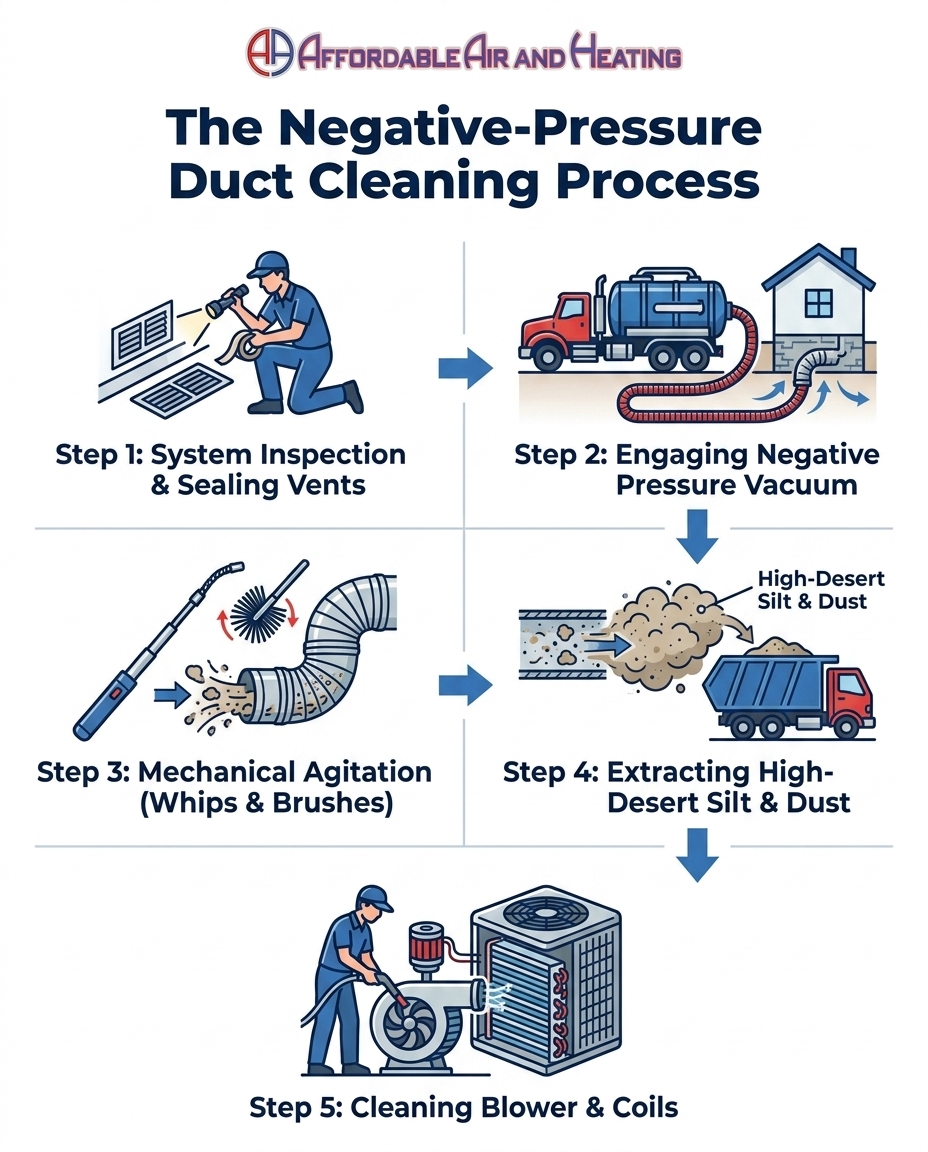
Step 1: Initial System Inspection and Home Protection
A legitimate duct cleaning service never begins by blindly shoving a hose into a vent. The preparatory phase is critical for ensuring the safety of the home and the effectiveness of the extraction. Evaluating a duct cleaning service's methodology to ensure they use proper negative-pressure equipment rather than ineffective shortcuts begins the moment the technicians walk through the door.
1. Comprehensive System Walkthrough: The process begins with a detailed assessment of the ductwork layout. Technicians map out the supply lines, return lines, and the main trunk connections. They determine the optimal access points for the negative pressure vacuum and assess the overall extent of the buildup.
2. EPA Guideline Evaluation: The EPA recommends duct cleaning specifically when ducts are clogged with excessive amounts of dust, debris, or biological growth. A visual inspection, often utilizing specialized duct cameras, confirms the necessity of the service and establishes a baseline for the "before and after" comparison.
3. Rigorous Home Protection: Professional technicians treat the home with respect. Before any heavy equipment is brought inside, they lay down protective drop cloths over flooring, place corner guards on walls to prevent hose scuffs, and wear protective shoe covers. The goal is to leave the home cleaner than when they arrived.
4. Component Inspection: The initial assessment extends beyond the metal tubes. Technicians inspect the entire air conditioning system, checking the condition of the evaporator coil, the blower motor, and the drain pan. If these central components are heavily soiled, cleaning the ducts alone will not solve the air quality issue.
Step 2: Sealing the Vents and Engaging the Vacuum
Once the home is protected and the system is mapped, the technicians begin setting up the negative-pressure environment. This specific setup stands in stark contrast to scammers who just use standard shop-vacs and never bother to control the system's airflow.
1. Creating the Vacuum Seal: To achieve true negative pressure, the system must be closed off. Technicians go room by room, blocking off all supply and return registers with specialized foam blocks or adhesive zone masks. This step is non-negotiable; if the vents are left open, the vacuum will simply pull ambient room air rather than pulling the targeted debris from the far ends of the ductwork.
2. Trunk Line Connection: The heart of the operation is the negative pressure collection unit, which is either a massive truck-mounted system or a heavy-duty portable HEPA unit. Technicians cut a precise access hole in the main supply and return trunk lines—the large metal plenums directly attached to the air handler. The heavy-duty vacuum hose is connected directly to this access point and sealed tight.
3. Engaging the Negative Pressure: When the massive vacuum unit is turned on, the change in the home's air dynamics is immediate. The unit pulls thousands of cubic feet of air per minute (CFM), creating a powerful one-way airflow throughout the entire duct network.
4. Verifying Containment: Before proceeding, technicians verify that the negative pressure is holding. They check the sealed registers to ensure the vacuum is actively pulling inward. This setup is exactly what prevents decades of accumulated debris from escaping into the bedrooms and living spaces during the agitation phase.
Step 3: Mechanical Agitation to Dislodge Stubborn Debris
Vacuum pressure alone is not enough to clean a duct system. If you have ever tried to vacuum a muddy floor without scrubbing it first, you understand the limitation. The continuous negative pressure acts as the transport mechanism, but mechanical agitation is required to actually free the stuck-on debris from the duct walls.
1. Introducing Specialized Agitation Tools: Technicians utilize a variety of specialized tools powered by high-pressure air compressors. The most common tools are pneumatic whips (often called "skipper balls") and rotary brushes. These tools are inserted into the ductwork through the registers or small access holes drilled into the main lines.
2. Breaking Loose the Caked-On Dirt: As the pneumatic whips travel down the duct, they thrash wildly against the interior walls. This aggressive mechanical whipping action shatters the hardened layers of dust, pet hair, and construction debris. Rotary brushes perform a similar function, scrubbing the walls of round flexible ducts without tearing the delicate inner lining.
3. Extracting Lancaster CA Desert Silt: In the high desert, specialized agitation tools are specifically required to dislodge ultra-fine silt that clings stubbornly to duct walls. This microscopic sand acts like sandpaper, embedding itself into the galvanized metal or flex-duct ridges. The aggressive whipping action is the only way to lift this heavy particulate into the airstream.
4. Continuous Extraction: Because the entire system is under extreme negative pressure, the moment the mechanical tools knock the debris loose, the vacuum instantly pulls it out of the duct and into the collection unit outside. Vacuuming alone, without this mechanical agitation, leaves the most harmful, dense debris behind.
Step 4: Cleaning the Main HVAC Components
A professional air duct cleaning is actually a complete HVAC system cleaning. The ductwork is simply the delivery system; the central air handler is the heart that pumps the air. Evaluating a duct cleaning service's methodology to ensure they use proper negative-pressure equipment also means verifying that they address the central machinery.
1. Blower Motor and Housing: The blower wheel is essentially a large fan that pushes air through the home. Over time, the cupped blades of the blower wheel pack tightly with dust. This added weight throws the wheel out of balance, straining the motor and reducing airflow. Technicians carefully remove the blower assembly, clean each individual blade, and vacuum the surrounding housing.
2. Evaporator Coil Restoration: The evaporator coil sits above the furnace and is responsible for cooling the air. Because it is constantly wet with condensation during the summer, it acts as a magnet for dust. A clogged coil restricts airflow, freezes up the system, and ruins energy efficiency. Technicians use specialized coil cleaners and fin combs to safely remove the insulating layer of dirt.
3. Preventing Immediate Re-contamination: Leaving these central components dirty will immediately re-contaminate clean ducts. If you spend hours sanitizing the metal tubes but leave a thick layer of dust on the blower wheel, the moment the heating equipment turns on, it will blow that dust right back into the pristine ductwork.
4. Final Visual Verification: Once the components and ducts are cleaned, technicians perform a final visual inspection. They ensure the drain pan is clear of sludge, the coils are breathing freely, and the main access panels are sealed shut with professional-grade sheet metal patches and mastic tape.
How to Spot a 'Blow-and-Go' Duct Cleaning Scam
Identifying whether an air duct cleaning service is performing a true system-wide sanitization or just doing a superficial shop-vac pass after heavy late-summer AC usage requires knowing exactly what to look for. Unscrupulous operators rely on the fact that most homeowners cannot see inside their own ductwork. By following a clear checklist, you can evaluate a technician's methodology and protect your home from illegitimate operators.
• Check their equipment upon arrival: If the technicians arrive with nothing more than a standard wet/dry shop vacuum on wheels, stop the job immediately. True negative pressure requires massive, heavy-duty collection units that are either truck-mounted or large portable HEPA machines that require two people to carry.
• Look for agitation tools: A vacuum hose alone will not clean a duct. Ensure the technicians are bringing in air compressors, pneumatic whips, and rotary brushes. If they do not have specialized tools to scrub the inside of the metal, they are only performing a superficial pass.
• Watch their prep work: Legitimate professionals will spend considerable time blocking off your supply and return vents before turning on the vacuum. If a technician simply removes a vent cover, shoves a hose in, and turns it on while all other vents in the house remain open, they are not utilizing negative pressure.
• Time the service: A proper, whole-home sanitization takes time. Suspiciously short service times—anything under an hour for a standard single-family home—strongly indicate a scam. Properly cleaning the blower motor, the coils, and every individual duct run is physically impossible in 45 minutes.
• Ask the right questions: Before work begins, ask the lead technician, "How do you establish negative pressure?" and "Will you be cleaning the evaporator coil and blower wheel as well?" Their answers will quickly reveal their level of expertise.
Frequently Asked Questions About Professional Air Duct Cleaning
What equipment do professionals use to clean air ducts?
Professionals use heavy-duty negative pressure vacuum collection systems, which are either truck-mounted or large portable units. To free the debris from the duct walls, they utilize mechanical agitation tools including pneumatic whips, skipper balls, and rotary brushes. High-powered air compressors are also required on-site to provide the continuous force needed to operate these specific agitation tools effectively.
How long does professional air duct cleaning take?
A proper professional cleaning typically takes 2 to 4 hours for an average single-family home. This timeline varies based on the total square footage of the home, the number of HVAC systems installed, and the extent of the contamination inside the ductwork. Homeowners should beware of services claiming they can finish the entire job in under an hour, as this indicates a superficial cleaning.
How messy is air duct cleaning?
A proper negative-pressure cleaning is completely contained and should not create a mess inside the home. Professional technicians take extensive precautions, using clean drop cloths, corner guards, and wearing protective booties to protect your flooring and furniture. Because the entire system is placed under a vacuum seal, all agitated dust is forcefully pulled outside or directly into a sealed HEPA unit, never into your living space.
How do you know if air duct cleaning was done right?
The best way to verify the work is through a visual inspection of the ductwork before and after the service, often facilitated by the technician's specialized cameras. You should also verify that the central air handler components, specifically the blower wheel and evaporator coils, were thoroughly cleaned. Finally, confirmation that negative pressure was maintained throughout the entire process ensures that no debris was left behind to recirculate.
Can professional duct cleaning damage my HVAC system?
When performed correctly by trained technicians using proper agitation tools, air duct cleaning is completely safe for your HVAC system. Damage typically only occurs when untrained individuals use improper equipment, aggressive scrapers, or harsh, unapproved chemicals inside the ductwork. Professional technicians know exactly how to handle delicate components, such as fiberglass-lined ducts, flexible plastic tubing, and fragile evaporator coil fins, without causing harm.
Ensure Your Home's Air Quality with the Right Methodology
Understanding the strict mechanics of the negative-pressure process is your best defense against ineffective, superficial cleaning services. By knowing exactly what equipment to look for and what questions to ask, you can confidently evaluate the methodology of any technician who enters your home. The difference between a clean vent cover and a truly sanitized respiratory system for your home comes down to the science of extraction.
Always take the time to verify the equipment and methodology before hiring a contractor. If you suspect your system is heavily loaded with ultra-fine desert dust following the long summer season, do not settle for shortcuts. Consult with a local expert who utilizes proper negative-pressure technology to ensure your home's air quality is thoroughly and safely restored.