What Causes That Musty Smell When Your AC Turns On


Why Does My AC Vents Smell Like a Locker Room?
Is your air conditioner blasting a wave of mildew-scented air every time the thermostat kicks on? If you are wondering exactly what causes that musty smell when your AC turns on, you are not alone. At Affordable Air and Heating, our team fields countless calls from homeowners noticing this pungent, damp odor rolling through their ductwork, especially during August as families prepare for the back-to-school transition and late-summer heavy cooling season. The industry term for this highly specific, unpleasant issue is "Dirty Sock Syndrome," and it indicates a biological problem hidden deep inside your system.
When an air conditioner runs constantly to combat late-summer heat, it generates a massive amount of internal condensation. This perpetual moisture creates the perfect environment for unwanted biological growth to take hold. Because the source of the odor is buried inside the unit's internal components, surface-level cleaning around your vents will not solve the problem. Addressing this requires more than a quick wipe-down; it means evaluating your complete air conditioning system and exploring targeted UV light air purification systems to neutralize the root cause.
The Hidden Mechanics Behind 'Dirty Sock Syndrome'
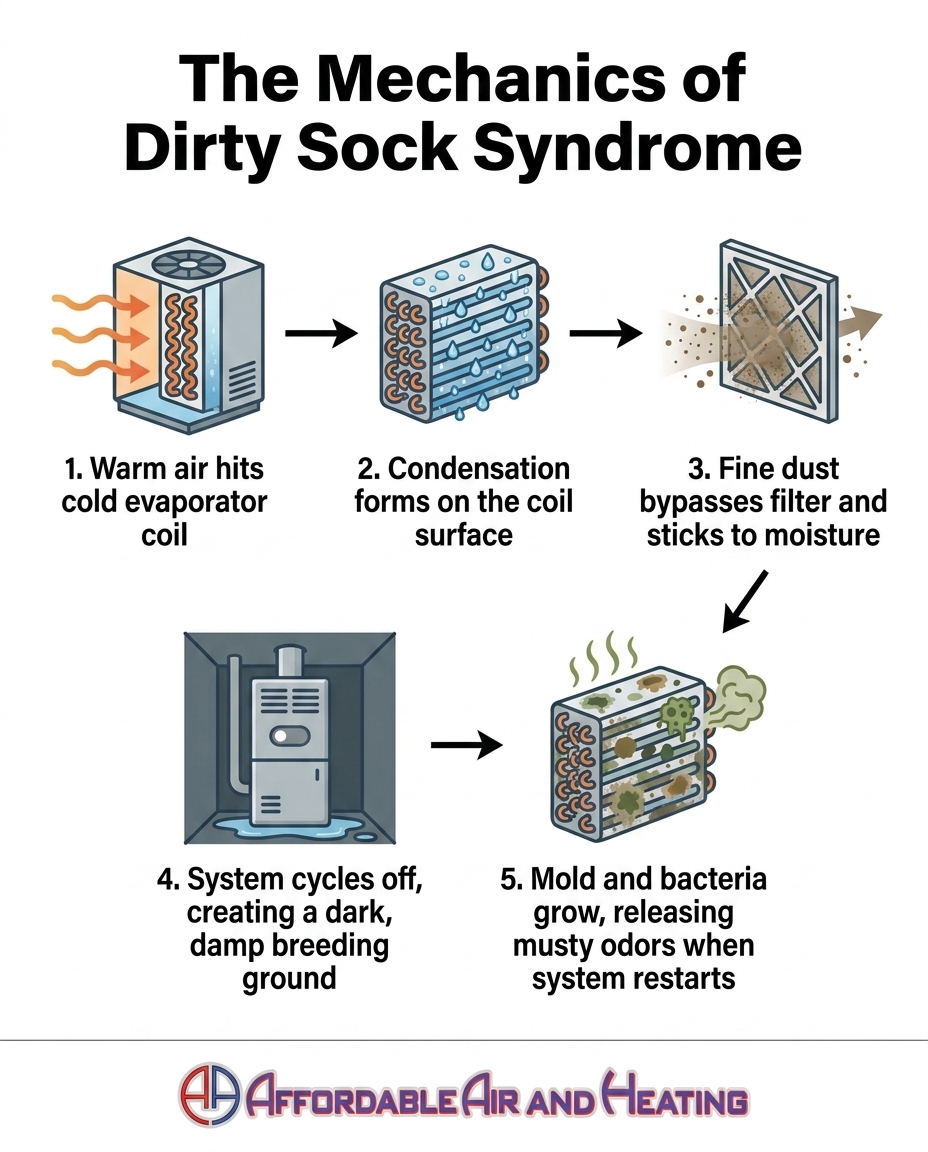
To understand why your house smells like a damp locker room, we have to look closely at how your air conditioner actually cools the air. Your AC does not just lower the temperature; it also dehumidifies your home. This process relies on a critical component called the evaporator coil, which sits inside your indoor air handler.
During the intense heat of August and end-of-season cooling, warm indoor air is constantly blown over this freezing-cold copper and aluminum coil. As the refrigerant inside the coil absorbs the heat, the humidity in the air condenses on the cold metal surface—exactly like water droplets forming on the outside of an ice-cold glass of water on a hot day. This means your evaporator coil spends almost the entire summer soaking wet.
How Condensation Becomes a Breeding Ground
The problem begins when the cooling cycle finishes and the system shuts off. The interior of your HVAC cabinet is pitch black, relatively warm, and extremely damp. This creates the ultimate breeding ground for microbial life.
• Microscopic dust infiltration: Even with a good filter, microscopic dust particles, skin cells, and pet dander eventually make their way into the ductwork and stick to the wet evaporator coil.
• The biological food source: This organic debris acts as a food source for mold, mildew, and bacteria.
• The odor release: As these microorganisms feed and multiply in the dark, they release volatile organic compounds (VOCs). When the blower motor kicks back on, those trapped VOCs are forcefully pushed into your living space, resulting in that sudden blast of musty air.
Understanding this mechanical process is the first step toward realizing that the smell is a symptom of a living biological problem inside your equipment, not just stale air.
How High Desert Conditions Accelerate Coil Contamination
In our years of serving homeowners in Lancaster and the Antelope Valley, the Affordable Air and Heating team has seen firsthand how our unique high desert climate acts as a powerful accelerant for coil contamination, often catching residents off guard.
First, the region experiences significant diurnal temperature variations—meaning the temperature can swing wildly from scorching daytime highs to surprisingly cool nights. These rapid temperature shifts force your air conditioner to cycle on and off frequently. Every time the system cycles off, the wet coil sits idle in the dark, giving bacteria and mold the undisturbed time they need to multiply.
Second, the high desert environment is notorious for producing exceptionally fine, alkaline airborne dust. Unlike the heavier soil found in coastal or humid regions, this powdery desert dust is easily picked up by the wind and drawn into homes. Because the particles are so microscopic, a large percentage of them bypass standard residential air filters. When this fine desert dust meets the heavy condensation on an active evaporator coil, it creates a thick, muddy sludge.
This sludge acts like a sponge, holding moisture against the delicate metal fins long after the system has turned off. For residents in Lancaster and the Antelope Valley, a musty-smelling AC is rarely a sign of homeowner neglect. It is simply the inevitable result of highly specific geographic and climate conditions forcing your HVAC system to process heavy dust loads alongside heavy condensation.
Why Changing Your Air Filter Won't Cure the Odor
When a bad smell starts coming from the vents, the standard first step for most homeowners is to check and replace the air filter. While keeping a clean filter is essential for system health, it is a common myth that a fresh filter will cure Dirty Sock Syndrome.
The Myth: A dirty filter is the source of the bad smell, and swapping it out will instantly purify the air.
The Reality: Standard 1-inch fiberglass filters are designed to protect the blower motor from large debris like pet hair, lint, and heavy dust. They are completely ineffective at stopping microscopic mold spores, bacteria, or the ultra-fine desert dust that feeds them. More importantly, the actual source of the odor—the biological growth—is located downstream from the filter, directly on the evaporator coil.
By the time you notice the musty smell during late-summer heavy cooling, the mold and bacteria have already established a colony on the coil. Putting a brand-new filter into the system is like putting a clean bandage over an infected wound; it does nothing to treat the underlying infection. The fresh air simply passes through the new filter, hits the contaminated coil, picks up the musty odor, and carries it into your living room.
Continuing to throw away clean filters week after week is a waste of money. Instead of chasing the symptom, homeowners should focus on improving air quality at home by addressing the root cause of the contamination deep inside the air handler.
The Unseen Impact of Biological Growth on System Efficiency
A locker-room smell is certainly a nuisance, but it is also a warning sign of a much deeper mechanical problem. The biological growth causing the odor is actively harming your air conditioner's performance and efficiency.
Airflow Restriction and Energy Waste
The evaporator coil is made up of hundreds of tightly packed, paper-thin aluminum fins. These fins need to be completely clear so air can pass through them easily. When a combination of desert dust, condensation, and microbial growth forms a layer of slime over these fins, it acts as an insulator. This insulation prevents the refrigerant from absorbing heat effectively.
Because the system can no longer cool the air efficiently, it is forced to run longer and harder to reach the temperature set on your thermostat. These extended cooling cycles lead to massive energy waste, driving up your utility bills precisely when you rely on your system the most during August and late-summer heavy cooling.
Furthermore, the restricted airflow increases the static pressure inside the ductwork, forcing the blower motor to strain against the blockage. Over time, this added stress can cause the motor to overheat and fail prematurely.
Beyond the mechanical wear and tear, there is the issue of what you are breathing. The EPA and ASHRAE (American Society of Heating, Refrigerating and Air-Conditioning Engineers) both highlight the negative impacts of biological contaminants in HVAC systems. When mold and bacteria thrive on the coil, their spores are continuously circulated through your home's ductwork. Exploring professional indoor air quality solutions is critical not just for stopping the smell, but for protecting your equipment and your indoor environment.
Permanent Fixes: Chemical Cleanings vs. UV Light Installations
Once you recognize that the musty smell is coming from biological growth on the evaporator coil, the next step is eliminating it. Homeowners generally have two professional options: a chemical coil cleaning or the installation of a UV-C light system. Understanding the difference between a temporary band-aid and a permanent cure is crucial.
• Professional Chemical Cleaning — How It Works: A technician applies foaming biocides to strip away existing mold, sludge, and bacteria from the coil fins. — Longevity of Results: Temporary. The coil is clean today, but moisture will return tomorrow, allowing growth to restart. — Best Application: Necessary as a first step to clear heavy existing buildup before applying a permanent solution.
• UV-C Light Installation — How It Works: A specialized ultraviolet light is mounted inside the cabinet, shining directly onto the evaporator coil 24/7. — Longevity of Results: Permanent. The UV light continuously disrupts the DNA of microbes, rendering them unable to reproduce. — Best Application: The definitive, long-term cure for homes suffering from chronic Dirty Sock Syndrome.
Chemical cleanings are a standard industry practice, but they are inherently reactive. You wait for the smell to return, pay for a cleaning, enjoy fresh air for a few months, and repeat the cycle when the late-summer heat brings the moisture back.
As local experts with deep expertise in comprehensive air quality, the team at Affordable Air and Heating focuses on installing UV light air purification systems directly over the coil as a permanent cure, rather than just selling recurring chemical cleanings. Ultraviolet germicidal irradiation (UVGI) is scientifically proven to inactivate microbial organisms. By bathing the dark, damp coil in UV-C light constantly, bacteria and mold are neutralized before they can ever form a colony. This proactive approach keeps the coil pristine, maintains system efficiency, and ensures the musty smell never returns to your vents.
What to Expect from a Professional AC Odor Diagnosis
Because the evaporator coil is housed deep inside the indoor air handler, diagnosing and treating Dirty Sock Syndrome requires specialized knowledge. We strongly advise against any DIY attempts to access the coil or apply store-bought chemicals. The aluminum fins are incredibly fragile and easily crushed, and using the wrong cleaning agents can corrode the metal, leading to catastrophic refrigerant leaks that void your manufacturer warranty.
Here is what you can expect when a trained Affordable Air and Heating expert arrives to diagnose your AC odor:
1. Safe System Access: The technician will safely power down the unit and carefully remove the access panels to expose the evaporator coil and internal cabinet.
2. Visual Coil Inspection: They will inspect the fins for signs of biological growth, dust impaction, and slime buildup that indicate Dirty Sock Syndrome.
3. Drainage Evaluation: The technician will check the condensate drain pan and line to ensure standing water isn't contributing to the damp environment.
4. Customized Treatment Plan: Based on the severity of the buildup, they will recommend a safe chemical cleaning to remove the existing colony, followed by the installation of a UV light system to prevent its return.
Professional intervention ensures the problem is solved quickly and safely. A technician can answer your questions, identify the source of the odor, and make sure the system runs great, keeping the house cool and smelling fresh during the most intense heat. Restoring clean air to your home is a straightforward, stress-free process when handled by an expert.
Frequently Asked Questions About Musty AC Smells
Why does my AC smell musty when it turns on?
A musty smell when your AC turns on is almost always caused by biological growth on the indoor evaporator coil. During the cooling process, this coil becomes covered in condensation. When the system cycles off, the dark, damp environment allows mold and bacteria to feed on microscopic dust, resulting in a locker-room odor that gets blown into your home.
How do you fix Dirty Sock Syndrome?
Fixing Dirty Sock Syndrome requires a two-step professional approach to address the root cause. First, a technician must perform a chemical cleaning of the evaporator coil to remove the existing mold and bacterial slime. Second, installing a UV-C germicidal light directly over the coil provides a permanent fix by continuously neutralizing new biological growth before it can take hold.
Is it safe to run the AC if it smells musty?
While running a musty AC won't immediately break the equipment, it is not recommended for long-term indoor air quality. The smell indicates that mold spores and volatile organic compounds (VOCs) are being actively circulated through your ductwork. Prolonged exposure to these biological contaminants can aggravate allergies and respiratory sensitivities, so it is best to have the system treated promptly.
Can a dirty air filter cause a musty smell?
A dirty air filter itself rarely causes a musty smell, but it can contribute to the conditions that create one. If a filter is clogged, airflow is restricted, which can cause excess moisture to linger inside the system. However, standard filters cannot trap the microscopic mold spores or fine dust that actually breed on the coil, which is why simply changing the filter won't eliminate the odor.
Do UV lights in HVAC eliminate odors?
Yes, UV lights are highly effective at eliminating HVAC odors caused by biological growth. By shining ultraviolet light directly onto the evaporator coil, the system disrupts the cellular DNA of mold, mildew, and bacteria. Without these microorganisms actively growing and releasing VOCs inside your air handler, the musty odors are permanently neutralized at the source.
How long does it take for mold to grow on an AC coil?
Under the right conditions, mold can begin growing on a damp AC coil in as little as 24 to 48 hours. During periods of heavy late-summer cooling, the coil remains constantly wet. If the system cycles off and sits idle in the warm, dark cabinet, airborne spores can quickly settle on the moisture and begin forming a colony almost immediately.
Restore Your Home's Fresh Air Today
Dealing with a sudden blast of mildew every time your thermostat kicks on is frustrating, but it is a highly solvable problem. You do not have to endure a locker-room odor through the back-to-school season, nor do you have to keep wasting money on standard air filters that fail to address the root cause.
If you are experiencing the telltale signs of Dirty Sock Syndrome, the most effective step you can take is to schedule a professional inspection with Affordable Air and Heating. By identifying the exact level of biological buildup and implementing targeted purification technology, you can eliminate the smell for good. Reach out to our experts today to discuss professional coil cleaning and UV light installation, and enjoy the peace of knowing your home's air is truly fresh, clean, and healthy.