What Is a Two-Stage Air Conditioner and How Does It Work? Here's the Short Answer
What is a two-stage air conditioner and how does it work is one of the most common questions homeowners ask when shopping for a new cooling system — and for good reason. If your home in the Antelope Valley is getting hit with triple-digit summer heat and you're tired of sky-high energy bills or rooms that never quite reach the right temperature, understanding your AC options matters a lot.
Here's a quick answer before we dive deeper:
A two-stage air conditioner uses a compressor that operates at two output levels instead of just one:
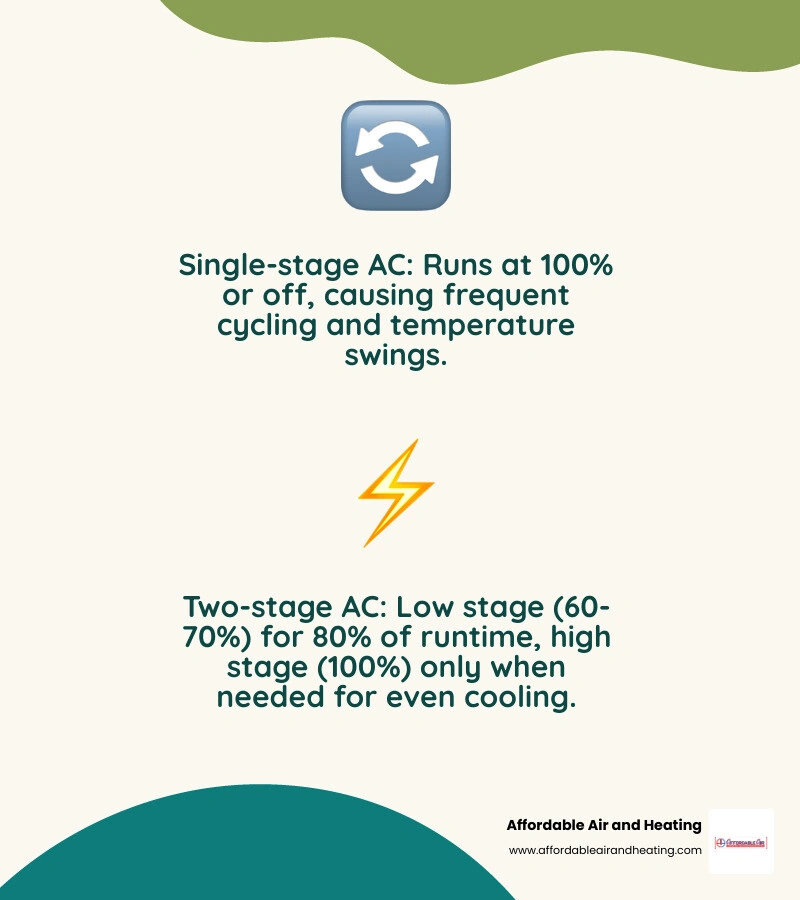
- Low stage — runs at roughly 60–70% capacity, used about 80% of the time
- High stage — runs at 100% capacity, used on the hottest days or when a large temperature drop is needed
The system starts on low, and if it can't keep up with the cooling demand, it automatically shifts to high. This means fewer on/off cycles, more even temperatures, better humidity control, and lower energy use compared to a traditional single-stage unit.
Unlike a single-stage air conditioner — which is essentially either blasting at full power or completely off — a two-stage system matches its output to what your home actually needs at any given moment. Think of it like a car with two gears: most of the time you cruise in the lower gear, and you only shift up when the road demands it.
What is a Two-Stage Air Conditioner and How Does It Work?
To understand how this technology transforms your home comfort, we need to look under the hood. In a traditional system, the compressor is the heart of the unit. In a single-stage model, that heart only has one beat: 100% power. It’s like a light switch—it’s either on or it’s off.
A two-stage system is more like a dimmer switch. It features a dual-capacity compressor that can adjust its output based on the specific cooling load of your home. When we talk about what is a two-stage air conditioner and how does it work, we are really talking about load-based switching.
During a typical May morning in Lancaster or Palmdale, your home doesn't need a massive blast of Arctic air to stay comfortable. A two-stage unit recognizes this and operates in its "low stage," usually at about 60% to 70% of its total capacity. This allows for a steady, gentle flow of Air Conditioning that keeps the temperature stable without the jarring "blast and stop" cycle of older units. When the afternoon sun starts beating down on the High Desert and the indoor temperature begins to rise, the system shifts into the "high stage" (100% capacity) to provide the muscle needed to beat back the heat.

Understanding the Mechanics: What is a Two-Stage Air Conditioner and How Does It Work?
The magic behind this technology often involves advanced components like the Copeland Scroll UltraTech compressor. In these systems, the compressor uses bypass ports to manage refrigerant flow. When the cooling demand is low, these ports open to "unload" the compressor, allowing it to pump only the amount of refrigerant needed for partial capacity.
When your thermostat signals that the temperature is drifting too far from your setpoint, the bypass ports close, and the system moves to full demand. This mechanical flexibility is what defines modern HVAC efficiency. Instead of the system working at maximum effort every time it turns on, it uses only the energy required to maintain the "sweet spot" of comfort.
Operational Efficiency and Stage Transitions
One of the biggest energy drains in any cooling system is the startup. Think of it like riding a bicycle: it takes a lot more effort to get the bike moving from a dead stop than it does to keep it coasting at a steady speed.
Because a two-stage unit runs for longer periods at a lower speed, it avoids the frequent on/off cycles that plague single-stage units. In fact, these systems spend about 80% of their runtime in the low-speed mode. This longer cooling cycle is actually a good thing! It means the air is being constantly filtered and dehumidified, and the system isn't constantly hitting your electrical grid with high-draw "start" signals. This smoother operation is a cornerstone of the Services we provide to homeowners looking to balance comfort with utility savings.
Two-Stage vs. Single-Stage and Variable-Speed Systems
When choosing a new system for your home in Santa Clarita or Santa Clarita, it helps to see how these technologies stack up side-by-side.
| Feature | Single-Stage | Two-Stage | Variable-Speed |
|---|---|---|---|
| Compressor Settings | 1 (On/Off) | 2 (Low/High) | Hundreds (Modulating) |
| Capacity Levels | 100% only | ~65% and 100% | 25% to 100% |
| Energy Efficiency | Up to 14-15 SEER | Up to 17-18 SEER | 20+ SEER |
| Humidity Control | Basic | Excellent | Superior |
| Temperature Swings | 2-4 degrees | ~1 degree | Within 0.5 degrees |
While a Heat Pump or AC unit with single-stage technology is often the most affordable upfront, it can lead to "hot spots" in the house and higher monthly bills. On the other end of the spectrum, variable-speed systems (sometimes found in high-end Mini Split units) are the "Cadillacs" of the industry, with up to 700 distinct compressor settings.
Comparing Performance Levels
Two-stage cooling is often considered the "perfect middle ground." It offers a significant jump in performance over fixed-speed units without the much higher price tag of fully modulating technology.
Single-stage units often feel like they are "trying too hard" to be cool—blowing freezing air for ten minutes and then shutting off until the room feels stuffy again. Two-stage systems eliminate those uncomfortable temperature swings. By staying in that 60-70% capacity range for the majority of the day, the system provides a consistent "coastal breeze" feel, even when the outdoor temperatures in Rosamond or Acton are anything but breezy.
Key Advantages of Two-Stage Cooling Technology
Why are so many of our neighbors in the Antelope Valley upgrading? The benefits go far beyond just "staying cool."
- Superior Humidity Control: Because the unit runs for longer cycles at a lower speed, the air spends more time passing over the cold evaporator coils. This allows the system to pull significantly more moisture out of the air. You’ll lose that "sticky" feeling, even during the humid monsoon transitions we sometimes see in the late summer.
- Energy Savings: By reducing the frequency of high-energy startups and running more efficiently at lower speeds, two-stage systems can reduce energy consumption by 15% to 35%. For a typical 2,000 sq ft home, this can translate into yearly savings of $500 to $1,000 on cooling costs.
- Quieter Operation: Most of the noise from an AC comes from the compressor and the fan running at full tilt. In the low stage, the system is remarkably quiet, making your backyard or patio much more enjoyable.
- Reduced Wear and Tear: Starting and stopping is hard on machinery. By running longer, steadier cycles, the system experiences less mechanical stress, often leading to a longer overall lifespan.
Maximizing Comfort: What is a Two-Stage Air Conditioner and How Does It Work in Antelope Valley?
In our unique desert climate, we deal with extreme temperature shifts. It’s not uncommon to see a 40-degree difference between a scorching afternoon in Palmdale and a cool evening.
A two-stage system is uniquely suited for this. During the 100°F+ peaks, the high stage keeps your family safe and cool. As the sun sets and the desert air cools down, the system doesn't just keep hammering away at full power. It downshifts, maintaining that perfect 72°F or 75°F setpoint with minimal effort. This results in much better indoor air quality and temperature stability, which you can read more about on our Blog. At Affordable Air and Heating, we’ve seen how this technology changes the way people feel about being home during the summer. Learn more About our commitment to local comfort.
Essential Components and Requirements for Two-Stage Systems
Upgrading to a two-stage system isn't just about swapping the outdoor "box." To get the full benefits, several components must work in harmony:
- The Thermostat: You cannot use a standard single-stage thermostat. You need a model specifically designed to communicate with a two-stage system. These thermostats monitor the "rate of change" in your home’s temperature. If the temperature isn't dropping fast enough—or if it's more than a few degrees away from the setpoint—the thermostat tells the AC to kick into the second stage.
- Variable-Speed Blower Motor: Inside your home, the furnace or air handler should ideally have a variable-speed motor. This allows the fan to slow down when the compressor is in the low stage, ensuring the airflow matches the cooling output.
- Properly Sized Ductwork: Because two-stage systems run longer, your ductwork must be sealed and sized correctly to ensure even distribution throughout every room in the house.
If you're unsure if your current setup is compatible, you can always Contact us for a professional evaluation.
Maintenance and Longevity for Advanced Systems
A well-maintained two-stage air conditioner typically lasts between 15 and 20 years. Because the system avoids the "heart attack" stress of constant full-power starts, it tends to reach the higher end of that lifespan.
However, these systems are more technologically advanced than their single-stage ancestors. Professional tune-ups are essential. During a maintenance visit, we check the refrigerant levels (which is critical for the stage transitions), inspect the electrical connections, and ensure the bypass mechanisms are functioning perfectly. Regular filter replacements remain the most important thing a homeowner can do to keep the airflow steady and the system happy.
Frequently Asked Questions about Two-Stage AC Units
How long do two-stage air conditioners typically last?
With proper maintenance, a two-stage unit usually lasts 15 to 20 years. The reduced stress from fewer on/off cycles helps the compressor and fan motor stay in better shape for a longer period compared to single-stage units.
What kind of thermostat is required for a two-stage system?
You will need a two-stage compatible thermostat. Some modern smart thermostats can handle this automatically, but it must have the specific wiring terminals (usually labeled Y1 and Y2) to control the different cooling levels. Some thermostats switch stages based on a timer (e.g., if the goal isn't met in 15 minutes), while others use the temperature differential.
Does a two-stage air conditioner run all the time?
It doesn't run all the time, but it does run for longer cycles than a single-stage unit. This is a feature, not a bug! Running longer at a lower, more efficient speed is what allows the system to provide better dehumidification and more even temperatures.
Conclusion
Understanding what is a two-stage air conditioner and how does it work is the first step toward a more comfortable, energy-efficient home. For those of us living in the Antelope Valley—from the windy plains of Mojave to the hills of Santa Clarita—having a cooling system that can adapt to our volatile weather is a game-changer.
At Affordable Air and Heating, we’ve been a family-owned staple in this community since 1996. We know the heat, and we know how to beat it without breaking the bank. Whether you are in Lancaster, Palmdale, or Stevenson Ranch, we are here to provide the expert, energy-efficient solutions your family deserves.
Ready to experience a more consistent level of comfort? Contact us for expert cooling solutions or Learn more about our Air Conditioning services today. We’ll help you decide if a two-stage system is the right investment for your home and your budget.