Why Your Furnace Smells Like Burning Dust on the First Chilly Morning


Is That Burning Smell Normal When You Turn on the Heat?
Are you wondering why your furnace smells like burning dust on the first chilly morning of the year? Every late September and early fall, our dispatch board at Affordable Air and Heating lights up with calls from homeowners who just switched their system from cooling to heating, only to have a harsh, smoky odor fill their living room within minutes. It is incredibly alarming. Your first instinct is likely to panic, wondering if something inside the walls is catching fire or if your heating equipment is melting down.
For professional help getting your home ready for the cold weather, learn more about our HVAC system services.
Here is the short answer our team gives out daily: in the vast majority of cases, this is a completely normal and harmless process. Your heating system has been sitting completely dormant for months. During that downtime, normal household particulate matter settles on the internal components. When the burners ignite for the very first time, that settled debris instantly vaporizes.
However, knowing that a brief odor is normal does not mean you should ignore every smell your vents produce. The goal of this guide is to share our on-the-job experience to help you confidently differentiate between a harmless seasonal burn-off and a dangerous mechanical or electrical failure. By understanding exactly what is happening inside your unit, you will know exactly when to let the system run its course and when to shut it down immediately to protect your home.
The Mechanics Behind the First Fall Furnace Burn-Off
To understand why your vents smell like a campfire, you have to look at what happens inside the equipment during the off-season. An unused heating system acts like a giant, stationary dust trap.
The Problem: Months of Inactivity
From late spring until early fall, your furnace's heat exchanger sits cold and idle in the dark. Even if you are running your air conditioner, the heating burners and the exterior of the heat exchanger are not actively engaged. Over these long months, airborne particles circulating through your home inevitably bypass the filter in small amounts and settle directly onto these cold metal surfaces. This includes pet dander, dead skin cells, lint, and general household dirt.
The Cause: Lancaster's High Desert Climate
The intensity of the smell is directly tied to the volume of dust in your home, and regional environmental factors play a massive role here. In our years of servicing HVAC systems across Lancaster and the High Desert, our team has seen firsthand how high summer winds and extremely dry conditions lead to heavy, fine particulate accumulation. This ultra-fine desert sand and dust easily infiltrates ductwork and settles on internal HVAC components. Because this specific type of dust is so prevalent in the region, the initial fall burn-off in our area is often significantly more pungent and noticeable compared to homes in milder, less windy climates. Upgrading your indoor air quality solutions can help reduce the amount of particulate matter that reaches your system in the first place.
The Solution: The Initial Ignition
When you finally switch the thermostat to "heat," the gas burners ignite. The flames shoot into the heat exchanger, a metal clam-shell component that separates the combustion process from your breathing air. This metal heats up to several hundred degrees in a matter of seconds. Any High Desert dust, lint, or dander resting on the outside of that metal is instantly incinerated. The blower fan then pushes air over this hot, freshly cleaned metal, picking up the smoky odor of the vaporized dust and distributing it out of every supply register in your house.
The Golden Rule: How Long Should the Burning Dust Smell Last?
While the initial odor is harmless, it should not last forever. At Affordable Air and Heating, our technicians have tested hundreds of local systems, and our transparency mandate means empowering homeowners with exact timeframes and clear diagnostic criteria so you can confidently distinguish between a normal event and a real hazard, rather than blindly telling you to call a professional for every little noise or smell.
The strict timeframe to watch is 30 to 60 minutes.
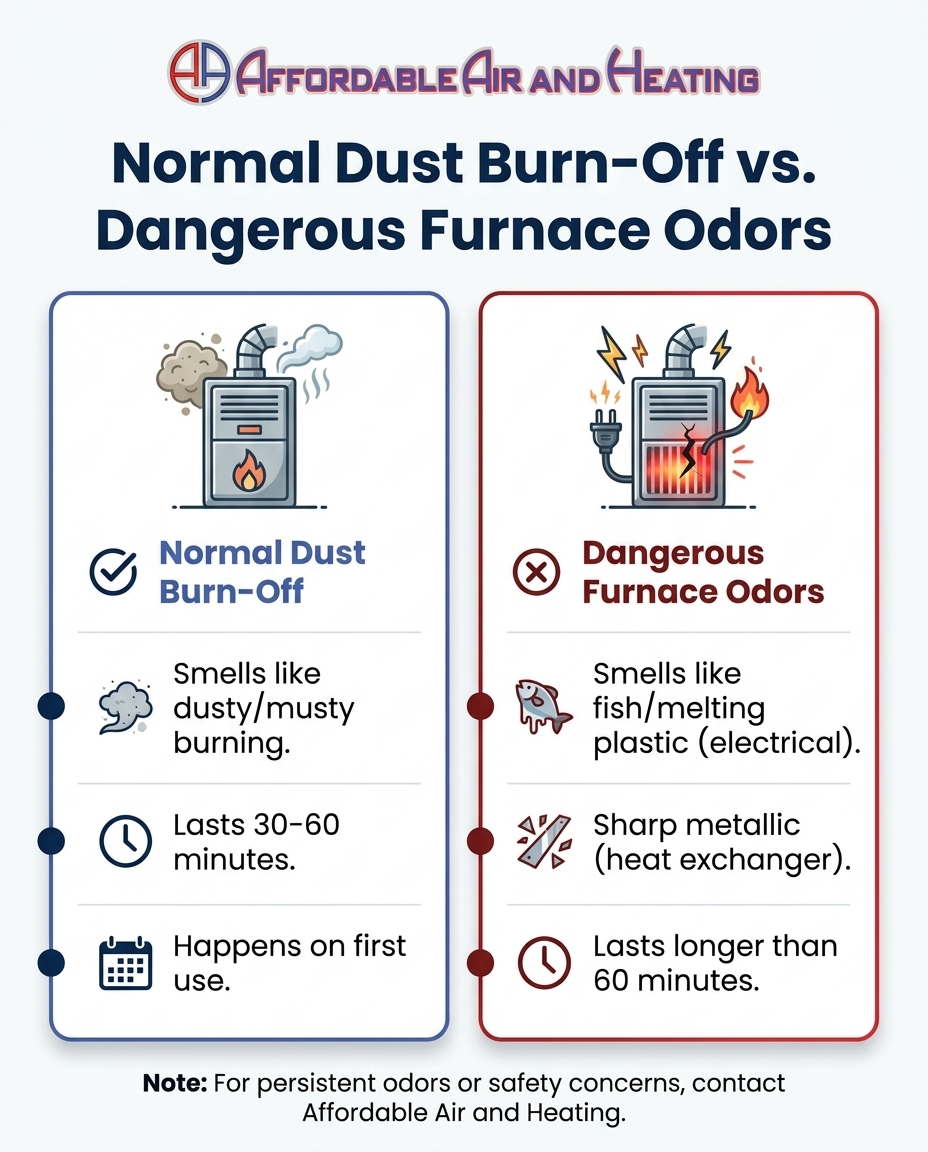
A normal dust burn-off lasts between 30 to 60 minutes (normal burn-off duration). During this window, the heat exchanger reaches its maximum operating temperature and completely bakes off the accumulated summer debris. The first 15 minutes will feature the strongest odor, as the bulk of the dust is vaporized. The remaining 15 to 45 minutes simply involve the blower fan flushing that residual smell out of your ductwork and living spaces.
If you turn on your heater and smell burning dust, we recommend letting the system run continuously for this hour. Do not turn the thermostat on and off repeatedly, as this prevents the heat exchanger from staying hot enough to finish the job. You can open a few windows or run ceiling fans to help ventilate the home while the process completes naturally.
The absolute rule: Any burning smell persisting beyond this strict 60-minute timeframe requires immediate action. Once the heat exchanger is clean, it stops producing odors. If the smell continues, it means something else is actively burning.
Warning Signs: When a Burning Odor Is Not Just Dust
Not all burning smells are created equal. While burning dust smells somewhat like a dusty radiator or a slightly scorched piece of lint, other odors indicate serious mechanical or electrical failures that jeopardize your safety.
If you notice any of the following odors, especially in late September / early fall when testing the system, shut the unit off immediately.
• Electrical / Melting Wires — Likely Cause: Failing blower motor, fried circuit board, or a bad relay switch overheating. Often smells fishy or like ozone. — Danger Level: Critical Fire Hazard — Required Action: Shut off at thermostat immediately. Call for professional repair.
• Burning Plastic / Rubber — Likely Cause: A foreign object (like a child's toy) dropped down a vent, or internal wire casing melting. — Danger Level: High — Required Action: Shut off system. Inspect visible floor registers. Do not open furnace cabinet.
• Sharp Metallic / Chemical — Likely Cause: A cracked heat exchanger leaking combustion gases, or overheating metal components. — Danger Level: Severe Health Risk (Carbon Monoxide) — Required Action: Shut off system. Open windows. Evacuate if CO alarms sound.
• Dusty / Musty Campfire — Likely Cause: Normal accumulation of household and desert dust burning off the heat exchanger. — Danger Level: Low (if under 60 minutes) — Required Action: Monitor for 30 to 60 minutes. Ventilate home.
It is vital to explicitly warn against unsafe DIY investigations. Never open the furnace cabinet to check for melted wiring or cracked metal yourself. These cabinets house high-voltage electrical connections and live gas lines. If you are ever dealing with strange system behaviors, such as vents blowing warm air after a power outage or persistent burning smells, leave the internal paneling to a licensed technician.
What to Do If the Smell Persists or Changes
If the odor coming from your vents exceeds the normal 30 to 60 minutes (normal burn-off duration), or if the smell suddenly shifts from dusty to electrical, you must take immediate action to protect your equipment and your home. Follow these structured steps:
1. Turn off the heating system at the thermostat immediately. Do not simply lower the target temperature. Switch the system mode entirely from "Heat" to "Off." This stops the flow of gas to the burners and cuts the primary power demand to the blower motor, halting whatever component is actively overheating.
2. Check your air filter. A severely clogged, dirty air filter is one of the most common culprits behind an electrical burning smell. When the filter is packed with heavy summer dust, the blower motor has to work twice as hard to pull air through it. This intense strain causes the motor to draw excessive electrical current, overheat, and begin melting its own wire insulation. If the filter is dark gray and caked with debris, replace it immediately.
3. Ventilate the living space safely. Open nearby windows and run ceiling fans to clear the harsh odors from your home. If you feel lightheaded or if your carbon monoxide detectors trigger, evacuate the house and call emergency services.
4. Schedule a professional diagnostic. Persistent smells require a trained eye to ensure the system is safe to operate for the rest of the season. A licensed technician from our team has the tools to test electrical amp draws, inspect the heat exchanger for microscopic cracks, and verify that no internal components are actively melting.
To ensure your system is thoroughly inspected and cleaned before the cold weather sets in, schedule professional heating maintenance.
Frequently Asked Questions About Fall Furnace Odors
How long is it normal for a furnace to smell like burning?
In our experience, it is completely normal for the smell to last for 30 to 60 minutes during the first heating cycle of the season. This window gives the internal heat exchanger enough time to reach its maximum temperature and fully incinerate any dust or lint that settled on it over the summer. Once that initial hour passes, the smell should completely dissipate and not return for the rest of the winter.
What does a bad furnace heat exchanger smell like?
A cracked or failing heat exchanger often produces a sharp, metallic, or chemical odor, distinct from the smell of burning household dust, and requires immediate shutdown. Because the heat exchanger separates toxic combustion gases from your breathing air, a crack can allow formaldehyde and other dangerous byproducts to mix into your ductwork. If you smell bitter chemicals or hot metal, turn the unit off and call a professional immediately.
When should I be worried about my heater smelling?
You should be concerned if the smell lasts longer than an hour, if it smells like melting plastic or electrical wiring, or if it triggers your carbon monoxide detectors. A normal dust burn-off has a very specific, temporary timeline. Any odor that persists, grows stronger, or smells like an electrical fire indicates a mechanical failure that needs urgent attention.
Why does my furnace smell like burning plastic?
This is usually caused by an object falling into the floor registers, or internal electrical components (like a failing blower motor) melting. Shut the system off immediately. Homes with small children or pets often experience plastic smells when toys or crayons are accidentally dropped down the supply vents and begin melting when the hot air hits them. Alternatively, failing wire casings inside the cabinet produce a very similar toxic plastic odor.
Should I open windows when I turn on the heater for the first time?
Yes, opening a few windows for ventilation during the first 30 to 60 minutes of operation is a great way to help clear out the harmless dust burn-off odor quickly. Running ceiling fans can also help push the smoky air out of the house. Just remember to close the windows once the hour is up so your heating system doesn't waste energy trying to warm the outdoors.
Can heavy desert dust cause my smoke alarms to trigger during the first heating cycle?
Yes. In Lancaster and the High Desert, the heavy accumulation of fine silica sand and particulate matter can create a burn-off intense enough to trigger sensitive smoke alarms. If this happens, do not disable your alarms. Simply open windows to ventilate the home, ensure the smell is strictly dusty (not electrical), and wait for the 30 to 60-minute window to pass.
Ensure a Safe, Warm Home This Heating Season
As the temperatures drop in late September and early fall, turning on your heating system shouldn't be a source of stress. Remember that a brief, 30 to 60-minute burning dust smell is a completely normal part of fall preparation. The heat exchanger simply needs to clear away the debris that settled during the long summer months.
Knowing the difference between harmless dust and a dangerous electrical hazard is the key to true peace of mind. If the odor clears up within an hour, you are ready for the chilly months ahead. However, if your system exhibits any warning signs, smells like melting plastic, or simply needs a professional cleaning after a long, dusty summer, do not hesitate to act. Schedule a comprehensive seasonal tune-up with our team to ensure your equipment runs safely, efficiently, and odor-free all winter long.