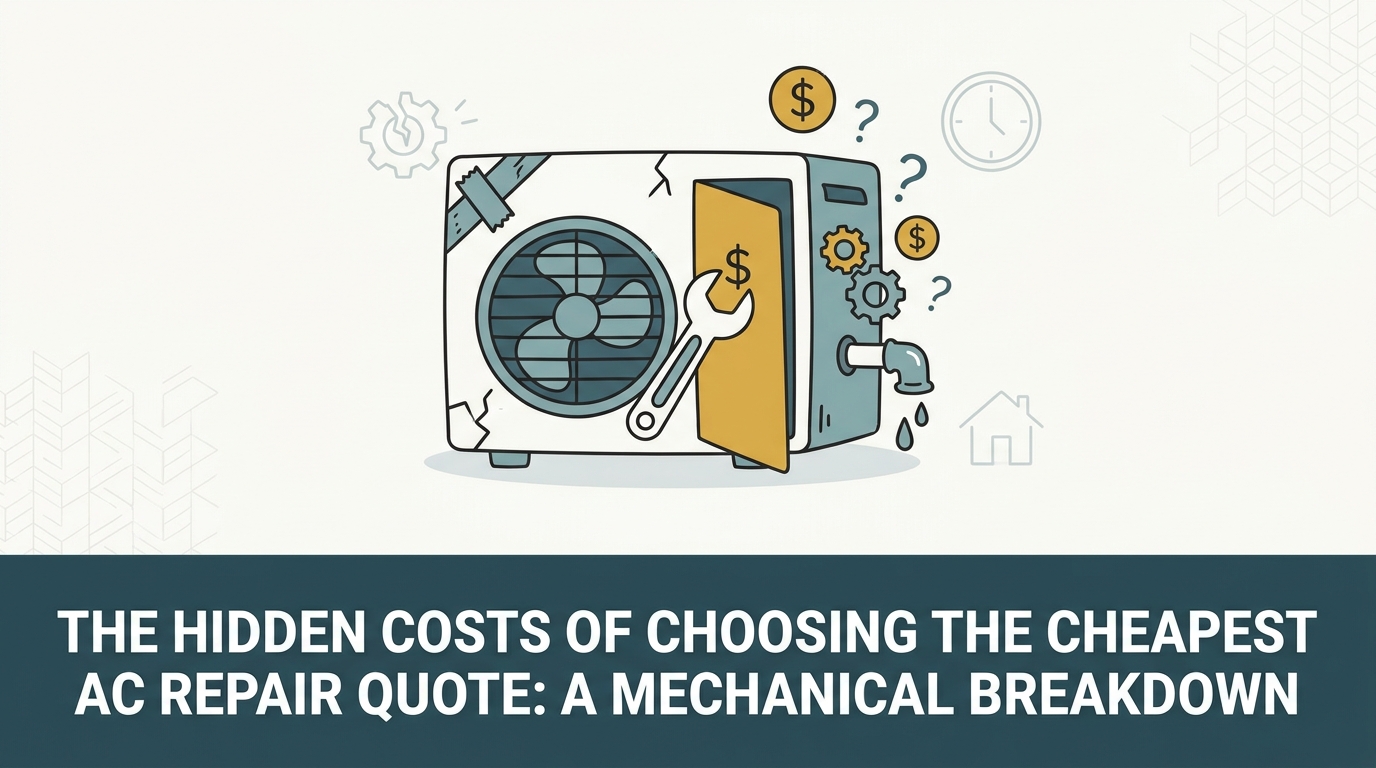
The Hidden Costs of Choosing the Cheapest AC Repair Quote: A Mechanical Breakdown


Myth: The Lowest Quote Always Saves You Money on Repairs
A common myth among homeowners is that you can avoid the hidden costs of choosing the cheapest AC repair quote simply by picking the lowest number on a piece of paper. The truth is, that unusually low price tag often hides a cut-rate fix that mechanically leads to a blown compressor just weeks later. Here at our business, our team frequently sees the fallout from this exact scenario during the peak mid-July heat. When you find yourself evaluating an abnormally low diagnostic or flat-rate repair fee against a standardly priced quote from a licensed professional, it is easy to assume the cheaper option is a great deal. However, an abnormally low diagnostic or flat-rate repair fee usually signals skipped steps rather than genuine savings. Treating a symptom without fixing the root cause guarantees a repeat failure. If you want to protect your system from these risks, exploring affordable air conditioning services from licensed professionals ensures the job is done right.
Many homeowners believe that air conditioning repair is a commodity—that every technician performs the exact same work, just at different price points. This fundamental misunderstanding is what makes cut-rate quotes so appealing. If the end result is cold air blowing from the vents, why pay more? The problem with this logic is that cooling a house temporarily is very different from restoring a system to its proper mechanical baseline. A standard residential AC compressor is a highly engineered, delicate piece of machinery that relies on precise electrical and chemical balances. When a technician offers an abnormally low diagnostic or flat-rate repair fee, they are virtually forced to skip the time-consuming measurements required to verify those balances.
The true cost of skipped steps: A cheap repair might get your system running for the weekend, but it often leaves the underlying mechanical stress completely unaddressed. Over the following days and weeks, that hidden stress compounds. The unit draws more electricity, internal components overheat, and eventually, a catastrophic failure occurs. What started as a seemingly harmless attempt to save money on a basic repair transforms into a massive replacement bill. Understanding the mechanical realities of these cut-rate fixes is the only way to evaluate quotes objectively and protect your property.
Affordable Air Conditioning vs. Cheap Labor
To make an informed decision about your HVAC system, you have to understand the fundamental difference between affordable air conditioning and cheap labor. While these terms sound similar, they represent entirely different approaches to mechanical service, diagnostics, and long-term value.
In our years servicing the local area, we have learned that affordable air conditioning is built on the concept of long-term value. Professional technicians focus on proper diagnostics, lasting solutions, and systemic health. When a licensed professional arrives at your home, they do not just look at the broken part; they evaluate the entire system to understand why that part failed in the first place. This comprehensive approach takes time, specialized tools, and extensive training. The goal is to ensure that once a repair is completed, the standard residential AC compressor and all supporting components operate strictly within their designed parameters. You pay a fair price upfront to avoid expensive secondary failures down the road.
Cheap labor, on the other hand, is entirely transactional. The primary goal is to get the unit running as quickly as possible, collect an abnormally low diagnostic or flat-rate repair fee, and move on to the next call. To offer such low prices, these operators must cut corners. This usually means skipping essential diagnostic steps, such as measuring superheat and subcooling (often aiming for precise targets like 10 to 15 degrees of subcooling), testing electrical draw in exact amps, or checking static pressure.
• Bait-and-switch pricing: Many cut-rate contractors use an abnormally low diagnostic or flat-rate repair fee simply to get their foot in the door, only to aggressively upsell unnecessary services once the unit is dismantled.
• Counterfeit or used parts: To maintain profit margins on cheap quotes, some technicians install generic, incorrectly sized, or even salvaged parts that do not meet manufacturer specifications.
• Lack of liability insurance: Cheap labor often operates without proper licensing or insurance. If a botched repair causes water damage or an electrical fire, you are left entirely responsible for the fallout.
When you choose cheap labor, you are not actually saving money; you are simply deferring the cost of the repair—and multiplying it. A professional focuses on the cure, while a cut-rate technician merely masks the symptoms.
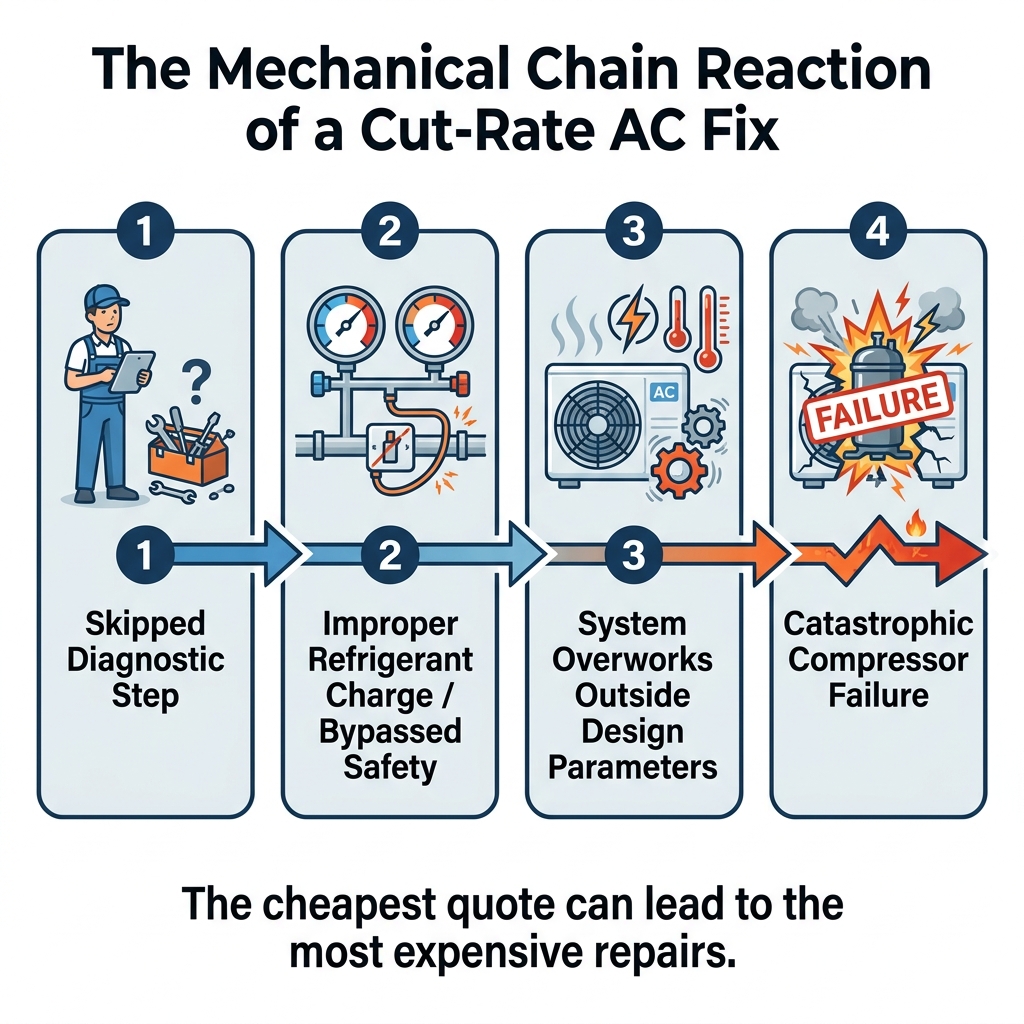
The Mechanical Chain Reaction of a Cut-Rate Fix
To truly understand why an abnormally low diagnostic or flat-rate repair fee is a red flag, you have to look at the objective, mechanical consequences of a rushed repair. One of the most common examples of a cut-rate fix is an improper refrigerant charge. Refrigerant is the lifeblood of your cooling system, and the standard residential AC compressor is its heart. The system operates in a closed loop, meaning the amount of refrigerant inside must be exact, often dialed in down to the ounce for modern 16 SEER and 18 SEER systems.
The problem of overcharging: When a technician rushes a job, they might add refrigerant without properly measuring the system's superheat and subcooling. If they add too much, the system becomes overcharged. A standard residential AC compressor is designed to pump vapor, not liquid. When a system is overcharged, liquid refrigerant can travel backward through the suction line and enter the compressor. When our technicians evaluate a failed compressor, liquid slugging is a pattern we see often. Because liquid cannot be compressed, the internal valves and scroll plates inside the compressor are subjected to immense hydraulic pressure, eventually shattering under the strain.
The problem of undercharging: Conversely, if a technician fails to find and repair a leak, the system will run undercharged. The compressor relies on the cool, returning refrigerant vapor to cool its internal motor windings. When the system is starved of refrigerant, the compressor runs continuously while simultaneously losing its primary cooling mechanism. The motor windings overheat, the internal insulation melts away, and the compressor eventually suffers a fatal electrical short to ground.
According to U.S. Department of Energy (DOE) guidelines, improper refrigerant charging is one of the leading causes of premature equipment failure. The DOE emphasizes that a system must be charged precisely to manufacturer specifications to maintain efficiency and longevity. A technician offering an abnormally low diagnostic or flat-rate repair fee simply cannot afford to spend the 45 to 60 minutes required to dial in a perfect charge.
When Diagnostics Are Skipped
The mechanical chain reaction almost always begins when diagnostics are skipped. Imagine a scenario where a system is freezing up. A professional will test airflow, check the blower motor, inspect the evaporator coil, and measure refrigerant pressures to find the exact cause. A cut-rate technician will simply guess the problem—often assuming it just needs a little refrigerant.
Treating this symptom without fixing the underlying cause guarantees a repeat failure. If the real issue was a failing blower motor, adding refrigerant to a standard R-410A system will drastically overcharge it. The unit might run for a few days, but the standard residential AC compressor is now fighting against incorrect pressures, poor airflow, and improper cooling. Within weeks, the mechanical stress reaches a breaking point, resulting in a total system failure that costs a significant amount to rectify.
How Bypassed Safeties Destroy Compressors
Another incredibly common shortcut taken by technicians offering an abnormally low diagnostic or flat-rate repair fee involves the system's electrical fail-safes. A standard residential AC compressor relies on a network of electrical safety switches and contactors to protect it from damaging conditions.
Understanding the contactor: The contactor is a heavy-duty mechanical relay located inside the outdoor condenser. When your thermostat calls for cooling, it sends a low-voltage signal to the contactor, which then pulls shut, allowing high-voltage electricity to flow to the compressor and condenser fan. Over time, the metal pads inside the contactor can become pitted, burned, or stuck due to electrical arcing. If a contactor begins to fail, the proper repair is to replace it entirely.
The cut-rate shortcut: A pattern we see often in the local area is a cheap technician who might not have the correct part on their truck, or who simply wants to finish the job quickly. Instead of replacing a failing contactor or a tripped pressure switch, they will physically bypass the safety mechanism. They might wire the system so that the compressor receives constant power, or they might jump out a high-pressure switch that is intentionally shutting the system down to prevent an explosion.
The mechanical reality of this shortcut is terrifying. Safety switches exist for a reason. A high-pressure switch, for example, cuts power to the compressor if the refrigerant pressure exceeds safe limits (often climbing past 400 PSI due to a dirty coil or a failing fan motor). If a technician bypasses this switch, the standard residential AC compressor will continue to run even as internal pressures climb to dangerous levels. The compressor will pump until the internal heat causes the oil to break down, the bearings to seize, and the motor to burn out completely. By removing the system's fail-safes, the cut-rate technician guarantees that the next minor issue will result in the total destruction of the equipment.
The Impact of Peak Heat on Compromised Equipment
The risks associated with cheap labor are magnified exponentially by the climate. With typical weather extremes in the local area pushing temperatures well into the upper registers during late August heat waves, your cooling system enters a period of maximum strain. During peak heat, a standard residential AC compressor is often required to run at a 100% duty cycle, meaning it operates continuously for hours on end just to maintain the temperature inside your home.
Our team knows firsthand that when a system is healthy and properly calibrated, it can handle this continuous operation. The refrigerant pressures remain stable, the compressor motor stays cool, and the electrical draw remains within safe limits. However, if the system has been subjected to a cut-rate fix, peak heat is exactly when the hidden mechanical flaws will expose themselves.
Consider a standard residential AC compressor that is slightly undercharged because a cut-rate technician failed to locate a small leak. In mild weather, the compressor might cycle on and off enough to prevent catastrophic overheating. But when local weather extremes hit, the compressor never gets a chance to rest. The lack of cool returning vapor causes the internal temperature of the compressor to skyrocket. The lubricating oil begins to vaporize, metal grinds against metal, and the unit fails.
The true cost of an abnormally low diagnostic or flat-rate repair fee is almost always realized on the hottest day of the year. When compromised equipment fails under maximum strain, you are left without air conditioning during a dangerous heat wave, and emergency replacement becomes your only option. The small amount of money saved on the initial repair is instantly wiped out by the massive cost of an emergency installation.
Evaluating Your Options: Avoiding The Hidden Costs of Choosing the Cheapest AC Repair Quote
To protect your home and your wallet, you must learn how to objectively evaluate quotes. When comparing an abnormally low diagnostic or flat-rate repair fee against a standard professional quote, our team recommends looking at exactly what you are getting for your money. The table below breaks down the stark differences between professional diagnostics and cut-rate quick fixes.
• Diagnostic Approach — Professional Diagnostics: Comprehensive testing of electrical, airflow, and refrigerant systems to find the root cause. — Cut-Rate Quick Fixes: Guesswork and symptom-treating to finish the job as quickly as possible.
• Parts Quality — Professional Diagnostics: Original Equipment Manufacturer (OEM) or high-quality, properly sized universal parts. — Cut-Rate Quick Fixes: Counterfeit, salvaged, or incorrectly sized parts that strain the system.
• Warranty & Liability — Professional Diagnostics: Backed by labor warranties and comprehensive liability insurance for your protection. — Cut-Rate Quick Fixes: Little to no warranty; homeowner assumes all risk for property damage.
• Industry Standards — Professional Diagnostics: Strict adherence to ACCA (Air Conditioning Contractors of America) and DOE guidelines. — Cut-Rate Quick Fixes: Bypassed safeties, improper charging, and ignored manufacturer specifications.
The value of doing it right: A slightly higher upfront cost for proper diagnostics prevents the total loss of the equipment. When a licensed professional takes the time to verify that your standard residential AC compressor is operating within its exact design parameters, they are actively extending the lifespan of your system. They ensure that safety switches are functional, refrigerant levels are precise, and electrical connections are secure. By rejecting the abnormally low diagnostic or flat-rate repair fee, you are investing in peace of mind and long-term mechanical reliability.
Frequently Asked Questions About AC Repair Estimates
What causes an AC compressor to fail?
An AC compressor usually fails due to underlying mechanical stress caused by poor maintenance or improper repairs. Common culprits include improper refrigerant charge, blocked airflow, power surges, and bypassed electrical safety switches. When a standard residential AC compressor is forced to operate outside its design parameters, internal components overheat, lose lubrication, or suffer fatal electrical shorts.
Is it cheaper to repair or replace an AC compressor?
If your standard residential AC compressor is no longer under warranty, replacement is often the more financially sound choice. The labor required to safely remove the old compressor, flush the lines, weld in a new unit, and recharge the system is extensive. In many cases, especially if you are upgrading from an outdated 10 SEER unit to a modern 16+ SEER system, putting that money toward a completely new, high-efficiency outdoor unit provides better long-term value and a fresh manufacturer warranty.
How do I know if my HVAC quote is fair?
A fair HVAC quote provides a detailed, written breakdown of the problem, the proposed solution, and the parts required. It should include proper diagnostics rather than just a guess based on a quick visual inspection. If a quote features an abnormally low diagnostic or flat-rate repair fee that seems too good to be true, it likely omits essential testing and relies on bait-and-switch tactics.
What happens if AC refrigerant is overcharged?
Overcharging a system with refrigerant forces liquid to flow backward into the compressor, a condition known as liquid slugging. Because a standard residential AC compressor is designed to compress vapor, attempting to compress liquid creates immense hydraulic pressure. This pressure will quickly shatter internal valves, destroy scroll plates, and ruin the compressor entirely.
Can a bad contactor ruin an AC compressor?
Yes, a failing contactor can absolutely destroy a compressor. If the metal contacts become pitted and weld themselves shut, the contactor will continuously send high voltage to the compressor, even when the thermostat tells the system to turn off. The standard residential AC compressor will run endlessly until it overheats and burns out.
Why do some contractors offer unusually low diagnostic fees?
Contractors often use an abnormally low diagnostic or flat-rate repair fee as a loss leader to get their foot in the door. Once inside, they rely on high-pressure sales tactics to upsell unnecessary services or push for premature system replacements. These low fees rarely cover the actual time and overhead required to perform a thorough, accurate mechanical diagnostic.
Secure Long-Term Reliability for Your Cooling System
Understanding the hidden costs of choosing the cheapest AC repair quote is the first step in protecting your home's most expensive appliance. A cut-rate fix that relies on bypassed safeties or an improper refrigerant charge will always lead to a mechanical chain reaction, ultimately destroying your standard residential AC compressor. Treating the symptom without addressing the root cause guarantees that the system will fail again, usually when you need it most.
At our business, we know that investing in professional, licensed diagnostics is the only way to ensure long-term value and true mechanical reliability. Quality workmanship means doing the job right the first time, verifying every electrical and chemical parameter, and preventing catastrophic secondary failures. Do not let an abnormally low diagnostic or flat-rate repair fee trick you into sacrificing your equipment. Book a reliable, comprehensive AC repair with a trusted local expert today to secure the lasting comfort your home deserves.