California Mini Split Permits: What Every Homeowner Needs to Know First
If you've been wondering do you need a permit to install a mini split in California, the short answer is: yes, in almost every case.
Here's a quick breakdown before we dive deeper:
| Situation | Permit Required? |
|---|---|
| New mini split installation (any size) | Yes |
| Replacement of existing unit | Yes, in most jurisdictions |
| New electrical circuit or panel work | Yes (separate electrical permit) |
| ADU mini split installation | Yes, plus possible Title 24/HERS testing |
| Minor repair (no refrigerant or wiring) | Generally no |
California treats mini split systems as permanent mechanical equipment under the California Mechanical Code. That means any installation involving refrigerant lines, electrical wiring, or structural wall penetrations triggers a permit requirement — no matter how small the system is.
For Antelope Valley homeowners dealing with scorching summers and cold desert winters, a mini split can be a game-changer for year-round comfort. But skipping the permit process can lead to serious problems down the road — from insurance denials to complications when selling your home.
This guide walks you through everything you need to know about California mini split permits, step by step.
Do you need a permit to install a mini split in California?

When homeowners in Santa Clarita or Palmdale decide to upgrade their comfort, the administrative side is often the last thing on their minds. However, the legal reality is clear: under the California Building Code, Mini Split Systems are classified as permanent mechanical fixtures. Because these systems require a dedicated electrical circuit, the handling of pressurized refrigerants, and the penetration of exterior walls, they fall squarely under the jurisdiction of local building departments.
In May 2026, California's standards remain some of the strictest in the nation. A permit isn't just a "suggestion"—it is a mandatory requirement designed to ensure that the equipment is sized correctly for your home, installed safely, and meets the state's rigorous energy efficiency goals. Whether you are adding a single-zone unit to a sunroom or a multi-zone system for your entire house, you will need to secure a mechanical permit. In many instances, a separate electrical permit is also required to ensure your home’s main service panel can safely handle the new load.
Do you need a permit to install a mini split in California for an ADU?
The rise of Accessory Dwelling Units (ADUs) in areas like Lancaster and Quartz Hill has made mini splits the go-to HVAC solution for these smaller living spaces. If you are building or converting an ADU, the permitting process is even more critical. State law requires all ADUs to meet Title 24 Energy Standards.
When providing Mini Split Services Santa Clarita, we often find that ADU projects require specialized documentation, such as HERS (Home Energy Rating System) testing. Even though mini splits are ductless, California code often mandates HERS verification for refrigerant charge and airflow to ensure the unit operates at peak efficiency. Furthermore, because ADUs often involve new structural walls, the permit ensures that the wall penetrations for the refrigerant lines are properly sealed and flashed to prevent moisture damage or pests from entering the new dwelling.
Do you need a permit to install a mini split in California for a replacement unit?
You might think that if you already have an old unit and are simply swapping it for a newer, more efficient model, you can skip the paperwork. However, even a "like-for-like" replacement usually requires a permit in California.
Local building departments in cities like Valencia want to verify that the new equipment complies with current efficiency standards (such as SEER2 ratings) and that the existing electrical system is still up to code for the new hardware. When we perform Mini Split Services Valencia, we ensure that the transition from old to new is fully documented. This is especially important if the new unit uses a different type of refrigerant, as line sets may need to be replaced or flushed to meet modern environmental regulations.
Why Permits are Mandatory for California HVAC Installations
At Affordable Air and Heating, we’ve been family-owned since 1996, and we’ve seen why these regulations exist. They aren't just about red tape; they are about protecting your family and your investment.
- Fire Prevention and Electrical Safety: Mini splits require high-voltage connections (typically 208/230V). An unpermitted installation might use the wrong wire gauge or bypass a necessary disconnect switch, creating a significant fire hazard.
- Refrigerant Handling: Under federal law (EPA Section 608), refrigerants must be handled by certified professionals. Permits ensure that the system is leak-tested, preventing harmful gases from escaping into the atmosphere or into your home.
- Structural Integrity: To install a mini split, we must drill a hole (usually 3 inches in diameter) through your home's exterior envelope. A permit ensures this is done without compromising structural studs and is sealed to prevent water intrusion.
- System Performance: Part of the permit process involves verifying that the unit is properly sized. An oversized unit will short-cycle and fail to dehumidify, while an undersized unit will run constantly, spiking your energy bills.
For reliable Mini Split Services Lancaster, having a professional handle the permitting ensures that all these safety benchmarks are met.
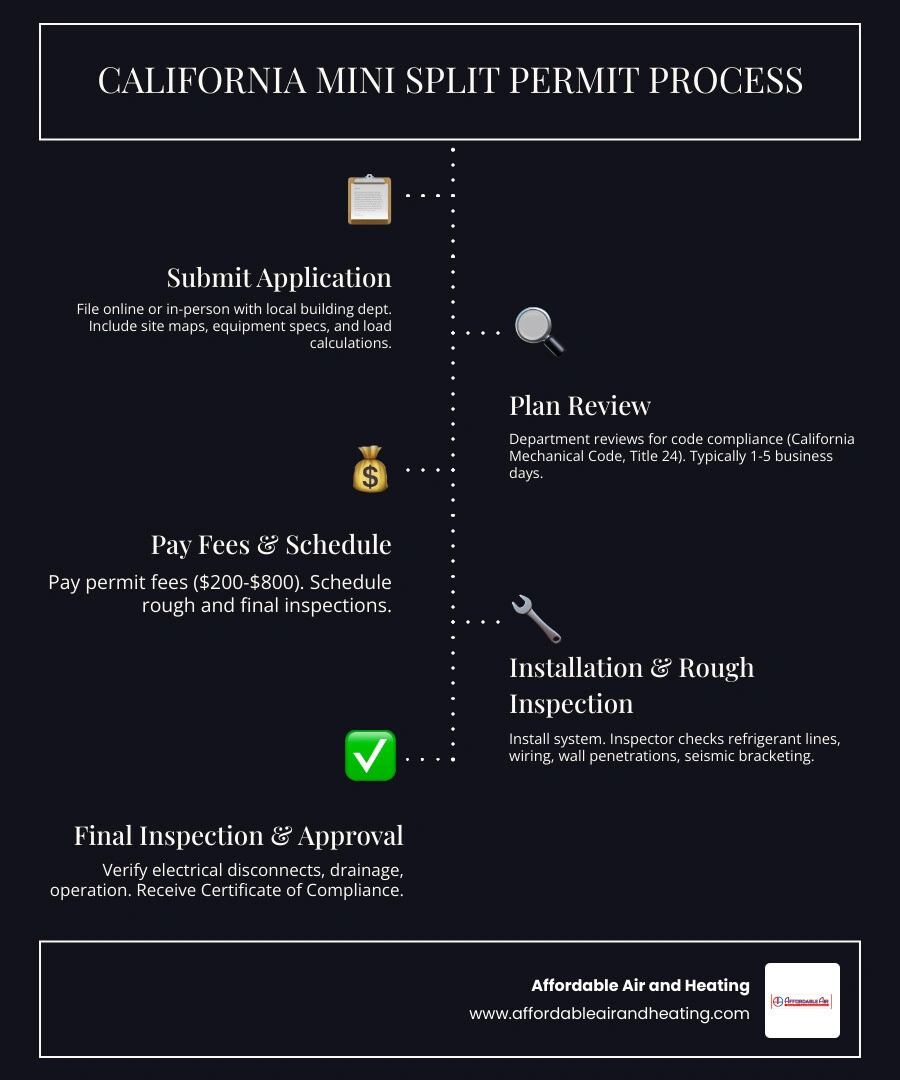
The Step-by-Step Permit Approval and Inspection Process
Navigating the bureaucracy of local government can be daunting, but the process generally follows a predictable path. In many Antelope Valley jurisdictions, this process has moved online, making it faster than it was a decade ago.
- Application Submission: We (or the homeowner) submit an application through the local building department’s portal. This includes the project scope and contractor information.
- Plan Review: For more complex multi-zone installs, the city may require a site map showing where the outdoor condenser will be placed in relation to property lines.
- Issuance: Once approved and fees are paid, the permit is issued. In some areas, "Express Permits" for simple HVAC work can be issued the same day.
- Installation: The work is performed according to the approved plans and manufacturer specifications.
- Inspection Scheduling: Once the unit is running, a final inspection is scheduled with a city official.
Our team providing Mini Split Services Palmdale handles the heavy lifting here, ensuring that the paperwork matches the high-quality physical work on-site.
Required Documentation and Plans for Application
To get that "Approved" stamp, the building department needs specific data. You can't just tell them you're "putting in an AC." They typically require:
- Manual J Load Calculations: This proves the unit is the right size for the room's square footage, insulation, and window orientation.
- Equipment Specifications: The make and model of the unit, such as Daikin Mini Splits, which provide the high efficiency levels California requires.
- Wiring Diagrams: A simple sketch showing the electrical run from the main panel to the outdoor disconnect and finally to the indoor air handler.
- Site Plan: A drawing showing the outdoor unit's location to ensure it meets "setback" requirements (distance from the property line).
What to Expect During the Final Inspection
The final inspection is the "moment of truth." The inspector will visit your home in Quartz Hill or Saugus to verify a few key items:
- Electrical Disconnect: There must be a weather-proof electrical shut-off box located within sight of the outdoor unit.
- Seismic Bracketing: Because we live in "earthquake country," the outdoor unit must be securely bolted to a concrete pad or wall bracket to prevent it from moving during a tremor.
- Condensate Drainage: The inspector will check that the water drained from the indoor unit is being piped to an appropriate location (like a garden or drain) and not just dumping into your home's crawlspace or onto a public walkway.
- Noise Levels: Some cities have strict decibel limits for outdoor equipment. The inspector ensures the unit isn't so loud that it violates local noise ordinances.
For homeowners in the high desert, our Mini Split Services Quartz Hill include a pre-inspection check to make sure everything is perfect before the city official arrives.
Risks and Consequences of Skipping the Permitting Process
It might be tempting to hire a "handyman" to install a unit "off the books" to save time. In California, this is a gamble that rarely pays off.
- Fines and Penalties: If the city discovers unpermitted work, they can level heavy fines—often double or triple the original permit fee. In extreme cases, they can force you to remove the equipment entirely.
- Insurance Denials: This is the big one. If an unpermitted HVAC unit causes an electrical fire or a water leak that damages your home, your insurance company has the legal right to deny your claim because the work was not performed to code.
- Escrow Complications: When you go to sell your home, the buyer’s home inspector or the title company will check for permits. If they find unpermitted HVAC work, it can stall the sale, force a price reduction, or require you to get "after-the-fact" permits, which is a much more expensive and stressful process.
- Voided Warranties: Most major manufacturers, including those for the Daikin Fit New systems, require proof of professional, permitted installation to honor their 10- or 12-year warranties. Without a permit, you're on the hook for all future repair costs.
Local Variations and Title 24 Energy Standards
While California has a state-wide building code, local jurisdictions often add their own "flavor" to the requirements. For example, Los Angeles may have different noise-level requirements than a more rural part of the Antelope Valley.
| Feature | Typical Requirement in CA |
|---|---|
| Efficiency | Minimum SEER2 ratings (often 15.2 or higher) |
| Placement | Usually 3+ feet from property lines |
| Testing | HERS duct leakage (if ducts are present) or refrigerant charge |
| Title 24 | Mandatory for all new construction and major retrofits |
In Climate Zone 9 (which covers much of our service area), energy standards are particularly strict because of the extreme heat. When we handle HVAC Installation Santa Clarita, we ensure every unit meets or exceeds these 2026 standards, helping you stay compliant while lowering your monthly utility bills.
Frequently Asked Questions about California Mini Split Permits
Who is responsible for obtaining the permit—homeowner or contractor?
Legally, either can pull the permit. However, we strongly recommend that your licensed HVAC contractor handles it. When a contractor pulls the permit, they are legally responsible for the work meeting code. If you pull it as an "owner-builder," you are assuming all the liability for any mistakes made during installation. At Affordable Air and Heating, we include permit management as part of our Services to give our customers total peace of much-needed peace of mind.
How long does it take to get a mini split permit approved?
In May 2026, many cities offer "Express Permits" or "Over-the-Counter" (OTC) permits for simple residential mini split installs. These can be approved in as little as 24 to 48 hours. However, if you are in a coastal area with stricter zoning or if your project is part of a larger remodel, it can take 2 to 4 weeks. Seasonal backlogs in the middle of summer can also add a few days to the wait time.
Can homeowners install a mini split themselves and pull their own permit?
While California allows for "owner-builder" permits, it is generally not recommended for mini splits. Handling refrigerant requires EPA certification, and the electrical work involved is complex. If you install it yourself and it fails the city inspection, you may have to pay a professional to come out and fix your mistakes anyway, often costing more than if you had hired a pro from the start. Furthermore, DIY installations almost always void the manufacturer's warranty.
Conclusion
So, do you need a permit to install a mini split in California? Absolutely. While it adds a few steps to the beginning of your project, it is the only way to ensure your system is safe, efficient, and legal.
At Affordable Air and Heating, we specialize in making this process as smooth as possible for our neighbors in Acton, Palmdale, Santa Clarita, and throughout the Antelope Valley. Since 1996, our family-owned business has focused on providing energy-efficient solutions and professional compliance at prices that make sense for your budget. We know the local codes inside and out, and we’re here to handle everything from the initial load calculation to the final city sign-off.
Don't leave your home's safety and value to chance. Contact us for expert help with your mini split installation today, and let's get your home ready for the California weather the right way!