Facing an Aging AC in the Late-Summer Heat?
Is your air conditioner actually failing, or is it just struggling to keep up with the August late-summer extreme heat? When faced with a system that can no longer handle the temperature, many homeowners find themselves asking: Is It Worth Upgrading to a High-SEER AC Unit? It is a critical question to answer before you commit to a major home improvement, especially when your current equipment is running nonstop but your house still feels uncomfortably warm.
Dealing with an aging or struggling AC unit during the most intense weeks of late summer is incredibly stressful. The days are long, the sun is relentless, and the last thing you want to worry about is whether your cooling system will make it through the afternoon. When an old unit finally reaches its breaking point, you are forced into a sudden decision. Do you stick with a standard, baseline replacement model, or do you invest in a high-efficiency system?
When it is time to stop repairing and start replacing, you need a team that provides professional HVAC services to guide your air conditioning upgrade and installation.
Making this choice requires looking beyond generic advice. Standard national averages simply do not apply to high desert cooling demands. The wear and tear your system experiences in our specific climate is unique, which means the way you calculate the value of high-efficiency technology needs to be unique, too. Before you make a choice, it helps to understand exactly how efficiency ratings work and why they matter so much more in extreme environments.
Beyond National Averages: Why SEER Matters More in the High Desert
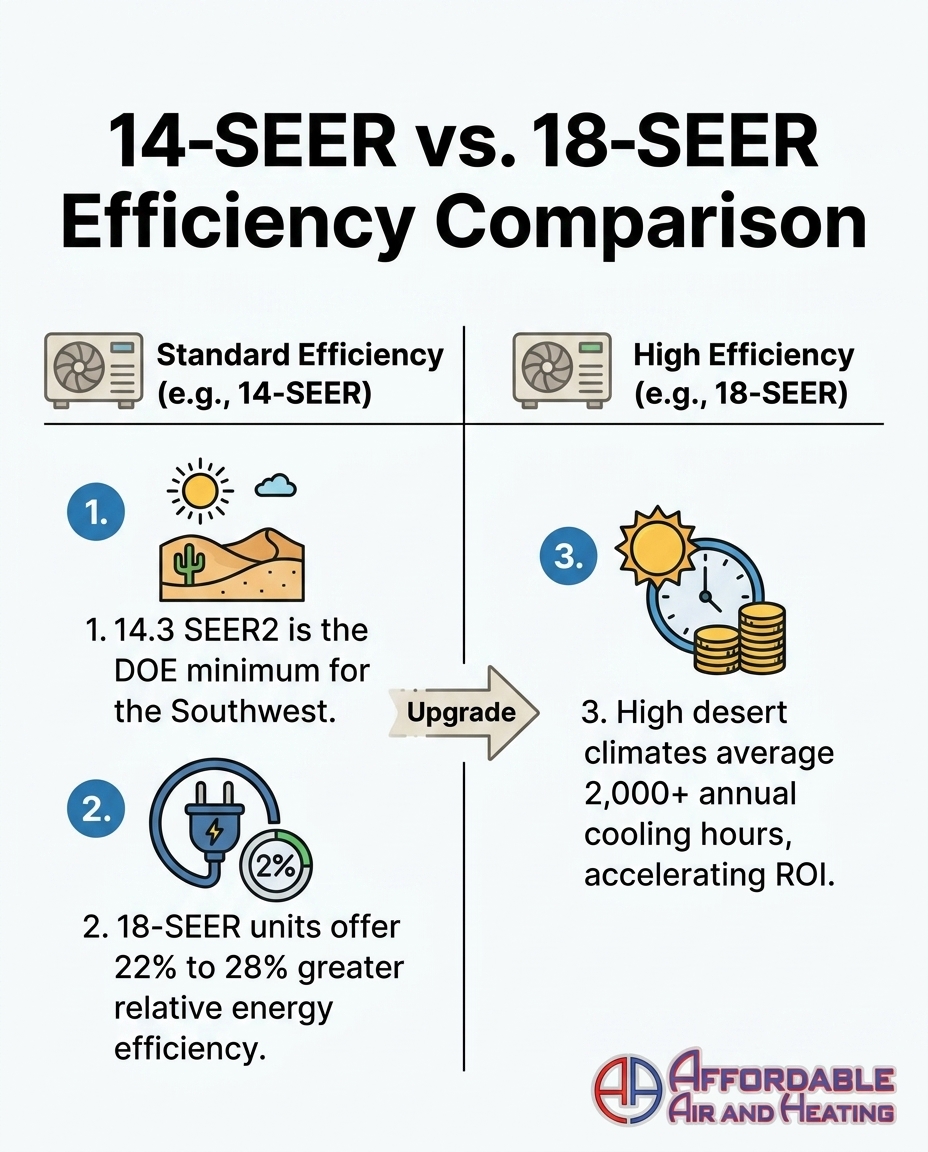
To make an informed decision, you first need to understand what efficiency ratings actually measure. SEER stands for Seasonal Energy Efficiency Ratio. You can think of it like miles per gallon (MPG) for your car. The higher the SEER rating, the less energy the air conditioner requires to produce the same amount of cooling. Currently, the Department of Energy (DOE) mandates a minimum rating of 14.3 SEER2 for all new residential AC installations in the Southwest region.
However, understanding the baseline is only half the battle. If you look up return-on-investment calculators online, most of them use national average cooling hours. These generic tools typically assume an air conditioner runs for about 1,000 hours a year. In a mild climate, that math works perfectly fine. But for residents in Lancaster CA and the Antelope Valley, those national averages drastically underrepresent our reality.
The High Desert Difference:
• Extended cooling seasons: Our heat does not just peak in July and vanish. It stretches long into the late summer and early fall.
• Extreme temperature spikes: Triple-digit heatwaves mean your cooling system works overtime, pushing components to their absolute limits.
• Double the runtime: Local AC units run significantly longer and harder, often accumulating well over 2,000 annual cooling hours.
Because your system runs twice as long as the national average, the energy you consume accumulates twice as fast. This is why standard efficiency advice is often obsolete here. When you are running your AC constantly, you are also accumulating energy savings at a much faster rate. For those focused on saving money on summertime cooling, a higher SEER rating becomes significantly more impactful locally than it would in a milder, coastal climate.
Head-to-Head Comparison: 14-SEER vs. 18-SEER Efficiency Ratings
When you sit down to compare your options, the most common debate comes down to the baseline minimum versus a premium upgrade. To help you visualize the difference, we can look at the 14-SEER vs 18-SEER relative efficiency percentages. Understanding these differences side-by-side makes it easier to see what you are actually getting for your investment.
• Relative Efficiency — Standard 14-SEER (Baseline): Meets minimum DOE standards — High-Efficiency 18-SEER (Premium): 22% to 28% more energy efficient
• Compressor Type — Standard 14-SEER (Baseline): Single-stage (All on or all off) — High-Efficiency 18-SEER (Premium): Variable-speed or two-stage
• Upfront Investment — Standard 14-SEER (Baseline): Lower initial percentage cost — High-Efficiency 18-SEER (Premium): Higher initial percentage cost
• Payback Speed — Standard 14-SEER (Baseline): Standard utility consumption — High-Efficiency 18-SEER (Premium): Accelerated payback in heavy-use climates
• Comfort Control — Standard 14-SEER (Baseline): Basic temperature management — High-Efficiency 18-SEER (Premium): Superior humidity and even cooling
Standard 14-SEER Baseline
The standard 14-SEER model represents the baseline for modern cooling. It meets all current regional regulatory requirements for the Southwest, ensuring that your new system is compliant and safe. The primary advantage of a 14-SEER unit is the lower upfront investment percentage. If your primary goal is simply getting cold air blowing again with the smallest initial commitment, this is the standard choice. However, these units typically rely on standard single-stage operation. This means the compressor runs at 100% capacity until the thermostat reaches your desired temperature, then shuts off completely.
High-Efficiency 18-SEER Performance
Stepping up to an 18-SEER model introduces you to a premium, high-efficiency alternative. The most significant benefit is the 22-28% reduction in relative energy usage compared to a base 14-SEER model. This reduction is achieved because high-efficiency units often include advanced compressor technology. Instead of running at full blast all the time, they adjust their output to match the exact cooling demand of your home. Because they use significantly less electricity to do the same amount of work, they offer an accelerated payback timeline, especially in heavy-use climates where the system runs for hours on end.
How Extreme Heatwaves Accelerate Your Return on Investment
When you look at the 22-28% efficiency advantage of an 18-SEER unit, it is important to connect that percentage to the concept of return on investment (ROI). The relative payback timeline is the amount of time it takes for your monthly energy savings to offset the higher upfront cost of the premium unit. In a mild climate where an AC only runs a few weeks out of the year, that payback timeline can stretch out for a decade or more, making the high-efficiency unit harder to justify.
But the high desert is a completely different story. Running an AC during prolonged triple-digit heatwaves maximizes that 22-28% efficiency advantage. Every single hour your system runs, it uses roughly a quarter less energy than a standard baseline model would. When you multiply that by 2,000 or more annual cooling hours, the consistent, heavy usage during peak summer months turns theoretical savings into tangible utility bill relief.
Why high usage speeds up payback:
• Volume of hours: More hours running equals more hours actively saving energy.
• Peak demand efficiency: High-SEER units maintain their efficiency better under extreme strain.
• Compounding savings: Month after month of heavy use stacks your percentage savings rapidly.
This reality is something local residents experience every year. One homeowner reached out for an AC installation during a stretch of incredibly hot summer days. They needed a system that could handle the intense climate. Following a professional installation, they noted that their house stayed very cold even during peak afternoon heat, and the equipment ran flawlessly under the heavy demand. What might take 10 years to pay off in a mild coastal city can pay off significantly faster in the desert because the system is simply doing so much more work.
Navigating Late-Summer AC Failures and Replacement Choices
August late-summer extreme heat is a peak time for catastrophic wear and tear on aging systems. After months of battling the high desert sun, older components that were barely hanging on in June finally give out. When a breakdown happens in the middle of a heatwave, the urgency to restore comfort is immense.
Rushing a replacement decision often leads homeowners to default to the lowest upfront cost—typically a standard 14-SEER unit. When your house is sweltering, it is completely natural to want the fastest, simplest solution available. However, panic-buying a less efficient unit locks you into higher energy consumption for the next ten to fifteen years. Even when an urgent replacement is needed, taking just a moment to evaluate your long-term efficiency options is a smart move.
Another local homeowner experienced this firsthand when their AC unit broke down entirely on a Thursday afternoon. Because they reached out quickly, a technician arrived within hours to assess the situation and provide clear replacement options. Rather than rushing blindly, they were able to choose the right system for their home, and the new unit was delivered and installed by the very next day. This highlights the importance of rapid, professional installation. You can restore your home's comfort quickly without having to sacrifice long-term value or settle for a less efficient system just because you were in a hurry.
Smart Ways to Offset the Cost of a High-Efficiency Upgrade
It is a fact that 18-SEER units require a higher initial investment percentage than standard models. Advanced technology naturally requires a greater commitment upfront. However, there are actionable financial pathways to make a high-efficiency unit accessible, allowing you to enjoy the benefits without straining your budget.
One of the biggest advantages of working with a transparent company is getting an honest financial breakdown. We believe in providing clear comparisons without blind upselling, ensuring you understand the true relative costs and savings of each option. By spreading the cost of the system over time, you can often structure your upgrade so that the monthly energy savings help offset the monthly investment.
Strategies to manage the upgrade cost:
• Explore financing plans: Utilizing flexible HVAC financing options allows you to break the total investment into manageable, predictable monthly increments.
• Look for utility incentives: Many local utility companies offer programs designed to encourage homeowners to install high-efficiency equipment.
• Check for energy rebates: High-efficiency systems frequently qualify for general energy efficiency rebates at the state or regional level.
• Investigate tax credits: Federal tax incentives are often available for qualifying high-SEER installations, which can lower your effective upfront cost when tax season arrives.
We always advise readers to check local utility programs and consult with a tax professional for current incentive availability. Combining these financial tools with the ongoing energy savings makes the leap from a 14-SEER to an 18-SEER much more attainable.
Comfort Beyond the Numbers: Variable-Speed Technology
While energy savings are usually the primary reason homeowners look into high-SEER units, the secondary benefits are just as impactful. An 18-SEER unit offers comfort beyond the numbers. These premium systems typically feature two-stage or variable-speed compressors, which fundamentally change the way your home is cooled.
Contrast this with the "all-on or all-off" nature of standard 14-SEER single-stage units. A single-stage unit turns on at 100% power, blasts cold air until the thermostat clicks off, and then shuts down completely. This creates noticeable temperature swings in the house—it gets a little too cold, then a little too warm, over and over again.
Variable-speed technology, on the other hand, operates more like the cruise control on your car. It can run at lower capacities—say, 40% or 60%—for longer, uninterrupted periods. This steady operation provides vastly better humidity control and maintains much more consistent indoor temperatures. Because the system isn't constantly turning on and off, it operates much more quietly. Upgrading to a high-efficiency unit offers a noticeable improvement in daily living comfort, not just utility efficiency. Plus, installing equipment with these advanced features often makes you eligible for available energy efficiency rebates that are not offered for standard single-stage models.
Make a Confident, Cost-Effective Cooling Choice
Deciding between a baseline and a premium cooling system comes down to your specific household needs. While a 14-SEER unit is perfectly adequate and meets all regional requirements, an 18-SEER unit offers an accelerated relative payback in high-demand climates like Lancaster CA and the Antelope Valley. The extreme heat here means your system works harder, which in turn means your percentage savings stack up much faster.
It is vital to look at the long-term percentage savings rather than just the initial sticker shock. A high-efficiency system provides superior comfort, better humidity control, and ongoing relief on your energy consumption for years to come. We encourage you to reach out for a transparent, no-pressure evaluation of your specific home cooling needs, so you can make a choice that keeps you comfortable and cost-effective for the long haul.
Frequently Asked Questions
Is it worth upgrading from a 14 SEER to an 18 SEER?
Yes, in heavy-use climates, upgrading to an 18 SEER is generally considered a highly worthwhile investment. Because the system runs for so many hours during the summer, the energy efficiency gains accumulate rapidly. Over the lifespan of the equipment, the reduction in energy consumption often outweighs the initial upgrade cost, while also providing superior indoor comfort.
How much more efficient is an 18 SEER AC compared to a standard model?
An 18-SEER air conditioning unit is approximately 22% to 28% more energy efficient than a baseline 14-SEER model. This means that for every hour the system is running, it requires significantly less electricity to produce the exact same amount of cooling. Over a long, hot summer, that percentage difference translates into substantial reductions in your overall household energy usage.
Does a higher SEER rating mean the AC cools the house faster?
A higher SEER rating does not necessarily mean the house cools down faster; rather, it means the house cools down more efficiently and evenly. High-SEER units often use variable-speed compressors that run longer at lower speeds, which is excellent for maintaining a consistent temperature. While a standard unit might blast cold air quickly and then shut off, a high-efficiency unit provides steady, uninterrupted comfort.
What is the minimum SEER rating required for new installations in California?
The Department of Energy mandates a minimum rating of 14.3 SEER2 for all new residential air conditioning installations in the Southwest region, which includes California. This updated standard ensures that all new equipment meets a baseline level of energy efficiency. Any standard unit you purchase today will meet this requirement, but many homeowners choose to exceed it for better long-term savings.
Do high-SEER AC units require special maintenance?
High-SEER units do not necessarily require "special" maintenance, but they do require consistent, professional upkeep to protect their advanced components. Because they feature variable-speed motors and sophisticated electronics, skipping annual tune-ups can degrade their efficiency over time. Regular filter changes and professional inspections are essential to ensure the system continues to operate at its peak percentage efficiency.
How long does it take to see a return on investment for an 18-SEER unit?
The relative payback timeline depends entirely on your local climate and how often you run the system. In mild climates, it can take many years to offset the upfront cost through energy savings. However, in extreme heat environments where the AC runs for 2,000 or more hours a year, the high volume of use accelerates the payback timeline significantly, allowing you to see a return much faster.