How Pets Impact Your HVAC System's Maintenance Needs


Why Does Pet Ownership Change Your HVAC Maintenance Rules?
Have you ever wondered how pets impact your HVAC system's maintenance needs, especially when your system seems to struggle more than usual as the seasons change? If you have dogs or cats, you might notice that the familiar 90-day filter replacement advice just isn't cutting it anymore. Shedding dog and indoor cat hair combines with ambient dust to rapidly clog return filters, forcing your equipment to work overtime. This creates a concrete problem for homeowners: figuring out the exact, accelerated maintenance schedule required to keep your system breathing freely. Standard advice simply does not apply when you add shedding pets to a dusty environment.
To protect your indoor air quality and prevent sudden breakdowns, you need a strategy tailored to your specific household.
In our experience serving the Lancaster high desert, our team at Affordable Air and Heating regularly sees how the local environment introduces significant dust into your home. The wind blows fine particulate matter through tiny cracks around windows and doors, settling onto your floors and furniture. When you introduce shedding pets into this environment, the situation escalates. Pet dander is naturally oily and sticky. As it floats through your home, it acts like a magnet for that dry desert dust, creating a dense, heavy compound that your air conditioner has to filter out.
The accelerated timeline: Most standard home maintenance guides assume you live in a mild climate with no pets. They suggest checking your equipment once a season. However, our technicians know that your reality involves a continuous cycle of shedding and dust accumulation. This means the rules of engagement change entirely. You can no longer rely on the calendar to tell you when to service your equipment; you have to rely on the physical reality of what your pets are pulling into your ductwork.
The Hidden Cost of Ignoring Pet Dander
When you delay addressing this compounding issue, the costs go far beyond a dusty living room. Your system is designed to push a specific volume of air. When that airflow is restricted, every single component inside the cabinet has to work harder. The longer you wait to establish a pet-specific maintenance routine, the more you risk catastrophic failure right when you need your cooling or heating the most.
What Happens When Pet Hair Enters Your Air Conditioning System?
Understanding the mechanical reality of how pet hair moves through your home is the first step in preventing damage. Your air conditioning system is essentially a giant vacuum. It pulls warm air from your rooms, cools it, and pushes it back out. Unfortunately, it pulls in everything else floating in that air, too.
The Journey of Pet Hair:
1. Shedding and settling: Your pet sheds hair and microscopic dander, which settles onto your carpets, hard floors, and upholstery.
2. Agitation: As you walk through the house, or as your pets play, this settled debris is kicked back up into the air.
3. The return cycle: The return vents of your HVAC system pull this airborne debris into the ductwork.
4. The filter barrier: The hair and dander travel through the ducts until they slam into your air filter, where they begin to accumulate.
According to the Environmental Protection Agency (EPA), indoor pollutant levels can be 2 to 5 times higher than outdoor levels, and homes with multiple pets sit at the very top of that scale. When standard 1-inch filters are bombarded with this debris, they quickly become overwhelmed.
The Compounding Effect of Dust and Dander
The real danger lies in how pet dander interacts with the environment. In the Lancaster high desert, ambient dust is exceptionally dry. Pet dander, on the other hand, contains natural skin oils. When the dry dust meets the oily dander inside your ductwork, they bind together.
This combination creates a dense, impenetrable mat on the surface of your air filter. Unlike loose dust, which might still allow some air to pass through, this sticky mat severely restricts airflow. Your system is now fighting a two-front war: trying to pull air through a physical barrier while simultaneously trying to cool your home. This forces the system to run longer cycles, consuming more electricity and accelerating wear and tear on moving parts.
Can Pet Dander and Hair Damage Your Blower Motor?
The short answer is yes. The blower motor is the heart of your air circulation system. Its sole job is to turn a large fan that pushes conditioned air through your ductwork and into your living spaces. When pet hair and dander create a wall at the filter, the blower motor takes the brunt of the punishment.
How restricted airflow causes motor failure:
• Increased static pressure: The motor has to spin faster and push harder to move the same volume of air through a clogged filter.
• Thermal overload: Blower motors actually rely on the air they are pushing to keep themselves cool. When airflow drops, the motor loses its cooling mechanism and begins to overheat.
• Electrical strain: As the motor struggles, it draws more electrical current, which can trip breakers or burn out internal wiring.
Our technicians at Affordable Air and Heating see the results of this strain frequently. In fact, a pattern we see often in Lancaster homes involves homeowners returning from a late summer vacation to find their AC unit completely broken down. When our team arrived at a recent call, we diagnosed a severe mechanical failure caused by a burned-out fan motor that had suffocated under months of pet hair and dust. We had to provide replacement options and install a new unit the very next day. While we got this customer's cooling back quickly, our primary goal is always to help you catch airflow restrictions early to prevent these expensive mechanical breakdowns in the first place.
The warning signs of a struggling motor: If you notice your vents are barely blowing air, or if you hear a high-pitched whining or loud humming noise coming from your indoor unit, your blower motor is likely suffocating. In homes with pets, this is almost always traced back to a severe accumulation of hair and dust.
Why the Standard 90-Day Filter Rule Fails Pet Owners
One of the most persistent myths in home maintenance is that every homeowner can wait three months between filter changes. This generic 90-day filter replacement advice simply does not apply to homes with pets, especially in dusty regions. If you follow this rule, you are actively putting your system at risk.
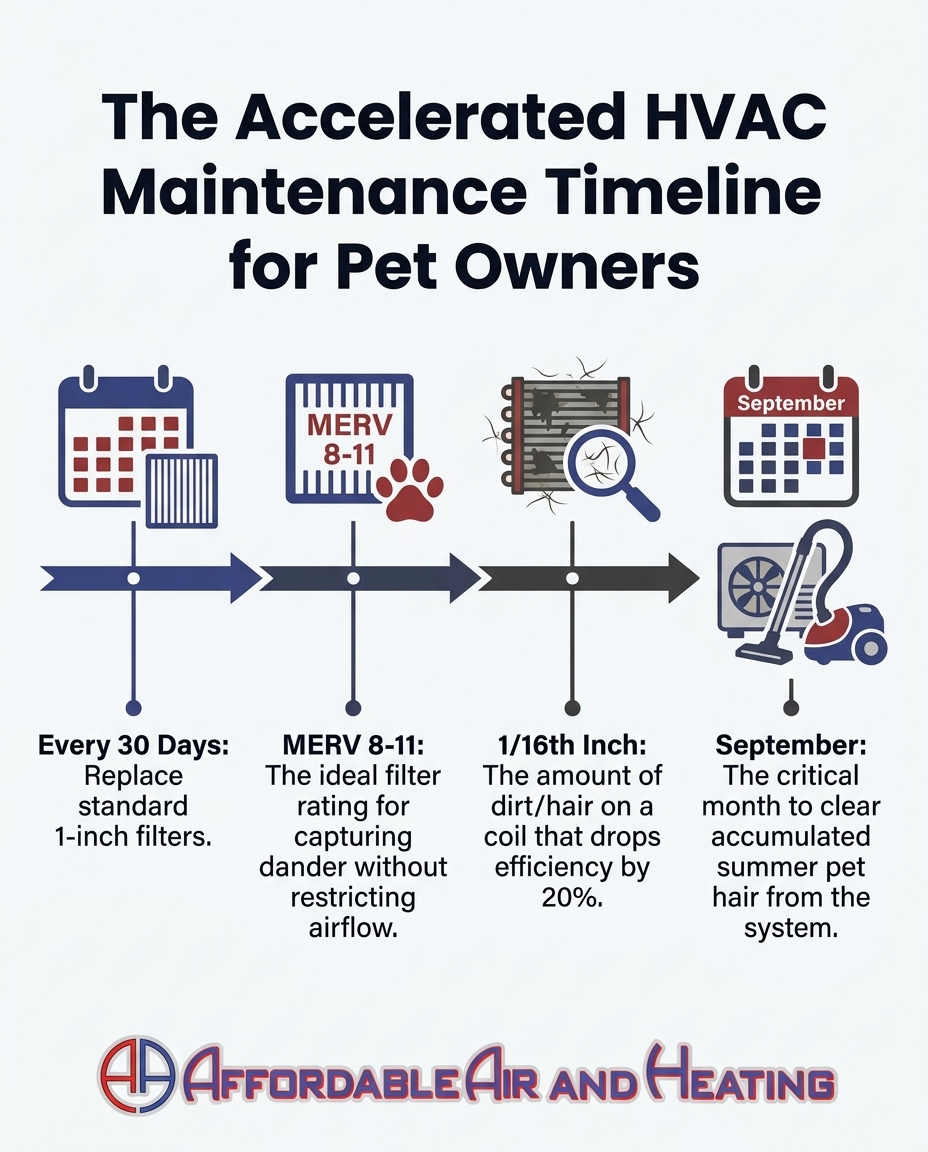
For homes with multiple shedding pets in the Lancaster high desert, we strongly recommend an accelerated 30-day schedule. Your filter is fighting a constant battle against both outdoor particulate matter and indoor dander. Waiting 90 days allows that dense, sticky mat to form, choking off your airflow completely.
• No pets, mild climate — Recommended Filter Change Frequency: Every 60 to 90 days — Primary Contaminants: Standard household dust, lint
• One pet, mild climate — Recommended Filter Change Frequency: Every 45 to 60 days — Primary Contaminants: Light dander, hair, dust
• Multiple pets, dusty climate — Recommended Filter Change Frequency: Every 30 days (Strict) — Primary Contaminants: Heavy dander, high-desert dust, shedding hair
While changing your filter monthly is the primary defense, you also need secondary strategies for dealing with pet dander in your home before it reaches the return vents. Frequent vacuuming with a HEPA filter and regular pet grooming drastically reduce the volume of hair your HVAC system has to process.
Choosing the Right MERV Rating for Pets
MERV (Minimum Efficiency Reporting Value) measures how effectively a filter traps microscopic particles. When you have pets, you need a filter that captures dander without choking the system.
The sweet spot: MERV 8 to 11 is generally recommended for pet owners. These filters are dense enough to trap pet dander, hair, and high-desert dust, but porous enough to allow proper airflow.
The danger of going too high: It is tempting to buy a MERV 14 or higher filter to trap every possible allergen. However, unless your system was specifically designed for high-efficiency filtration, these dense filters act just like a clog. They restrict airflow so severely that they can cause the exact same blower motor and coil issues as a dirty filter.
How Does Pet Hair Cause Evaporator Coils to Freeze?
The evaporator coil is the part of your indoor unit responsible for actually cooling the air. It is filled with extremely cold liquid refrigerant. As warm air from your home blows over the coil, the refrigerant absorbs the heat and humidity, cooling the air before it is pushed back into your rooms.
Because the coil is constantly dealing with condensation (humidity pulled from the air), it is naturally damp. If your air filter is clogged—or if pet hair bypasses a cheap filter—that hair gets sucked directly onto the damp evaporator coil. It sticks instantly.
The Department of Energy (DOE) notes that just 1/16th of an inch of dirt and hair on an evaporator coil can reduce system efficiency by up to 20%. But the real danger is freezing.
The freezing process explained:
1. Pet hair blankets the evaporator coil, acting as an insulating barrier.
2. Warm air from your home can no longer reach the cold metal of the coil.
3. Because the refrigerant isn't absorbing heat, it stays far too cold.
4. The natural condensation on the outside of the coil rapidly drops below freezing.
5. A solid block of ice forms over the coil, completely stopping all airflow.
When this happens, liquid refrigerant can flow backward into the outdoor compressor, destroying the most expensive component of your entire system. This is why investing in whole-home air purification systems can be a game-changer for pet owners, as they trap these particles long before they reach the vulnerable coil.
The Warning Signs of a Frozen Coil
If you suspect pet hair has compromised your coil, look for these immediate warning signs:
• Warm air blowing from vents: The system is running, but no heat is being removed from the air.
• Visible ice: You may see ice forming on the indoor unit or on the copper refrigerant lines outside.
• Unusual hissing or bubbling noises: This indicates the refrigerant is struggling to flow properly through the frozen system.
Why Is the September Fall-Prep Crucial for Pet Owners?
Timing your maintenance is just as important as the maintenance itself. September marks a critical transition period. The heavy summer cooling season is winding down, and the winter heating season is just around the corner. During this September fall-prep window, your evaporator coils and blower motors are sitting at their absolute peak load of accumulated summer pet hair and dust.
If you switch your system over to heat without clearing out this debris, you risk burning that accumulated dust onto your heat exchanger, creating terrible odors and posing a fire risk. A pre-heating season tune-up is essential to reset your system.
As Lancaster's local experts, our team at Affordable Air and Heating is committed to thorough, transparent maintenance that goes beyond a quick glance. Based on our years of preparing high-desert homes for the winter, our technicians specifically check for pet-related airflow restrictions to prevent expensive mechanical breakdowns.
What a pet-focused seasonal inspection includes:
• Coil inspection: Checking the deep fins of the evaporator coil for embedded dog or cat hair.
• Blower motor testing: Measuring the electrical draw of the motor to ensure it isn't overworking due to hidden blockages.
• Ductwork assessment: Looking for heavy dust and dander buildup just behind the return vents.
• Filter calibration: Ensuring your current filter MERV rating is appropriate for your specific equipment's airflow capacity.
By scheduling HVAC maintenance services in September, you clear out the summer's mess and ensure your system is clean, safe, and ready to handle the winter workload.
Frequently Asked Questions About HVAC Maintenance for Pet Owners
How often should I change my AC filter with pets in a dusty climate?
You should change your standard 1-inch AC filter every 30 days if you have pets in a dusty climate. The combination of shedding hair and high-desert dust creates a sticky mat that restricts airflow much faster than in standard environments. Sticking to a strict monthly schedule is the best way to protect your blower motor.
Can pet hair damage an evaporator coil?
Yes, pet hair can severely damage an evaporator coil by causing it to freeze. When hair bypasses the filter and sticks to the damp coil, it acts as an insulator, preventing warm air from reaching the refrigerant. This causes condensation to freeze into a block of ice, which can ultimately destroy your outdoor compressor.
Why is my HVAC filter getting dirty so fast?
Your HVAC filter is getting dirty quickly because pet dander and natural skin oils act as a magnet for dry ambient dust. When these two elements meet in your ductwork, they bind together to create a heavy, dense layer of debris. If you live in a region with high winds, this process accelerates rapidly.
Does having pets make your house dustier?
Having pets significantly increases the amount of dust and particulate matter in your home. Pets not only shed hair and dander, but they also track in outdoor dirt, pollen, and debris on their paws and coats. The EPA notes that indoor pollutant levels are heavily influenced by the presence of indoor animals.
What is the best MERV rating for homes with shedding dogs?
The best MERV rating for homes with shedding dogs is typically between MERV 8 and MERV 11. This range provides a perfect balance, trapping fine dander and hair without severely restricting the airflow your system needs to function. Ratings of MERV 14 or higher can actually suffocate older systems if not properly retrofitted.
How does professional maintenance differ for homes with multiple pets?
Professional maintenance for homes with multiple pets focuses heavily on clearing hidden airflow restrictions. Technicians spend extra time inspecting the deep fins of the evaporator coil for embedded hair and testing the blower motor for signs of thermal overload caused by chronic filter clogs.
Protect Your System from Pet Hair and Dust This Season
Managing how pets impact your HVAC system's maintenance needs ultimately comes down to an accelerated filter schedule and professional oversight. You cannot rely on generic advice when your equipment is battling a constant influx of high-desert dust and shedding hair. Clearing out the heavy summer buildup now is the most effective way to prevent catastrophic winter breakdowns.
If you want a definitive answer on the health of your system and peace of mind before the seasons change, don't wait for your blower motor to fail. Schedule a thorough maintenance check with Affordable Air and Heating today to ensure your equipment is clean, efficient, and ready to keep your family—and your pets—comfortable all year long.