How Long Should a Furnace Cycle Last During a 40-Degree Night?


Is Your Furnace Cycling Normally on Chilly Fall Nights?
Are you lying awake listening to your heating system turn on and off, wondering if it is running too much or too little? Understanding exactly how long should a furnace cycle last during a 40-degree night is one of the most common questions we hear from homeowners as the weather shifts. When late fall and November temperatures finally drop, your heating system suddenly has to work much harder to keep your indoor environment comfortable. That sudden change in operation often leaves you guessing whether the system is functioning perfectly or struggling to keep up.
If you need reliable HVAC services, getting a professional baseline is the best place to start. A typical pattern we see is that homeowners notice a change in the sound and frequency of their heating cycles during the first real cold snap. Hearing the blower motor kick on, run for a while, and shut down repeatedly can cause understandable anxiety. You want to know if that current cycle length is a completely normal response to the cold or an early warning sign of inefficiency that needs attention.
Before peak winter weather arrives, it helps to understand the basic mechanics of how your heating equipment operates. Knowing the difference between a healthy heating cycle and a problematic one allows you to make informed decisions about your home. We will break down exactly what to expect from your system, what signs point to trouble, and how to evaluate your equipment's performance so you can sleep comfortably through the cold.
The Baseline: Normal Furnace Cycle Duration at 40 Degrees
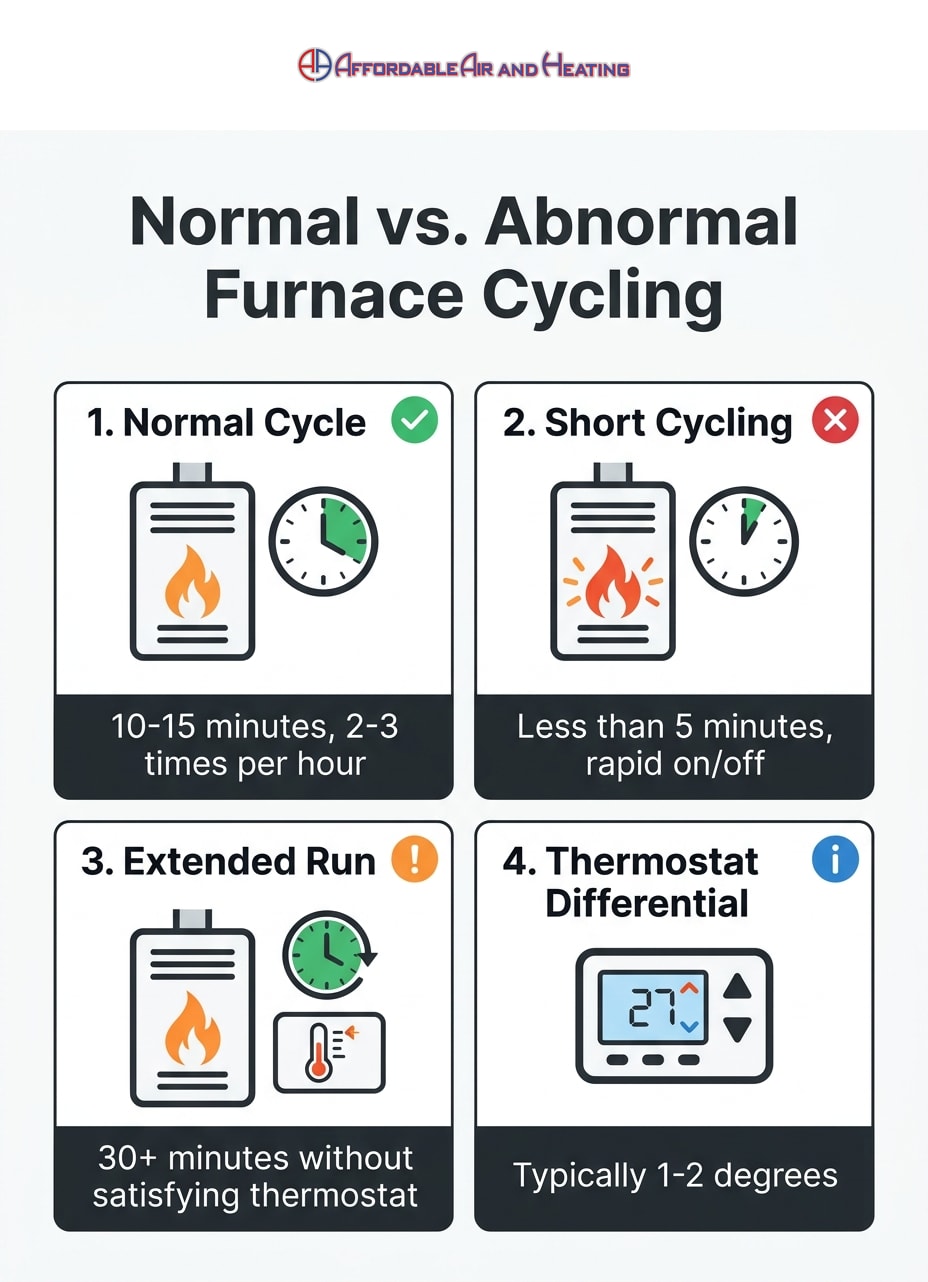
The short answer is that on a typical 40-degree night, a properly functioning furnace should run for 10 to 15 minutes per cycle. Once the system reaches the target temperature set on your thermostat, it will shut off, wait for the house to cool down slightly, and then start the process again. Under these specific weather conditions, you can expect your heating system to complete about 2 to 3 full cycles per hour.
If you are looking into heating repair and maintenance, understanding this 10-to-15-minute baseline is incredibly helpful. This duration allows the equipment enough time to warm up fully, distribute heated air evenly throughout your rooms, and operate at its peak efficiency rating. Cycles that are significantly shorter or longer than this window often point to an underlying mechanical or environmental issue.
A major factor controlling this cycle length is your thermostat differential. Most modern thermostats are programmed with a 1-to-2-degree differential. This means if you set your heat to 70 degrees, the thermostat will allow the room to drop to 68 or 69 degrees before signaling the furnace to turn back on. It will then run until the room reaches 70 or 71 degrees. This built-in buffer prevents the system from turning on and off constantly.
Baseline Expectations for a Standard Heating System:
• Average Cycle Length: 10 to 15 minutes of continuous operation.
• Cycles Per Hour: 2 to 3 complete cycles during 40-degree weather.
• Thermostat Differential: 1 to 2 degrees of temperature swing.
• System Requirements: Assumes a properly sized unit and standard home insulation.
Keep in mind that these baseline numbers reflect a system that is perfectly sized for the square footage of the home. If your equipment is too large or too small, or if your home lacks adequate insulation, those baseline numbers will shift dramatically.
Why High Desert Temperature Drops Cause Longer Initial Cycles
Heating a home in the Lancaster high desert presents a unique set of environmental challenges that you will not find in other climates. If you live in an area with steady, predictable cold weather, your heating system maintains a fairly consistent rhythm. However, the high desert is known for dramatic diurnal temperature variation. This means we frequently experience massive swings in temperature from the heat of the day to the chill of the night.
It is not uncommon for a sunny, 70-degree afternoon to plummet into a 40-degree night within just a few hours. Lancaster's drastic day-to-night temperature shifts put sudden, heavy demand on heating systems, causing longer initial recovery cycles than in climates with steady 40-degree weather. As the sun goes down, the thermal mass of your home loses heat rapidly. When your thermostat finally triggers the heating system to turn on, the furnace has a tremendous amount of ground to make up.
This first evening cycle is often called a "recovery cycle." Because the house has cooled down so quickly, the system might need to run for 20 or even 25 minutes just to establish that initial baseline of warmth. Many homeowners across the Lancaster and Antelope Valley service areas mistake this long recovery cycle for a broken system. In reality, a longer initial run time is a perfectly normal response to a rapid environmental temperature drop.
How to Tell the Difference:
• Runs 25 minutes once at sunset, then settles into 15-minute cycles. — Likely Cause: Normal high desert recovery cycle. — Action Needed: None. The system is adapting to the sudden temperature drop.
• Runs for 25+ minutes every single cycle throughout the night. — Likely Cause: System is struggling or undersized. — Action Needed: Monitor performance and consider a professional evaluation.
• Runs for 3 minutes, shuts off, and repeats endlessly. — Likely Cause: Short cycling due to a mechanical fault. — Action Needed: Requires immediate professional diagnosis.
Reassure yourself that if your system runs a bit long right after the sun sets in the Lancaster high desert, it is likely just doing exactly what it was designed to do. The true test of your system's health is how it behaves during the middle of the night once the indoor temperature has stabilized.
Short Cycling: When Your Furnace Turns On and Off Too Quickly
While a long recovery cycle is normal, a system that turns on and off rapidly is experiencing a serious mechanical fault known as short cycling. If you are timing your system on a 40-degree night and notice that the burner runs for less than five minutes before shutting down, you have a problem. Short cycling prevents your home from ever reaching the desired temperature, leaves certain rooms feeling freezing cold, and wastes a massive amount of energy.
Short cycling is rarely a thermostat issue; it is almost always a protective shutdown initiated by the system's internal safety sensors. One of the most common culprits is a dirty flame sensor. If this sensor cannot detect a strong, steady flame within a few seconds of ignition, it will shut the gas valve off immediately to prevent a dangerous gas buildup. Another frequent cause is an overheating heat exchanger. If airflow is severely restricted, the heat cannot escape into your ductwork. The internal temperature of the unit skyrockets, and the high-limit switch trips, shutting the system down to prevent a fire.
If you are interested in diagnosing gas furnace short-cycling, you must understand that this is not a condition you can simply ignore or wait out. True short cycling always requires professional attention. A licensed technician has the specialized tools to test the electrical draw of the blower motor, measure the gas pressure at the manifold, and safely clean sensitive ignition components.
The Danger of Ignoring Short Cycles
Allowing a heating system to short cycle for days or weeks will cause compounding damage to the equipment. The most significant wear and tear happens during the startup sequence. Constantly forcing the blower motor and the ignition components to start, stop, and restart drastically reduces their lifespan.
Furthermore, your utility bills will spike. A furnace uses the most energy during the first minute of operation as it powers up the draft inducer motor, ignites the burners, and gets the heavy blower wheel spinning. If it does this 10 times an hour instead of 3 times an hour, your energy waste multiplies rapidly. Finally, if the root cause of the short cycling is an overheating heat exchanger, ignoring the problem runs the risk of cracking the metal. A cracked heat exchanger is a severe safety hazard that often requires a complete system replacement.
Extended Run Times: Is It Just Cold, or Is It Inefficient?
On the opposite end of the spectrum from short cycling is the problem of extended run times. You might notice that your system kicks on and simply never seems to turn off. If your equipment is running for 30, 40, or even 50 minutes continuously without raising the indoor temperature to match the thermostat setting, the system is highly inefficient.
In the Lancaster high desert, we often see this issue pop up when a home has an undersized furnace. If the equipment does not have the British Thermal Unit (BTU) capacity required to heat the specific square footage of the house, it will run endlessly in a futile attempt to reach the target temperature. It is like trying to cool down a large living room with a single desk fan; the equipment will run forever, but the space will never reach the desired comfort level.
Another major contributor to extended run times is poor home insulation or drafty windows. If your heating system is pumping warm air into the living room, but that heat is immediately escaping through uninsulated attic spaces or poorly sealed window frames, the furnace will have to run constantly just to break even. The equipment might actually be functioning perfectly, but the thermal envelope of the house is failing.
Working Hard vs. Failing to Heat:
• Working Hard: The system runs for 25 minutes, the house feels warm, the thermostat reaches its target, and the system shuts off. This is a normal response to a cold house.
• Failing to Heat: The system runs for 45 minutes, the air coming from the vents feels lukewarm, the thermostat never reaches its target, and the house still feels chilly. This indicates a severe efficiency problem, a failing blower motor, or a major ductwork leak.
Mechanical and Environmental Factors Affecting Cycle Length
Bridging the gap between normal operation and the need for professional maintenance requires looking at the specific variables in your home. Several mechanical and environmental factors directly impact how long your system runs during those chilly late fall and November nights. Addressing these factors can often restore normal cycle times and improve your overall comfort.
1. Airflow Restrictions: The most common reason a heating system struggles is a lack of airflow. When a standard one-inch air filter becomes clogged with dust, pet dander, and debris, the blower motor has to work twice as hard to pull air through the system. This restriction forces the equipment to run longer to circulate the same amount of heat. In severe cases, poor airflow causes the system to overheat and short cycle. Upgrading your indoor air quality solutions and maintaining clean filters is the first step to proper cycle lengths.
2. Thermostat Placement: The location of your thermostat plays a massive role in cycle duration. If your thermostat is mounted on a wall directly across from a drafty front door, it will constantly read a colder temperature than the rest of the house, forcing the system to run endlessly. Conversely, if it is located near a heat-generating appliance or directly in the path of a heating vent, it will read a falsely high temperature and shut the system down prematurely.
3. System Sizing: Proper BTU sizing is non-negotiable for a healthy heating cycle. An oversized unit will blast the house with heat, satisfy the thermostat in three minutes, and shut down, leading to severe short cycling and uneven temperatures. An undersized unit will run continuously without ever keeping the house warm. Only a professional load calculation can determine the exact size required for your specific square footage.
4. Ductwork Integrity: If your ductwork runs through an unconditioned attic or crawlspace and has significant leaks, you are losing a massive percentage of your heated air before it ever reaches your living spaces. Leaky ducts extend the run time needed to warm the house, driving up your utility bills and putting unnecessary wear on the blower motor.
Frequently Asked Questions About Cold Weather Furnace Cycles
When the temperature drops to 40 degrees, homeowners naturally have a lot of questions about their heating equipment. Here are direct answers to the most common concerns regarding cycle times and system performance.
How many minutes should a furnace run per cycle?
A properly functioning heating system should run for 10 to 15 minutes per cycle. This duration allows the equipment to warm up efficiently and distribute air evenly throughout the home. If your system consistently runs for less than 5 minutes or more than 30 minutes under normal conditions, it requires a professional evaluation.
Is it normal for a furnace to run for 20 minutes?
Yes, running for 20 minutes can be completely normal, especially during a recovery cycle. If the temperature outside drops rapidly, or if you just turned the thermostat up several degrees, the system needs extra time to overcome the cold thermal mass of the house. As long as it eventually satisfies the thermostat and shuts off, a 20-minute cycle is generally safe.
Why does my furnace turn on every 5 minutes?
Turning on every 5 minutes is a classic sign of short cycling, usually caused by a dirty flame sensor, a clogged air filter, or an overheating heat exchanger. The system is initiating a safety shutdown to prevent damage or fire. You should turn the system off and schedule a professional diagnostic immediately to prevent further damage to the ignition components.
Is it normal for a furnace to run constantly in cold weather?
No, a heating system should not run constantly without ever shutting off, even in 40-degree weather. If it runs continuously, it usually means the unit is undersized for the home, your ductwork is leaking heavily, or your home lacks the insulation needed to retain the heat. A system that never rests will experience premature mechanical failure.
What causes a furnace to short cycle?
Short cycling is most commonly caused by restricted airflow that leads to overheating, which trips the high-limit safety switch. It can also be caused by a malfunctioning thermostat, a dirty flame sensor that fails to read the burner flame, or an oversized unit that heats the space too rapidly. Professional testing is required to pinpoint the exact electrical or mechanical fault.
How does the thermostat differential affect furnace run time?
The thermostat differential dictates the temperature swing allowed before the system turns on or off, usually set to 1 or 2 degrees. A wider differential (like 2 degrees) means the system will stay off longer but run for a longer period when it finally kicks on. A tighter differential keeps the temperature very precise but causes the equipment to cycle more frequently.
Get Professional Diagnostics Before Peak Winter Hits
While longer initial recovery cycles can be perfectly normal on a cold late fall or November evening, rapid on-and-off short cycling is a clear warning sign that something is mechanically wrong. Understanding your system's baseline gives you the knowledge to spot these issues early. If your equipment is consistently failing to meet the standard 10-to-15-minute cycle baseline, it is time to have a professional take a closer look.
Working with a team that provides honest diagnostics and flat-rate pricing means you will understand exactly why your equipment is short-cycling or running long before any parts replacement is recommended. We believe in finding the actual root cause of the airflow or ignition issue rather than just guessing at a solution. Schedule a professional inspection today to secure your peace of mind and ensure your home stays reliably warm all winter long.