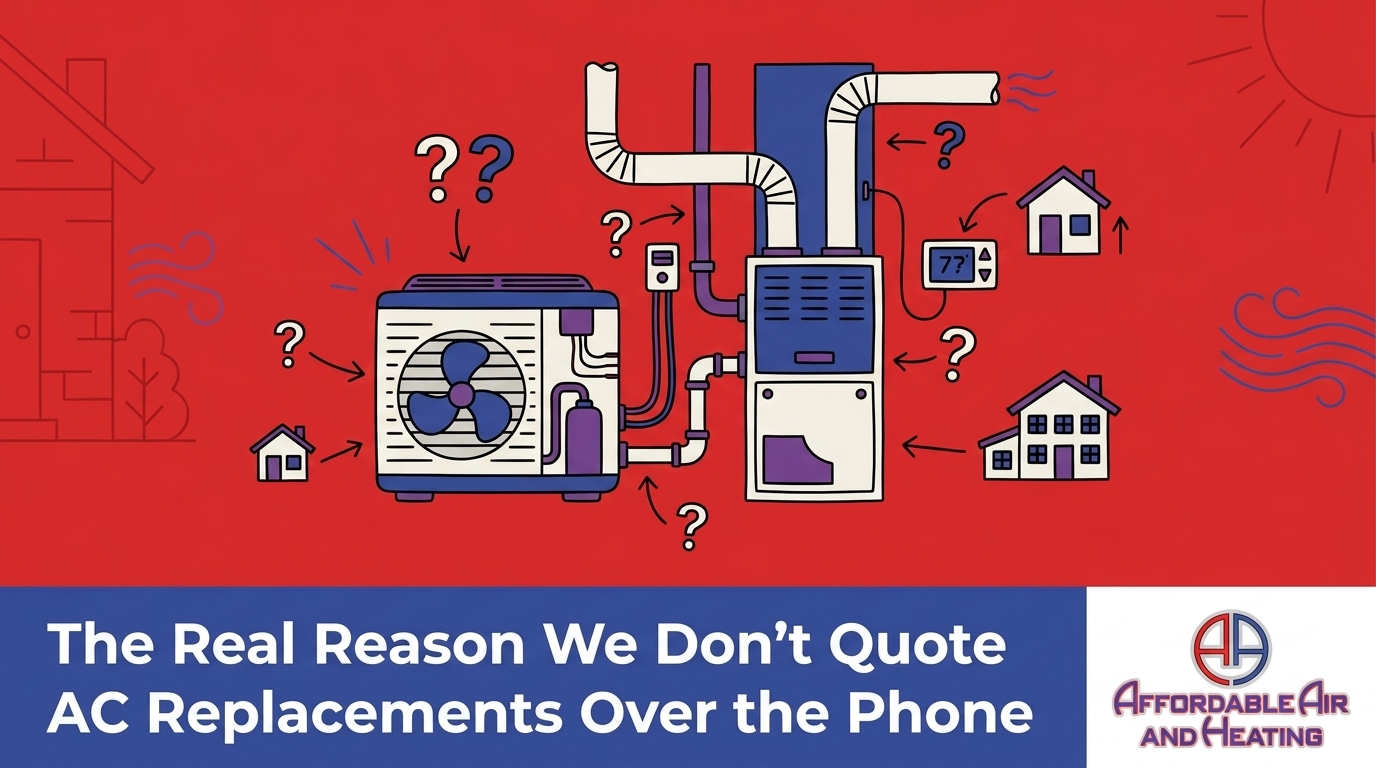
The Real Reason We Don't Quote AC Replacements Over the Phone


The Hidden Danger of Blind AC Replacement Estimates
When your system suddenly fails in the middle of a brutal late-summer heatwave, you just want a quick answer. At Affordable Air and Heating, our team fields dozens of these frantic August calls, but the real reason we don't quote AC replacements over the phone comes down to protecting your home from catastrophic mechanical failures. It is completely understandable to want an immediate price tag when your house is sweltering and your family is uncomfortable. You are staring at a broken thermostat, feeling the August high-desert heat pressing against the windows, and looking for the fastest possible lifeline to restore your comfort.
However, demanding an immediate phone quote introduces a massive concrete problem: blind guesses completely ignore the critical mechanical factors unique to your home. A dispatcher sitting at a desk cannot see your deteriorating attic ductwork, your maxed-out electrical panel, or your home's thermal envelope. This leaves you at a serious decision point. You can either accept a fast, inaccurate phone guess that risks premature system failure, or you can require a thorough in-person assessment that physically measures your home's infrastructure to guarantee the job is done right.
Before you commit to a blind guess, learning exactly what goes into professional HVAC services can save you from unexpected breakdowns and ensure your new system actually performs when you need it most.
Why Square Footage Alone Fails in Extreme Climates
The most common misconception in the cooling industry is that a home's square footage is the only number needed to size a new unit. In our years of serving Lancaster CA, we've found that up to 70% of homes have improperly sized HVAC systems precisely because of this lack of proper load calculations. When a contractor guesses your system size over the phone based solely on floor space, they are setting you up for an undersized unit that runs constantly without ever actually cooling the home, or an oversized unit that short-cycles and leaves the air feeling sticky.
The Variables That Actually Matter
Square footage is only one small variable in a much larger equation. In a climate like Lancaster CA, where sustained triple-digit summer highs are the norm, a system sized merely by floor space will severely struggle to overcome the intense thermal load. To get an accurate measurement, our team relies on an industry standard known as a Manual J load calculation.
• Only measures the floor area of the home. — The Manual J Reality: Measures ceiling height, overall volume, and air flow dynamics.
• Assumes all windows let in the same amount of heat. — The Manual J Reality: Calculates the exact direction, size, and shading of every window.
• Ignores the materials used to build your house. — The Manual J Reality: Factors in brick, siding, roofing materials, and insulation quality.
• Results in a blind guess over the phone. — The Manual J Reality: Requires an in-person, detailed physical inspection of the property.
The bottom line: When a system is forced to battle extreme heat, guesswork fails. A proper calculation ensures your equipment has the exact capacity needed to cool your specific layout efficiently, without wasting energy or burning out the compressor prematurely.
The Critical Role of Ductwork Integrity
Your cooling system is only as good as the ductwork delivering the air. One of the primary reasons we warn against phone quotes is that connecting a brand-new, high-efficiency AC to deteriorating attic ducts will cause premature system failure. If your ducts are undersized, crushed, or leaking, you could be losing a massive amount of the cooling power you just paid for.
When our technicians perform an in-person assessment, they conduct a rigorous physical inspection to ensure your ductwork can handle a modern system. Here is exactly what we check:
• Return air drops: Measuring the return air side ensures the system can actually pull in enough air to breathe. A starved system will freeze up and fail.
• Duct leakage: Undersized or leaky ductwork can reduce system efficiency by up to 20-30%, blowing conditioned air directly into your hot attic instead of your living room.
• Insulation degradation: In the August high-desert heat, duct insulation can bake and crumble. Uninsulated ducts absorb attic heat, warming the air before it ever reaches your vents.
• Airflow balance: Checking how air distributes across the house prevents hot and cold spots, ensuring consistent comfort in every room.
If an in-person inspection reveals that your ductwork is compromised beyond repair, alternative solutions must be discussed on-site. For homes with severely damaged ducts or complicated layouts, exploring ductless mini split options might be the most efficient path forward. A phone representative simply cannot make that call.
Evaluating Electrical Panel Capacity for Modern Units
Another major blind spot of the over-the-phone estimate is the home's electrical infrastructure. Modern high-efficiency cooling systems often have entirely different amperage and breaker requirements than units built 15 to 20 years ago. Technology has advanced rapidly, and while newer systems are incredibly energy-efficient, their variable-speed compressors and advanced blowers require specific, stable power supplies.
The Danger of Maxed-Out Panels
We routinely see older homes in Lancaster CA with electrical panels that are already maxed out. When a homeowner wants to upgrade their cooling technology—perhaps moving away from a traditional air conditioner to a modern heat pump installation—the existing electrical panel must be carefully evaluated. (Utility rebate programs such as Home Performance Plus for SCE customers may apply to qualifying equipment, so ask us which programs are open.) An over-the-phone quote cannot determine if a panel upgrade or a new dedicated circuit is required to safely run the new equipment.
Failing to account for these electrical needs leads to massive headaches. If an installation crew arrives with a new unit only to discover the breaker box cannot handle the load, you are suddenly facing surprise installation delays, unexpected electrical contractor fees, and severe safety hazards. A thorough in-person inspection checks the panel capacity upfront, ensuring the transition to a new system is completely safe and seamless.
Insulation and Thermal Load Assessments
Your home's ability to keep heat out is just as important as your AC's ability to pump cold air in. The amount and quality of your attic insulation directly dictate how much heat enters the living space. A home with poor, settled insulation requires a completely different cooling strategy than a tightly sealed, well-insulated home.
Without visually inspecting the attic, contractors are merely guessing at the home's thermal retention. If they guess wrong, your new system will be fighting a losing battle against the August high-desert heat. Properly matching the equipment to the home's actual thermal load ensures the system runs efficiently, cycles correctly, and maintains comfortable humidity levels.
This attention to detail makes a massive difference in real-world performance. A proper in-person thermal assessment lets a technician install the right equipment for the home's insulation profile and answer all your questions, so the new equipment keeps the house cool even during the worst summer heat. Understanding these thermal dynamics is also crucial when troubleshooting other issues, such as why your vents might blow warm air after a sudden system reset.
How Bait-and-Switch Pricing Tactics Work
The demand for fast answers over the phone has unfortunately given rise to deceptive practices in the HVAC industry. Some contractors provide an artificially low quote over the phone just to win the job during the frantic late-summer rush. They know that a desperate homeowner is likely to jump at the lowest number they hear.
The True Cost of a Low-Ball Quote
The problem arises on installation day. Once the old unit is ripped out and the crew is in your backyard, the surprise fees begin. Suddenly, there are charges for "unforeseen" duct modifications, required electrical upgrades, or necessary code compliance changes. These modifications were never unforeseen—they simply weren't checked because the contractor never came to the house.
At Affordable Air and Heating, we refuse to guess because it protects you from these unexpected cost overruns. Emphasizing this refusal to give phone quotes is our core defense against low-balling, showcasing our commitment to transparent and honest business practices. Insisting on an in-person evaluation is a mark of mechanical expertise and integrity; it guarantees that the price you are quoted is the price you actually pay, based on factual data rather than a sales gimmick.
What to Expect During an In-Home HVAC Assessment
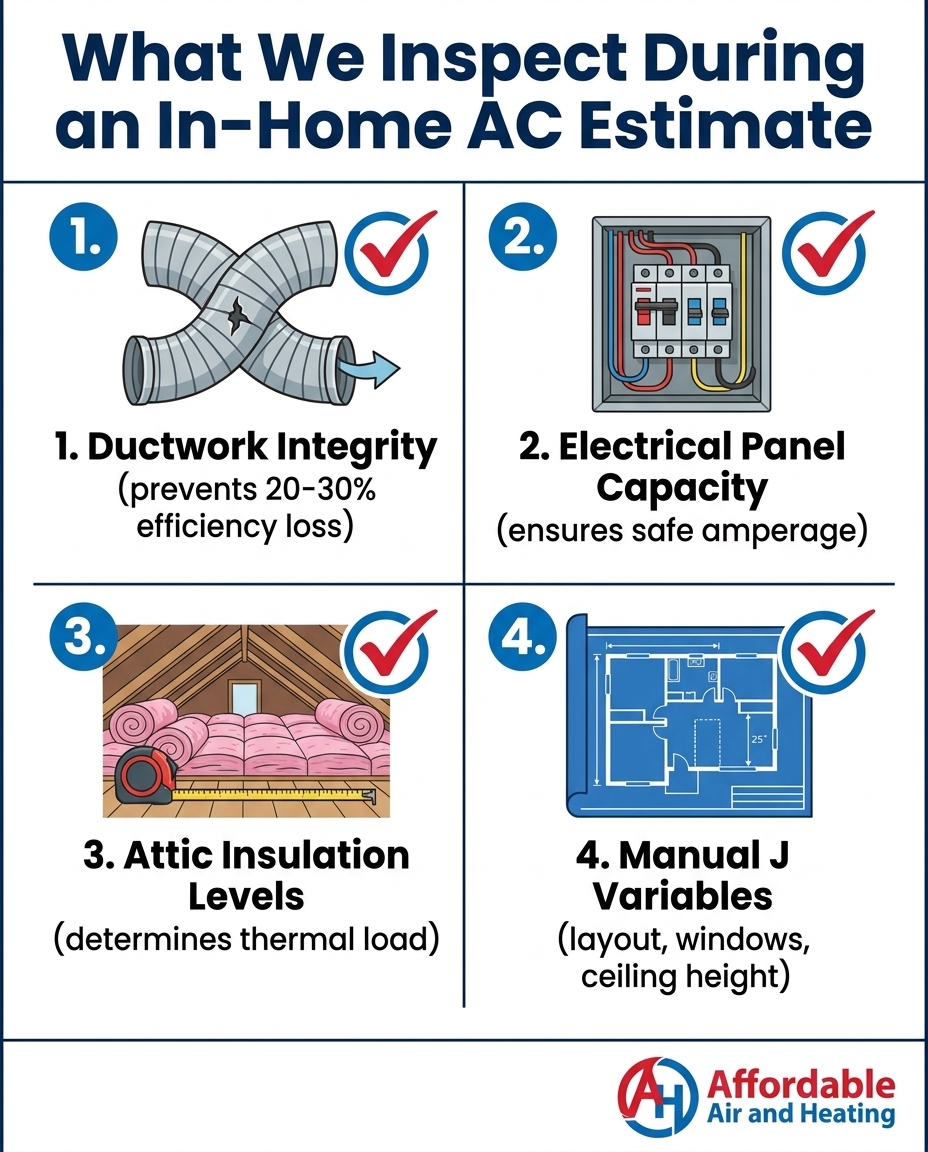
When you choose to bypass the blind phone guess and schedule a proper evaluation, you are choosing accuracy and peace of mind. A professional in-home HVAC assessment is a structured, data-driven process designed to physically measure all variables. Here is exactly what you should expect when an Affordable Air and Heating technician arrives at your home:
1. Physical measurement of existing ductwork: The technician will inspect your attic or crawlspace to measure the return air sizing, check for collapsed runs, and evaluate the overall integrity of the duct system.
2. Inspection of the electrical panel: The technician will open your breaker box to verify that your home has the available amperage and dedicated circuits required to safely power modern, high-efficiency cooling equipment.
3. Evaluation of insulation and window exposures: By assessing the depth of your attic insulation and noting the direction and size of your windows, the technician gathers the necessary data for an accurate load calculation.
4. Providing transparent replacement options: Based on the factual mechanical data collected, the technician will sit down with you to present honest, customized replacement options that fit your home's exact needs.
Protecting Your Investment with an Accurate Assessment
Investing in a new cooling system is a major decision, and it deserves more than a blind guess. As we have seen, an accurate installation estimate absolutely requires physically measuring ductwork, inspecting electrical panels, and assessing insulation levels. Skipping these steps might save a few minutes on the front end, but it drastically increases the risk of poor performance, surprise fees, and premature system failure.
In the extreme heat of Lancaster CA, you cannot afford to cut corners. This thorough in-person process is the only way to protect your investment and ensure your home remains a comfortable refuge when the temperatures soar. We encourage all homeowners to prioritize mechanical accuracy over the convenience of a fast phone guess.
A clear, logical explanation of your home's specific needs proves that an in-person visit is always in your best interest. If you are tired of struggling with a failing system, the real reason we don't quote AC replacements over the phone is simply because we refuse to compromise on your comfort. When you are ready for a transparent, data-driven evaluation, explore your professional air conditioning replacement options and get the accurate answers your home deserves.
Frequently Asked Questions
Why can't HVAC companies give quotes over the phone?
An accurate quote requires a physical inspection of your home's unique infrastructure. Without seeing your ductwork, your electrical panel, and your insulation, any price given over the phone is merely a blind guess. Reputable companies refuse to guess because it often leads to surprise fees and improperly sized equipment on installation day.
What happens during an in-home AC estimate?
During an in-home estimate, a technician evaluates the specific mechanical realities of your house. They will measure your existing ductwork, check your electrical panel's capacity, assess your attic insulation, and note your window exposures. This factual data is then used to present honest, transparent replacement options tailored to your home.
Do I need a Manual J calculation for a new AC?
Yes, a Manual J calculation is the industry standard for determining the exact cooling capacity your home requires. Unlike a basic square-footage guess, this calculation factors in ceiling height, window direction, and insulation quality. Skipping this step often results in an undersized unit that runs constantly or an oversized unit that short-cycles.
How long does an in-person AC replacement estimate take?
A thorough in-person estimate typically takes between 45 to 90 minutes. This allows the technician enough time to inspect the attic, check the breaker box, measure the home's layout, and discuss your comfort goals. It is a small investment of time that protects you from a decade of poor system performance.
Will an improperly sized AC unit fail faster in extreme heat?
Absolutely, an incorrectly sized unit takes on massive mechanical stress during severe heatwaves. An undersized unit will run non-stop trying to reach the thermostat setting, burning out the compressor prematurely. Proper sizing ensures the system cycles correctly, saving energy and extending the lifespan of the equipment.